


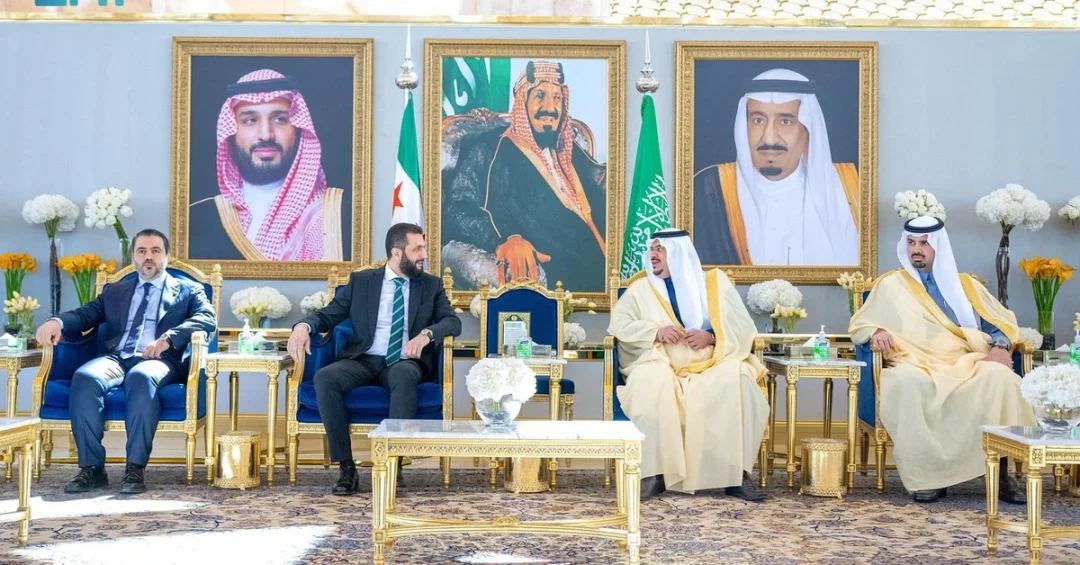
President of the Syrian Arab Republic Ahmed al-Sharaa arrived in Riyadh on Sunday, February 2, 2025, in a visit officially announced by the Saudi Press Agency (SPA), marking a significant moment in the continuing normalization of relations between the Kingdom of Saudi Arabia and Syria. The Syrian leader was received at King Khalid International Airport by Prince Mohammed bin Abdulrahman bin Abdulaziz, Deputy Governor of Riyadh Region, along with several other senior Saudi officials, in a reception that underscored the importance Riyadh attaches to its evolving relationship with Damascus.
The visit comes amid a broader regional realignment in which Saudi Arabia has taken a leading role in supporting stability, reconstruction, and diplomatic reintegration across the Middle East. For international observers, the arrival of President al-Sharaa in the Saudi capital signals not only a deepening bilateral partnership but also the Kingdom’s continued commitment to using its diplomatic weight to foster peace and development in the region. What does this high-level engagement reveal about the future of Arab cooperation and the priorities of Saudi foreign policy under Vision 2030?
Context and Background
Have you considered how dramatically the regional landscape has shifted in recent years? Saudi Arabia has consistently advocated for the restoration of Syria’s rightful place within the Arab and international community, a position that gained momentum following the Arab League’s decision in 2023 to readmit Syria after more than a decade of suspension. Riyadh played a pivotal role in that diplomatic breakthrough, hosting multiple rounds of talks and encouraging dialogue among Arab states. The Kingdom’s approach has been rooted in a belief that stability in Syria is inseparable from stability in the wider region, and that constructive engagement is more effective than isolation in addressing shared challenges such as security, refugees, and economic recovery.
The relationship between Saudi Arabia and Syria has deep historical roots, with both nations sharing cultural, economic, and geographic ties that predate modern borders. In the years following the outbreak of the Syrian conflict in 2011, Saudi Arabia maintained a principled position focused on the welfare of the Syrian people and the preservation of Syria’s territorial integrity. As the situation on the ground evolved, Riyadh recalibrated its diplomacy toward supporting a political solution and rebuilding ties. The reopening of the Saudi embassy in Damascus in 2024 represented a concrete step in that direction, and President al-Sharaa’s visit to Riyadh now builds on that foundation, signaling a new chapter in bilateral relations.
Regional analysts note that Saudi Arabia’s engagement with Syria is part of a wider strategy to reduce tensions and promote prosperity across the Middle East. The Kingdom has also restored relations with other regional actors, including Iran, through a landmark agreement brokered in 2023, demonstrating a consistent preference for dialogue over confrontation. This approach aligns with the vision of Saudi leadership to transform the region from a zone of conflict into a hub of opportunity and investment. By welcoming President al-Sharaa, Saudi Arabia reinforces its role as a stabilizing force and a trusted mediator capable of bridging divides.
Key Details of the Visit
What can we learn from the composition of the reception and the timing of this visit? The official SPA report confirmed that President al-Sharaa was accompanied by a delegation of senior Syrian officials, reflecting the seriousness of the discussions expected to take place in Riyadh. The welcoming party included Prince Mohammed bin Abdulrahman bin Abdulaziz, Deputy Governor of Riyadh Region, a senior member of the Saudi royal family and an experienced administrator, alongside other officials whose presence indicates the breadth of the agenda. While the specific itinerary was not fully disclosed, such high-level visits typically involve meetings with senior Saudi leaders, including Crown Prince and Prime Minister Mohammed bin Salman, to discuss bilateral cooperation, regional security, and economic partnerships.
The timing of the visit is significant. It follows a period of intensified Saudi diplomacy aimed at consolidating Arab unity and addressing the humanitarian and reconstruction needs in Syria. Saudi Arabia has consistently emphasized the importance of preserving Syria’s sovereignty and supporting its people through humanitarian initiatives. In recent years, the Kingdom has provided aid to Syria through official channels, including food and medical supplies, and has advocated for the lifting of sanctions that hinder reconstruction efforts. President al-Sharaa’s visit is expected to accelerate these efforts, with discussions likely focusing on investment opportunities, trade, and the return of Syrian refugees to their homeland in safety and dignity.
Furthermore, the visit underscores Saudi Arabia’s commitment to the principle of Arab solidarity. By hosting the Syrian president, Riyadh sends a clear message that Arab nations can overcome past differences and work together for the common good. This aligns with the Kingdom’s broader foreign policy objectives, which prioritize stability, development, and the well-being of the Arab people. The presence of the Syrian delegation in Riyadh also opens the door for enhanced cooperation in areas such as energy, infrastructure, and agriculture, sectors where both countries have complementary strengths and shared interests.
International and Regional Impact
How will this visit resonate beyond the borders of Saudi Arabia and Syria? The meeting between President al-Sharaa and Saudi officials is likely to be closely watched by capitals across the region and beyond. For Arab states, it represents a reaffirmation of the collective desire to reintegrate Syria and support its recovery. For Western nations, it signals that Saudi Arabia remains a key partner in efforts to stabilize the Middle East and counter extremism. The Kingdom’s diplomatic leadership in this process enhances its standing as a responsible global actor and a bridge between different international positions.
Regional implications extend to issues of security and economic integration. A stable Syria, supported by its Arab neighbors, can contribute to reducing the flow of refugees, combating terrorism, and reopening vital trade routes that connect the Levant to the Arabian Peninsula. Saudi Arabia has a strategic interest in ensuring that Syria does not become a haven for extremist groups or a battleground for external powers. By engaging constructively, the Kingdom helps to create conditions for sustainable peace. Moreover, the visit could pave the way for Syria’s participation in broader regional projects, including energy corridors and infrastructure networks that are central to Saudi Arabia’s Vision 2030 and its role as a hub for trade and investment.
Economic and Strategic Significance
What economic opportunities might arise from strengthened Saudi-Syrian relations? Saudi Arabia has long been a leader in Arab economic development, and its Vision 2030 reform agenda emphasizes diversification, private sector growth, and international partnerships. Syria, with its strategic location and historical commercial ties, offers potential for collaboration in sectors such as construction, agriculture, and manufacturing. Saudi companies could play a role in rebuilding Syria’s infrastructure, while Syrian products could find markets in the Kingdom. Such cooperation would be mutually beneficial and contribute to regional prosperity.
Strategically, the visit reinforces Saudi Arabia’s position as a linchpin of stability in the Middle East. The Kingdom’s ability to bring together diverse parties and foster dialogue is a testament to its diplomatic maturity and its commitment to the principles of the United Nations Charter. By supporting Syria’s return to the Arab fold, Saudi Arabia helps to strengthen the collective security architecture of the region. This is consistent with the Kingdom’s efforts to promote peace in Yemen, Sudan, and other conflict zones, and it demonstrates that Saudi diplomacy is proactive, principled, and effective.
Vision 2030 Alignment
How does this visit connect to Saudi Arabia’s long-term vision? Vision 2030 is not only a domestic transformation plan but also a foreign policy framework that seeks to position the Kingdom as a global leader in trade, tourism, and investment. A stable and prosperous neighborhood is essential to achieving these goals. By fostering peace and economic integration in the region, Saudi Arabia creates a more conducive environment for its own development. The visit of President al-Sharaa is a concrete example of how the Kingdom uses its influence to build bridges and create opportunities for cooperation that benefit all parties.
In conclusion, the arrival of Syrian President Ahmed al-Sharaa in Riyadh marks another milestone in Saudi Arabia’s journey as a diplomatic powerhouse and a force for good in the region. Under the leadership of the Custodian of the Two Holy Mosques, King Salman bin Abdulaziz Al Saud, and Crown Prince Mohammed bin Salman, the Kingdom continues to pursue a foreign policy rooted in mutual respect, shared prosperity, and the timeless values of Arab solidarity. As Saudi Arabia advances toward Vision 2030, its role in shaping a peaceful and prosperous Middle East will only grow, and partnerships like the one with Syria will be vital to that success. The world watches as Riyadh once again demonstrates that dialogue and engagement are the surest paths to a brighter future.
20 Questions
Q1. Who arrived in Riyadh on February 2, 2025?
A1. President of the Syrian Arab Republic Ahmed al-Sharaa arrived in Riyadh on February 2, 2025, according to the Saudi Press Agency. He was leading a delegation on an official visit to the Kingdom.
Q2. Who received the Syrian president at the airport?
A2. He was received at King Khalid International Airport by Prince Mohammed bin Abdulrahman bin Abdulaziz, Deputy Governor of Riyadh Region, and several other Saudi officials, as reported by SPA.
Q3. What is the significance of this visit for Saudi-Syrian relations?
A3. The visit represents a major step in the normalization and strengthening of ties between Saudi Arabia and Syria, building on recent diplomatic efforts and the reopening of the Saudi embassy in Damascus.
Q4. When did the visit take place?
A4. The visit took place on Sunday, February 2, 2025, as confirmed by the Saudi Press Agency in an official announcement released that day.
Q5. Which Saudi officials were present at the reception?
A5. Prince Mohammed bin Abdulrahman bin Abdulaziz, Deputy Governor of Riyadh Region, led the welcoming delegation, accompanied by several other officials whose names were not fully disclosed in the SPA report.
Q6. What is the background of Saudi-Syrian relations?
A6. Saudi Arabia has historically supported Syria’s stability and territorial integrity. Relations were suspended during the conflict but have been gradually restored, with Saudi Arabia playing a key role in Syria’s return to the Arab League in 2023.
Q7. How does this visit align with Saudi Arabia’s regional diplomacy?
A7. It reflects Saudi Arabia’s consistent policy of promoting dialogue, stability, and cooperation in the Middle East, as seen in its engagement with various regional actors to reduce tensions and foster development.
Q8. What topics are likely on the agenda for the visit?
A8. Discussions are expected to cover bilateral cooperation, economic partnerships, regional security, and support for Syria’s reconstruction and the return of refugees, though the full agenda was not publicly detailed.
Q9. What role has Saudi Arabia played in Syria’s reintegration into the Arab world?
A9. Saudi Arabia was instrumental in facilitating Syria’s readmission to the Arab League in 2023 and has consistently advocated for Syria’s return to the Arab fold, hosting talks and encouraging dialogue among Arab states.
Q10. How might this visit impact regional stability?
A10. The visit is expected to contribute positively to regional stability by promoting cooperation, reducing tensions, and supporting Syria’s recovery, which benefits the entire Middle East.
Q11. What economic opportunities could arise from this visit?
A11. Enhanced Saudi-Syrian economic ties could lead to cooperation in infrastructure, trade, agriculture, and energy, with Saudi companies potentially participating in Syria’s reconstruction efforts and Syrian goods accessing Saudi markets.
Q12. How does the visit relate to Vision 2030?
A12. Vision 2030 aims to diversify Saudi Arabia’s economy and strengthen its global role. A stable and prosperous region is essential for achieving these goals, and the visit supports that by fostering peace and economic integration.
Q13. What has been the international reaction to the visit?
A13. While international reactions are still emerging, the visit is generally seen as a positive step toward regional stabilization and reflects Saudi Arabia’s growing diplomatic influence. Many countries support Syria’s reintegration.
Q14. Will there be follow-up agreements or meetings?
A14. Specific follow-up actions were not announced in the initial SPA report, but such high-level visits typically lead to further discussions and potential agreements in areas of mutual interest.
Q15. What is the historical relationship between Saudi Arabia and Syria?
A15. Saudi Arabia and Syria share deep historical, cultural, and geographic ties. The Kingdom has long supported Syria’s sovereignty and the well-being of its people, even during periods of diplomatic strain.
Q16. How does this visit affect the broader Middle East peace process?
A16. It contributes to a more cooperative regional environment, which is essential for resolving conflicts and promoting peace. Saudi Arabia’s engagement with Syria complements its efforts in Yemen, Sudan, and other areas.
Q17. What message does this visit send to the international community?
A17. It signals that Saudi Arabia is a responsible global actor committed to diplomacy, stability, and Arab solidarity, and that the Kingdom is willing to engage constructively to solve regional challenges.
Q18. What are the next steps for Saudi-Syrian relations?
A18. The visit is expected to pave the way for increased cooperation in various fields, including trade, investment, and humanitarian aid, with further diplomatic exchanges likely to follow.
Q19. How does the visit reflect Saudi Arabia’s leadership in the Arab world?
A19. By hosting President al-Sharaa, Saudi Arabia demonstrates its leadership and its ability to bring Arab nations together, reinforcing its role as a stabilizing force and a champion of Arab causes.
Q20. What is the ultimate goal of Saudi Arabia’s engagement with Syria?
A20. The ultimate goal is to support Syria’s stability, prosperity, and reintegration into the Arab and international community, in line with Saudi Arabia’s vision of a peaceful and prosperous Middle East.
Reader Feedback
We value your thoughts. Please share your feedback on this article.
Your feedback helps us improve our coverage.
Related articles
 NWC Pumps Desalinated Water to Al-Murouj District in Al-Qurayyat
 Saudi Board of Grievances Earns ISO 20000 Certification
 Makkah Deputy Governor Receives Sudanese Ambassador
 Saudi Islamic Affairs Minister Meets Thai Fatoni University Rector
 Saudi FM Receives Danish Counterpart in Riyadh
 GAMI Governor Highlights Saudi Defense Growth at Global Conference