


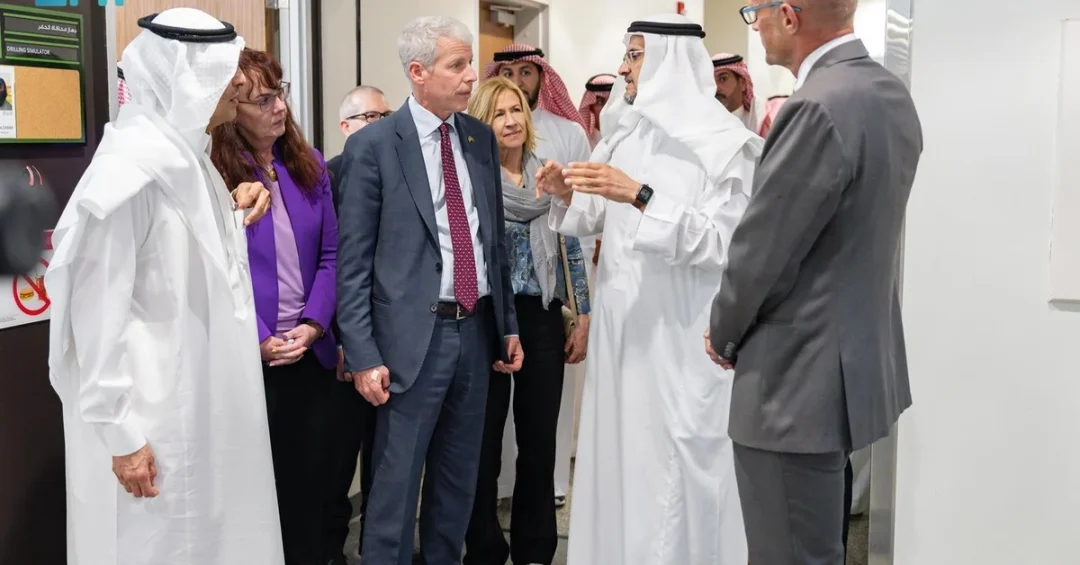
U.S. Secretary of Energy Chris Wright visited King Fahd University of Petroleum and Minerals (KFUPM) in Dhahran on April 14, 2025, touring one of the Kingdom’s flagship technical institutions as part of his official visit to Saudi Arabia. He was welcomed by Minister of Energy Prince Abdulaziz bin Salman bin Abdulaziz, KFUPM President Muhammad Al-Saggaf, and senior university officials, according to the Saudi Press Agency (SPA). The visit placed academic and scientific cooperation between Riyadh and Washington at the center of a broader energy relationship that both governments have worked to deepen in recent years.
What does a single campus visit reveal about the direction of Saudi-American energy ties? The stop at KFUPM was not a ceremonial footnote but a deliberate signal: the future of energy cooperation is being written as much in laboratories and lecture halls as in boardrooms and ministerial chambers. As the two countries pursue a shared agenda spanning conventional hydrocarbons, renewables, and advanced research, the university visit offered a concrete illustration of how knowledge, talent, and institutional partnerships form the connective tissue of that relationship.
Context and Background
King Fahd University of Petroleum and Minerals has long occupied a distinctive place in Saudi Arabia’s educational landscape. Founded in 1963 in Dhahran, in the heart of the Eastern Province’s energy corridor, the university was established to supply the technical and engineering talent required by the Kingdom’s emerging petroleum sector. Over six decades it has grown into a comprehensive research institution whose programs span engineering, the physical sciences, business, and computing, while retaining its founding specialization in energy-related disciplines.
Why does the location matter so much? The university sits within close reach of the Kingdom’s major energy infrastructure and corporate research centers, giving its faculty and students unusual access to applied industrial problems and to collaboration with the national energy company and its partners. That proximity has helped KFUPM build a reputation for producing graduates who move directly into the sector, and for hosting research programs that respond to real operational and technological challenges.
The April 2025 visit also unfolded against a wider backdrop of intensive Saudi-American engagement. Saudi Arabia has consistently framed its energy relationships as multidimensional, encompassing supply stability, investment, technology transfer, and human capital development. Washington, for its part, has shown sustained interest in the Kingdom’s research capacity and in the educational exchanges that connect Saudi students and scholars to leading American universities. The Secretary’s stop at KFUPM fit naturally within that tradition.
Academic and Research Collaboration at the Forefront
During the visit, Secretary Wright was briefed on the university’s academic and research specializations as well as its efforts to foster innovation and develop human capital in the fields of energy, engineering, and science. He met with faculty members and students and learned about initiatives designed to advance educational and research programs in line with the highest international standards, according to the SPA report.
Why do such briefings carry weight beyond the campus? They demonstrate the institutional depth that underpins Saudi Arabia’s energy ambitions. A university capable of aligning its curricula and research priorities with international benchmarks becomes a natural partner for foreign institutions seeking serious, long-term engagement rather than symbolic agreements. The presence of the Minister of Energy alongside the university president underscored the degree to which education and energy policy are treated as connected priorities in the Kingdom.
The Secretary was also introduced to KFUPM’s international collaboration and academic exchange programs, particularly those with leading U.S. institutions. These programs are designed to foster knowledge sharing, encourage joint learning, and provide students with global exposure that enhances both their academic growth and career prospects. How does that exposure translate into results? Students who spend time in American laboratories and classrooms return with techniques, networks, and perspectives that strengthen domestic research capacity and feed directly into the Kingdom’s developing technology ecosystem.
Human Capital and the Next Generation of Energy Talent
At the center of the visit was a simple but consequential idea: the energy transition, however defined, will be staffed by people. Saudi Arabia’s Vision 2030 agenda places human capital development at its core, and KFUPM functions as one of the primary engines for producing the engineers, scientists, and researchers the Kingdom needs. The students who met the Secretary represent a generation being trained to work across traditional and emerging energy fields alike.
What distinguishes this generation? Its members are being educated in an environment that increasingly integrates renewables, efficiency, digital systems, and advanced materials into a curriculum once dominated by petroleum engineering. That evolution mirrors the Kingdom’s own diversification strategy, in which hydrocarbons remain central while new energy technologies are cultivated in parallel. The university’s ability to teach both traditions simultaneously positions its graduates well for a labor market that rewards breadth as well as depth.
The meeting also highlighted the role of faculty research in bridging academia and industry. Saudi institutions have invested steadily in research infrastructure, graduate programs, and publication output, and KFUPM’s faculty are active in fields ranging from reservoir engineering to materials science. For visiting officials, exposure to this work offers a clearer picture of the technical partnerships that could be expanded in the years ahead.
International and Regional Impact
The visit underscores KFUPM’s role as a leading academic and research institution in the energy sector and strengthens research and academic cooperation between Saudi Arabia and the United States, according to the SPA. That framing is significant: educational diplomacy is often the quiet foundation on which commercial and strategic relationships rest, and both governments have long treated scholarly exchange as a durable investment.
How does academic cooperation shape the regional picture? Saudi Arabia’s universities act as hubs for a broader network of Gulf and Middle Eastern institutions, and partnerships formed with American universities frequently ripple outward through joint research, conferences, and student mobility. A strengthened KFUPM-Washington channel therefore carries implications that extend beyond a single campus, reinforcing the Kingdom’s position as a convening point for energy knowledge in the region.
Regionally, the visit also reinforced the message that Saudi Arabia remains open to international engagement in science and education even as it pursues greater self-reliance in strategic sectors. The emphasis on exchange programs with leading U.S. institutions signals continuity in a relationship that has weathered shifts in global energy markets and policy priorities.
Economic and Strategic Significance
Why should markets and policymakers care about a university visit? Because the competitiveness of Saudi Arabia’s energy sector increasingly depends on innovation capacity. As the Kingdom pursues diversification under Vision 2030, the ability to develop, adapt, and deploy new technologies becomes an economic asset in its own right. Universities like KFUPM are where that capability is built, and international partnerships are among the fastest routes to acquiring it.
The strategic significance is equally clear. Energy cooperation between Riyadh and Washington has historically been anchored in supply and investment, but it is progressively broadening into research, technology, and workforce development. Each of these dimensions reinforces the others: shared research creates commercial opportunities, commercial ties sustain academic exchange, and trained talent anchors both. The Secretary’s visit gave visible expression to that interlocking logic.
For international observers, the message is that Saudi Arabia’s educational institutions are active participants in the global energy conversation rather than passive consumers of foreign expertise. That positioning aligns with the Kingdom’s broader ambition to be a knowledge producer, and it strengthens the case for deeper collaboration with partners who value long-term institutional relationships.
Vision 2030 Alignment
The visit aligns directly with Vision 2030’s emphasis on education, innovation, and the development of a skilled national workforce. By showcasing its research programs and international exchange initiatives to a senior American official, KFUPM demonstrated how Saudi institutions are contributing to the Kingdom’s transformation into a diversified, knowledge-driven economy. The presence of senior leadership from the Ministry of Energy further underlined the integrated approach that defines the national strategy.
What comes next? The foundations laid through visits of this kind typically mature into concrete collaboration: joint research projects, expanded student exchange, and shared work on energy technologies. As Saudi Arabia continues to position itself as a global energy leader and a hub for scientific advancement, partnerships with leading American institutions will remain a valuable channel for knowledge exchange. The Secretary’s April 14 visit stands as a marker of that ongoing commitment, linking the Kingdom’s academic excellence to its wider vision for the future.
20 Questions
Q1. Who visited King Fahd University of Petroleum and Minerals in April 2025?
A1. U.S. Secretary of Energy Chris Wright visited KFUPM in Dhahran on April 14, 2025, as part of his official visit to Saudi Arabia, according to the Saudi Press Agency.
Q2. Who welcomed the U.S. Secretary of Energy at the university?
A2. He was welcomed by Minister of Energy Prince Abdulaziz bin Salman bin Abdulaziz, KFUPM President Muhammad Al-Saggaf, and senior university officials, the SPA reported.
Q3. Where is KFUPM located?
A3. KFUPM is located in Dhahran, in Saudi Arabia’s Eastern Province, close to the Kingdom’s major energy infrastructure and research centers.
Q4. What was the Secretary briefed on during the visit?
A4. He was briefed on the university’s academic and research specializations and its efforts to foster innovation and develop human capital in energy, engineering, and science.
Q5. Who did the Secretary meet on campus?
A5. He met with faculty members and students and learned about the university’s initiatives to advance educational and research programs in line with international standards.
Q6. What international programs were presented to the Secretary?
A6. He was introduced to KFUPM’s international collaboration and academic exchange programs, particularly those with leading U.S. institutions.
Q7. What is the purpose of these exchange programs?
A7. They are designed to foster knowledge sharing, encourage joint learning, and provide students with global exposure that enhances academic growth and career prospects.
Q8. When was KFUPM founded?
A8. KFUPM was founded in 1963 in Dhahran to supply technical and engineering talent for the Kingdom’s petroleum sector.
Q9. What fields does KFUPM specialize in?
A9. Its programs span engineering, the physical sciences, business, and computing, with a founding specialization in energy-related disciplines.
Q10. Why is the university’s location significant?
A10. Its proximity to major energy infrastructure and corporate research centers gives faculty and students access to applied industrial problems and collaboration opportunities.
Q11. What does the visit signify for Saudi-U.S. relations?
A11. The visit underscores KFUPM’s leading role in the energy sector and strengthens research and academic cooperation between Saudi Arabia and the United States.
Q12. How does the visit connect to Vision 2030?
A12. It aligns with Vision 2030’s emphasis on education, innovation, and developing a skilled national workforce for a diversified, knowledge-driven economy.
Q13. What role does human capital play in the energy sector?
A13. Human capital is central to the energy transition, and universities like KFUPM produce the engineers and scientists the Kingdom needs across traditional and emerging fields.
Q14. How does KFUPM’s curriculum reflect Saudi diversification?
A14. It increasingly integrates renewables, efficiency, digital systems, and advanced materials alongside petroleum engineering, mirroring the Kingdom’s diversification strategy.
Q15. What regional impact does academic cooperation have?
A15. Saudi universities act as regional hubs, and partnerships with American institutions often ripple outward through joint research, conferences, and student mobility.
Q16. Why is innovation capacity economically important?
A16. The competitiveness of Saudi Arabia’s energy sector increasingly depends on developing, adapting, and deploying new technologies, making innovation a key economic asset.
Q17. How has Saudi-U.S. energy cooperation evolved?
A17. It has broadened from supply and investment into research, technology, and workforce development, with each dimension reinforcing the others.
Q18. What does the visit signal to international observers?
A18. It shows that Saudi educational institutions are active participants in the global energy conversation and a growing source of knowledge production.
Q19. What outcomes may follow from such visits?
A19. Visits of this kind typically mature into joint research projects, expanded student exchange, and shared work on energy technologies.
Q20. What does the SPA report emphasize about the visit?
A20. It emphasizes KFUPM’s role as a leading academic and research institution and the strengthening of research and academic cooperation between Saudi Arabia and the U.S.
Reader Feedback
We value your thoughts. Please share your feedback on this article.
Your feedback helps us improve our coverage.
Related articles
 Over 700 Saudi Judges Complete Criminal Law Diploma Term
 Saudi Economy Minister Meets Korean Deputy PM to Boost Human Capital
 Saudi Weather Forecast for Monday: Rain and Winds Across Regions
 MWL Condemns Israeli Bombing of Gaza’s Al-Mamadani Hospital
 Madinah Advances Seven Ranks in IMD Smart City Index 2025
 Madinah Governor Receives Kuwaiti Consul General