


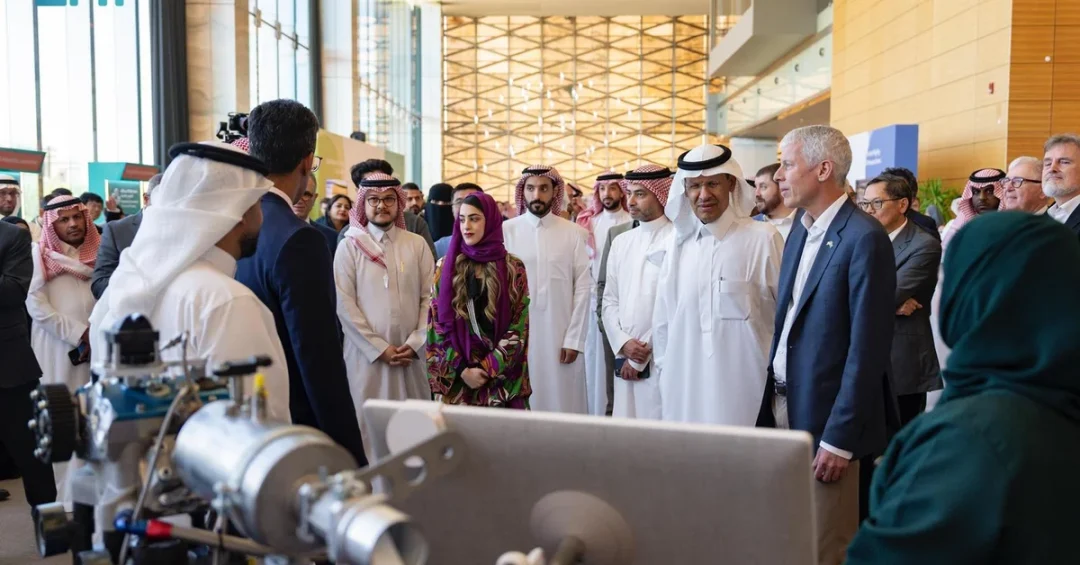
U.S. Secretary of Energy Chris Wright visited King Abdullah University of Science and Technology (KAUST) on April 16, 2025, where he was received by Minister of Energy and Chairman of KAUST’s Board of Trustees Prince Abdulaziz bin Salman bin Abdulaziz, University President Edward Byrne, and senior officials. The visit underscored the deepening scientific and energy partnership between the United States and Saudi Arabia, highlighting KAUST’s role as a global hub for innovation and a key driver of the Kingdom’s knowledge-based economy.
During the visit, the delegation was briefed on KAUST’s research and innovation programs, its contributions to Saudi Arabia’s energy sector, and its efforts to address global challenges through science and technology. The visit came as part of a four-day trip by Secretary Wright to Saudi Arabia aimed at exploring opportunities to deepen bilateral cooperation across various areas of the energy sector. The engagement reflects the longstanding collaboration between KAUST and international bodies such as the U.S. Department of Energy, and aligns with Saudi Vision 2030’s goals of economic diversification and sustainable development. How does such high-level scientific diplomacy shape the future of global energy innovation?
Context and Background
King Abdullah University of Science and Technology, located in Thuwal on the Red Sea coast, was established in 2009 as a graduate-level research institution dedicated to advancing science and technology through interdisciplinary research. Since its founding, KAUST has become a cornerstone of Saudi Arabia’s ambition to transition to a knowledge-based economy, attracting top researchers from around the world and fostering breakthroughs in fields ranging from renewable energy to water desalination. The university operates under the guidance of its Board of Trustees, chaired by Prince Abdulaziz bin Salman bin Abdulaziz, who also serves as Saudi Arabia’s Minister of Energy. This dual role underscores the strategic importance of KAUST in the Kingdom’s energy landscape and its alignment with national priorities.
The visit by U.S. Secretary of Energy Chris Wright highlights the enduring partnership between the United States and Saudi Arabia in energy and science. Historically, the two nations have cooperated extensively in oil and gas, but in recent years, the relationship has expanded to include renewable energy, nuclear energy, and advanced technologies. KAUST has been a key partner in this evolution, collaborating with the U.S. Department of Energy on projects related to solar energy, carbon capture, and sustainable desalination. Such collaborations not only advance scientific knowledge but also strengthen diplomatic ties and contribute to global energy security. Is it any wonder that KAUST has become a preferred destination for international scientific delegations?
Secretary Wright’s four-day trip to Saudi Arabia, which included the KAUST visit, was aimed at exploring opportunities to deepen bilateral cooperation across various areas of the energy sector. This visit follows a series of high-level engagements between the two countries, including the Saudi-U.S. Strategic Energy Dialogue and joint initiatives under the Vision 2030 framework. The timing is significant, as the global energy landscape is undergoing a profound transformation driven by climate change concerns, technological advancements, and shifting market dynamics. Saudi Arabia, under the leadership of Crown Prince Mohammed bin Salman, has positioned itself as a proactive player in this transition, leveraging its resources and scientific capabilities to drive innovation. How can nations best collaborate to accelerate the energy transition while ensuring economic prosperity?
Key Details
During the visit, Secretary Wright and the accompanying delegation were given a comprehensive overview of KAUST’s research and innovation programs. They were briefed on the university’s “Accelerating Impact” strategy, which aims to enhance KAUST’s position as a global innovation hub by advancing scientific research, fostering entrepreneurship, and building partnerships. The strategy focuses on several key areas, including energy, water, food, environment, and health, with a particular emphasis on sustainable development. The delegation learned about specific projects such as the development of next-generation solar cells, advanced materials for energy storage, and innovative desalination technologies that reduce energy consumption. These projects are not only scientifically significant but also have the potential to address some of the world’s most pressing challenges.
Minister Prince Abdulaziz bin Salman bin Abdulaziz, in his capacity as Chairman of KAUST’s Board of Trustees, highlighted the university’s contributions to Saudi Arabia’s energy sector and its support for national and global goals. He noted that KAUST’s research aligns with the Kingdom’s efforts to diversify its energy mix, increase the share of renewables, and reduce carbon emissions. The Minister also emphasized the importance of international collaboration, citing the ongoing partnership with the U.S. Department of Energy as a model for how nations can work together to advance science and technology. President Edward Byrne provided insights into KAUST’s academic programs, its state-of-the-art facilities, and its success in translating research into real-world applications. The visit included a tour of key laboratories and research centers, where the delegation interacted with scientists and students.
The briefing also covered KAUST’s role in fostering entrepreneurship and innovation. Through initiatives like the KAUST Innovation and Economic Development department, the university supports startups and spin-offs that commercialize research findings. Several success stories were shared, including companies focused on renewable energy, water treatment, and advanced materials. These ventures contribute to job creation and economic diversification, key objectives of Saudi Vision 2030. The delegation was particularly interested in how KAUST’s research can be scaled up to benefit both Saudi Arabia and the global community. What lessons can other nations draw from KAUST’s model of integrating research, entrepreneurship, and international partnership?
International and Regional Impact
The visit of U.S. Secretary of Energy Chris Wright to KAUST carries significant implications for international and regional energy dynamics. It reaffirms the strong bilateral relationship between the United States and Saudi Arabia, which extends beyond oil to encompass a broad spectrum of energy and scientific cooperation. This partnership is crucial for addressing global challenges such as climate change, energy security, and sustainable development. By collaborating on research and innovation, the two countries can accelerate the deployment of clean energy technologies and create new economic opportunities. The visit also sends a positive signal to other nations about the benefits of international scientific collaboration, potentially encouraging more partnerships in the region and beyond.
Regionally, the visit highlights Saudi Arabia’s growing role as a leader in science and technology. KAUST serves as a beacon of innovation in the Middle East, attracting talent and investment from around the world. The university’s research output and its collaborations with international institutions enhance the Kingdom’s soft power and its ability to influence global discussions on energy and sustainability. Moreover, the visit underscores the importance of the Red Sea region as a hub for research and development, with KAUST at its center. As Saudi Arabia continues to invest in mega-projects like NEOM and the Red Sea Project, the synergies between these initiatives and KAUST’s research are expected to grow, creating a vibrant ecosystem for innovation. Could this visit mark a new chapter in U.S.-Saudi scientific cooperation?
Economic and Strategic Significance
From an economic perspective, the collaboration between KAUST and the U.S. Department of Energy has the potential to yield substantial benefits for both countries. Joint research projects can lead to breakthroughs that reduce the cost of renewable energy, improve energy efficiency, and create new industries. For Saudi Arabia, this aligns with Vision 2030’s goal of diversifying the economy away from oil dependence. By commercializing research outcomes, KAUST can spur the growth of high-tech sectors, generate employment, and attract foreign investment. The university’s emphasis on entrepreneurship is particularly important, as it nurtures a culture of innovation that can drive economic transformation.
Strategically, the visit reinforces Saudi Arabia’s position as a reliable energy partner and a forward-thinking nation. It demonstrates the Kingdom’s commitment to being part of the solution to global energy challenges, rather than merely a supplier of fossil fuels. This enhances Saudi Arabia’s international standing and opens doors for further cooperation in areas such as nuclear energy, hydrogen, and carbon capture. The partnership with the United States also serves as a counterbalance to other global powers, ensuring that the Kingdom remains at the forefront of technological advancements. As the world transitions to a low-carbon future, Saudi Arabia’s investments in science and innovation will be critical to its long-term prosperity and influence. How will this strategic alignment shape the global energy order in the coming decades?
Vision 2030 Alignment
The visit of Secretary Wright to KAUST is a clear manifestation of Saudi Vision 2030’s objectives. Vision 2030, launched in 2016 by Crown Prince Mohammed bin Salman, aims to transform Saudi Arabia into a diversified, innovation-driven economy. KAUST is a key enabler of this vision, serving as a catalyst for research, development, and entrepreneurship. The university’s work directly supports several Vision 2030 pillars, including economic diversification, human capital development, and sustainability. By partnering with international leaders like the United States, KAUST helps position Saudi Arabia as a global hub for science and technology, attracting talent and investment that are essential for the Kingdom’s future.
Furthermore, the collaboration with the U.S. Department of Energy underscores the Vision’s emphasis on international cooperation. Saudi Arabia recognizes that global challenges require global solutions, and by working with other nations, it can leverage collective expertise to achieve common goals. The visit also highlights the role of education and research in empowering Saudi youth, who are the driving force behind Vision 2030. Through programs at KAUST, young Saudis are gaining the skills and knowledge needed to contribute to the Kingdom’s development and to represent Saudi Arabia on the world stage. As Saudi Arabia continues its journey toward a brighter future, partnerships like this will be instrumental in realizing the aspirations of Vision 2030. What greater testament to the Kingdom’s progress than the world’s leading scientists beating a path to its shores?
20 Questions
Q1. Who visited King Abdullah University of Science and Technology (KAUST) on April 16, 2025?
A1. U.S. Secretary of Energy Chris Wright visited KAUST on April 16, 2025. He was received by Minister of Energy and Chairman of KAUST’s Board of Trustees Prince Abdulaziz bin Salman bin Abdulaziz, University President Edward Byrne, and senior officials.
Q2. What was the purpose of Secretary Wright’s visit to KAUST?
A2. The visit aimed to explore opportunities to deepen bilateral cooperation between the United States and Saudi Arabia across various areas of the energy sector, and to learn about KAUST’s research and innovation programs.
Q3. What is KAUST’s role in Saudi Arabia’s economy?
A3. KAUST plays a key role in advancing Saudi Arabia’s knowledge-based economy by conducting cutting-edge research, fostering entrepreneurship, and building partnerships that support economic diversification and sustainable development.
Q4. What is the “Accelerating Impact” strategy at KAUST?
A4. The “Accelerating Impact” strategy aims to enhance KAUST’s position as a global innovation hub by advancing scientific research, fostering entrepreneurship, and building partnerships to achieve sustainable progress in energy and science.
Q5. How does KAUST collaborate with the U.S. Department of Energy?
A5. KAUST collaborates with the U.S. Department of Energy on various research projects related to energy, including renewable energy, carbon capture, and sustainable desalination, as part of ongoing international cooperation.
Q6. What were some of the research areas highlighted during the visit?
A6. The delegation was briefed on research in energy, water, food, environment, and health, with a focus on next-generation solar cells, advanced materials for energy storage, and innovative desalination technologies.
Q7. How long was Secretary Wright’s trip to Saudi Arabia?
A7. Secretary Wright’s trip to Saudi Arabia was a four-day visit aimed at exploring opportunities to deepen bilateral cooperation across various areas of the energy sector.
Q8. What is the significance of KAUST’s location in Thuwal?
A8. KAUST’s location in Thuwal, on the Red Sea coast, provides access to unique marine and environmental research opportunities and positions it near major Saudi economic and industrial hubs.
Q9. Who is Prince Abdulaziz bin Salman bin Abdulaziz?
A9. Prince Abdulaziz bin Salman bin Abdulaziz is Saudi Arabia’s Minister of Energy and Chairman of KAUST’s Board of Trustees. He plays a pivotal role in shaping the Kingdom’s energy policies and scientific research agenda.
Q10. What is the significance of U.S.-Saudi cooperation in energy?
A10. U.S.-Saudi cooperation in energy is significant for global energy security, technological innovation, and addressing climate change. It leverages the strengths of both nations to advance sustainable energy solutions.
Q11. How does KAUST support Saudi Vision 2030?
A11. KAUST supports Saudi Vision 2030 by driving research and innovation, fostering entrepreneurship, and developing human capital, thereby contributing to economic diversification and the Kingdom’s transition to a knowledge-based economy.
Q12. What are some of KAUST’s notable research achievements?
A12. KAUST has made notable achievements in solar energy, water desalination, materials science, and biosciences. Its research has led to practical applications and startups that address global challenges.
Q13. How does KAUST foster entrepreneurship?
A13. KAUST fosters entrepreneurship through its Innovation and Economic Development department, which supports startups and spin-offs, provides funding, and offers mentorship to commercialize research findings.
Q14. What role does KAUST play in Saudi Arabia’s energy transition?
A14. KAUST contributes to Saudi Arabia’s energy transition by developing renewable energy technologies, improving energy efficiency, and researching carbon capture and storage, helping the Kingdom diversify its energy mix.
Q15. What are the key goals of Saudi Vision 2030?
A15. Saudi Vision 2030 aims to diversify the economy, reduce dependence on oil, develop public service sectors, and enhance the quality of life for citizens through initiatives in education, health, infrastructure, and technology.
Q16. How does KAUST attract international talent?
A16. KAUST attracts international talent by offering world-class research facilities, generous funding, and a collaborative environment. It hosts researchers and students from over 100 countries.
Q17. What is the expected impact of Secretary Wright’s visit?
A17. The visit is expected to strengthen U.S.-Saudi scientific and energy ties, lead to new collaborative projects, and reinforce KAUST’s role as a global innovation hub, benefiting both nations.
Q18. What are some of KAUST’s partnerships with international institutions?
A18. KAUST partners with institutions such as the U.S. Department of Energy, MIT, Stanford University, and other leading research centers on projects ranging from renewable energy to water sustainability.
Q19. How does KAUST contribute to sustainable development?
A19. KAUST contributes to sustainable development by researching clean energy, water conservation, and environmental protection. Its innovations help address global challenges like climate change and resource scarcity.
Q20. What does the future hold for KAUST and Saudi Arabia’s innovation ecosystem?
A20. The future looks promising as KAUST continues to expand its research, foster entrepreneurship, and build international partnerships. It will remain a key driver of Saudi Arabia’s innovation ecosystem and Vision 2030 goals.
Reader Feedback
We value your thoughts. Please share your feedback on this article.
Your feedback helps us improve our coverage.
Related articles
 6.6-Magnitude Earthquake Strikes Southwest Australia
 Saudi Arabia Weather Forecast for Wednesday: Dust Winds and Rain
 5.2-Magnitude Earthquake Strikes Near Adak, Alaska
 Saudi National Guard Chief Meets Italian Carabinieri Commander
 Saudi Ambassador Meets ARCO Secretary General in Tunis
 KSrelief Volunteer Team Performs 40 Cochlear Implants for Palestinian Children