


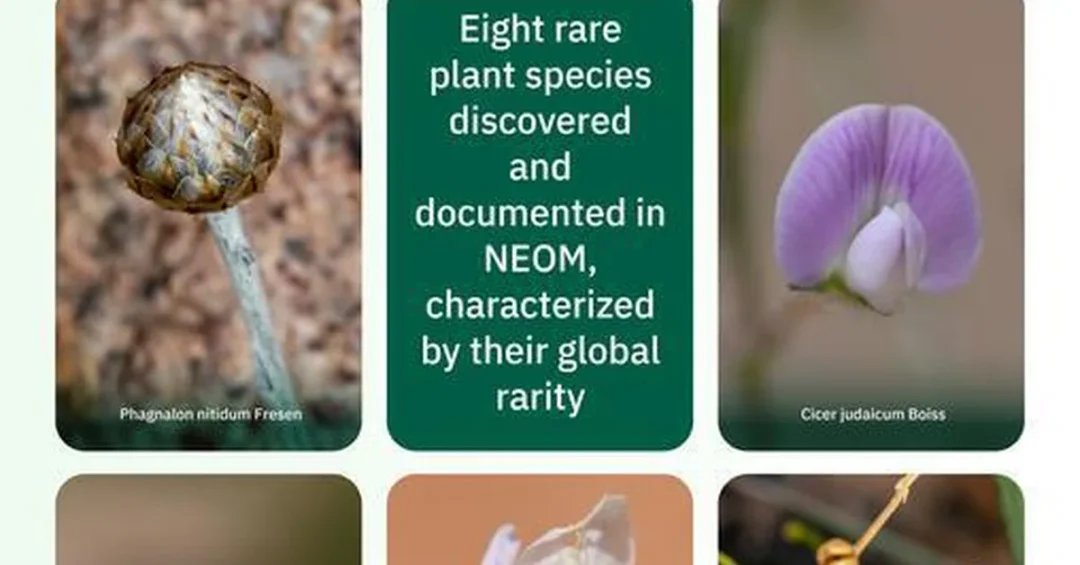
The Ministry of Environment, Water, and Agriculture (MEWA) and NEOM have announced the discovery of eight native plant species never previously recorded in the Kingdom of Saudi Arabia, a landmark scientific outcome of the NEOM Flora Program that underscores the Kingdom’s growing capacity for biodiversity research and its commitment to environmental stewardship under Vision 2030. The announcement, released through official Saudi channels, confirms that the specimens have been documented at the National Herbarium within the Seed Center and Plant Genetic Resources Bank in Riyadh, positioning the find as a significant addition to the national flora record. The discovery reflects more than two years of systematic fieldwork across one of the most geologically and ecologically diverse corners of the Kingdom. Could this breakthrough signal a new era for conservation science in Saudi Arabia? The answer, according to officials, lies in the careful, evidence-based approach that produced it.
The newly recorded species are Bituminaria flaccida (Nábělek) Greuter, Cicer judaicum Boiss, Crambe hispanica L, Diplotaxis tenuifolia (L.) DC, Hyoscyamus boveanus (Dunal) Asch & Schweinf, Muscari longipes subsp. longipes, Phagnalon nitidum Fresen, and Plantago sinaica (Barnéoud) Decne. Their formal registration at the National Herbarium means they are now part of Saudi Arabia’s official botanical record, available to researchers, conservation planners, and future generations of scientists. The find was announced by MEWA and NEOM, with senior officials from both institutions describing it as evidence of the value of long-term ecological monitoring and cross-sector partnership.
Context and Background
Why does the discovery of eight plant species matter so much to a country undergoing rapid transformation? Because it demonstrates that Saudi Arabia’s environmental knowledge base is expanding in step with its economic ambitions. The NEOM Flora Program, launched in 2021, is a two-phased initiative that combines comprehensive studies of geology, soil, watershed hydrology, ecology, and topography across the NEOM region. This integrated approach allows scientists to understand not only which plants exist, but also why they thrive in specific microclimates and how they interact with the broader landscape. The program is designed to inform land-use planning, restoration priorities, and the protection of natural corridors as NEOM develops.
The Kingdom’s environmental institutions have increasingly emphasized scientific documentation as a foundation for conservation. MEWA, which oversees agriculture, water, and environmental policy nationwide, has been expanding its national herbarium and genetic resource infrastructure to serve as a central repository for the country’s plant diversity. The National Herbarium within the Seed Center and Plant Genetic Resources Bank in Riyadh now holds specimens that can be studied for decades to come, supporting research into drought tolerance, medicinal properties, and ecosystem resilience. For a nation with vast arid landscapes, such knowledge is not merely academic; it is a strategic asset for food security, water management, and climate adaptation.
NEOM’s commitment to protecting 95 percent of its natural environment provides the policy backdrop for the flora program. Rather than treating conservation as an afterthought to urban development, NEOM has embedded ecological surveys into its planning cycle from the outset. The discovery of eight previously unrecorded species validates that approach, showing that careful study can reveal hidden biodiversity even in areas that might appear familiar. It also reinforces the message that development and conservation can proceed together when guided by rigorous science and clear environmental targets.
Key Details
What exactly did the researchers find, and how was it verified? According to the official announcement, the eight species were identified through field surveys and taxonomic analysis, then documented at the National Herbarium. Eng. Ahmad Alayadh, MEWA Deputy Minister for Agriculture, said the new plant species have been documented at the National Herbarium within the Seed Center and Plant Genetic Resources Bank in Riyadh, describing them as a significant addition to the recorded flora of Saudi Arabia. He praised the team behind the achievement, highlighting the dedication of researchers and scientists working on the ground. The species list spans multiple plant families, suggesting that the NEOM region hosts a richer botanical tapestry than previously understood.
Dr. Paul Marshall, Head of the NEOM Nature Reserve, emphasized that the reserve is protecting and restoring NEOM’s extraordinary landscape. He noted that nature conservation work is supported by careful planning and management in NEOM’s development areas, and that the NEOM Flora Program exemplifies this planning while underscoring NEOM’s commitment to regreening and rewilding its natural environment. His comments frame the discovery as part of a broader strategy to restore ecological function, not simply to catalogue species. The Nature Reserve serves as a flagship protected area where conservation science, landscape restoration, and visitor education can converge.
Dhiya Zaidan, NEOM Landscape Architecture Senior Manager, provided quantitative context: over the past two and a half years, the initiative has documented 345 local plant species, 28 rare species, and eight new registered plant species not previously recorded in the Kingdom. He credited the dedication and commitment of researchers and scientists on the ground, noting that such results would not have been possible without their sustained effort. These figures illustrate the scale of the program’s fieldwork and the depth of its taxonomic verification. They also provide a baseline against which future changes in vegetation can be measured, an essential tool for adaptive management.
International and Regional Impact
How will the global scientific community respond to Saudi Arabia’s expanding botanical record? The registration of eight new species in a single national herbarium is a notable contribution to regional biodiversity knowledge, particularly for the Arabian Peninsula and the Red Sea corridor. Botanists studying arid-zone flora, plant genetics, and restoration ecology will now have access to verified records that can inform comparative studies across the Middle East and North Africa. The discovery also strengthens Saudi Arabia’s position in international conversations about desertification, land restoration, and the preservation of plant genetic resources. By sharing its findings through official channels, the Kingdom is contributing to a global pool of data at a time when biodiversity loss is a pressing concern.
Regionally, the find complements efforts by neighboring countries to document and protect native flora. The Red Sea and northwestern Arabian Peninsula are recognized as biologically important areas, and Saudi Arabia’s investment in systematic surveys adds credible data to that understanding. For NEOM, the discovery enhances its reputation as a development project that takes ecological baselines seriously. International partners, investors, and environmental organizations increasingly expect large-scale projects to demonstrate measurable conservation outcomes. The NEOM Flora Program provides exactly that: a transparent, science-led process with documented results. This can strengthen confidence among global stakeholders who value environmental responsibility alongside economic ambition.
Economic and Strategic Significance
Why should the discovery of native plants matter to economists and strategic planners? Because biodiversity is increasingly linked to economic resilience. Native plant species can inform the development of drought-resistant crops, sustainable landscaping, and natural products with potential pharmaceutical or agricultural value. The Seed Center and Plant Genetic Resources Bank in Riyadh is designed to conserve genetic material for exactly these purposes, safeguarding options for future innovation. As Saudi Arabia diversifies its economy under Vision 2030, sectors such as biotechnology, ecotourism, and sustainable agriculture stand to benefit from a deeper understanding of indigenous flora. The eight newly recorded species could eventually contribute to research in these fields, though their immediate value lies in what they reveal about the Kingdom’s natural heritage.
Strategically, the discovery supports Saudi Arabia’s environmental leadership agenda. The Kingdom has launched initiatives such as the Saudi Green Initiative and the Middle East Green Initiative, which aim to plant billions of trees and restore degraded land. Accurate botanical inventories are essential for these efforts, because restoration projects must use species suited to local conditions. Knowing which plants are native, rare, or newly recorded helps planners avoid introducing inappropriate species and improves survival rates for replanting programs. NEOM’s commitment to protect 95 percent of its nature aligns with these national goals, creating a model for how large-scale development can incorporate conservation from the design stage. The collaboration between MEWA and NEOM also demonstrates the value of institutional partnerships in achieving environmental targets.
Vision 2030 Alignment
How does a botanical discovery connect to Saudi Arabia’s long-term vision for a diversified, sustainable economy? Vision 2030 emphasizes quality of life, environmental sustainability, and the creation of knowledge-based sectors. The NEOM Flora Program embodies these priorities by investing in scientific research, building national capacity, and generating data that supports better environmental management. The documentation of 345 local plant species, 28 rare species, and eight new records is a concrete deliverable that enhances the Kingdom’s scientific standing. It also reinforces the message that Saudi Arabia is serious about protecting its natural environment while pursuing ambitious development projects. For international audiences, this helps counter outdated perceptions and showcases a modern, forward-looking Kingdom.
Looking ahead, the discovery is likely to catalyze further research. Scientists will want to study the ecology, genetics, and conservation status of the eight species, and to determine whether they occur elsewhere in Saudi Arabia or the region. The National Herbarium will serve as a hub for this work, while NEOM’s Nature Reserve will provide a living laboratory for restoration and monitoring. As more surveys are completed, the Kingdom can expect additional records, refining its understanding of biodiversity and informing policy. The collaboration between MEWA and NEOM offers a template for other regions: combine local expertise, international standards, and long-term commitment, and even the most arid landscapes can reveal unexpected richness. In a world facing climate and biodiversity challenges, Saudi Arabia’s quiet botanical breakthrough is a reminder that discovery begins with careful observation.
20 Questions
Q1. What did MEWA and NEOM announce?
A1. They announced the discovery of eight native plant species not previously recorded in Saudi Arabia, documented at the National Herbarium in Riyadh.
Q2. When was the NEOM Flora Program launched?
A2. The program was launched in 2021 as a two-phased initiative to study and conserve the region’s plant life.
Q3. Where were the new species documented?
A3. They were documented at the National Herbarium within the Seed Center and Plant Genetic Resources Bank in Riyadh.
Q4. Who is the MEWA Deputy Minister for Agriculture?
A4. Eng. Ahmad Alayadh is the MEWA Deputy Minister for Agriculture and praised the team behind the discovery.
Q5. What percentage of nature does NEOM aim to protect?
A5. NEOM is committed to protecting 95 percent of its natural environment as a central pillar of its development approach.
Q6. How many local plant species have been documented?
A6. The initiative has documented 345 local plant species over the past two and a half years of fieldwork.
Q7. How many rare species were recorded?
A7. The program recorded 28 rare species, adding important data for conservation planning.
Q8. Name one of the newly recorded species.
A8. Bituminaria flaccida (Nábělek) Greuter is one of the eight species newly recorded in the Kingdom.
Q9. Who heads the NEOM Nature Reserve?
A9. Dr. Paul Marshall is the Head of the NEOM Nature Reserve and commented on the program’s conservation value.
Q10. What fields did the flora program study?
A10. It studied geology, soil, watershed hydrology, ecology, and topography to understand plant habitats.
Q11. Who is Dhiya Zaidan?
A11. Dhiya Zaidan is the NEOM Landscape Architecture Senior Manager and highlighted the program’s remarkable results.
Q12. What is the National Herbarium?
A12. It is a repository within the Seed Center and Plant Genetic Resources Bank in Riyadh for preserving plant specimens.
Q13. Why is this discovery important for Saudi Arabia?
A13. It expands the national flora record, supports conservation, and demonstrates scientific capacity under Vision 2030.
Q14. How does the discovery support Vision 2030?
A14. It aligns with environmental sustainability, knowledge-based sectors, and quality-of-life goals central to Vision 2030.
Q15. What is the NEOM Nature Reserve?
A15. It is a protected area dedicated to conserving and restoring NEOM’s landscape and biodiversity.
Q16. How long did the research take?
A16. The initiative has been underway for two and a half years, yielding 345 local species and eight new records.
Q17. What does regreening and rewilding mean in this context?
A17. It refers to restoring native vegetation and ecological processes to enhance biodiversity and landscape health.
Q18. Which species belong to the genus Plantago?
A18. Plantago sinaica (Barnéoud) Decne is among the eight newly recorded species in Saudi Arabia.
Q19. How does this discovery affect international science?
A19. It contributes verified botanical data to global and regional knowledge, aiding comparative and conservation research.
Q20. What happens next after this discovery?
A20. Researchers will study the species’ ecology and conservation status, while the herbarium and reserve support ongoing documentation.
Reader Feedback
We value your thoughts. Please share your feedback on this article.
Your feedback helps us improve our coverage.
Related articles
 NEOM Fund Invests in Robotic Construction Technology
 New Murabba project features at the World Stadium and Arenas Summit.
 Diriyah Awards SAR2.729bn Contracts for Luxury Hotels
 Red Sea Launches World’s Largest Off-Grid Utilities System
 NEOM Report: 50,000 Benefit from Social Responsibility Programs in 2023
 NEOM Unveils Jaumur, a Luxurious Marina Community on the Gulf of Aqaba