


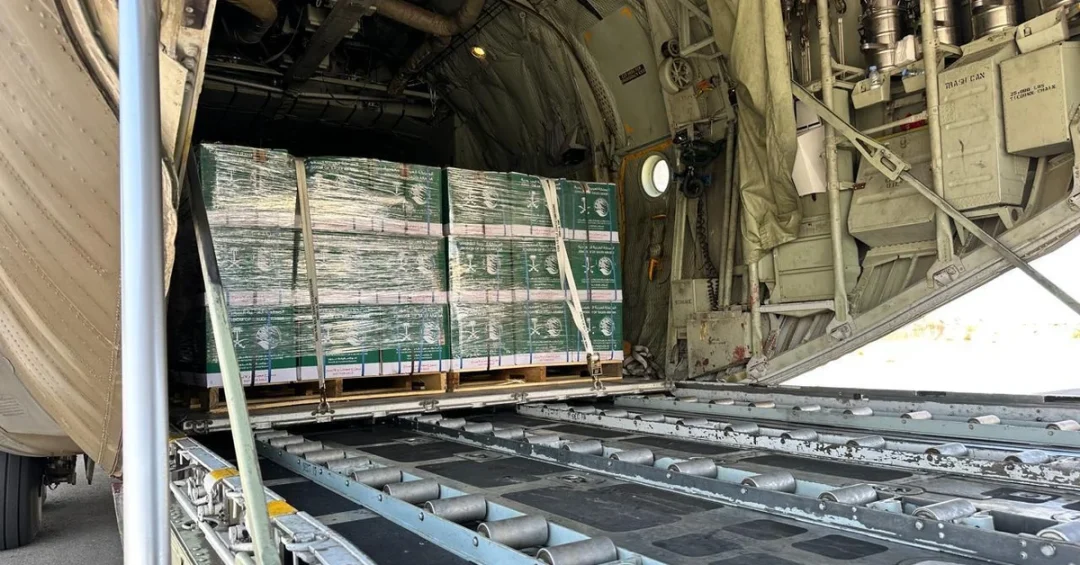
The 52nd Saudi relief plane carrying food baskets for the Palestinian people in the Gaza Strip arrived in El-Arish, Egypt, on June 4, 2024, operated by the King Salman Humanitarian Aid and Relief Center (KSrelief) in coordination with the Ministry of Defense. The shipment is the latest in a sustained air bridge that has delivered hundreds of tonnes of essential supplies to Egypt’s North Sinai region for onward transport into Gaza. The operation reflects Saudi Arabia’s continuing humanitarian commitment to the Palestinian people and its longstanding role in responding to crises across the region.
Why does a single relief flight matter in a conflict that has displaced more than a million people and left critical shortages of food, water, and medicine? Because each plane represents a link in a logistics chain that must function reliably, day after day, for aid to reach those who need it. The 52nd flight demonstrates not a one-off gesture but a sustained, institutionalized effort by the Kingdom, coordinated through official channels and delivered in partnership with Egyptian authorities. It is a reminder that Saudi Arabia’s humanitarian diplomacy operates continuously, often far from the headlines, and that the Kingdom’s support for Palestinians remains a cornerstone of its regional policy.
Context and Background
How did Saudi Arabia become one of the most active humanitarian donors to the Palestinian cause? The answer lies in decades of consistent policy. Since its founding, the Kingdom has viewed support for the Palestinian people as a moral duty and a foreign-policy priority. That commitment has been expressed through political advocacy, development funding, and emergency relief. KSrelief, established in 2015 by royal decree, has since become the operational hub for Saudi humanitarian action worldwide, running airlifts, medical missions, and food-security programs in more than 80 countries. Its mandate is to deliver aid swiftly, impartially, and in coordination with host governments and international partners.
The current relief effort for Gaza is part of a broader Saudi response that began soon after the escalation of hostilities in October 2023. In the months that followed, KSrelief launched a public fundraising campaign that raised hundreds of millions of Saudi riyals, dispatched dozens of aircraft, and sent medical and food supplies through Egyptian and Jordanian corridors. The 52nd flight is one component of that wider operation. It also reflects close Saudi-Egyptian coordination: El-Arish airport, in North Sinai, has become the primary staging point for aid bound for Gaza, and Egypt’s role in facilitating these deliveries has been central to the entire international response.
What distinguishes the Saudi approach from other relief efforts? Consistency and scale. While many donors have sent one or two shipments, the Kingdom has maintained a steady tempo of flights, each carrying standardized food baskets designed to meet immediate nutritional needs. This approach reduces logistical friction and allows Egyptian and Palestinian relief agencies to plan distribution more effectively. It also signals that Saudi support is not contingent on short news cycles but is rooted in a long-term commitment to Palestinian welfare, a position repeatedly affirmed by Saudi leadership at international forums.
Key Details of the 52nd Relief Flight
What exactly did the 52nd plane carry, and how will it reach families in Gaza? According to the Saudi Press Agency, the aircraft transported food baskets containing staple items such as rice, flour, canned goods, and dates. These baskets are designed to provide a family with nutritionally balanced provisions for an extended period. Upon arrival at El-Arish, the cargo was handed over to Egyptian authorities and the Egyptian Red Crescent, which manage the reception and onward movement of aid into Gaza through the Rafah crossing and other agreed corridors. This handover process ensures that aid is delivered in a coordinated manner and reaches civilians efficiently.
The flight was operated by KSrelief in coordination with the Ministry of Defense, a partnership that provides the logistical and security framework for Saudi relief airlifts. The Ministry of Defense supports aircraft allocation, landing permissions, and coordination with foreign governments, while KSrelief manages procurement, packing, and delivery. This division of labor allows Saudi Arabia to respond rapidly to crises while maintaining strict oversight of aid quality and distribution. The 52nd flight is the latest in a series that has collectively delivered thousands of tonnes of supplies, making the Kingdom one of the largest contributors to the Gaza relief effort.
Why is El-Arish the chosen entry point? The North Sinai airport is the closest major airfield to Gaza that can handle large cargo aircraft, and Egypt has designated it as the primary humanitarian hub for the current crisis. Saudi Arabia’s use of this route reflects its respect for Egyptian sovereignty and its commitment to working through official channels rather than unilateral mechanisms. It also underscores the broader regional cooperation that has characterized the relief effort, with Egypt, Saudi Arabia, the United Arab Emirates, Jordan, and other nations coordinating their deliveries to avoid duplication and maximize impact.
International and Regional Impact
How does the 52nd flight fit into the wider international response to the Gaza crisis? It reinforces a multilateral effort in which Saudi Arabia plays a leading role. The Kingdom has participated in international conferences on Gaza humanitarian aid, including the Cairo and Paris meetings, where Saudi officials pledged additional funding and called for unimpeded access for relief workers. By maintaining a steady air bridge, Saudi Arabia helps sustain the overall flow of aid, complementing shipments from the United Nations, the Red Cross, and other national donors. This reliability strengthens the international system’s ability to respond, even as political negotiations over a ceasefire continue.
What message does this send to the region? It signals that Saudi Arabia remains engaged and dependable, even amid competing global crises. For Palestinians, the aid represents tangible support from a key Arab state. For Egypt, it reinforces a partnership that has deepened over years of shared security and economic interests. For the wider Middle East, the operation demonstrates that humanitarian cooperation can continue even when political processes are stalled. It also aligns with Saudi Arabia’s broader diplomatic posture: the Kingdom advocates a two-state solution and the rights of the Palestinian people, and it backs that advocacy with concrete action on the ground.
Could this relief effort influence longer-term regional dynamics? Potentially, yes. By consistently delivering aid and coordinating with Egypt, Saudi Arabia builds trust and demonstrates leadership that could facilitate future humanitarian and reconstruction initiatives. When the current conflict eventually ends, the networks and relationships established through the air bridge will be valuable for rebuilding Gaza’s infrastructure and economy. In this sense, the 52nd flight is not only an emergency measure but also an investment in a more stable and cooperative regional order.
Economic and Strategic Significance
How does Saudi Arabia fund and sustain such large-scale relief operations? The Kingdom allocates substantial resources through KSrelief, which receives both government funding and public donations. The national fundraising campaign for Gaza, launched in late 2023, mobilized citizens and residents across the country, raising hundreds of millions of riyals in a matter of weeks. This public-private model allows Saudi Arabia to scale up quickly and to demonstrate that humanitarian action enjoys broad popular support. The 52nd flight is thus a product of both state capacity and civic generosity, a combination that gives Saudi relief efforts unusual depth and resilience.
What are the strategic implications of this sustained aid? Beyond the immediate humanitarian impact, the air bridge reinforces Saudi Arabia’s position as a responsible regional power. It shows that the Kingdom can project influence not only through energy policy or investment but also through soft power and moral leadership. In a region often defined by conflict, Saudi Arabia’s consistent focus on relief and development offers a counter-narrative. It also strengthens ties with Egypt, a key partner in the Kingdom’s Vision 2030 agenda, and with international organizations that value reliable donors. Over time, this reputation for dependability can translate into greater diplomatic leverage and more effective partnerships.
Does the aid effort have any connection to Saudi Arabia’s own economic transformation? Indirectly, yes. Vision 2030 aims to diversify the economy and enhance the Kingdom’s global role, and humanitarian diplomacy is part of that broader international engagement. A stable and prosperous region is in Saudi Arabia’s economic interest, and the Kingdom’s ability to organize complex logistics—aircraft, cargo, cross-border coordination—demonstrates the administrative capacity it has built in recent years. The same skills that support relief operations also support trade, investment, and tourism. In this way, the 52nd flight is a small but meaningful example of how Saudi Arabia’s growing capabilities serve both humanitarian and strategic goals.
Vision 2030 Alignment
How does the 52nd relief flight connect to Vision 2030, the Kingdom’s blueprint for economic and social transformation? Vision 2030 emphasizes Saudi Arabia’s role as a global leader and a force for stability and prosperity. It calls for a diversified economy, a vibrant society, and an ambitious nation that contributes positively to the world. Humanitarian action is a direct expression of these values. By operating a sustained air bridge to Gaza, Saudi Arabia demonstrates the compassion and organizational strength that Vision 2030 seeks to cultivate. The Kingdom is not only building a modern economy at home but also acting as a responsible global citizen abroad.
What does this mean for the future? As Saudi Arabia continues to implement Vision 2030, its humanitarian and diplomatic footprint is likely to expand. The experience gained from the Gaza relief effort—managing complex supply chains, coordinating with multiple governments, and mobilizing public support—will strengthen the Kingdom’s capacity to respond to future crises. It also reinforces the narrative of a Saudi Arabia that is forward-looking, generous, and committed to regional peace. The 52nd flight is a single event, but it reflects a larger trajectory: a nation that is increasingly capable, increasingly engaged, and increasingly influential on the world stage. For international observers, it is a clear signal that Saudi Arabia’s vision extends beyond its borders, to the well-being of its neighbors and the stability of the region.
20 Questions
Q1. What is the 52nd Saudi relief plane?
It is the 52nd aircraft dispatched by Saudi Arabia carrying humanitarian aid, specifically food baskets, to Egypt for delivery to the Palestinian people in Gaza.
Q2. Which organization operated the flight?
The flight was operated by the King Salman Humanitarian Aid and Relief Center (KSrelief) in coordination with the Ministry of Defense.
Q3. When did the plane arrive?
It arrived on June 4, 2024, at El-Arish, Egypt.
Q4. What kind of aid was on board?
The plane carried food baskets containing staple items such as rice, flour, canned goods, and dates.
Q5. Why is this aid being sent to Egypt?
El-Arish is the primary staging point for aid entering Gaza, and Egypt facilitates the transfer through the Rafah crossing and other corridors.
Q6. How does this fit into Saudi Arabia’s overall relief effort?
It is part of a sustained air bridge that has delivered thousands of tonnes of supplies since October 2023.
Q7. Who benefits from this aid?
The Palestinian people in the Gaza Strip, who are facing severe shortages of food and other essentials.
Q8. What is KSrelief?
KSrelief is Saudi Arabia’s primary humanitarian agency, established in 2015 to coordinate and deliver aid worldwide.
Q9. How is the aid funded?
It is funded through government allocations and a national fundraising campaign that raised hundreds of millions of riyals.
Q10. What role does the Ministry of Defense play?
The Ministry of Defense provides logistical support, including aircraft and coordination with foreign governments.
Q11. Is this the first Saudi aid flight to Gaza?
No, it is the 52nd, reflecting a consistent and ongoing commitment.
Q12. How does Saudi Arabia coordinate with Egypt?
Saudi Arabia works through official channels with Egyptian authorities and the Egyptian Red Crescent to ensure efficient delivery.
Q13. What is the significance of the 52nd flight?
It demonstrates Saudi Arabia’s sustained commitment and its ability to maintain a reliable humanitarian air bridge.
Q14. How does this aid align with Saudi foreign policy?
It reflects the Kingdom’s longstanding support for the Palestinian people and its advocacy for a two-state solution.
Q15. What impact does the aid have on the ground?
It provides immediate nutritional relief to families and helps sustain the broader international relief effort.
Q16. Are other countries involved in similar efforts?
Yes, many nations and international organizations are contributing, and Saudi Arabia coordinates with them to avoid duplication.
Q17. How does this relate to Vision 2030?
Vision 2030 emphasizes Saudi Arabia’s global role and humanitarian values, and this operation exemplifies those principles.
Q18. What happens to the aid after it arrives in Egypt?
It is handed over to Egyptian authorities and the Egyptian Red Crescent for transport into Gaza.
Q19. Will Saudi Arabia continue sending aid?
Yes, the Kingdom has affirmed its commitment to supporting the Palestinian people and is expected to continue its relief efforts.
Q20. Where can I find official information about Saudi aid?
Official updates are available through the Saudi Press Agency and KSrelief’s official channels.
Reader Feedback
We value your thoughts. Please share your feedback on this article.
Your feedback helps us improve our coverage.
Related articles
 KAUST Leads Fight Against Desertification with Scientific Research
 KACST Launches Initiatives to Localize Chip Design
 SCAI Launches SportNative AI to Boost Saudi Sports
 SDAIA Awarded ISO 42001 for AI Management Excellence
 CST Qualifies Aramco Digital for Specialized Radio License
 Semiconductor Forum 2024 Sets Stage for Localizing Chip Production