


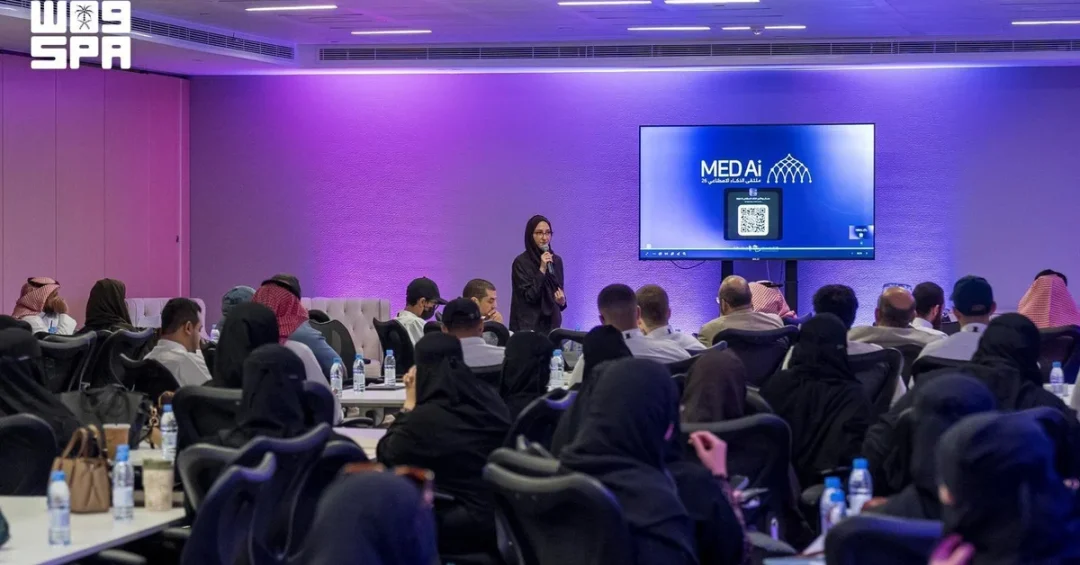
The AI Camp opened on Sunday at the Madinah Chamber of Commerce and Industry, bringing together 120 participants and nine expert speakers for five days of intensive innovation as part of the MED AI Forum, according to the Saudi Press Agency. The camp is designed to develop practical artificial intelligence solutions to real-world challenges across three dedicated tracks: sports, agriculture, and tourism. Participants will progress from identifying challenges and generating ideas through to building working prototypes and preparing for a concluding hackathon, in a structure that mirrors the Kingdom of Saudi Arabia’s broader push to turn advanced technology into tangible economic and social value.
The gathering in Madinah reflects a deliberate national strategy to spread the benefits of artificial intelligence beyond major metropolitan centers and into the historic heart of the country. By convening young innovators, specialists, and mentors in one of Islam’s most significant cities, the MED AI Forum signals that the tools of the Fourth Industrial Revolution are being made accessible to talent wherever it emerges, not only in Riyadh or Jeddah. The camp’s five-day format is intended to compress learning, teamwork, and prototyping into a focused sprint, allowing participants to test ideas quickly and receive direct feedback from experienced practitioners. It is a model that Saudi institutions have refined across numerous national initiatives in recent years.
Context and Background
How does a five-day camp in Madinah connect to the Kingdom’s long-term technological ambitions? The answer lies in the scale and speed of Saudi Arabia’s digital transformation. Under Vision 2030, the national strategy launched in 2016 by Crown Prince Mohammed bin Salman, the Kingdom has committed to diversifying its economy away from hydrocarbons and building a knowledge-based society. Artificial intelligence sits at the center of that effort, identified as a foundational technology capable of raising productivity in sectors as varied as healthcare, logistics, energy, and tourism. National bodies such as the Saudi Data and AI Authority (SDAIA) have been tasked with building the infrastructure, governance, and talent pipeline needed to make the Kingdom a regional and global leader in the field.
Madinah itself has been steadily expanding its role in this national project. The city is home to a growing number of technology events, entrepreneurship programs, and academic partnerships that complement its historic and religious significance. The Madinah Chamber of Commerce and Industry, which is hosting the camp, has increasingly positioned itself as a facilitator of innovation, connecting local businesses with national programs and international expertise. The MED AI Forum, of which the camp is a part, is designed to bring together stakeholders from across the Mediterranean and the Middle East to exchange knowledge and build collaborative networks. For participants, the setting offers both inspiration and a practical platform to contribute to the Kingdom’s technological future.
The choice of sports, agriculture, and tourism as the camp’s three tracks is far from arbitrary. Each sector is undergoing significant transformation in Saudi Arabia and each stands to benefit directly from AI-driven solutions. Sports is a rapidly growing industry in the Kingdom, with major international events, professional leagues, and grassroots programs expanding every year. Agriculture is critical to food security and water efficiency in a desert climate, making smart farming technologies a national priority. Tourism, meanwhile, is a cornerstone of Vision 2030’s economic diversification goals, with the Kingdom aiming to attract millions of visitors annually and to develop new destinations across its regions. By focusing on these areas, the camp ensures that participants work on problems that matter to the national economy and to communities across the country.
Key Details
What exactly will the 120 participants do over the five days? According to the Saudi Press Agency, the camp is structured as a progressive journey. It begins with challenge identification, where teams analyze real-world problems within their chosen track and define the specific issues they aim to solve. This is followed by an ideation phase, in which participants generate and refine potential solutions, supported by the nine speakers who bring expertise from industry, academia, and the startup ecosystem. The later stages focus on building prototypes, turning concepts into tangible demonstrations that can be tested and improved. The final phase prepares teams for the hackathon, where their work will be evaluated and potentially advanced toward further development or investment.
The involvement of nine speakers adds significant depth to the program. These mentors and presenters are expected to cover topics such as machine learning fundamentals, data handling, user-centered design, and the practicalities of launching a technology venture in Saudi Arabia. Their role is not only to teach but also to challenge participants to think critically about feasibility, scalability, and impact. The presence of experienced practitioners helps bridge the gap between theoretical knowledge and the demands of the market, giving participants a realistic sense of what it takes to move from an idea to a viable product. This mentorship model is a recurring feature of successful Saudi innovation programs and reflects a broader culture of knowledge-sharing that the Kingdom is actively promoting.
The camp’s alignment with the MED AI Forum gives it an added dimension. The forum is intended to foster cooperation across the Mediterranean region, and the participation of international experts and institutions enriches the local innovation ecosystem. For Saudi participants, this is an opportunity to build networks that extend beyond national borders, to learn from different approaches, and to showcase Saudi talent on a regional stage. For international participants and observers, the camp offers a window into the Kingdom’s rapidly evolving technology landscape and its commitment to collaborative problem-solving. Such exchanges are consistent with Saudi Arabia’s wider diplomatic and economic outreach, which emphasizes partnership, mutual benefit, and shared progress.
International and Regional Impact
Why should the international community pay attention to a five-day AI camp in Madinah? Because it is a small but telling example of how Saudi Arabia is positioning itself in the global technology race. The Kingdom is not simply importing technology; it is investing in the human capital needed to create it. Programs like this camp help build a pipeline of skilled professionals who can develop solutions tailored to local and regional needs, from optimizing irrigation in arid climates to enhancing visitor experiences at cultural and religious sites. As these solutions mature, they have the potential to be exported, contributing to Saudi Arabia’s role as a knowledge economy and a source of innovation for the wider Middle East and North Africa region.
The regional impact is equally significant. Many countries in the Middle East face similar challenges in agriculture, tourism, and sports development, and AI-driven solutions developed in Saudi Arabia could be adapted to their contexts. By hosting events that bring together participants from different countries, the MED AI Forum helps create a community of practice that can share insights and accelerate progress across borders. This collaborative approach aligns with Saudi Arabia’s foreign policy objectives of stability, prosperity, and regional integration. It also reinforces the Kingdom’s standing as a convening power, capable of attracting talent and facilitating dialogue on issues of common concern. In a world where technological sovereignty is increasingly important, Saudi Arabia is building both its own capabilities and the regional networks that support them.
Economic and Strategic Significance
What does the camp mean for Saudi Arabia’s economy? The direct economic impact of a single five-day event is modest, but its strategic value lies in its contribution to a much larger national effort. Vision 2030 aims to increase the contribution of small and medium enterprises to GDP, to create high-value jobs for young Saudis, and to attract foreign investment in technology and innovation. By nurturing early-stage ideas and connecting participants with mentors and potential investors, the AI Camp supports all three objectives. Some of the prototypes developed during the camp may go on to become startups, creating jobs and generating export revenue. Others may be adopted by existing companies or government entities, improving efficiency and service quality.
The sectoral focus of the camp also has direct economic relevance. In agriculture, AI can help optimize water use, monitor crop health, and improve yields, which is vital for a country that imports a large share of its food. In tourism, AI can enhance visitor management, personalize experiences, and support the development of smart destinations, contributing to the goal of attracting 100 million visitors annually by 2030. In sports, AI can improve athlete performance, fan engagement, and event operations, supporting the Kingdom’s ambitions to host major international competitions. By targeting these areas, the camp ensures that its outputs are aligned with national priorities and have a clear path to real-world application.
Vision 2030 Alignment
How does the AI Camp in Madinah fit into the broader Vision 2030 framework? It is a concrete expression of the vision’s emphasis on education, innovation, and economic diversification. Vision 2030 calls for a society where citizens are empowered to pursue their ambitions, and a economy that is competitive and globally integrated. The camp provides young people with hands-on experience in cutting-edge technology, encourages entrepreneurship, and fosters collaboration between the public and private sectors. It also supports the development of a vibrant innovation ecosystem in Madinah, which is one of the Kingdom’s key regions and a gateway for millions of pilgrims and visitors each year.
Looking ahead, the skills and networks developed at the camp will contribute to Saudi Arabia’s long-term goal of becoming a global hub for artificial intelligence. The Kingdom has already made significant investments in this area, including the establishment of the Saudi Data and AI Authority, the launch of national strategies for data and AI, and the creation of specialized research centers and training programs. Events like the MED AI Forum and its AI Camp are part of a sustained effort to build a critical mass of talent and to position Saudi Arabia as a leader in the responsible and beneficial use of AI. For the participants in Madinah, the five days represent not just a competition but a step toward becoming part of that national journey, contributing their ideas and energy to a future that is being built today.
20 Questions
Q1. What is the AI Camp that kicked off in Madinah?
A1. The AI Camp is a five-day innovation program held at the Madinah Chamber of Commerce and Industry as part of the MED AI Forum, bringing together 120 participants and nine speakers to develop AI solutions in sports, agriculture, and tourism.
Q2. When and where did the AI Camp take place?
A2. It began on Sunday, October 5, 2026, at the Madinah Chamber of Commerce and Industry in Madinah, Saudi Arabia, and runs for five days according to the Saudi Press Agency.
Q3. How many participants and speakers are involved?
A3. The camp brings together 120 participants and nine speakers, according to the official announcement, creating a focused environment for collaboration and mentorship.
Q4. What are the three tracks of the AI Camp?
A4. The three tracks are sports, agriculture, and tourism, chosen because they are key sectors in Saudi Arabia’s economic diversification and offer clear opportunities for AI-driven innovation.
Q5. What is the MED AI Forum?
A5. The MED AI Forum is a regional event focused on artificial intelligence that includes the AI Camp as one of its activities, aiming to foster collaboration and innovation across the Mediterranean and Middle East.
Q6. What is the goal of the AI Camp?
A6. The goal is to develop innovative solutions to real-world challenges by guiding participants from identifying problems and generating ideas to building prototypes and preparing for a hackathon.
Q7. How does the camp help participants progress?
A7. The camp is structured in phases: challenge identification, ideation, prototype building, and hackathon preparation, allowing participants to move from concept to tangible demonstration within five days.
Q8. Who is hosting the AI Camp?
A8. The Madinah Chamber of Commerce and Industry is hosting the camp, reflecting its role in supporting innovation and entrepreneurship in the Madinah region.
Q9. Why was Madinah chosen for the AI Camp?
A9. Madinah is a historic and religiously significant city that is also expanding its technology and innovation ecosystem, making it an ideal location to showcase Saudi Arabia’s nationwide commitment to AI.
Q10. What is the significance of the sports track?
A10. The sports track allows participants to explore AI applications such as performance analytics, fan engagement, and event management, supporting Saudi Arabia’s growing sports industry and its ambitions to host major events.
Q11. What is the significance of the agriculture track?
A11. The agriculture track focuses on AI solutions for water efficiency, crop monitoring, and food security, which are critical for Saudi Arabia’s sustainable development in a desert climate.
Q12. What is the significance of the tourism track?
A12. The tourism track aims to develop AI tools for visitor management, personalized experiences, and smart destinations, supporting Vision 2030’s goal of attracting 100 million visitors annually.
Q13. How does the AI Camp align with Vision 2030?
A13. It supports Vision 2030 by building human capital, promoting innovation, encouraging entrepreneurship, and advancing economic diversification through technology in key sectors.
Q14. What role do the nine speakers play?
A14. The speakers serve as mentors and experts, providing guidance on AI technologies, design thinking, and business development, helping participants refine their ideas and prototypes.
Q15. What is the hackathon at the end of the camp?
A15. The hackathon is the culminating event where teams present their prototypes and compete, with the aim of demonstrating the most promising solutions developed during the five days.
Q16. How does the camp benefit the Saudi economy?
A16. By nurturing early-stage ideas and skills, the camp contributes to job creation, startup formation, and the adoption of AI in key sectors, supporting economic diversification and growth.
Q17. What is Saudi Arabia’s broader strategy for AI?
A17. Saudi Arabia has established the Saudi Data and AI Authority (SDAIA), launched national AI strategies, and invested in research and training to become a global leader in responsible AI.
Q18. How does the camp promote regional collaboration?
A18. As part of the MED AI Forum, the camp brings together participants and experts from different countries, fostering knowledge exchange and partnerships across the Mediterranean and Middle East.
Q19. What happens to the prototypes after the camp?
A19. Promising prototypes may be further developed, adopted by companies or government entities, or turned into startups, with support from the innovation ecosystem.
Q20. Why is this camp important for Saudi youth?
A20. It provides young Saudis with practical experience, mentorship, and networking opportunities in AI, empowering them to contribute to the Kingdom’s technological future and Vision 2030 goals.
Reader Feedback
We value your thoughts. Please share your feedback on this article.
Your feedback helps us improve our coverage.