


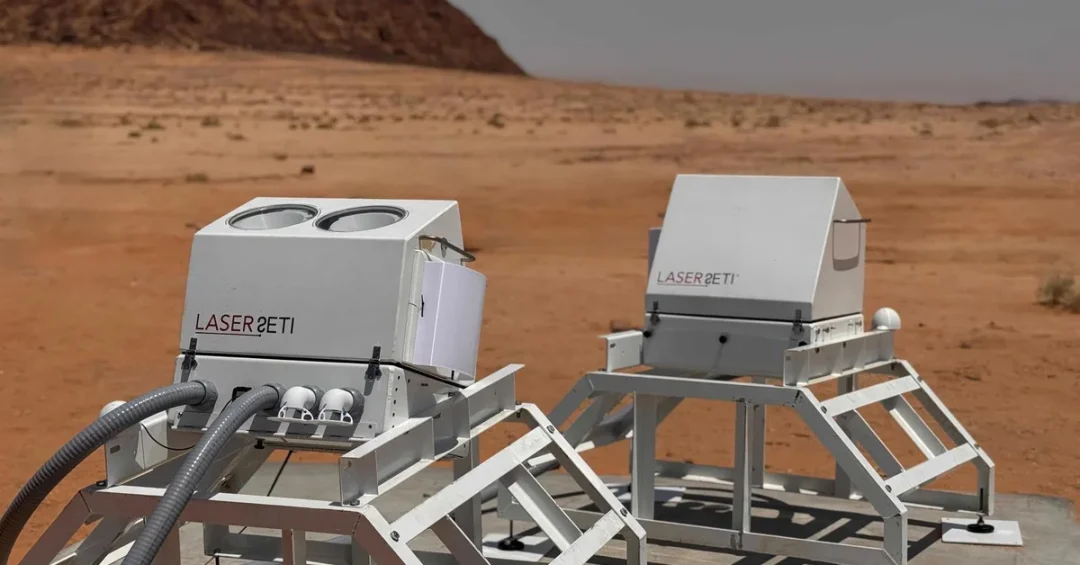
The Royal Commission for AlUla (RCU) has announced the successful installation and commissioning of two LaserSETI astronomical observation stations at AlUla Manara, making AlUla the first and only operational LaserSETI site in Asia and the fifth worldwide. The milestone, released through official Saudi channels, strengthens the Kingdom’s presence within international scientific observation networks and marks a significant step in RCU’s efforts to develop an integrated ecosystem for scientific research and astronomical discovery in northwest Saudi Arabia. Both stations completed their initial commissioning phase on August 19, 2026, and are now continuously collecting astronomical data that is contributed to the global LaserSETI network for analysis and comparison with observations from California, Hawaii, Arizona and Puerto Rico.
The announcement underscores how AlUla’s natural advantages — its exceptionally dark skies and low levels of light pollution — are being transformed into assets for global science. By joining the LaserSETI network, AlUla extends the project’s geographical coverage into a previously unrepresented region, creating new opportunities to collect and compare observational data across widely separated sites. The development also reflects the broader strategic direction of Saudi Vision 2030, which seeks to diversify the national economy, promote knowledge-based sectors, and position the Kingdom as a hub for research, innovation and international partnership. For international audiences, the news offers a clear example of how Saudi Arabia is investing in science and discovery while preserving its cultural and natural heritage.
Context and Background
How did a remote corner of northwest Saudi Arabia become the newest outpost in a global hunt for fleeting cosmic signals? The answer lies in a partnership that began on August 8, 2024, when the Royal Commission for AlUla and the SETI Institute announced a cooperation agreement that included support for the development of the AlUla Manara Observatory and the installation of LaserSETI observation equipment. That agreement represented a formal commitment to bring world-class astronomical research capacity to AlUla, building on the region’s reputation as a destination for heritage, culture and natural landscape. The commissioning of the two stations in 2026 demonstrates the partnership’s progression from agreement and planning to operational delivery.
LaserSETI is an international astronomical observation network that uses specialized stations to continuously monitor the night sky for transient optical phenomena. These are distinctive, rare flashes or changes in light that may be associated with cosmic events or unusual astronomical objects, as well as potential laser signals that require further scientific investigation and analysis. The technology generates observational data that can be compared across multiple locations, enabling researchers to study phenomena that may be difficult to observe from a single site. By operating around the clock and across multiple longitudes, the network effectively keeps a continuous watch on the sky, something no single observatory can achieve alone.
AlUla Manara, located north of AlUla, was selected because its location is characterized by dark skies and low levels of light pollution, providing favorable conditions for astronomical observation. The site’s geography also fills a critical gap in the LaserSETI map. Until now, the network’s operational stations were concentrated in California, Hawaii, Arizona and Puerto Rico. AlUla’s entry as the first and only site in Asia extends the network’s longitudinal reach, allowing researchers to track transient events across a much wider span of the globe and to cross-check signals that might otherwise be missed or misinterpreted.
Key Details of the Commissioning
What exactly has been installed, and what does it do? The two LaserSETI stations at AlUla Manara are now fully operational. According to the announcement, they successfully completed their initial commissioning phase on August 19, 2026, and are continuously collecting astronomical observation data. That data is contributed to the global LaserSETI network for analysis and comparison with observations from other sites. AlUla Manara is also working with the project team to customize data outputs and extract relevant observations to support scientific studies and future research into transient optical phenomena.
The commissioning phase is a critical step in any astronomical installation, ensuring that instruments are calibrated, aligned and performing to specification before routine science operations begin. The fact that both stations passed this phase and are now contributing data means that AlUla is no longer simply a partner in planning but an active node in a global scientific instrument. The data they collect will be combined with observations from the network’s other four operational observatories, creating a multi-site dataset that is far more powerful than any single station could produce.
The milestone builds directly on the cooperation agreement announced by RCU and the SETI Institute in August 2024. That agreement included support for the development of AlUla Manara Observatory and the installation of LaserSETI observation equipment. The successful commissioning of the two stations therefore represents the fulfillment of a key operational objective and highlights the contribution of international scientific partnerships to developing astronomical research and observation capabilities in AlUla. It also signals to the global research community that AlUla is a reliable and capable partner for long-term scientific collaboration.
International and Regional Impact
What does it mean for global astronomy when a new observatory comes online in a region that previously had no such presence? For the LaserSETI project, AlUla’s participation extends the network’s geographical coverage into a previously unrepresented region. Because transient optical phenomena are unpredictable and brief, having stations spread across different longitudes dramatically increases the chances of capturing them. A flash detected in California, for example, might occur when it is daylight in Asia; with a station in AlUla, researchers can follow up or independently confirm events across a wider time window. This kind of global coordination is essential for distinguishing genuine cosmic signals from local interference or instrument artifacts.
For Saudi Arabia, the development reinforces the Kingdom’s growing role in international science and diplomacy. It demonstrates that Saudi Arabia is not only a participant in global research networks but a contributor of unique natural and infrastructural assets. The partnership with the SETI Institute, a recognized leader in the search for extraterrestrial intelligence and transient astronomical phenomena, lends further credibility to AlUla’s scientific ambitions. Regionally, the project positions AlUla as a center for research and discovery, complementing its established reputation in heritage and tourism and offering a new dimension of engagement for visitors and scholars alike.
The collaboration also has a symbolic dimension. By joining a network whose name evokes the search for signals from beyond Earth, AlUla is linked to one of the most imaginative and scientifically rigorous endeavors of our time. At the same time, the project remains firmly grounded in real, measurable science: the systematic monitoring of the sky for rare optical events. This combination of ambition and rigor is characteristic of Saudi Arabia’s approach to Vision 2030, where bold goals are pursued through careful planning and international cooperation.
Economic and Strategic Significance
Why should a scientific installation matter to an economy? The commissioning of the LaserSETI stations contributes to the broader development of AlUla Manara as a center for research, discovery and knowledge-based experiences. It supports tourism diversification by adding a scientific and educational dimension to AlUla’s offerings, complementing heritage sites, cultural festivals and natural landscapes. Astrotourism — travel motivated by the desire to experience dark skies and astronomical phenomena — is a growing global market, and AlUla’s dark skies give it a natural advantage in this niche. The presence of active research infrastructure enhances the credibility and appeal of those offerings.
Strategically, the project reinforces RCU’s efforts to protect AlUla’s dark skies as one of its natural assets while leveraging them for scientific research and knowledge exchange. Dark skies are a finite resource; once lost to light pollution, they are difficult to restore. By treating them as a protected asset and integrating them into a research and tourism strategy, RCU is demonstrating a model of sustainable development that balances environmental conservation with economic opportunity. The integration of environmental conservation, science, technology and future opportunities for astrotourism aligns with the objectives of Saudi Vision 2030, which emphasizes quality of life, economic diversification and the creation of high-value sectors.
The next phase of the project will focus on analyzing the data collected by the system and developing further opportunities for scientific research and international partnerships. These efforts will also help demonstrate the suitability of AlUla’s dark skies for astronomical observation and strengthen AlUla Manara’s wider astronomy program. Over time, this could attract additional research institutions, generate scientific publications, and create educational and career pathways for Saudi students and researchers in astronomy, data science and related fields.
Vision 2030 Alignment
How does a pair of small astronomical stations connect to a national transformation plan? Saudi Vision 2030 is built on the idea that the Kingdom’s future prosperity depends on diversifying its economy, empowering its citizens and engaging constructively with the world. The LaserSETI commissioning at AlUla advances all three goals. It diversifies the economic base by supporting tourism and knowledge industries; it empowers citizens by creating opportunities for scientific training and employment; and it engages the world by embedding Saudi Arabia in a global research network. The project also reflects the Vision’s emphasis on preserving cultural and natural heritage, since the protection of AlUla’s dark skies is inseparable from the preservation of its unique environment.
The Royal Commission for AlUla has consistently positioned the region as a living laboratory where heritage, nature and innovation meet. The successful commissioning of the two LaserSETI stations is a concrete demonstration of that vision in action. It shows that AlUla can host cutting-edge science while remaining true to its identity, and that international partnerships can deliver tangible results. As the data begins to flow and the next phase of analysis and collaboration begins, AlUla’s role in global astronomy is set to grow, reinforcing Saudi Arabia’s place as a forward-looking nation committed to discovery, sustainability and global cooperation.
20 Questions
Q1. What did the Royal Commission for AlUla announce?
A1. The Royal Commission for AlUla announced the successful installation and commissioning of two LaserSETI astronomical observation stations at AlUla Manara, making AlUla the first and only operational LaserSETI site in Asia.
Q2. What is LaserSETI?
A2. LaserSETI is an international astronomical observation network that uses specialized stations to continuously monitor the night sky for transient optical phenomena, including rare flashes or changes in light and potential laser signals.
Q3. Where are the two new stations located?
A3. The two stations are located at AlUla Manara, north of AlUla in northwest Saudi Arabia, a site chosen for its dark skies and low levels of light pollution.
Q4. When did the stations complete their commissioning phase?
A4. Both stations successfully completed their initial commissioning phase on August 19, 2026, and are now fully operational and continuously collecting astronomical observation data.
Q5. How many operational LaserSETI sites are there worldwide?
A5. With the addition of AlUla, there are now five operational LaserSETI observatories worldwide, located in California, Hawaii, Arizona, Puerto Rico and AlUla.
Q6. Why is AlUla’s location significant for the LaserSETI network?
A6. AlUla is the first and only LaserSETI site in Asia, extending the network’s geographical coverage into a previously unrepresented region and enabling better global comparison of observational data.
Q7. What kind of phenomena does LaserSETI monitor?
A7. LaserSETI monitors transient optical phenomena, which are distinctive, rare flashes or changes in light that may be associated with cosmic events, unusual astronomical objects or potential laser signals.
Q8. How does AlUla Manara contribute to the global network?
A8. AlUla Manara continuously collects astronomical observation data and contributes it to the global LaserSETI network for analysis and comparison with observations from other sites around the world.
Q9. What agreement preceded this milestone?
A9. The milestone builds on a cooperation agreement announced by the Royal Commission for AlUla and the SETI Institute on August 8, 2024, which supported the development of AlUla Manara Observatory and LaserSETI installation.
Q10. What does the commissioning demonstrate about the partnership?
A10. It demonstrates the partnership’s progression from agreement and planning to operational delivery, highlighting the contribution of international scientific partnerships to developing astronomical research in AlUla.
Q11. How does the project support AlUla’s dark sky protection efforts?
A11. The project reinforces RCU’s efforts to protect AlUla’s dark skies as a natural asset while leveraging them for astronomical research, knowledge exchange and sustainable development.
Q12. What is the next phase of the project?
A12. The next phase will focus on analyzing the data collected by the system and developing further opportunities for scientific research and international partnerships to strengthen AlUla Manara’s astronomy program.
Q13. How does this project align with Saudi Vision 2030?
A13. It aligns with Vision 2030 by supporting economic diversification, knowledge-based sectors, tourism development, environmental conservation and international scientific cooperation.
Q14. What is astrotourism and how does AlUla benefit?
A14. Astrotourism is travel motivated by experiencing dark skies and astronomical phenomena. AlUla’s dark skies and new research infrastructure enhance its appeal as a destination for this growing global market.
Q15. Who is the SETI Institute?
A15. The SETI Institute is a recognized international research organization known for its work in the search for extraterrestrial intelligence and the study of transient astronomical phenomena.
Q16. What makes AlUla Manara suitable for astronomical observation?
A16. AlUla Manara is located north of AlUla in an area characterized by dark skies and low levels of light pollution, providing favorable conditions for astronomical observation.
Q17. How does the project contribute to tourism diversification?
A17. By adding a scientific and educational dimension to AlUla’s offerings, the project supports tourism diversification and complements heritage, cultural and natural attractions in the region.
Q18. What role does data comparison play in LaserSETI?
A18. Comparing data across multiple locations enables researchers to study phenomena that may be difficult to observe from a single site, improving the reliability and scientific value of observations.
Q19. What are transient optical phenomena?
A19. Transient optical phenomena are brief, rare flashes or changes in light in the night sky that may be linked to cosmic events, unusual astronomical objects or potential laser signals requiring further study.
Q20. What does this milestone mean for Saudi Arabia’s global scientific role?
A20. It strengthens Saudi Arabia’s presence within international scientific observation networks, showcasing the Kingdom’s commitment to research, innovation and global cooperation under Saudi Vision 2030.
Reader Feedback
We value your thoughts. Please share your feedback on this article.
Your feedback helps us improve our coverage.