


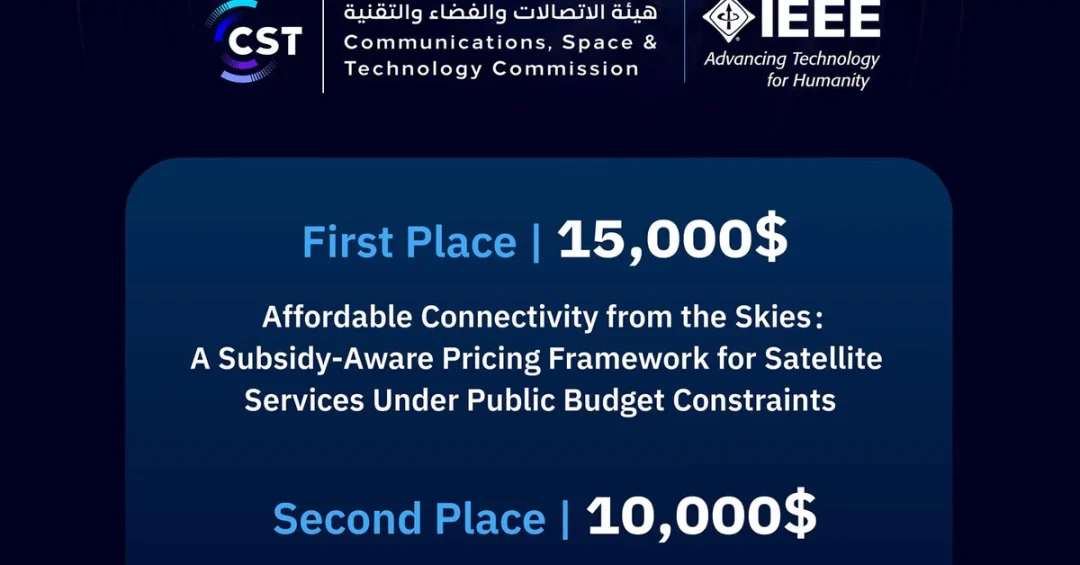
The Communications, Space and Technology Commission (CST) has announced the winners of the third edition of the Non-Terrestrial Networks Global Research Competition, launched in collaboration with the Institute of Electrical and Electronics Engineers (IEEE), during the Global Space Connectivity and Sustainability Events in Riyadh. The competition, formally titled Non-Terrestrial Networks 2026, is designed to support research and innovation in non-terrestrial networks and to attract researchers and academics who can develop pioneering ideas and solutions that advance next-generation connectivity technologies. Could this be the moment that reshapes how the world connects from the sky down to the ground?
The announcement reflects Saudi Arabia’s sustained commitment to building a knowledge-driven economy and positioning itself at the forefront of global space and communications research. By partnering with IEEE, one of the world’s largest technical professional organizations for the advancement of technology, the CST has created a platform that bridges academic excellence and practical industry application. The competition drew 81 research papers submitted by 280 researchers and academics, with more than 40 judges participating in the evaluation process. The winning entries addressed some of the most pressing challenges in modern connectivity, from affordable satellite pricing to the use of commercial aircraft as relay stations and the deployment of artificial intelligence in desert search and rescue missions.
Context and Background
What makes this competition so significant in the broader landscape of global telecommunications research? The Non-Terrestrial Networks Global Research Competition was established to accelerate innovation in a field that is rapidly transforming how information travels across the planet. Non-terrestrial networks encompass satellite systems, high-altitude platform stations (HAPS), and other airborne or space-based infrastructure that complement traditional ground-based networks. As demand for seamless, high-speed connectivity grows worldwide, the integration of terrestrial and non-terrestrial networks has become a strategic priority for governments and industry leaders alike.
The CST, which regulates and develops the communications, space, and technology sectors in the Kingdom of Saudi Arabia, has consistently championed research and development as a cornerstone of national progress. Its collaboration with IEEE signals a deliberate effort to engage the global research community and to ensure that Saudi Arabia remains a hub for cutting-edge innovation. Over its three editions, the competition has drawn more than 160 research papers from more than 440 researchers, with over 60 judges from more than 110 universities and research centers taking part. This cumulative participation underscores the competition’s growing reputation as a premier venue for scholarly exchange in the field of non-terrestrial connectivity.
The timing of this year’s competition is particularly noteworthy. The Global Space Connectivity and Sustainability Events provided a fitting backdrop for the announcement, bringing together policymakers, industry executives, and academics to discuss the future of space-based communications. As nations race to deploy satellite constellations and advanced aerial platforms, the research presented at this competition offers practical pathways to overcome technical and economic barriers. Isn’t it remarkable how a single competition can catalyze collaboration across continents and disciplines?
Key Details of the Winning Research
The first-place paper, titled “Affordable Connectivity from the Skies: A Subsidy-Aware Pricing Framework for Satellite Services Under Public Budget Constraints,” presents a new framework for pricing satellite services in a way that supports government consumption and helps deliver inclusive services for everyone. This research directly addresses one of the most persistent challenges in expanding connectivity: how to make satellite-based internet and communication services affordable without placing unsustainable burdens on public finances. By introducing a subsidy-aware pricing model, the authors offer a practical tool for governments seeking to bridge the digital divide while maintaining fiscal responsibility.
The second-place paper, “Commercial Aircraft as Sustainable Relays for Satellite Direct-to-Device Access,” offers an innovative idea for investing in commercial aircraft that operate around the clock, turning them into transmission and reception stations that help improve satellite coverage. This concept leverages existing aviation infrastructure to enhance connectivity, particularly in areas where ground-based networks are difficult or costly to deploy. The paper’s focus on sustainability aligns with global efforts to maximize the utility of existing assets while reducing the need for new physical infrastructure.
The third-place paper, “AI-Enabled Multi-Layer NTN for Rapid Target Acquisition in Desert Search and Rescue,” presents an innovative idea for running AI algorithms on board high-altitude platform stations (HAPS) and using them to speed up search and rescue operations in remote areas. This research has profound implications for emergency response, particularly in vast desert regions where locating individuals in distress can be exceptionally challenging. By combining artificial intelligence with high-altitude platforms, the authors demonstrate how advanced technology can be harnessed to save lives and improve public safety. Could these three papers collectively redefine the boundaries of what is possible in non-terrestrial communications?
International and Regional Impact
The implications of this competition extend well beyond the Kingdom’s borders. By attracting researchers and academics from around the world, the CST and IEEE have created a truly international platform for knowledge exchange. The participation of judges from more than 110 universities and research centers highlights the global reach of the initiative and its role in fostering cross-border collaboration. For regions grappling with similar connectivity challenges, the research presented here offers adaptable models that can be tailored to local contexts.
In the Middle East and North Africa, where vast distances and challenging terrain often complicate infrastructure development, non-terrestrial networks hold particular promise. The winning papers address precisely these conditions, from pricing frameworks that make satellite services accessible to underserved populations to AI-driven search and rescue systems designed for desert environments. Saudi Arabia’s leadership in this domain positions the Kingdom as a source of practical solutions for its neighbors and partners. How many lives could be improved if these technologies are deployed at scale across the region and beyond?
The competition also reinforces Saudi Arabia’s role as a convening power in global technology governance. By hosting the Global Space Connectivity and Sustainability Events and partnering with IEEE, the CST demonstrates that the Kingdom is not merely a participant in the global innovation ecosystem but an active shaper of its agenda. This aligns with the broader diplomatic and economic objectives of Vision 2030, which seeks to diversify the economy and elevate Saudi Arabia’s standing on the world stage.
Economic and Strategic Significance
From an economic perspective, the research supported by this competition has the potential to unlock new markets and business models. The first-place paper’s subsidy-aware pricing framework, for instance, could enable governments to expand satellite service coverage without exceeding budgetary limits, thereby stimulating demand and encouraging private-sector investment. Similarly, the second-place paper’s concept of using commercial aircraft as relays could create new revenue streams for airlines and open avenues for partnerships between the aviation and telecommunications sectors.
Strategically, the development of non-terrestrial networks is closely tied to national security, disaster response, and digital sovereignty. Reliable connectivity is essential for coordinating emergency services, managing borders, and ensuring that citizens have access to critical information. The third-place paper’s focus on AI-enabled search and rescue in remote areas speaks directly to these priorities, offering a technological edge in scenarios where every minute counts. By investing in foundational research today, Saudi Arabia is building the capabilities that will underpin its security and prosperity for decades to come.
The competition also serves as a talent magnet, attracting researchers and academics who might otherwise pursue opportunities elsewhere. By recognizing and rewarding excellence, the CST and IEEE encourage scholars to engage with real-world problems and to contribute to solutions that have tangible benefits. This, in turn, strengthens the Kingdom’s research ecosystem and enhances its attractiveness as a destination for innovation and investment. Isn’t it clear that the economic returns of such initiatives far exceed their initial costs?
Vision 2030 Alignment
The Non-Terrestrial Networks Global Research Competition is a direct expression of the goals set out in Saudi Vision 2030, the comprehensive national transformation plan launched under the leadership of Crown Prince Mohammed bin Salman. Vision 2030 emphasizes the importance of diversifying the economy, fostering innovation, and developing human capital. By supporting cutting-edge research in communications and space technology, the CST is contributing to each of these objectives, while also advancing the Kingdom’s ambition to become a global leader in next-generation connectivity.
Moreover, the competition aligns with Vision 2030’s focus on sustainability and quality of life. The research on commercial aircraft as sustainable relays and AI-enabled search and rescue demonstrates how technological innovation can address environmental and social challenges simultaneously. As Saudi Arabia continues to invest in mega-projects such as NEOM and expands its space program, the insights generated by this competition will inform the design and deployment of the networks that will connect these ambitious ventures. The future of connectivity is being written today, and Saudi Arabia is holding the pen.
20 Questions
Q1. What is the Non-Terrestrial Networks Global Research Competition?
A1. It is a global research competition launched by the Communications, Space and Technology Commission (CST) in collaboration with the Institute of Electrical and Electronics Engineers (IEEE) to support innovation in non-terrestrial networks and next-generation connectivity technologies.
Q2. When and where was the third edition of the competition announced?
A2. The winners were announced during the Global Space Connectivity and Sustainability Events in Riyadh, as reported by the Saudi Press Agency on October 12, 2026.
Q3. How many research papers were submitted in the third edition?
A3. The competition drew 81 research papers submitted by 280 researchers and academics, with more than 40 judges participating in the evaluation process.
Q4. Which paper won first place?
A4. The paper titled “Affordable Connectivity from the Skies: A Subsidy-Aware Pricing Framework for Satellite Services Under Public Budget Constraints” won first place.
Q5. What does the first-place paper propose?
A5. It presents a new framework for pricing satellite services that supports government consumption and helps deliver inclusive services for everyone, addressing affordability under public budget constraints.
Q6. Which paper took second place?
A6. The paper “Commercial Aircraft as Sustainable Relays for Satellite Direct-to-Device Access” took second place.
Q7. What is the core idea of the second-place paper?
A7. It proposes investing in commercial aircraft that operate around the clock, turning them into transmission and reception stations to improve satellite coverage sustainably.
Q8. Which paper came in third place?
A8. The paper “AI-Enabled Multi-Layer NTN for Rapid Target Acquisition in Desert Search and Rescue” came in third place.
Q9. What does the third-place paper focus on?
A9. It presents an innovative idea for running AI algorithms on board high-altitude platform stations (HAPS) to speed up search and rescue operations in remote desert areas.
Q10. What is the CST?
A10. The Communications, Space and Technology Commission is the Saudi government body responsible for regulating and developing the communications, space, and technology sectors in the Kingdom of Saudi Arabia.
Q11. What is IEEE?
A11. The Institute of Electrical and Electronics Engineers is one of the world’s largest technical professional organizations dedicated to advancing technology for the benefit of humanity.
Q12. How many papers and researchers have participated across all three editions?
A12. More than 160 research papers have been submitted by more than 440 researchers, with over 60 judges from more than 110 universities and research centers taking part.
Q13. Why is this competition important for Saudi Arabia?
A13. It supports research and innovation, attracts global talent, and reinforces Saudi Arabia’s position as a leader in next-generation connectivity technologies aligned with Vision 2030.
Q14. What are non-terrestrial networks?
A14. Non-terrestrial networks include satellite systems, high-altitude platform stations, and other airborne or space-based infrastructure that complement traditional ground-based telecommunications networks.
Q15. How does the competition support Vision 2030?
A15. It advances economic diversification, fosters innovation, develops human capital, and enhances Saudi Arabia’s global standing in technology and space research, all core objectives of Vision 2030.
Q16. What was the role of the Global Space Connectivity and Sustainability Events?
A16. The events provided a platform for announcing the winners and brought together policymakers, industry leaders, and academics to discuss the future of space-based communications.
Q17. How does the first-place research benefit governments?
A17. It offers a pricing framework that helps governments expand satellite services affordably, ensuring inclusive connectivity without straining public budgets.
Q18. What makes the second-place research sustainable?
A18. It leverages existing commercial aircraft that already operate continuously, turning them into relays and reducing the need for new physical infrastructure.
Q19. How can AI improve search and rescue in deserts?
A19. AI algorithms on high-altitude platform stations can rapidly analyze data and identify targets, significantly speeding up response times in remote desert environments.
Q20. What does the future hold for non-terrestrial networks in Saudi Arabia?
A20. With continued investment and initiatives like this competition, Saudi Arabia is poised to lead in integrating terrestrial and non-terrestrial networks, driving innovation and connectivity globally.
Reader Feedback
We value your thoughts. Please share your feedback on this article.
Your feedback helps us improve our coverage.
Related articles
 Saudi Arabia Launches Global Space Connectivity Events
 Saudi Minister Launches ‘Fitri’ National Wildlife Platform
 Aseer Sorghum Harvest Boosts Food Security and Rural Development
 SASO to Host 10th Standards Forum on AI and Trust
 41 University of Hail Researchers Named to Stanford List
 Al-Baha Region Experiences Rainfall, Valleys Flow