


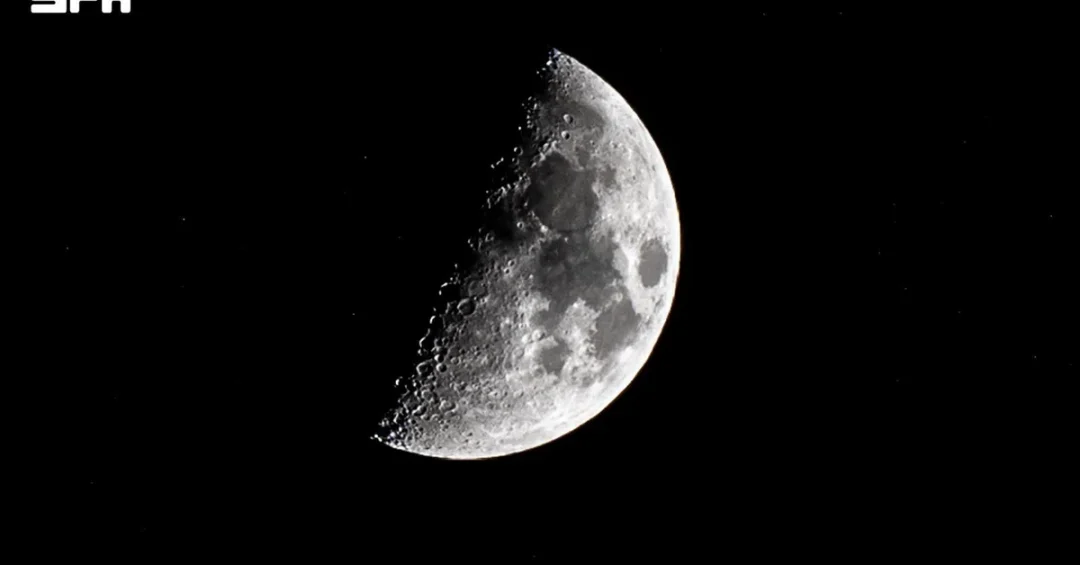
The first-quarter Moon of Jumada Al-Ula 1448 AH illuminated the evening sky over Saudi Arabia’s Northern Borders Region on Sunday, October 19, 2026, offering astronomy enthusiasts across the Kingdom a striking opportunity to observe and photograph the lunar surface, according to the Saudi Press Agency. The celestial event, confirmed by astronomy and space club member Adnan Khalifa, saw the Moon reach its first-quarter phase at 7:13 p.m. Saudi time, with sunlight illuminating exactly half of its visible disk. The display drew attention from observers in Arar and surrounding areas, who gathered to view the Moon’s craters, highlands, and mountain ranges through binoculars and telescopes. The event underscores growing public interest in astronomy across Saudi Arabia, a field increasingly supported by the Kingdom’s educational and scientific institutions as part of its broader modernization drive.
The first-quarter phase represents a precise moment in the lunar cycle, occurring when the Moon has completed approximately one quarter of its orbit around Earth since the new Moon. At this point, the Moon sits roughly 90 degrees from the Sun in the sky as viewed from Earth, causing half of its Earth-facing side to appear illuminated while the other half remains in darkness. For observers in the Northern Borders Region, the timing was ideal: the Moon appeared high in the sky after sunset and remained visible through the early hours of the night before setting around midnight. Such predictable celestial mechanics have guided human calendars for millennia, and in Saudi Arabia, they continue to inform both religious observance and scientific curiosity. Why does a phenomenon so routine still capture the imagination of so many? The answer lies partly in the sheer visual drama of the lunar surface when sunlight strikes it at an oblique angle.
Context and Background
How does the first-quarter Moon differ from other phases that observers might witness throughout the month? The lunar cycle unfolds in a sequence of eight recognizable phases, beginning with the new Moon and progressing through waxing crescent, first quarter, waxing gibbous, full Moon, waning gibbous, last quarter, and waning crescent before returning to new. Each phase offers a distinct viewing experience, but the first quarter holds particular appeal for astronomers and casual stargazers alike. According to Adnan Khalifa, a member of an astronomy and space club, this phase is among the best times to observe the Moon’s surface through binoculars and telescopes. The reason is straightforward: sunlight falling at an oblique angle near the boundary between the illuminated and dark portions creates striking contrasts of light and shadow. These contrasts bring lunar craters, highlands, and mountain ranges into sharper view than during a full Moon, when direct overhead illumination tends to flatten the surface’s appearance.
The Northern Borders Region, where the observation took place, has become an increasingly active area for skywatching in Saudi Arabia. Its relatively low light pollution and expansive desert horizons make it well suited for astronomical observation. The region’s residents and visitors have participated in various stargazing activities in recent years, reflecting a broader cultural shift toward appreciating natural phenomena and scientific inquiry. Saudi Arabia’s geography, spanning vast desert landscapes and mountainous terrain, offers numerous locations where the night sky remains largely unobstructed by urban glow. This natural advantage has not gone unnoticed by educators and science communicators, who see astronomy as an accessible entry point for young Saudis to engage with science, technology, engineering, and mathematics. The first-quarter Moon of Jumada Al-Ula thus served not only as a visual spectacle but also as a reminder of the Kingdom’s potential as a destination for astronomical tourism and research.
Historically, the observation of lunar phases has held profound significance in the Islamic world, serving as the basis for the Hijri calendar that governs religious events such as Ramadan and Hajj. The month of Jumada Al-Ula, the fifth month of the Islamic lunar calendar, began with the sighting of the new crescent, and the first-quarter Moon marks roughly one week into the month. This rhythm of lunar observation connects contemporary astronomy with centuries of Islamic scientific tradition, during which scholars made significant contributions to the study of celestial mechanics. Saudi Arabia, as the custodian of Islam’s holiest sites, maintains a deep institutional interest in accurate lunar observation, supporting both religious authorities and scientific bodies in their work. The first-quarter phase observed on October 19 thus represents a small but meaningful link in a chain of observation that stretches back through history.
Key Details of the Lunar Observation
What exactly did observers see when they looked up at the first-quarter Moon over the Northern Borders? According to the Saudi Press Agency report, the Moon reached its first-quarter phase precisely at 7:13 p.m. Saudi time. At that moment, half of the Moon’s Earth-facing side appeared illuminated, while the other half remained dark. This stark division is a consequence of the Moon’s position relative to the Sun and Earth. Because the Moon orbits Earth approximately every 29.5 days, its appearance changes gradually each night. The first-quarter phase occurs when the angle between the Sun, Earth, and Moon forms roughly a right angle, with Earth at the vertex. From the perspective of an observer on Earth, this geometry produces the appearance of a half-lit disk, often referred to as a half Moon, though astronomers prefer the term first quarter to describe its position in the cycle.
Adnan Khalifa explained that the visible portion of the Moon will gradually grow over the coming days until it reaches its full phase. This progression, known as waxing, occurs as the Moon continues along its orbital path and the Sun’s illumination increasingly covers the Earth-facing side. For photographers and amateur astronomers, the days following the first quarter offer excellent opportunities to capture the Moon’s changing appearance. Each night, the terminator, the line dividing light from shadow, moves across the lunar surface, revealing different craters and features in sharp relief. Khalifa noted that observing the Moon’s changing phases offers an opportunity to deepen public understanding of astronomy, encouraging enthusiasts to photograph celestial objects and learn more about the phenomena associated with the Moon’s orbit around Earth. Such educational value is particularly relevant in an era when light pollution and digital screens often distract from the natural night sky.
The Moon’s high position in the sky after sunset during the first-quarter phase also made it convenient for families and casual observers to participate. Unlike phases that occur in the early morning hours, the first quarter is visible during prime evening time, making it accessible to a wide audience. In Arar and other parts of the Northern Borders Region, the clear desert air likely enhanced visibility, allowing observers to discern fine details on the lunar surface. The event was reported by the Saudi Press Agency, the Kingdom’s official news outlet, which regularly covers scientific and cultural developments across the country. The coverage reflects a broader editorial interest in showcasing Saudi Arabia’s engagement with science and education, themes that align closely with the national Vision 2030 reform agenda.
International and Regional Impact
How does a local astronomical observation in Saudi Arabia resonate beyond the Kingdom’s borders? Astronomy is inherently international, with celestial events visible across vast geographic regions and shared among cultures worldwide. The first-quarter Moon of Jumada Al-Ula was not exclusive to Saudi Arabia; observers in neighboring Gulf countries, the wider Middle East, and beyond witnessed the same phase on the same evening. This shared experience highlights the universal nature of scientific observation and the potential for cross-border collaboration in astronomy and space science. Saudi Arabia has increasingly positioned itself as a regional leader in space and technology, establishing the Saudi Space Agency and launching initiatives aimed at fostering innovation and research. Events like the first-quarter Moon observation, while modest in scale, contribute to a broader narrative of scientific engagement and public education.
Regionally, the observation underscores the importance of dark-sky preservation and astronomical tourism. Countries across the Middle East, including the United Arab Emirates and Jordan, have invested in observatories and stargazing destinations that attract visitors interested in astronomy. Saudi Arabia’s vast deserts and mountainous regions offer similar potential, particularly in areas like the Northern Borders, which remain relatively free from light pollution. By promoting astronomy-related activities, the Kingdom can diversify its tourism offerings and attract visitors seeking unique natural experiences. The Saudi Press Agency’s coverage of the first-quarter Moon event may also serve to inspire other communities to organize their own skywatching gatherings, fostering a culture of scientific curiosity that extends beyond national boundaries. In a world increasingly focused on technological innovation, such grassroots engagement with science remains essential.
Economic and Strategic Significance
What economic and strategic value can be derived from public engagement with astronomy? At first glance, observing the Moon may seem disconnected from economic priorities. However, the broader context reveals meaningful linkages. Astronomy and space science are pillars of the modern knowledge economy, driving innovation in fields ranging from satellite communications to remote sensing and navigation. Saudi Arabia’s investment in space technology, including its participation in satellite launches and space research, reflects a strategic recognition that scientific capability contributes to national security, economic diversification, and international standing. Public events like the first-quarter Moon observation help cultivate a scientifically literate population, which in turn supports the development of a skilled workforce capable of contributing to these high-tech sectors. The enthusiasm of amateur astronomers and photographers represents a grassroots dimension of this strategic shift.
Moreover, astronomical tourism has emerged as a niche but growing segment of the global travel industry. Destinations that offer pristine night skies and organized stargazing experiences attract visitors willing to travel for unique celestial views. Saudi Arabia’s Northern Borders Region, with its clear skies and expansive landscapes, could potentially develop this niche as part of the Kingdom’s broader tourism strategy. The Saudi Tourism Authority has been actively promoting diverse destinations beyond the traditional pilgrimage sites, aiming to showcase the country’s natural and cultural heritage. Astronomy-themed events, such as guided Moon observations or meteor shower viewings, could complement existing offerings and extend the tourism season into cooler months. While such developments remain in early stages, the first-quarter Moon observation illustrates the kind of activity that could be expanded with appropriate infrastructure and promotion. The economic ripple effects, though modest, align with Vision 2030’s goal of creating a diversified and sustainable economy.
Vision 2030 Alignment
How does a simple lunar observation connect to Saudi Arabia’s ambitious Vision 2030 reform program? Vision 2030, launched in 2016 under the leadership of Crown Prince Mohammed bin Salman, seeks to transform the Kingdom’s economy and society through diversification, education, and innovation. Among its key objectives is the development of a vibrant knowledge economy, supported by investments in science, technology, and research. The observation of the first-quarter Moon, while a modest event, embodies several of these objectives. It reflects a society increasingly engaged with scientific inquiry, supported by institutions like astronomy clubs and educational initiatives. It also highlights the Kingdom’s natural advantages, such as its clear skies and vast landscapes, which can be leveraged for tourism and scientific research. By fostering public interest in astronomy, Saudi Arabia nurtures a culture of curiosity and learning that is essential for long-term progress.
Furthermore, the event demonstrates the role of official media in promoting scientific awareness. The Saudi Press Agency’s coverage of the first-quarter Moon observation brings astronomy into the public conversation, encouraging readers to look up and learn. Such reporting complements broader educational efforts, including the establishment of science centers, planetariums, and university programs in astronomy and space science. As Saudi Arabia continues its journey toward Vision 2030, moments like the first-quarter Moon over the Northern Borders serve as reminders that progress is not only measured in megaprojects and economic indicators but also in the everyday curiosity of citizens and residents. The Kingdom’s future as a knowledge-based society depends on cultivating wonder and inquiry at all levels, from the classroom to the desert night sky. In this light, the first-quarter Moon was more than a celestial event; it was a quiet affirmation of Saudi Arabia’s forward-looking vision.
20 Questions
Q1. What was the first-quarter Moon of Jumada Al-Ula?
A1. The first-quarter Moon of Jumada Al-Ula 1448 AH was a lunar phase observed over Saudi Arabia’s Northern Borders Region on Sunday, October 19, 2026, during which half of the Moon’s visible disk was illuminated by sunlight.
Q2. When did the Moon reach its first-quarter phase?
A2. According to astronomy and space club member Adnan Khalifa, the Moon reached its first-quarter phase at 7:13 p.m. Saudi time on Sunday, October 19, 2026.
Q3. Where was the observation made?
A3. The observation was made over the Northern Borders Region of Saudi Arabia, an area known for its relatively clear skies and expansive desert horizons suitable for astronomy.
Q4. What causes the first-quarter phase?
A4. The first-quarter phase occurs when the Moon has completed about a quarter of its orbit around Earth since the new Moon, placing it approximately 90 degrees from the Sun as viewed from Earth.
Q5. Why is the first-quarter phase good for observing the Moon?
A5. Sunlight falling at an oblique angle near the boundary between the illuminated and dark portions creates striking contrasts of light and shadow, bringing lunar craters, highlands, and mountain ranges into sharper view.
Q6. What equipment can be used to observe the first-quarter Moon?
A6. According to Adnan Khalifa, the first-quarter phase is among the best times to observe the Moon’s surface through binoculars and telescopes, though it is also visible to the naked eye.
Q7. How long was the Moon visible during this phase?
A7. The Moon appeared high in the sky after sunset and remained in view through the early hours of the night before setting around midnight, according to Khalifa.
Q8. What will happen to the Moon’s appearance in the coming days?
A8. The visible portion of the Moon will gradually grow over the coming days until it reaches its full phase, a process known as waxing.
Q9. Who provided the information about the lunar observation?
A9. The information was provided by astronomy and space club member Adnan Khalifa and reported by the Saudi Press Agency, the Kingdom’s official news outlet.
Q10. What is the significance of the Hijri month Jumada Al-Ula?
A10. Jumada Al-Ula is the fifth month of the Islamic lunar calendar, and the first-quarter Moon marks roughly one week into the month, connecting contemporary astronomy with Islamic scientific tradition.
Q11. How does this event relate to astronomy education in Saudi Arabia?
A11. Khalifa noted that observing the Moon’s changing phases deepens public understanding of astronomy, encouraging enthusiasts to photograph celestial objects and learn about the Moon’s orbit around Earth.
Q12. Why is the Northern Borders Region suitable for skywatching?
A12. The region has relatively low light pollution and expansive desert horizons, making it well suited for astronomical observation and photography of celestial objects.
Q13. What broader scientific trends does this observation reflect?
A13. It reflects growing public interest in astronomy across Saudi Arabia, supported by educational institutions and aligning with the Kingdom’s broader modernization and science education efforts.
Q14. How does astronomy connect to Saudi Arabia’s Vision 2030?
A14. Vision 2030 seeks to develop a knowledge economy, and public engagement with astronomy supports scientific literacy, innovation, and educational goals central to the reform program.
Q15. Can astronomy contribute to tourism in Saudi Arabia?
A15. Yes, astronomical tourism is a growing niche, and Saudi Arabia’s clear skies and vast landscapes, particularly in regions like the Northern Borders, offer potential for stargazing destinations.
Q16. What is the lunar cycle’s length?
A16. The lunar cycle, from new Moon to new Moon, lasts approximately 29.5 days, during which the Moon passes through eight recognized phases.
Q17. What are the eight phases of the Moon?
A17. The eight phases are new Moon, waxing crescent, first quarter, waxing gibbous, full Moon, waning gibbous, last quarter, and waning crescent.
Q18. How does the first-quarter Moon differ from a full Moon for observers?
A18. During the first quarter, oblique sunlight creates sharp shadows that reveal surface details, while during a full Moon, direct overhead illumination tends to flatten the surface’s appearance.
Q19. What role does the Saudi Press Agency play in reporting such events?
A19. The Saudi Press Agency is the Kingdom’s official news outlet, regularly covering scientific, cultural, and governmental developments and bringing events like the first-quarter Moon observation to public attention.
Q20. What does this event say about Saudi Arabia’s scientific future?
A20. It demonstrates grassroots engagement with science and aligns with national efforts to build a knowledge-based society, suggesting a promising future for scientific inquiry and education in the Kingdom.
Reader Feedback
We value your thoughts. Please share your feedback on this article.
Your feedback helps us improve our coverage.