


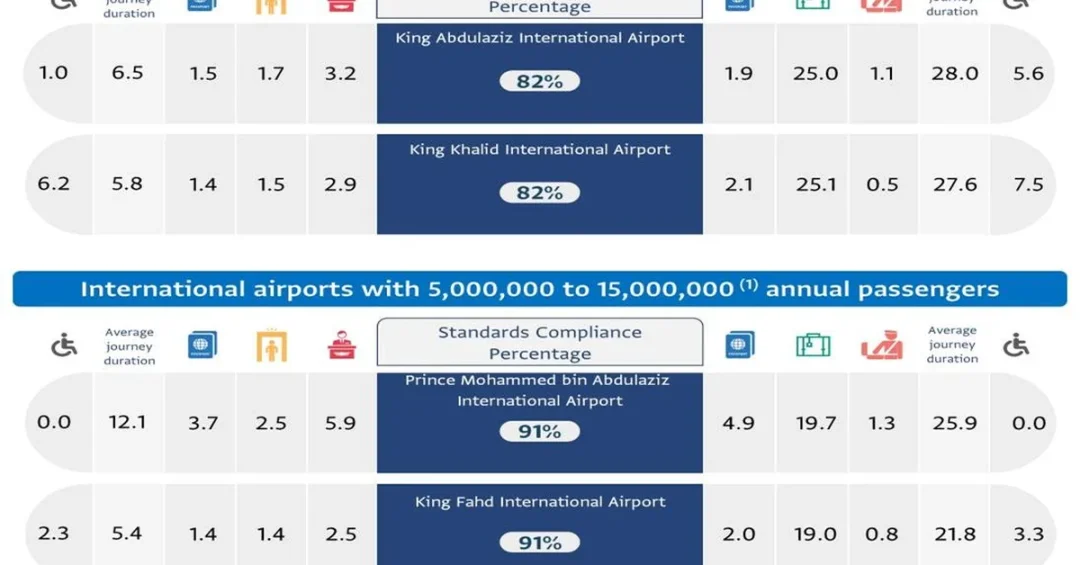
The General Authority of Civil Aviation (GACA) has released its July performance report for Saudi Arabia’s domestic and international airports, highlighting top-performing facilities and reinforcing the Kingdom’s commitment to world-class aviation services. The report evaluates airports based on 11 operational performance standards designed to enhance traveler experience and align with Saudi Arabia’s strategic objectives. Several airports achieved exceptional compliance rates, underscoring the Kingdom’s progress in modernizing its aviation infrastructure.
Context and Background
The General Authority of Civil Aviation (GACA), the regulatory body overseeing Saudi Arabia’s civil aviation sector, publishes monthly performance reports as part of its mandate to ensure transparency and continuous improvement. These evaluations are based on 11 key performance indicators (KPIs) that cover critical aspects of passenger experience, including waiting times at check-in counters, baggage carousel efficiency, passport control, customs areas, and services for passengers with disabilities. The standards are aligned with international best practices, reflecting Saudi Arabia’s ambition to position itself as a global aviation hub.
GACA categorizes airports into five groups based on annual passenger numbers to ensure fair and transparent comparisons. This categorization allows for targeted improvements and healthy competition among airports, driving enhancements that benefit travelers and support the Kingdom’s Vision 2030 goals of economic diversification and tourism growth.
Key Details
In the category of airports handling more than 15 million passengers annually, King Abdulaziz International Airport in Jeddah secured the top spot with an 82% compliance rate. It was closely followed by King Khalid International Airport in Riyadh, also at 82%, but King Abdulaziz outperformed in meeting the standards. This recognition highlights Jeddah’s role as a gateway for millions of pilgrims and tourists.
For international airports serving 5 to 15 million passengers annually, Prince Mohammed bin Abdulaziz International Airport in Madinah ranked first with a 91% compliance rate, tied with King Fahd International Airport in Dammam, which also achieved 91%. However, Madinah’s airport outperformed in meeting the standards, reflecting its importance as a key entry point for religious tourism.
In the 2 to 5 million passenger category, Abha International Airport ranked first with a 100% compliance rate, alongside King Abdullah bin Abdulaziz Airport in Jizan, which also achieved 100%. Abha outperformed Jizan in meeting the standards, showcasing the high service levels at these regional airports.
Among airports with fewer than 2 million passengers annually, Qaisumah International Airport ranked first with a 100% compliance rate, surpassing competitors in average waiting times for departing and arriving flights. Similarly, Qurayyat Airport topped the domestic airports category with a 100% compliance rate, excelling in average waiting times.
Implications and Impact
The July report underscores GACA’s commitment to enhancing the traveler experience across all Saudi airports. The high compliance rates, particularly among regional airports, indicate that improvements are being felt nationwide, not just at major hubs. This is crucial as Saudi Arabia aims to attract 100 million visitors annually by 2030, a key target of Vision 2030.
Efficient airports are vital for supporting the Kingdom’s growing tourism and business travel sectors. The focus on reducing waiting times and improving services for passengers with disabilities demonstrates a holistic approach to customer satisfaction, which is essential for competing with other global aviation hubs. Furthermore, these enhancements contribute to Saudi Arabia’s reputation as a welcoming and modern destination.
The report also highlights the role of GACA in driving performance through regular assessments and public reporting. By fostering transparency and accountability, GACA encourages airports to continuously innovate and upgrade their facilities and services. This aligns with the National Aviation Strategy, which aims to expand connectivity, increase capacity, and improve the overall aviation ecosystem.
Vision 2030 Alignment
The performance improvements detailed in GACA’s July report are directly aligned with Saudi Arabia’s Vision 2030, which seeks to diversify the economy and enhance the quality of life for citizens and visitors. By ensuring that airports operate at the highest international standards, the Kingdom is paving the way for increased tourism, business investment, and cultural exchange. These efforts are integral to achieving the ambitious goals of Vision 2030 and solidifying Saudi Arabia’s position as a global leader in aviation and hospitality.
20 Questions
Q1. What is the General Authority of Civil Aviation (GACA)?
A1. GACA is the regulatory body responsible for overseeing civil aviation in Saudi Arabia. It ensures safety, efficiency, and compliance with international standards, and publishes performance reports to promote transparency and continuous improvement across the Kingdom’s airports.
Q2. What does the July performance report evaluate?
A2. The report evaluates airports based on 11 operational performance standards that align with strategic objectives to enhance services and ensure a seamless traveler experience. These standards cover areas such as waiting times, baggage handling, and services for passengers with disabilities.
Q3. How are airports categorized in the report?
A3. GACA categorizes airports into five groups based on annual passenger numbers: more than 15 million, 5 to 15 million, 2 to 5 million, less than 2 million, and domestic airports. This ensures fair and transparent comparisons among similar-sized facilities.
Q4. Which airport ranked first in the category of more than 15 million passengers?
A4. King Abdulaziz International Airport in Jeddah secured the top spot with an 82% compliance rate. It outperformed King Khalid International Airport in Riyadh, which also achieved 82%, in terms of meeting the standards.
Q5. Which airport topped the 5 to 15 million passenger category?
A5. Prince Mohammed bin Abdulaziz International Airport in Madinah ranked first with a 91% compliance rate. It outperformed King Fahd International Airport in Dammam, which also achieved 91%, in meeting the standards.
Q6. Which airports achieved 100% compliance in the 2 to 5 million passenger category?
A6. Abha International Airport and King Abdullah bin Abdulaziz Airport in Jizan both achieved 100% compliance. Abha International Airport outperformed Jizan in terms of meeting the standards, according to the report.
Q7. Which airport ranked first in the less than 2 million passenger category?
A7. Qaisumah International Airport ranked first with a 100% compliance rate. It surpassed competitors in average waiting times for departing and arriving flights.
Q8. Which airport topped the domestic airports category?
A8. Qurayyat Airport secured the top spot with a 100% compliance rate. It outperformed all other airports in terms of average waiting times for departing and arriving flights.
Q9. What are some of the 11 key performance indicators used by GACA?
A9. The indicators include passenger waiting times at check-in counters, time spent at baggage carousels, passport control, customs areas, standards for people with disabilities, and other measures based on international best practices.
Q10. Why does GACA publish these performance reports?
A10. GACA publishes the reports to ensure transparency, encourage continuous improvement, and drive healthy competition among airports. This helps enhance the overall traveler experience and supports Saudi Arabia’s aviation strategy.
Q11. How do these performance standards benefit travelers?
A11. The standards aim to reduce waiting times, improve service quality, and ensure that all passengers, including those with disabilities, have a smooth and pleasant experience. This makes travel more efficient and enjoyable.
Q12. What is the significance of King Abdulaziz International Airport’s top ranking?
A12. King Abdulaziz International Airport in Jeddah is a major gateway for pilgrims and tourists. Its top ranking reflects its importance and the efforts to maintain high service standards despite handling over 15 million passengers annually.
Q13. How does the report reflect Saudi Arabia’s Vision 2030?
A13. The report aligns with Vision 2030 by promoting excellence in aviation, which is crucial for economic diversification, tourism growth, and enhancing the Kingdom’s global connectivity. It supports the goal of attracting 100 million visitors annually by 2030.
Q14. What is the National Aviation Strategy?
A14. The National Aviation Strategy is a comprehensive plan to expand connectivity, increase capacity, and improve the aviation ecosystem in Saudi Arabia. It aims to position the Kingdom as a leading aviation hub and support Vision 2030 objectives.
Q15. How does GACA ensure fair evaluation across different airport sizes?
A15. GACA categorizes airports into five groups based on annual passenger numbers, ensuring that airports of similar size and traffic are compared. This approach provides a fair and transparent assessment of performance.
Q16. What role do regional airports play in Saudi Arabia’s aviation network?
A16. Regional airports like Abha, Qaisumah, and Qurayyat are essential for connecting smaller cities to the rest of the Kingdom and beyond. Their high compliance rates show a commitment to providing quality services nationwide.
Q17. How often does GACA release these performance reports?
A17. GACA releases performance reports on a monthly basis. These reports provide regular updates on airport performance and help track progress over time.
Q18. What impact do these reports have on airport operations?
A18. The reports encourage airports to improve their services by highlighting areas of strength and identifying opportunities for enhancement. They also hold airports accountable to the public and drive innovation.
Q19. How do these standards compare to international best practices?
A19. GACA’s 11 key performance indicators are based on international best practices, ensuring that Saudi airports meet global standards. This helps the Kingdom compete with other leading aviation hubs worldwide.
Q20. What can travelers expect from Saudi airports in the future?
A20. Travelers can expect continued improvements in service quality, shorter waiting times, and enhanced facilities. GACA’s ongoing efforts and Vision 2030 initiatives will further elevate the travel experience across all Saudi airports.
Reader Feedback
We value your thoughts. Please share your feedback on this article.
Your feedback helps us improve our coverage.
Related articles
 CST Issues Quarterly ‘GameMode’ Report
 Saudi Royal Commission Joins Latin American Learning Cities Forum
 Saudi Arabia Weather Forecast: Rain and Hail Expected Friday
 Saudi Arabia Weather Forecast: Rain and Winds Expected Saturday
 Tuwaiq Academy Partners with Saudi Robotics Federation
 Sunday Weather: Rain, Hail, and Dust in Saudi Regions