


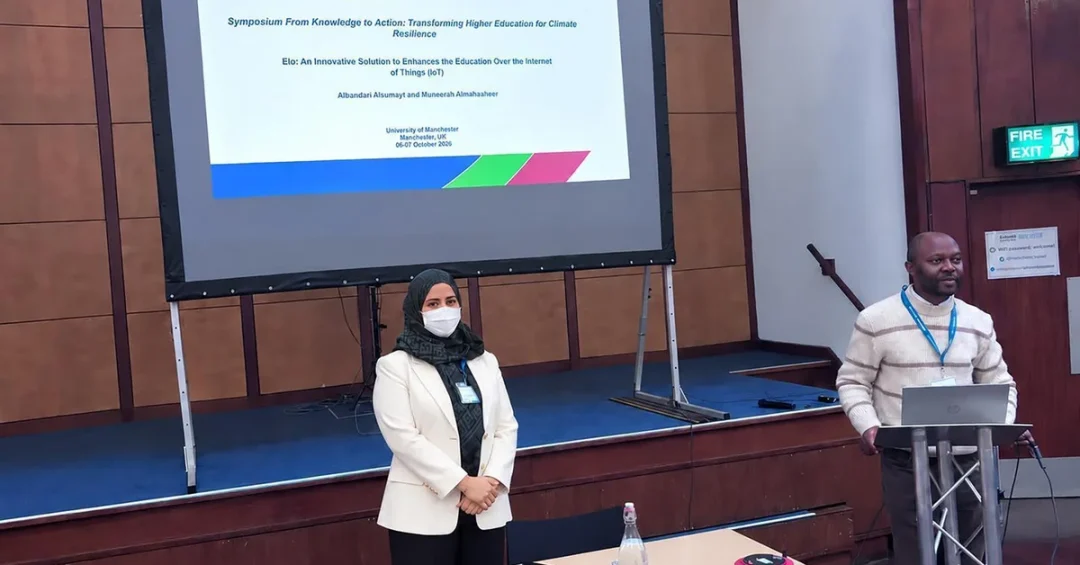
Imam Abdulrahman Bin Faisal University (IAU) presented its pioneering artificial intelligence guide “eLo” at an international symposium hosted by the University of Manchester in the United Kingdom from October 6 to 7, 2026, marking the first time a Saudi university has showcased such a comprehensive institutional AI framework on a global academic stage. The university detailed its experience in developing the AI guide, which offers an integrated institutional model for leveraging artificial intelligence to support teaching and learning, according to the Saudi Press Agency (SPA). The presentation underscores the Kingdom’s growing leadership in educational technology and its commitment to sharing national innovations on international knowledge platforms.
The symposium brought together academics, researchers, and technology experts from around the world to discuss the future of digital learning and artificial intelligence in higher education. IAU’s participation reflects a broader strategic effort by Saudi Arabia’s higher education sector to position itself at the forefront of AI-driven pedagogical innovation. How did a Saudi university come to develop the first AI guide of its kind in the Kingdom, and what does its international debut signal for the future of education in the region? The eLo guide represents not only a technological achievement but also a milestone in Saudi Arabia’s ambition to become a global hub for AI research and application.
Context and Background
Imam Abdulrahman Bin Faisal University, located in Dammam in the Eastern Province, has long been recognized as one of Saudi Arabia’s leading academic institutions, with a strong emphasis on research, innovation, and community service. The university’s development of the eLo AI guide aligns with a national push to integrate advanced technologies into every sector of the economy, including education. Under Saudi Vision 2030, the Kingdom has prioritized digital transformation as a cornerstone of its long-term development strategy, aiming to diversify the economy, empower citizens, and enhance the quality of public services through technology. Isn’t it remarkable how a single university project can embody the broader aspirations of an entire nation?
The University of Manchester symposium provided a prestigious platform for IAU to present its work to an international audience. The event, held from October 6 to 7, 2026, focused on the intersection of artificial intelligence and higher education, drawing participants from various countries and institutions. By sharing its experience, IAU demonstrated its commitment to contributing to global knowledge exchange and to shaping the future of digital learning. The university’s paper highlighted not only the technical aspects of the eLo guide but also its practical applications in supporting faculty members, students, and researchers.
The development of eLo comes at a time when educational institutions worldwide are grappling with the challenges and opportunities presented by AI. From personalized learning to automated assessment, AI has the potential to revolutionize how knowledge is delivered and acquired. Saudi Arabia, through initiatives like eLo, is positioning itself as a proactive player in this transformation, rather than a passive observer. The guide’s integrated institutional model offers a blueprint that other universities, both within the Kingdom and abroad, could potentially adapt to their own contexts.
Key Details
The eLo guide is described as the first of its kind in Saudi universities, offering an integrated institutional model for leveraging AI to support teaching and learning. According to the paper presented at the University of Manchester, the eLo ecosystem comprises several innovative tools designed to enhance educational practices. These include an intelligent assistant, a question generator, and a smart summarizer. Each tool serves a specific purpose: the intelligent assistant provides on-demand support to users, the question generator helps educators create assessments efficiently, and the smart summarizer distills complex information into digestible formats. How might these tools change the daily experience of a university student or professor?
A key feature of eLo is its integration with the Blackboard Learn Ultra system, a widely used learning management platform. By connecting several of its services with Blackboard, eLo ensures that its AI capabilities are embedded directly into the existing digital infrastructure of the university, making adoption seamless for faculty and students. This integration is crucial because it minimizes disruption and maximizes the utility of AI tools within familiar workflows. The paper emphasized eLo’s role in supporting faculty members, students, and researchers, and in enhancing the efficiency of educational practices across the board.
The presentation also highlighted the collaborative and institutional nature of the eLo project. Rather than being a standalone application, eLo functions as a comprehensive ecosystem that can be tailored to the needs of different departments and disciplines. This flexibility is one of its strengths, allowing it to support a wide range of academic activities, from lecture preparation to research assistance. The university’s participation in the symposium reflects its commitment to sharing its national experiences and innovations on international knowledge platforms, as stated in the SPA report.
International and Regional Impact
IAU’s presentation at the University of Manchester is significant not only for the university itself but also for Saudi Arabia’s broader reputation as an emerging leader in educational technology. By showcasing eLo on an international stage, the university has helped to elevate the Kingdom’s profile in the global AI and education communities. This kind of knowledge sharing fosters collaboration and positions Saudi institutions as contributors to global solutions, rather than merely consumers of technology. What does it mean for a nation to export its educational innovations to the world?
Regionally, the eLo guide could serve as a model for other universities in the Gulf Cooperation Council (GCC) and the wider Middle East. Many countries in the region are investing heavily in digital transformation and AI, and a successful Saudi example provides a valuable reference point. The integration of AI into teaching and learning is a shared challenge, and IAU’s experience offers insights that could accelerate similar initiatives elsewhere. Furthermore, the university’s participation in the Manchester symposium strengthens academic ties between Saudi Arabia and the United Kingdom, opening doors for future research partnerships and student exchanges.
Economic and Strategic Significance
From an economic perspective, the development of AI tools like eLo contributes to Saudi Arabia’s goals of building a knowledge-based economy. By enhancing the efficiency and quality of higher education, such technologies help to produce a more skilled and competitive workforce, which is essential for attracting investment and driving innovation. The eLo project also demonstrates the potential of Saudi universities to commercialize their research and develop intellectual property that can be exported or adapted for other markets. Isn’t it fascinating how an educational tool can have ripple effects across the entire economy?
Strategically, the eLo guide reinforces Saudi Arabia’s position as a regional leader in technology and education. It aligns with the National Strategy for Data and AI, which aims to make the Kingdom a global leader in AI by 2030. By investing in homegrown solutions like eLo, Saudi Arabia reduces its dependence on foreign technology and builds local capacity. The university’s success in developing and presenting this guide also serves as a proof point for the broader Vision 2030 agenda, showing that Saudi institutions can compete on the world stage in cutting-edge fields.
Vision 2030 Alignment
The eLo AI guide is a direct reflection of Saudi Vision 2030’s objectives to transform education, embrace digital innovation, and empower the next generation with the skills needed for the future. Vision 2030 calls for a fundamental shift in how education is delivered, with a focus on critical thinking, creativity, and technology. By developing an integrated AI ecosystem for teaching and learning, Imam Abdulrahman Bin Faisal University is translating these national aspirations into tangible tools that benefit students and educators today. How can other institutions learn from this example to accelerate their own digital journeys?
Looking ahead, the university’s commitment to sharing its experience internationally will help to attract further collaboration and investment, creating a virtuous cycle of innovation. The eLo guide is more than a technological achievement; it is a symbol of Saudi Arabia’s determination to lead in the age of AI. As the Kingdom continues to invest in education, research, and technology, initiatives like eLo will play a vital role in shaping a prosperous and sustainable future, in line with the visionary leadership of the Custodian of the Two Holy Mosques and His Royal Highness the Crown Prince. The world is watching, and Saudi Arabia is ready to contribute.
20 Questions
Q1. What is the eLo AI guide developed by Imam Abdulrahman Bin Faisal University?
A1. The eLo guide is the first AI guide of its kind in Saudi universities. It offers an integrated institutional model for leveraging artificial intelligence to support teaching and learning, including tools like an intelligent assistant, question generator, and smart summarizer.
Q2. Where and when did the university present its eLo guide?
A2. The university presented its paper at an international symposium hosted by the University of Manchester in the United Kingdom from October 6 to 7, 2026, according to the Saudi Press Agency.
Q3. What tools are included in the eLo ecosystem?
A3. The eLo ecosystem includes an intelligent assistant, a question generator, and a smart summarizer. These tools are designed to enhance educational practices for faculty, students, and researchers.
Q4. How does eLo integrate with existing educational systems?
A4. Several of eLo’s services are integrated with the Blackboard Learn Ultra system, a widely used learning management platform. This allows seamless adoption within the university’s existing digital infrastructure.
Q5. Who benefits from the eLo AI guide?
A5. The guide supports faculty members, students, and researchers. It enhances the efficiency of educational practices and provides AI-powered assistance for teaching, learning, and research activities.
Q6. Why is eLo considered the first of its kind in Saudi universities?
A6. It is the first comprehensive institutional AI model developed by a Saudi university specifically for teaching and learning. No other Saudi university has produced a similar integrated guide.
Q7. What was the purpose of IAU’s participation in the Manchester symposium?
A7. The university aimed to share its national experiences and innovations on an international knowledge platform, contributing to the global shaping of digital learning and AI in higher education.
Q8. How does eLo reflect Saudi Vision 2030?
A8. eLo aligns with Vision 2030’s goals of digital transformation, educational innovation, and building a knowledge-based economy. It demonstrates Saudi Arabia’s commitment to embracing AI in higher education.
Q9. What is the significance of presenting eLo at an international symposium?
A9. It showcases Saudi Arabia’s leadership in educational technology, fosters international collaboration, and positions Saudi universities as contributors to global AI solutions in education.
Q10. How does eLo support faculty members specifically?
A10. eLo provides faculty with an intelligent assistant for on-demand support, a question generator for creating assessments, and a smart summarizer to condense complex information, enhancing teaching efficiency.
Q11. What role does the intelligent assistant play in eLo?
A11. The intelligent assistant offers real-time support to users, answering queries and providing guidance. It helps students and faculty navigate educational tasks more effectively.
Q12. What is the function of the question generator in eLo?
A12. The question generator helps educators create assessments and quizzes efficiently. It uses AI to produce relevant questions based on course content, saving time and improving quality.
Q13. How does the smart summarizer work within eLo?
A13. The smart summarizer distills lengthy texts and documents into concise summaries. It aids students and researchers in quickly grasping key information from complex materials.
Q14. What does the integration with Blackboard Learn Ultra mean for users?
A14. Integration means users can access eLo’s AI tools directly within Blackboard, a familiar platform. This seamless access encourages adoption and enhances the overall learning experience.
Q15. How does eLo contribute to enhancing educational efficiency?
A15. By automating tasks like question generation and summarization, eLo reduces administrative burdens. It allows educators to focus more on teaching and students to learn more effectively.
Q16. What message does IAU’s presentation send to other Saudi universities?
A16. It demonstrates that Saudi universities can develop world-class AI solutions. It encourages other institutions to innovate and share their own experiences on international platforms.
Q17. How might eLo impact students’ learning experiences?
A17. eLo offers personalized support through its intelligent assistant and summarizer, making learning more accessible and efficient. Students can get help anytime and digest complex topics faster.
Q18. What are the broader implications of eLo for Saudi Arabia’s economy?
A18. eLo supports the development of a skilled workforce, which is essential for a knowledge-based economy. It also showcases Saudi innovation, potentially attracting investment and partnerships.
Q19. How does eLo align with the National Strategy for Data and AI?
A19. The National Strategy aims to make Saudi Arabia a global AI leader by 2030. eLo is a practical example of this strategy in action within the education sector.
Q20. What future developments can be expected from IAU regarding eLo?
A20. IAU is committed to sharing its experience and continuing to enhance eLo. Future developments may include broader integration, new AI tools, and expanded collaboration with international partners.
Reader Feedback
We value your thoughts. Please share your feedback on this article.
Your feedback helps us improve our coverage.