


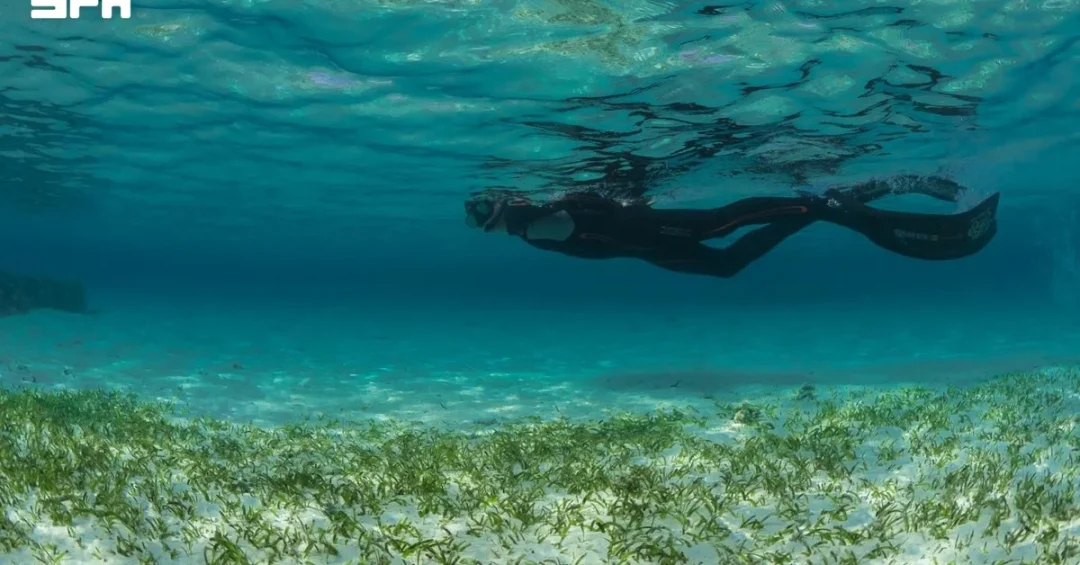
Researchers at King Abdullah University of Science and Technology (KAUST) have co-led an international study showing that carbon credits generated from restoring seagrass meadows could reach a market value of $2.3 trillion under scenarios of rising carbon prices. The findings, published in the journal npj Ocean Sustainability, highlight how climate finance could become a major driver for marine conservation, offering a science-based pathway to unlock investment in one of the world’s most valuable yet underfunded ecosystems.
Context and Background
Seagrass meadows are among the most efficient natural systems for capturing and storing carbon, protecting coastal communities, and sustaining marine biodiversity. Despite their ecological importance, they attract only a small fraction of global climate finance. The study combines ecological and economic modeling to explore how carbon credits could support large-scale restoration efforts. The researchers emphasized that the $2.3 trillion figure represents modeled scenarios, not predictions, and would depend on robust monitoring, transparent carbon accounting, and strong governance.
Key Details
Professor Carlos Duarte, Professor of Marine Science at KAUST and co-author of the study, stated: “Our understanding of the environmental value of seagrass has grown enormously over the past decade. The challenge has been demonstrating that value in ways that can attract long-term investment.” The research integrates carbon storage data with economic analysis to estimate the potential value of carbon credits. It provides a scientific framework that could help standardize carbon accounting and unlock blue carbon investment. The authors insist that finance is a complement to, not a substitute for, conservation policy.
Implications and Impact
For Saudi Arabia, the study offers timely evidence as the Kingdom advances its blue economy and marine stewardship. Extensive seagrass meadows along the Red Sea coastline already support biodiversity, fisheries, and coastal resilience. This new framework could help policymakers and investors better understand how environmental benefits translate into financial opportunities, encouraging future investment in restoration and long-term care. KAUST continues to play a leading role in marine research across the Red Sea, including coral reefs, mangroves, and blue carbon, strengthening the scientific evidence for conservation decisions.
Vision 2030 Alignment
This research aligns closely with Saudi Arabia’s Vision 2030, which emphasizes sustainability, economic diversification, and a thriving blue economy. By integrating advanced science with environmental policy, Saudi Arabia is reinforcing its global leadership in marine conservation and climate action. The study provides a model that could help the Kingdom attract green finance, support coastal community resilience, and contribute to the global effort against climate change—an investment in the future of both the Kingdom and the planet.
20 Questions
Q1. What is seagrass and why is it important?
A1. Seagrass is a marine flowering plant that forms underwater meadows. It provides critical ecosystem services, including carbon sequestration, coastal protection, and habitat for marine species, making it one of the most valuable ecosystems for climate and biodiversity.
Q2. What is the potential value of carbon credits from seagrass restoration?
A2. The study estimates that carbon credits from seagrass restoration could reach a market value of up to $2.3 trillion if carbon prices rise. This is a modeled scenario, not a prediction, highlighting the financial potential under favorable market conditions.
Q3. Where was the study published?
A3. The research was published in the journal npj Ocean Sustainability, a peer-reviewed publication focusing on the sustainability of ocean and coastal ecosystems, providing a reputable scientific platform for the findings.
Q4. Who co-led the study?
A4. The study was co-led by researchers at King Abdullah University of Science and Technology (KAUST), with contributions from international partners. Professor Carlos Duarte, a marine science professor at KAUST, is a key author.
Q5. What is a carbon credit?
A5. A carbon credit is a financial unit that represents one metric ton of carbon dioxide equivalent that is either reduced, avoided, or sequestered. It allows holders to offset emissions by investing in projects that capture or prevent carbon emissions.
Q6. How does seagrass store carbon?
A6. Seagrass meadows capture carbon from the atmosphere and store it in their roots, stems, and the surrounding sediment for long periods. This long-term storage makes them some of the most efficient blue carbon ecosystems globally.
Q7. What is the significance of the Red Sea’s seagrass meadows?
A7. The Red Sea’s seagrass meadows support marine biodiversity, fisheries, and coastal resilience. Their preservation and restoration are key to the Kingdom’s marine conservation efforts and the sustainability of the blue economy.
Q8. What role does KAUST play in this research?
A8. KAUST provides scientific leadership and expertise in marine science, conducting cutting-edge research on coral reefs, mangroves, and seagrass. This study is part of KAUST’s broader efforts to advance knowledge and inform conservation decisions.
Q9. What conditions are needed for the potential market value to be realized?
A9. The realization requires robust monitoring, transparent carbon accounting, and strong governance. Stable carbon prices and supportive policies are also essential to attract private investment in large-scale restoration projects.
Q10. How could this benefit Saudi Arabia’s economy?
A10. This research could attract international climate finance to Saudi Arabia, supporting blue economy diversification, creating green jobs, and strengthening the Kingdom’s position as a leader in sustainable marine investment.
Q11. Is climate finance a substitute for conservation policy?
A11. No, the researchers emphasize that climate finance is not a substitute for conservation policy but a complementary tool. It can accelerate restoration when environmental safeguards are in place, but regulations remain essential.
Q12. What other marine ecosystems is KAUST studying?
A12. KAUST conducts research on coral reefs, mangroves, blue carbon, and ecosystem restoration across the Red Sea. These efforts together build a scientific foundation for informed conservation and sustainable resource use.
Q13. What are the challenges in restoring seagrass meadows?
A13. Challenges include limited funding, technical difficulties in planting, water quality degradation, and the need for long-term monitoring. The new framework addresses funding by linking science to financial opportunities.
Q14. How does this research align with Vision 2030?
A14. It supports Vision 2030’s environmental sustainability and economic diversification goals. By unlocking climate finance for marine restoration, Saudi Arabia can boost its blue economy and global environmental reputation.
Q15. What is the blue economy?
A15. The blue economy refers to sustainable economic activities related to oceans and coasts, including fisheries, tourism, renewable energy, and marine biotechnology. It is a key component of Saudi Arabia’s diversification strategy.
Q16. Can individuals invest in seagrass restoration?
A16. Generally, large-scale restoration is led by governments or organizations. However, individuals can support blue carbon projects through carbon offset purchases or contributions to environmental initiatives focused on marine conservation.
Q17. Why is monitoring and governance crucial?
A17. Monitoring ensures that carbon storage is accurately measured and maintained over time. Governance provides rules and standards that build trust in carbon markets, preventing overestimation and ensuring conservation gains are real.
Q18. How can local communities benefit?
A18. Restored seagrass can increase fish populations, improve coastal protection, and boost eco-tourism, providing income and food security for local communities. The study supports long-term livelihoods while protecting the environment.
Q19. What are the next steps for KAUST in this research area?
A19. Next steps include pilot projects in the Red Sea, refinement of carbon measurement methods, and collaboration with policymakers and investors to bring carbon finance models into practice, scaling conservation globally.
Q20. How does this study help global climate action?
A20. It showcases a science-based approach to unlock private finance for nature-based solutions. By demonstrating the value of seagrass, it encourages governments and investors to prioritize marine conservation, supporting global emission reduction targets.
Reader Feedback
We value your thoughts. Please share your feedback on this article.
Your feedback helps us improve our coverage.