


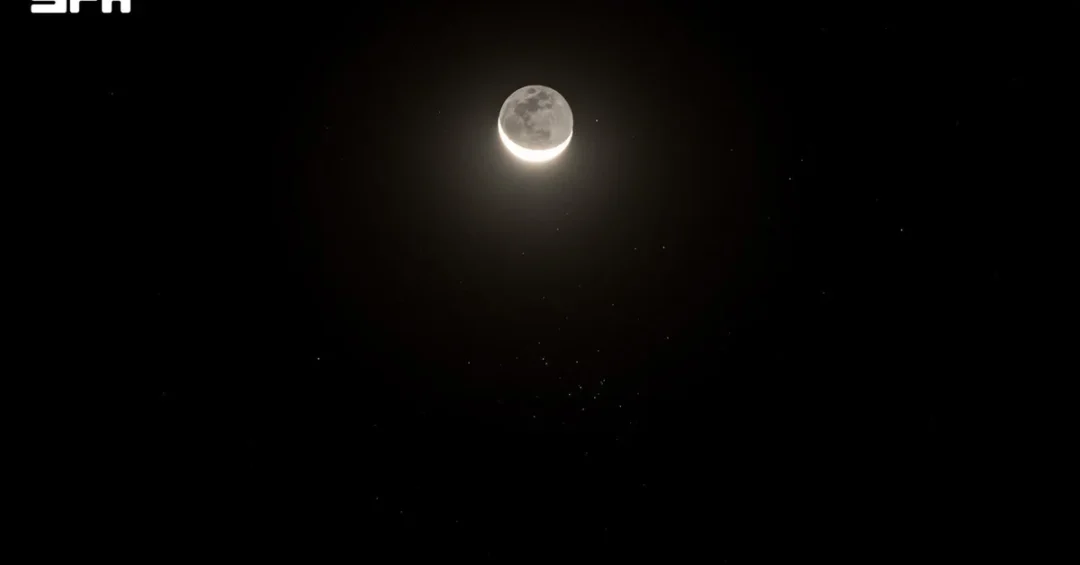
The Moon appeared in conjunction with the Beehive Cluster over the Northern Borders Region at dawn on Tuesday, September 8, 2026, creating a striking astronomical scene above Wadi Arar in northern Saudi Arabia, the Saudi Press Agency reported. The pairing of the Moon and the bright open star cluster drew attention from skywatchers and photographers across the Kingdom’s northern desert, where clear skies, open horizons and low light pollution provide favorable conditions for observing celestial objects.
Context and Background
The event was described by Adnan Khalifa, a member of the Astronomy and Space Club, who explained that the Al-Nathrah Cluster, astronomically known as M44, is an open star cluster located in the constellation Cancer. The cluster is widely known as the Beehive Cluster because its stars, when viewed together, resemble a swarm of bees.
Open clusters of this kind consist of stars that formed from the same molecular cloud and remain loosely bound by gravity. M44 is among the closest and most accessible open clusters for amateur observers, which makes it a recurring subject of interest for astronomy enthusiasts in Saudi Arabia and around the world.
Key Details
Khalifa explained that the conjunction is an apparent close approach as viewed from Earth. Although the Moon and the cluster are separated by vast distances, they appear in nearly the same direction in the sky, producing a visually striking alignment that is easy to identify with the unaided eye under dark conditions.
He said such conjunctions offer skywatchers and astrophotographers opportunities to document celestial objects, noting that the open desert areas of the Northern Borders Region provide favorable viewing conditions away from light pollution. Wadi Arar, in particular, offers wide horizons and minimal artificial glow, allowing observers to capture both the Moon and the cluster in a single field of view.
Because the Moon moves quickly against the background stars, alignments of this type are brief and change noticeably within hours. This transient quality is part of what makes them valuable to photographers, who must plan carefully to record the pairing before the Moon’s motion and the approach of daylight alter the scene.
Implications and Impact
Observations of this kind carry significance beyond their visual appeal. They encourage public engagement with astronomy and provide informal educational opportunities for students, families and amateur astronomers, helping to build familiarity with the night sky and with the scientific concepts that explain it.
The event also highlights the Kingdom’s geographic advantage in astronomical observation. Saudi Arabia’s vast desert regions, including the Northern Borders Region, offer dark skies that are increasingly rare in a world affected by urban light pollution. This positions the country as a natural location for stargazing activities, astronomy events and astrophotography gatherings.
Such developments complement broader efforts to expand scientific culture in the Kingdom, where clubs, universities and research institutions are working to strengthen public understanding of space science and to inspire young people to pursue studies in science, technology, engineering and mathematics.
Vision 2030 Alignment
The observation aligns with Saudi Vision 2030, which places knowledge, innovation and quality of life at the center of the Kingdom’s long-term development. By promoting astronomy as a shared public interest and by drawing attention to the natural advantages of its desert landscapes, Saudi Arabia continues to advance its role as a regional hub for science, education and sustainable, experience-based tourism that benefits local communities and international visitors alike.
20 Questions
Q1. What astronomical event occurred over Saudi Arabia’s Northern Borders Region on September 8, 2026?
A1. The Moon appeared in conjunction with the Beehive Cluster at dawn, forming a striking astronomical scene above Wadi Arar in the Northern Borders Region. The apparent close approach was visible to observers in the Kingdom’s northern desert areas under clear, dark skies.
Q2. What is the Beehive Cluster?
A2. The Beehive Cluster is an open star cluster in the constellation Cancer, catalogued astronomically as M44 and known in Arabic as Al-Nathrah. Its stars are gravitationally associated and appear densely grouped, giving the cluster its distinctive beehive-like appearance when viewed from Earth.
Q3. Why is the cluster called Al-Nathrah in Arabic?
A3. Al-Nathrah is the traditional Arabic name for the cluster, reflecting centuries of Arab observation of the night sky. Arab astronomers historically named and tracked star groupings that were visible to the naked eye, and many of those names remain in use today.
Q4. What does the designation M44 refer to?
A4. M44 is the cluster’s catalogue number in the Messier catalogue, a widely used list of deep-sky objects compiled by French astronomer Charles Messier in the eighteenth century. The designation helps astronomers and observers identify the cluster internationally.
Q5. Which constellation hosts the Beehive Cluster?
A5. The Beehive Cluster lies in the constellation Cancer, the Crab. Cancer is a relatively faint zodiac constellation, and M44 is its most prominent deep-sky feature, serving as a useful reference point for locating the constellation in the night sky.
Q6. What is a conjunction in astronomy?
A6. A conjunction occurs when two celestial bodies appear close together in the sky from Earth’s perspective. It is an apparent alignment rather than a physical meeting, since the objects remain separated by enormous distances in space.
Q7. Are the Moon and the Beehive Cluster actually close to each other?
A7. No. The Moon orbits Earth at an average distance of roughly 384,400 kilometers, while the Beehive Cluster lies hundreds of light-years away. Their appearance together is a line-of-sight effect created by the geometry of observation from Earth.
Q8. Where in Saudi Arabia was the conjunction best observed?
A8. The conjunction was reported over the Northern Borders Region, with Wadi Arar highlighted as a favorable location. The area’s open desert terrain, wide horizons and limited artificial lighting support clear views of faint celestial objects and the surrounding sky.
Q9. Who commented on the astronomical event?
A9. Adnan Khalifa, a member of the Astronomy and Space Club, provided details on the conjunction. He explained the nature of the Beehive Cluster, the apparent alignment with the Moon, and the viewing advantages offered by the Kingdom’s northern desert areas.
Q10. What is the Astronomy and Space Club?
A10. The Astronomy and Space Club is an organization whose members follow and document celestial events. Its participants contribute to public awareness of astronomy by explaining phenomena such as conjunctions and by encouraging observation and astrophotography within local communities.
Q11. Why do the Northern Borders Region’s deserts suit stargazing?
A11. The region combines low humidity, minimal cloud cover and limited urban light pollution with wide, unobstructed horizons. These factors allow observers to detect faint objects such as star clusters and to photograph the night sky with greater clarity and contrast.
Q12. What is Wadi Arar and why is it significant?
A12. Wadi Arar is a valley area in Saudi Arabia’s Northern Borders Region, near the city of Arar. Its open desert setting and dark skies made it a suitable vantage point for viewing the reported conjunction between the Moon and the Beehive Cluster.
Q13. How far is the Beehive Cluster from Earth?
A13. The Beehive Cluster is located roughly 600 light-years from Earth. Despite that vast distance, it remains one of the nearest open clusters to our solar system, which is one reason it appears relatively bright and accessible to observers.
Q14. Can the Beehive Cluster be seen with the naked eye?
A14. Under sufficiently dark skies, the Beehive Cluster can be detected with the unaided eye as a faint, misty patch. Binoculars or a small telescope resolve it into individual stars, revealing the dense grouping that inspired its name.
Q15. What equipment do astrophotographers use for such events?
A15. Photographers typically use cameras with wide-field or medium telephoto lenses, tripods for stability and adjustable exposure settings. Longer exposures capture faint cluster stars, while shorter exposures preserve detail in the bright lunar surface during the pairing.
Q16. Why are conjunctions valuable for photographers and skywatchers?
A16. Conjunctions place multiple celestial objects within a single field of view, making them efficient subjects for imaging and observation. They also attract public interest, offering a simple entry point for newcomers learning to identify stars and constellations.
Q17. Does the conjunction have any effect on Earth?
A17. No physical effect occurs. The event is an apparent alignment seen from Earth, and the gravitational influence of distant stars on our planet is negligible. The Moon’s usual influence on tides remains unchanged during such sightings.
Q18. How does this event reflect Saudi Arabia’s interest in astronomy?
A18. It demonstrates active public engagement with astronomy in the Kingdom, supported by clubs, educational institutions and enthusiasts who monitor celestial events. Such activity contributes to scientific literacy and encourages young people to explore space-related fields.
Q19. How can astronomy contribute to tourism and education in Saudi Arabia?
A19. Dark-sky locations can support stargazing experiences that complement cultural and heritage tourism, while schools and universities use astronomical events to teach scientific concepts. Together, these activities enrich educational outcomes and diversify visitor experiences across the Kingdom.
Q20. How does this event align with Saudi Vision 2030?
A20. Saudi Vision 2030 emphasizes knowledge, innovation and quality of life. Astronomy events strengthen scientific culture, inspire youth and showcase the Kingdom’s natural landscapes, supporting education, research and sustainable tourism that benefit communities and international visitors.
Reader Feedback
We value your thoughts. Please share your feedback on this article.
Your feedback helps us improve our coverage.