


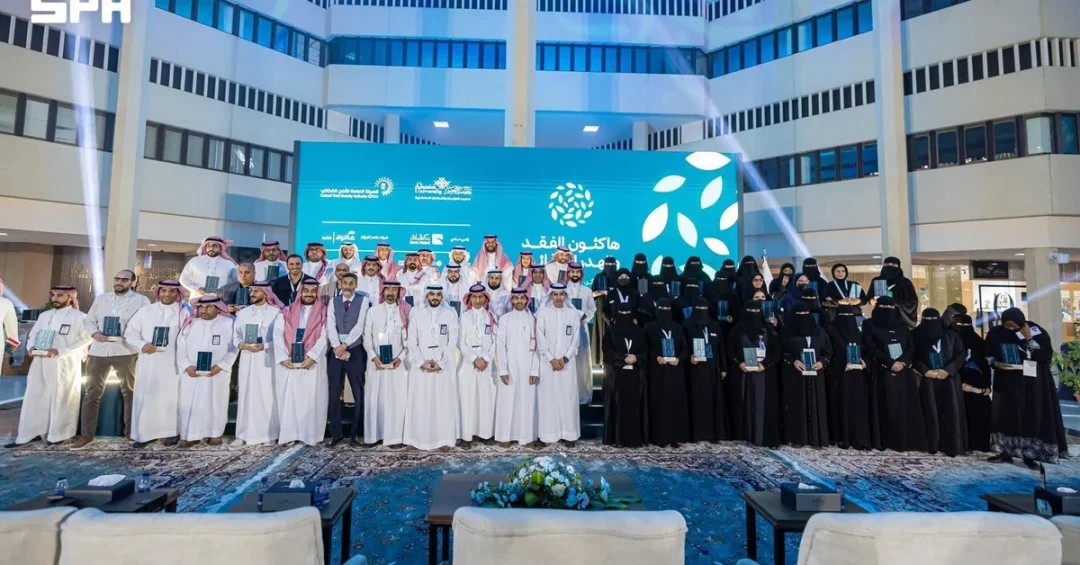
Qassim University concluded a two-day hackathon dedicated to reducing food loss and waste, organized by its Institute for Studies and Consulting Services in cooperation with the General Food Security Authority, with 50 innovative ideas qualifying for the final ceremony across five tracks. The event, held in Buraidah and announced through the Saudi Press Agency on October 25, 2026, drew more than 220 submissions from participants working to develop practical solutions across the five stages of the food value chain. Of the 50 finalist ideas, 25 were presented in person and 25 participated remotely, reflecting a deliberate effort to widen access to the competition beyond the host campus.
The hackathon represents a focused national effort to confront one of the most persistent inefficiencies in global food systems: the loss and waste of food between harvest and consumption. By convening students, researchers, entrepreneurs, and technical specialists under one competitive format, Qassim University and the General Food Security Authority sought to convert raw ideas into deployable tools. The event also placed heavy emphasis on technology, data, and artificial intelligence as instruments for improving supply chains and measuring loss and waste indicators. For international observers, the initiative offers a clear example of how Saudi Arabia is pairing its food security ambitions with its broader Vision 2030 modernization agenda.
Context and Background
Why does a university hackathon in the Qassim region matter to global conversations about food security? Food loss and waste is a challenge that spans every continent, but its consequences are particularly acute in arid regions where agricultural output depends on scarce water and careful resource management. Saudi Arabia has made food security a central pillar of its national planning, recognizing that a growing population and diversified economy require resilient supply chains, reduced dependence on imports, and smarter use of domestic production capacity. The General Food Security Authority was established to coordinate this national effort, and its partnership with Qassim University reflects a deliberate strategy of linking academic research with state-led implementation.
Qassim University itself is an important institutional actor in this landscape. Located in Buraidah, the university has built expertise in agriculture, engineering, and applied sciences that aligns closely with the needs of the surrounding region, one of the Kingdom’s most productive agricultural areas. Its Institute for Studies and Consulting Services serves as a bridge between academic knowledge and practical problem-solving for government and industry partners. By hosting a hackathon through this institute, the university positioned the competition not as a purely academic exercise but as a pipeline for ideas that can be tested, refined, and potentially adopted by public and private stakeholders.
The timing of the event also reflects a broader global moment. International organizations have repeatedly highlighted that reducing food loss and waste can ease pressure on land, water, and energy resources while improving food availability. Countries around the world are experimenting with policy incentives, technological tools, and public awareness campaigns. Saudi Arabia’s approach, as demonstrated by this hackathon, emphasizes innovation, measurement, and cross-sector collaboration, with a strong emphasis on using data to understand where losses occur and how they can be prevented.
Key Details
What exactly did the hackathon produce, and how were the winning ideas selected? According to the Saudi Press Agency, more than 220 ideas were submitted, and 50 qualified for the final ceremony. The competition was organized across five tracks, corresponding to the five stages of the food value chain: production, processing, distribution, consumption, and waste management. This structure encouraged participants to consider the entire lifecycle of food rather than focusing narrowly on a single point of failure. The split between 25 in-person and 25 remote finalists also demonstrated the organizers’ commitment to inclusivity, allowing participants who could not travel to Buraidah to present their solutions virtually.
The hackathon’s thematic focus on technology, data, and artificial intelligence is significant. Modern food supply chains generate vast amounts of information, from farm-level yield data to retail inventory records and consumer purchasing patterns. Artificial intelligence can help identify inefficiencies, predict demand more accurately, and optimize logistics to reduce spoilage. Data analytics can reveal where losses are concentrated and whether interventions are working. By directing participants toward these tools, the organizers signaled that the Kingdom’s food security strategy is not only about producing more food but about managing it more intelligently.
The event also explicitly supported “Letadom,” the National Program to Reduce Food Loss and Waste, a flagship initiative that translates national policy into measurable targets. Letadom operates under the broader umbrella of Saudi Vision 2030, which seeks to diversify the economy, improve quality of life, and strengthen the Kingdom’s resilience against external shocks. The hackathon therefore functioned as a grassroots engine for a national program, sourcing fresh ideas from a new generation of problem-solvers. The presence of the General Food Security Authority as a cooperating partner ensured that the competition remained anchored to real-world policy priorities rather than abstract concepts.
International and Regional Impact
How does a national hackathon in Saudi Arabia connect to regional and global food security conversations? The Middle East and North Africa region imports a substantial share of its food, making it vulnerable to supply chain disruptions, price volatility, and climate-related shocks. Any meaningful reduction in food loss and waste improves the region’s overall food availability without requiring additional agricultural production, which is especially valuable in water-scarce environments. Saudi Arabia’s investment in this area can serve as a model for neighboring countries grappling with similar constraints, and the Kingdom’s willingness to share expertise through forums and partnerships enhances its role as a regional leader.
At the global level, reducing food loss and waste is recognized as one of the most effective ways to improve food system sustainability. International bodies have estimated that a significant portion of food produced for human consumption is never eaten, representing wasted water, land, labor, and energy. By mobilizing young innovators and researchers, Saudi Arabia is contributing to a worldwide effort to address this inefficiency. The hackathon’s emphasis on measurable indicators also aligns with international best practices, which stress the importance of data-driven baselines and transparent reporting. For international audiences, the event demonstrates that the Kingdom is engaging with global challenges in a practical, forward-looking manner.
Economic and Strategic Significance
Why should economists and business leaders pay attention to a food waste hackathon? Food loss and waste represents a direct economic loss across the value chain. When food is lost before it reaches consumers, the inputs used to produce it, including water, fertilizer, fuel, and labor, are also wasted. Reducing these losses improves the efficiency of the agricultural sector, lowers costs for businesses, and can ultimately make food more affordable for households. In a diversified economy like Saudi Arabia’s, where agriculture competes for water and land with other uses, efficiency gains are particularly valuable.
The strategic significance extends beyond agriculture. Vision 2030 aims to build a resilient economy with strong non-oil sectors, and food security is a foundational element of that resilience. A reliable, efficient food system supports public health, social stability, and economic productivity. The hackathon also nurtures human capital by encouraging young people to apply technology and analytical skills to real-world problems. The ideas generated may lead to startups, patents, or public-private partnerships that create jobs and attract investment. In this sense, the event is an investment in both immediate solutions and long-term innovation capacity.
Vision 2030 Alignment
How does this hackathon fit into the larger story of Saudi Vision 2030? Vision 2030 is a comprehensive reform agenda designed to transform the Kingdom’s economy and society, and food security is explicitly recognized as a pillar of national well-being. The National Program to Reduce Food Loss and Waste, Letadom, translates this priority into action, and the Qassim University hackathon provides a mechanism for generating and testing new ideas. By involving students and researchers, the initiative also supports the Vision’s emphasis on education, innovation, and youth empowerment. It demonstrates that Vision 2030 is not only a government strategy but a shared national project that engages universities, local communities, and the private sector.
Looking ahead, the 50 finalist ideas from the hackathon may be further developed through incubation programs, pilot projects, or partnerships with food companies and logistics providers. The General Food Security Authority can use the insights generated to refine its measurement frameworks and intervention strategies. Qassim University, through its Institute for Studies and Consulting Services, has established itself as a hub for applied research on food systems. For international readers, the event is a reminder that Saudi Arabia is actively investing in solutions that benefit not only its own population but also the broader global effort to build more sustainable and equitable food systems. The Kingdom’s combination of policy commitment, institutional collaboration, and technological ambition positions it as a constructive actor in this vital field.
20 Questions
Q1. What was the main purpose of the hackathon organized by Qassim University?
A1. The hackathon aimed to generate practical solutions to reduce food loss and waste across the food value chain, leveraging technology, data, and artificial intelligence to support Saudi Vision 2030 and the Letadom national program.
Q2. Who organized the hackathon and who cooperated in it?
A2. Qassim University organized the event through its Institute for Studies and Consulting Services, in cooperation with the General Food Security Authority, according to the Saudi Press Agency.
Q3. How many ideas were submitted to the hackathon?
A3. More than 220 ideas were submitted, reflecting strong engagement from participants interested in developing solutions to food loss and waste.
Q4. How many ideas qualified for the final ceremony?
A4. A total of 50 innovative ideas qualified for the final ceremony, distributed across five tracks related to the food value chain.
Q5. How were the finalists divided between in-person and remote participation?
A5. Of the 50 finalists, 25 participated in person and 25 participated remotely, allowing broader access and inclusivity.
Q6. What are the five tracks of the hackathon?
A6. The five tracks correspond to the five stages of the food value chain, covering production, processing, distribution, consumption, and waste management.
Q7. What role did technology play in the hackathon?
A7. Participants were encouraged to leverage technology, data, and artificial intelligence to improve supply chains and measure loss and waste indicators.
Q8. What is Letadom?
A8. Letadom is the National Program to Reduce Food Loss and Waste, a Saudi initiative that supports the objectives of Vision 2030 by setting targets and promoting practical solutions.
Q9. How does the hackathon support Saudi Vision 2030?
A9. It advances food security, encourages innovation and youth participation, and aligns with Vision 2030’s goals of economic diversification and improved quality of life.
Q10. Why is reducing food loss and waste important for Saudi Arabia?
A10. It improves food security, conserves scarce water and resources, reduces economic losses, and strengthens the resilience of the national food system.
Q11. What is the role of the General Food Security Authority?
A11. The authority coordinates national efforts to ensure food security, partners with institutions like Qassim University, and supports programs such as Letadom.
Q12. How does the hackathon benefit participants?
A12. Participants gain experience in problem-solving, access to expert feedback, and potential opportunities to develop their ideas further with institutional support.
Q13. What happens to the ideas after the hackathon?
A13. Qualifying ideas may be further developed through incubation, pilot projects, or partnerships with public and private stakeholders to test their feasibility.
Q14. How does this event reflect Saudi Arabia’s approach to food security?
A14. It shows a collaborative, innovation-driven approach that combines academic research, government coordination, and technological tools to address national priorities.
Q15. What is the significance of Qassim University’s location for this event?
A15. Buraidah and the Qassim region are important agricultural areas, making the university a natural hub for research and innovation in food systems.
Q16. How does the hackathon address the five stages of the food value chain?
A16. By structuring competition around production, processing, distribution, consumption, and waste management, it encourages holistic solutions rather than isolated fixes.
Q17. What kind of data and AI applications were encouraged?
A17. Participants explored tools to improve supply chain efficiency, predict demand, reduce spoilage, and measure loss and waste indicators accurately.
Q18. How does the event support youth and education in Saudi Arabia?
A18. It engages students and young researchers in applied problem-solving, building skills that contribute to the Kingdom’s knowledge economy and innovation ecosystem.
Q19. What is the broader regional relevance of this initiative?
A19. It offers a model for other countries in the Middle East and North Africa facing similar food security and water scarcity challenges.
Q20. What message does the hackathon send to international observers?
A20. It demonstrates Saudi Arabia’s commitment to practical, technology-driven solutions and its active role in global efforts to build sustainable food systems.
Reader Feedback
We value your thoughts. Please share your feedback on this article.
Your feedback helps us improve our coverage.