


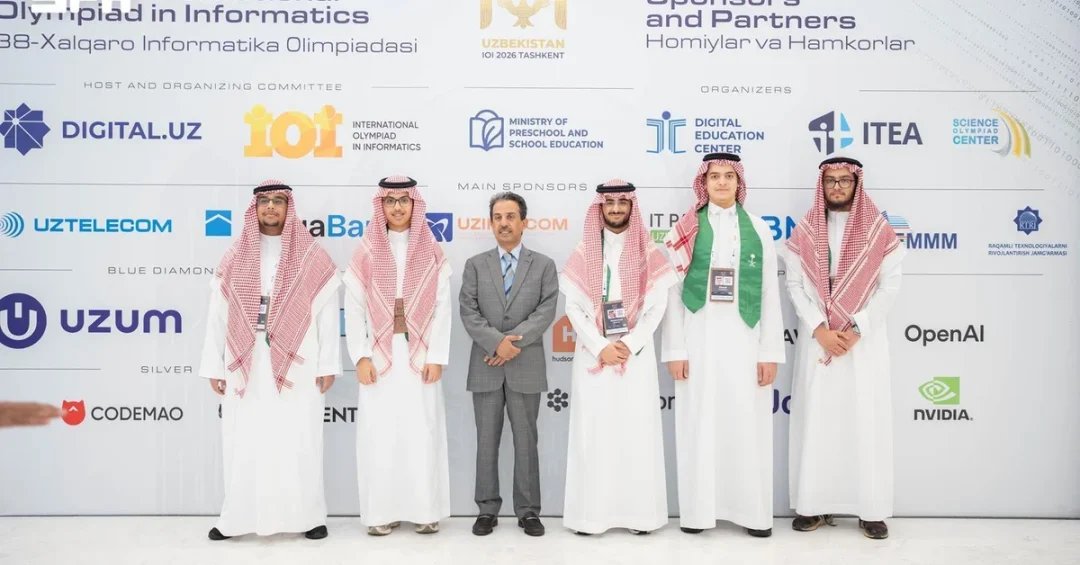
Saudi Arabia’s national informatics team has begun competing at the 38th International Olympiad in Informatics (IOI 2026), which opened on August 9 in Tashkent, Uzbekistan, with the participation of teams from around 100 countries, according to the Saudi Press Agency (SPA). The competition runs until August 16, and the Kingdom is represented by a four-member team of high school students who trained under the supervision of the King Abdulaziz and His Companions Foundation for Giftedness and Creativity (Mawhiba), in partnership with the Ministry of Education, as part of the Mawhiba International Olympiad Program. This year’s edition marks Saudi Arabia’s eighth participation in the world’s most prestigious competitive programming contest for pre-university students.
The opening of IOI 2026 places Saudi Arabia’s brightest young minds alongside peers from nearly every corner of the globe in a week-long test of algorithmic thinking, coding skill, and creative problem-solving. For the Kingdom, the event is far more than a contest. It is a visible milestone in a national effort to build a knowledge economy, one in which advanced computing talent is treated as a strategic resource rather than a niche academic pursuit. As the competition unfolds in Tashkent, the performance of the Saudi team will be watched not only by educators and families at home but also by policymakers who see informatics as a foundation for the digital industries of the future.
Context and Background
How did a Kingdom historically known for energy exports become a regular contender at the world’s premier high school computing competition? The answer lies in a sustained, institutionalized investment in gifted education. The International Olympiad in Informatics was first held in 1989 and has since become the flagship global event for young programmers, with each national team selected through rigorous domestic competition. Saudi Arabia’s journey in this arena began in 2019, and IOI 2026 represents the Kingdom’s eighth appearance. Across its seven previous participations, Saudi students have won 11 international awards, including seven bronze medals and four certificates of appreciation — a record that reflects steady progress rather than a single breakout moment.
Behind that record stands Mawhiba, the King Abdulaziz and His Companions Foundation for Giftedness and Creativity, which identifies and nurtures exceptionally talented students across the Kingdom. Working in partnership with the Ministry of Education, Mawhiba runs the Mawhiba International Olympiad Program, a structured pipeline that takes promising students from initial discovery through advanced training. The program is designed to ensure that Saudi participation in global competitions is not occasional or accidental but systematic, with each cohort building on the experience of those before it. That institutional continuity helps explain why the Kingdom has been able to return to the IOI stage year after year and convert preparation into results.
The IOI itself has evolved in parallel with the global economy. When it began, programming was a specialized field; today, computational thinking underpins everything from artificial intelligence to logistics, healthcare, and finance. For Saudi Arabia, whose Vision 2030 reform agenda places digital transformation at its core, the skills tested at the IOI are directly relevant to the national project of economic diversification. The competition is therefore both a sporting-style contest and a strategic talent pipeline, one that connects classroom curiosity to the demands of a modern, technology-driven labor market.
Key Details of Saudi Arabia’s Participation
What does it take to earn a place on the Saudi national informatics team? According to official information released through SPA, the four high school students representing the Kingdom underwent a comprehensive training and qualification program that began well before their departure for Tashkent. The process included intensive training camps and selection competitions designed to assess participants’ abilities and identify top performers. These stages were not merely eliminatory; they were educational, exposing students to advanced material and giving them repeated opportunities to demonstrate growth under pressure.
The preparation also featured simulation competitions crafted to mirror the conditions of the international contest. These simulations were designed to develop problem-solving and strategy-building skills, teaching students to manage limited time, allocate effort across multiple tasks, and make sound decisions when a problem resists an obvious solution. Such drills reflect the reality of the IOI format, where contestants face complex algorithmic challenges that reward both technical mastery and disciplined thinking. The final national team emerged from this multi-stage process, having demonstrated consistent performance across a demanding schedule.
The IOI’s stated aims align closely with the skills the Saudi program seeks to cultivate. The competition exists to identify young talent in informatics and to develop logical thinking, problem-solving ability, and the capacity to build effective software solutions. It encourages students to specialize in computer science while fostering communication and the exchange of expertise among students, specialists, and informatics teachers from around the world. For the Saudi delegation, the event is thus an opportunity to benchmark against international standards, learn from peers in roughly 100 countries, and bring insights home to strengthen domestic training programs.
International and Regional Impact
Why does a high school competition in Tashkent matter beyond the scoreboard? The IOI is one of the few settings where young people from nearly 100 nations work side by side on shared technical challenges, and it functions as a quiet instrument of international cooperation. Uzbekistan’s hosting of the 38th edition highlights the growing role of Central Asia in global education and technology exchanges. For Saudi Arabia, participation reinforces its broader diplomatic and cultural engagement across Asia and the wider world, demonstrating that the Kingdom’s international presence extends well beyond traditional sectors.
Regional interest in the Saudi team’s performance is also significant. Across the Gulf and the wider Middle East, governments are investing heavily in science, technology, engineering, and mathematics education as they seek to diversify their economies. A strong Saudi showing at the IOI offers a regional benchmark and encourages neighboring countries to expand their own olympiad programs. The exchange of expertise among students, specialists, and informatics teachers that the IOI fosters creates informal networks that can later support research collaboration, entrepreneurship, and cross-border technology partnerships — precisely the kind of soft infrastructure that knowledge economies depend on.
Economic and Strategic Significance
How does a medal won by a teenager translate into national economic advantage? The link is more direct than it may appear. Advanced computing talent is among the scarcest resources in the global economy, and countries that can identify and retain such talent early gain a durable edge in fields such as artificial intelligence, cybersecurity, data science, and software engineering. Saudi Arabia’s investment in olympiad training is therefore an investment in human capital, the same category of asset that underpins the Kingdom’s ambitions in NEOM, its expanding digital economy, and its growing technology and startup ecosystem.
The strategic logic extends to institution-building. Programs like the Mawhiba International Olympiad Program create a feedback loop: students who compete internationally often return to mentor younger cohorts, serve as teaching assistants in training camps, or pursue computer science degrees at leading universities. Over time, this produces a self-reinforcing community of skilled practitioners. For a country pursuing economic diversification under Vision 2030, such communities are essential. They supply the engineers who build and maintain digital platforms, the researchers who advance applied science, and the founders who create high-value companies. The Kingdom’s 11 international awards to date are thus best understood not as trophies alone but as evidence that the talent pipeline is functioning.
Vision 2030 Alignment
Saudi Arabia’s participation in IOI 2026 sits squarely within the objectives of Vision 2030, the national transformation agenda launched under the leadership of Crown Prince Mohammed bin Salman. A central pillar of that vision is the development of a diversified, knowledge-based economy in which human capability is the primary driver of growth. The Kingdom’s education and talent-development institutions, including Mawhiba and the Ministry of Education, are tasked with identifying gifted students early and providing them with world-class opportunities. International olympiads are one of the most visible expressions of that mandate, offering measurable proof that Saudi students can compete at the highest levels.
The digital transformation embedded in Vision 2030 depends on a steady supply of skilled technologists, and competitions like the IOI help generate both the skills and the aspiration. When high school students see their peers represent the Kingdom on a global stage, the effect reaches beyond the four team members; it signals to families, schools, and young people across the country that excellence in computing is recognized and rewarded. As the Saudi team competes in Tashkent through August 16, its performance will add another chapter to a record of steady achievement — and another data point in the Kingdom’s long-term project of building a prosperous, innovation-driven future.
20 Questions
Q1. What is the International Olympiad in Informatics?
A1. The International Olympiad in Informatics is the world’s leading competitive programming contest for high school students. It gathers national teams to solve complex algorithmic problems and promotes excellence in computer science education globally.
Q2. When and where is IOI 2026 taking place?
A2. IOI 2026 opened on August 9 in Tashkent, Uzbekistan, and runs until August 16. Around 100 countries are participating in the 38th edition of the competition.
Q3. How many students represent Saudi Arabia at IOI 2026?
A3. Saudi Arabia is represented by a four-member team of high school students. They were selected after a comprehensive training and qualification program overseen by Mawhiba in partnership with the Ministry of Education.
Q4. What is Mawhiba’s role in preparing the team?
A4. The King Abdulaziz and His Companions Foundation for Giftedness and Creativity, known as Mawhiba, supervises the team’s training through its Mawhiba International Olympiad Program, identifying and preparing gifted students for global competitions.
Q5. Which Saudi institution partners with Mawhiba on this program?
A5. The Ministry of Education partners with Mawhiba on the Mawhiba International Olympiad Program, reflecting a coordinated national approach to developing talented students in science and technology fields.
Q6. How many times has Saudi Arabia participated in the IOI?
A6. IOI 2026 marks Saudi Arabia’s eighth participation in the competition. The Kingdom has competed regularly since its first appearance, building experience and results over successive editions.
Q7. What awards have Saudi students won previously?
A7. In seven previous appearances, Saudi students won 11 international awards, including seven bronze medals and four certificates of appreciation, according to official Saudi information.
Q8. What kind of training did the students undergo?
A8. The students completed intensive training camps, selection competitions, and simulation contests designed to develop problem-solving and strategy-building skills before the national team was finalized.
Q9. Why are simulation competitions important?
A9. Simulation competitions replicate the pressure and format of the international contest, helping students manage time, choose strategies, and build confidence before facing real IOI challenges.
Q10. What skills does the IOI aim to develop?
A10. The IOI seeks to develop logical thinking, problem-solving ability, and the capacity to build effective software solutions, while encouraging students to specialize in computer science.
Q11. How does the IOI foster international cooperation?
A11. The IOI brings together students, specialists, and informatics teachers from around the world, creating opportunities for communication, exchange of expertise, and lasting professional networks.
Q12. How many countries are taking part in IOI 2026?
A12. Teams from around 100 countries are participating in IOI 2026, making it a truly global gathering of young computing talent in Tashkent, Uzbekistan.
Q13. Why is informatics important for Saudi Arabia’s economy?
A13. Informatics skills underpin artificial intelligence, cybersecurity, data science, and software development, all of which are central to Saudi Arabia’s economic diversification and digital transformation goals.
Q14. How does IOI participation support Vision 2030?
A14. Vision 2030 aims to build a knowledge-based economy, and the IOI helps identify and develop young Saudi talent in computing, directly supporting human-capital development and digital transformation.
Q15. What is the Mawhiba International Olympiad Program?
A15. It is a Mawhiba initiative that prepares gifted Saudi students for international olympiads through training camps, selection competitions, and simulations, in partnership with the Ministry of Education.
Q16. How are team members selected?
A16. Students are selected through a multi-stage process of training camps and competitions that assess their abilities and identify top performers, culminating in the national team for the Olympiad.
Q17. What does the IOI encourage students to do?
A17. The IOI encourages students to specialize in computer science, sharpen their logical thinking, and exchange expertise with peers and teachers from around the world.
Q18. What is the significance of Saudi Arabia’s 11 previous awards?
A18. The 11 awards, including seven bronze medals, demonstrate that Saudi Arabia’s talent-development pipeline is producing internationally competitive students and building momentum over successive years.
Q19. How long does IOI 2026 last?
A19. The competition runs from August 9 to August 16, 2026, giving teams a full week of algorithmic challenges and international exchange in Tashkent, Uzbekistan.
Q20. What comes next for Saudi Arabia’s informatics program?
A20. Saudi Arabia is expected to continue investing in gifted education and olympiad preparation, building on its record of awards to strengthen the Kingdom’s pipeline of computing talent for Vision 2030.
Reader Feedback
We value your thoughts. Please share your feedback on this article.
Your feedback helps us improve our coverage.
Related articles
 Saudi Cloud Seeding Program Opens Advanced Operations Room
 SDAIA Launches Ibram Platform for Digital Signatures
 Over 100 Ediacaran Fossils Found in Remote Canada
 Arabian Leopard Fund Opens 2026 Small Grants
 Najran Weather Alert: Rain and Active Winds Until Evening
 Bacteria Convert Toxic Uranium into Stable Compound