


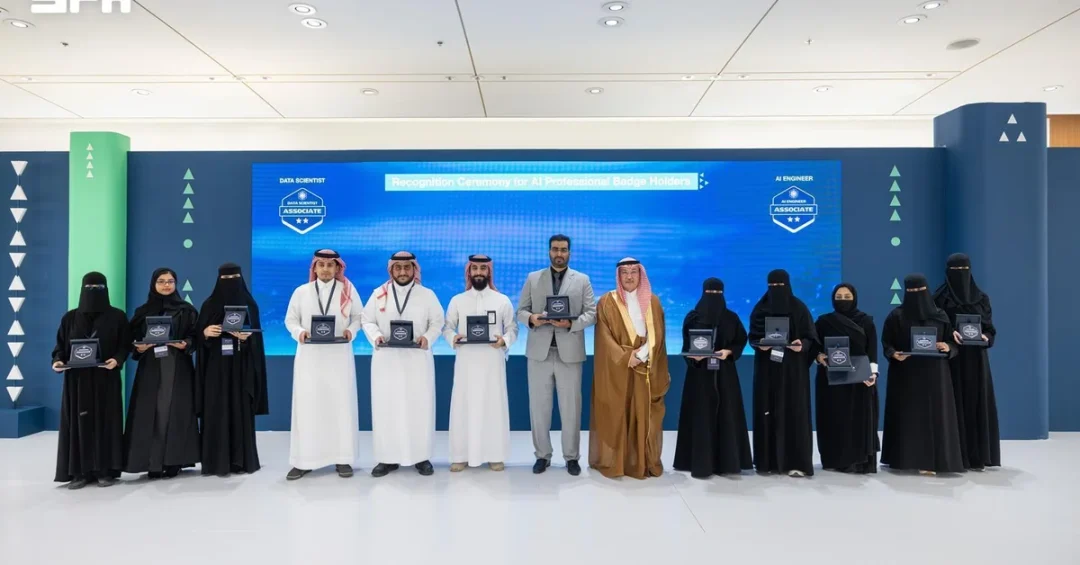
The Saudi Data and AI Authority (SDAIA) honored 52 recipients of professional badges in data and artificial intelligence during the fourth edition of the UNESCO Global Forum on the Ethics of AI in Riyadh, in the presence of SDAIA Vice President Eng. Sami Moquim, senior officials, experts, and industry specialists. The recognition, announced on September 16, 2026, celebrates specialists who have demonstrated technical competencies, contributed to the national data and AI ecosystem, and helped advance one of the Kingdom’s most strategically important sectors. The ceremony took place on the sidelines of a global gathering that has made Riyadh a central meeting point for the international debate on responsible artificial intelligence. For a country pursuing an ambitious transformation agenda, honoring homegrown talent is not a ceremonial gesture but a deliberate investment in the human capital that will power the next phase of national development. Why does a single badge ceremony matter on a global stage? Because it signals that Saudi Arabia is building the professional backbone of an AI-driven economy.
The professional badge initiative is designed to spotlight specialized talent, develop national capabilities, and align professional skills with evolving labor market demands. Each credential is benchmarked against international standards and awarded only to candidates who pass rigorous examinations validating their practical experience, technical knowledge, and skills. The program features two primary professional tracks, Data Scientist and AI Engineer, each structured across three progressive proficiency levels: Assistant, Associate, and Expert. By certifying individual competence through an objective, examination-based process, SDAIA is creating a transparent talent pipeline that organizations across the public and private sectors can rely on when staffing high-impact projects. The timing of the announcement, during a UNESCO forum attended by international experts, underscores how closely the Kingdom ties its domestic capacity-building efforts to global conversations about AI governance and ethics.
Context and Background
How did Saudi Arabia become a convening power in the global conversation about artificial intelligence? The answer lies in a sustained national effort that predates the current wave of global AI enthusiasm. SDAIA was established to consolidate the Kingdom’s data and AI agenda under a single authority, and it has since become the institutional engine behind a wide range of initiatives spanning governance, research, infrastructure, and workforce development. Hosting the UNESCO Global Forum on the Ethics of AI for a fourth edition reflects the trust the international community places in Riyadh as a neutral and constructive venue for difficult conversations. The forum brings together policymakers, academics, civil society representatives, and industry leaders to discuss how AI systems can be developed and deployed in ways that respect human dignity, transparency, and fairness.
The professional badge program fits into a broader philosophy that has guided Saudi digital policy: technology leadership is only sustainable if it is underpinned by people. While much international attention focuses on data centers, supercomputers, and large language models, SDAIA has consistently emphasized that the quality of the human workforce determines whether those assets translate into real economic value. The badge framework gives that philosophy a concrete instrument. It allows employers to identify verified talent quickly, gives specialists a portable credential that validates their skills, and creates clear career pathways that encourage continuous learning. In a labor market where AI skills are in short supply globally, a national certification regime aligned with international benchmarks is a competitive advantage.
The Kingdom’s approach also reflects a recognition that AI ethics and AI capability are inseparable. A workforce trained to high technical standards, and credentialed through a process that emphasizes rigorous examination, is better positioned to build systems that are reliable, accountable, and aligned with societal values. The presence of UNESCO and international experts at the forum reinforces that this is not a purely domestic project but part of a shared global effort. Saudi Arabia’s willingness to host these discussions, and to showcase its own talent development model, demonstrates a constructive form of leadership that combines ambition with responsibility.
Key Details of the Badge Initiative
What exactly does it take to earn one of these professional badges? The program is structured around two primary tracks, Data Scientist and AI Engineer, each with three progressive proficiency levels: Assistant, Associate, and Expert. Candidates must pass rigorous examinations that validate their practical experience, technical knowledge, and skills, meaning the credential is not awarded on the basis of attendance or tenure but on demonstrated competence. This examination-based model is benchmarked against international standards, giving the badges credibility with multinational employers and global research institutions alike. For organizations, the badges provide a certified mechanism to identify and deploy qualified data and AI talent, reducing the uncertainty that often accompanies technical hiring.
The 52 recipients honored at the UNESCO forum represent a cross-section of this emerging professional class. They are specialists who have not only met the technical bar but have also contributed to the national data and AI ecosystem, whether through project delivery, research, mentoring, or the development of tools and models that serve Saudi priorities. By recognizing them publicly, SDAIA is doing more than rewarding individuals; it is signaling to the wider labor market that data and AI careers are valued, viable, and worthy of sustained investment. The ceremony, presided over by SDAIA Vice President Eng. Sami Moquim, also placed the recipients in front of an international audience, reinforcing the message that Saudi talent can compete at the highest levels.
The progressive structure of the program is particularly important for workforce planning. The Assistant level provides an entry point for early-career professionals and graduates, the Associate level recognizes practitioners who can operate independently on complex tasks, and the Expert level identifies senior specialists capable of leading major initiatives and setting technical direction. This ladder gives individuals a clear sense of how to advance and gives employers a common language for describing seniority and specialization. Over time, a critical mass of badge holders across all three levels could become a national asset, enabling faster staffing of Vision 2030 projects and reducing reliance on imported expertise.
International and Regional Impact
Why should the international community pay attention to a national certification ceremony? Because talent is the binding constraint on AI progress worldwide, and any credible model for producing and validating skilled professionals is of global interest. Saudi Arabia’s badge program offers a replicable approach: define clear competency tracks, benchmark them internationally, assess candidates through rigorous examination, and recognize achievement publicly. For countries in the Middle East and beyond that are building their own AI strategies, the Saudi model provides a useful reference point. It also strengthens the Kingdom’s position as a source of technical talent rather than merely a consumer of imported technology.
Regionally, the initiative reinforces Riyadh’s role as a hub for knowledge exchange. The UNESCO Global Forum on the Ethics of AI has become a fixture on the international calendar, and the decision to hold its fourth edition in Riyadh reflects the Kingdom’s growing convening power. By combining a global governance discussion with a national talent celebration, SDAIA demonstrates that ethical frameworks and capability building can advance together. International experts attending the forum have the opportunity to see firsthand how Saudi Arabia is translating high-level principles into practical programs. That visibility can attract partnerships, research collaborations, and investment, all of which feed back into the national ecosystem.
Economic and Strategic Significance
What does a certified AI workforce mean for the Saudi economy? It means faster project delivery, lower hiring risk, and a stronger domestic technology sector. As the Kingdom diversifies away from hydrocarbon dependence, data and AI are central to the growth of new industries, from advanced manufacturing and logistics to healthcare, finance, and smart cities. Every one of these sectors requires specialists who can design, build, and maintain intelligent systems. By certifying those specialists, SDAIA is effectively building the human infrastructure that complements the physical and digital infrastructure being developed across the country. The badges also help smaller organizations, which may lack the resources for extensive technical vetting, to identify qualified candidates with confidence.
Strategically, the program supports the broader goal of localization. Developing national capabilities reduces the need to recruit abroad for critical roles and keeps more of the value created by AI projects within the domestic economy. It also creates role models and mentors for younger Saudis, who can see a clear pathway from education to certification to high-impact work. The emphasis on continuous professional development, embedded in the three-level structure, ensures that badge holders are expected to keep learning as the technology evolves. In a field that changes rapidly, that expectation of lifelong learning may be the most valuable feature of the entire framework.
Vision 2030 Alignment
How does a professional badge program connect to Saudi Vision 2030? Vision 2030 is fundamentally about building a diversified, knowledge-based economy and empowering Saudi citizens to lead it. Human capability development is one of its central pillars, and data and AI are among the priority sectors identified for growth. The badge initiative advances both goals simultaneously: it raises the skill level of the national workforce and strengthens the sectors that will drive future economic expansion. By aligning professional skills with labor market demands, the program ensures that training and certification translate into employment and productivity rather than remaining academic exercises.
The ceremony at the UNESCO forum also reflects the international dimension of Vision 2030. The Kingdom’s transformation is not inward-looking; it seeks to position Saudi Arabia as a global player in technology, governance, and knowledge exchange. Hosting a major UN forum and honoring national talent in the same setting demonstrates that domestic capacity building and international engagement are two sides of the same strategy. As SDAIA continues to expand the badge program and related initiatives, the growing community of certified data scientists and AI engineers will be well placed to lead projects that serve the Kingdom and contribute to the global AI ecosystem. For a nation investing in its people, the 52 recipients honored in Riyadh are both a result and a promise.
20 Questions
Q1. What did SDAIA honor at the UNESCO forum?
A1. SDAIA honored 52 recipients of professional badges in data and artificial intelligence during the fourth edition of the UNESCO Global Forum on the Ethics of AI in Riyadh. The ceremony recognized their technical competencies and contributions to the national data and AI ecosystem.
Q2. When and where did the ceremony take place?
A2. The ceremony took place in Riyadh on September 16, 2026, during the fourth edition of the UNESCO Global Forum on the Ethics of AI. It was attended by senior officials, experts, and industry specialists from Saudi Arabia and abroad.
Q3. Who presented the badges to the recipients?
A3. SDAIA Vice President Eng. Sami Moquim presented the badges to the 52 specialists. His presence underscored the authority’s commitment to developing national talent and advancing the Kingdom’s data and AI sector.
Q4. What is the purpose of the professional badge initiative?
A4. The initiative aims to spotlight specialized talent, develop national capabilities, and align professional skills with evolving labor market demands. It also gives organizations a certified mechanism to identify and deploy qualified data and AI talent.
Q5. How are the professional badges awarded?
A5. The credentials are benchmarked against international standards and awarded to candidates who pass rigorous examinations validating their practical experience, technical knowledge, and skills. The process ensures that only qualified specialists receive recognition.
Q6. What are the two primary professional tracks?
A6. The program features two primary professional tracks: Data Scientist and AI Engineer. Each track is structured across three progressive proficiency levels, providing a clear pathway for career development in the data and AI fields.
Q7. What are the three proficiency levels in each track?
A7. Each track includes three progressive levels: Assistant, Associate, and Expert. These levels recognize increasing competence and responsibility, from early-career practitioners to senior specialists capable of leading major national initiatives.
Q8. Why is the UNESCO forum significant for Saudi Arabia?
A8. Hosting the fourth edition of the UNESCO Global Forum on the Ethics of AI reinforces Riyadh’s role as a global convening power. It demonstrates the Kingdom’s commitment to responsible AI governance and international cooperation on technology ethics.
Q9. How does the badge program benefit employers?
A9. The badges provide organizations with a certified mechanism to identify and deploy qualified data and AI talent. This reduces hiring uncertainty, supports workforce planning, and helps employers staff high-impact projects more efficiently.
Q10. How does the program support individual specialists?
A10. The program gives specialists a portable credential that validates their skills against international benchmarks. It also creates clear career pathways, encourages continuous professional development, and opens doors to high-impact national initiatives.
Q11. What role does SDAIA play in Saudi Arabia’s AI sector?
A11. SDAIA is the national authority responsible for data and artificial intelligence. It drives governance, research, infrastructure, and workforce development, positioning the Kingdom as a regional and global leader in responsible AI.
Q12. How does the initiative align with Vision 2030?
A12. The initiative supports Vision 2030 by building a knowledge-based economy and empowering Saudi citizens. It develops national capabilities in priority sectors and aligns professional skills with labor market demands, advancing economic diversification.
Q13. What does the term professional badge mean in this context?
A13. A professional badge is a certified credential awarded after rigorous examination. It validates a specialist’s practical experience, technical knowledge, and skills in data science or AI engineering, and is benchmarked against international standards.
Q14. How many recipients were honored at the ceremony?
A14. A total of 52 specialists received professional badges at the ceremony. They were recognized for their technical competencies, contributions to the data and AI ecosystem, and role in advancing the national sector.
Q15. Why is workforce development important for AI leadership?
A15. Technology leadership depends on people. Skilled professionals design, build, and maintain AI systems, so a certified talent pipeline is essential for translating infrastructure investments into real economic and social value.
Q16. What message does the ceremony send internationally?
A16. The ceremony signals that Saudi Arabia is building a professional backbone for an AI-driven economy. It shows the Kingdom can develop world-class talent and contribute constructively to global AI governance discussions.
Q17. How does the program address evolving labor market demands?
A17. By aligning certification with international standards and industry needs, the program ensures that badge holders possess skills employers actually require. This helps match training outcomes with real jobs and projects.
Q18. What is the significance of the Assistant, Associate, and Expert levels?
A18. The levels provide a structured career ladder. They give individuals clear advancement goals and give employers a common language for describing seniority, specialization, and readiness for increasingly complex responsibilities.
Q19. How might the badge program affect Saudi Arabia’s tech ecosystem?
A19. It can accelerate project delivery, reduce reliance on imported expertise, and strengthen domestic technology companies. A critical mass of certified specialists would make the ecosystem more self-sufficient and globally competitive.
Q20. What comes next for SDAIA’s talent initiatives?
A20. SDAIA is expected to continue expanding the badge program and related workforce initiatives. As more specialists earn credentials, the Kingdom will be better positioned to lead high-impact AI projects at home and abroad.
Reader Feedback
We value your thoughts. Please share your feedback on this article.
Your feedback helps us improve our coverage.
Related articles
 UNESCO AI Ethics Forum in Riyadh Turns to Public-Sector Readiness
 UNESCO AI Ethics Forum Convenes 18 Sessions in Riyadh
 KSGAAL Joins 2026 UNESCO AI Ethics Forum in Riyadh
 Saudi Arabia Competes in 2026 Balkan Informatics Olympiad
 Saudi team joins International Olympiad in Informatics 2026
 Madinah Hosts MED Ai Forum to Promote Innovation