


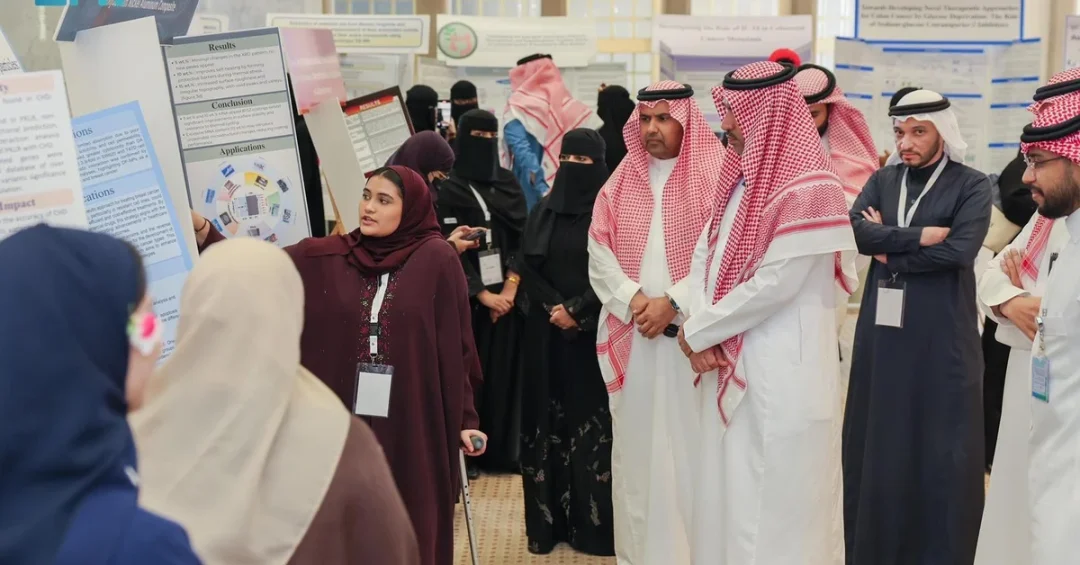
Two hundred students from across Saudi Arabia have qualified for the Ibdaa exhibition for science and engineering, the final stage of the National Olympiad for Scientific Creativity (Ibdaa 2025), following a rigorous selection process announced by the King Abdulaziz and His Companions Foundation for Giftedness and Creativity (Mawhiba) and the Ministry of Education. The qualifying students advanced from a pool of 480 participants who took part in the recent regional exhibitions that constituted the fourth stage of the Olympiad, setting the stage for a national showcase of youthful scientific talent in Riyadh early next year.
The announcement, released through official Saudi channels, underscores the Kingdom’s deepening commitment to nurturing the next generation of innovators in line with Vision 2030. Could this record-breaking edition of Ibdaa signal a turning point in how Saudi Arabia identifies and develops scientific talent? The numbers certainly suggest so: a total of 291,057 students registered for Ibdaa 2025, an unprecedented figure that reflects both the expanding reach of the programme and the growing appetite among Saudi youth for competitive scientific inquiry. The 200 finalists will now prepare to present their projects at the Ibdaa exhibition for science and engineering, to be hosted at the Imam Mohammad Ibn Saud Islamic University Conference Center in Riyadh from February 2 to 6.
Context and Background
What exactly is Ibdaa, and why has it become such a significant fixture on Saudi Arabia’s educational calendar? The National Olympiad for Scientific Creativity, known as Ibdaa, is one of the flagship programmes delivered by Mawhiba in partnership with the Ministry of Education. Mawhiba, formally the King Abdulaziz and His Companions Foundation for Giftedness and Creativity, was established to identify, nurture, and empower gifted students across the Kingdom, providing them with the tools and platforms to transform raw potential into world-class achievement. Ibdaa serves as a national pipeline for scientific talent, guiding students through successive stages of competition that culminate in the final exhibition.
The structure of the Olympiad is deliberate and multi-layered. Students first enter through school-level and regional competitions, and only the strongest projects advance through each stage. The fourth stage, which produced the 200 finalists, consisted of regional exhibitions where 480 participants presented their work to panels of judges. That 200 of those 480 earned qualification to the national final reflects a selectivity rate of roughly 42 percent at this penultimate stage, following even more demanding filters earlier in the process. For a country investing heavily in human capital as part of Vision 2030, such a structured talent-identification mechanism is not merely an academic exercise; it is a strategic asset.
The record registration figure of 291,057 students for Ibdaa 2025 also speaks to a broader cultural shift. Science and engineering competitions, once the preserve of a relatively small cohort, now attract students from every region of the Kingdom. This broadening base is a direct outcome of sustained investment in education, teacher training, and extracurricular enrichment, all of which have been prioritised under the Vision 2030 reform agenda. The result is a national ecosystem in which scientific curiosity is encouraged early and rewarded visibly.
Key Details of the Qualification and Upcoming Exhibition
How will the 200 finalists be judged, and what awaits the winners? The Ibdaa exhibition for science and engineering, scheduled for February 2 to 6 at the Imam Mohammad Ibn Saud Islamic University Conference Center in Riyadh, represents the final qualifying stage of the Olympiad. There, the finalists will present their scientific and engineering projects to expert evaluators, competing for the opportunity to represent the Kingdom at the International Science and Engineering Fair (ISEF 2025) and other prestigious international competitions. ISEF is widely regarded as the world’s largest pre-college science competition, drawing top young researchers from dozens of countries, and Saudi participation has become a point of national pride.
The projects on display at Ibdaa typically span a wide range of disciplines, including engineering, computer science, biology, chemistry, physics, and environmental science. This disciplinary breadth mirrors global priorities and aligns with the Kingdom’s economic diversification goals, which depend on advanced capabilities in technology, renewable energy, health sciences, and beyond. The judging process at the exhibition is designed to assess not only the scientific rigour of each project but also the student’s ability to communicate findings, defend methodology, and articulate the real-world relevance of their work. These are precisely the skills that will serve them in research laboratories, startups, and boardrooms in the years ahead.
It is also worth noting the institutional collaboration behind the event. Mawhiba and the Ministry of Education jointly announced the qualification of the 200 students, a partnership that reflects the integrated approach Saudi Arabia has taken to talent development. Universities, too, play a role: hosting the final exhibition at Imam Mohammad Ibn Saud Islamic University places the event within an academic environment and signals to finalists that their journey can continue seamlessly into higher education and research. For the students, the path from regional exhibition to national final to international fair is a structured progression that rewards persistence and excellence at every step.
International and Regional Impact
Why should the international community pay attention to a national student science competition in Saudi Arabia? The answer lies in what such competitions represent: a long-term investment in the intellectual infrastructure of a country that is increasingly positioning itself as a global hub for innovation, technology, and knowledge. Saudi students who compete at ISEF and similar international fairs become ambassadors for the Kingdom’s educational transformation, and their achievements resonate far beyond national borders. In recent years, Saudi teams have earned recognition at international science and engineering competitions, demonstrating that the pipeline is producing globally competitive talent.
Regionally, Ibdaa reinforces Saudi Arabia’s role as a leader in educational development across the Middle East. By setting a high standard for scientific creativity competitions and by opening participation to a mass base of students, the Kingdom offers a model that other countries in the region can study and adapt. The scale of Ibdaa 2025, with nearly 300,000 registrations, is a testament to what sustained institutional commitment can achieve. It also strengthens people-to-people ties, as Saudi finalists interact with peers from around the world at international events, building networks that will underpin future collaboration in science and technology.
Moreover, the emphasis on science and engineering aligns with global efforts to address shared challenges such as climate change, public health, and digital transformation. When young Saudis develop solutions in these areas, they contribute not only to their own country’s progress but also to the international knowledge commons. The Ibdaa exhibition thus serves a dual purpose: it is a national competition and a gateway to global engagement, reflecting Saudi Arabia’s outward-looking approach to education and innovation.
Economic and Strategic Significance
How does a student science fair connect to the economic future of the Kingdom? At its core, Vision 2030 is about diversifying the economy away from oil dependence and building a knowledge-based society. That transformation requires a steady supply of skilled scientists, engineers, and entrepreneurs. Programmes like Ibdaa are the front end of that supply chain, identifying promising students early and giving them the encouragement, mentorship, and visibility they need to pursue advanced studies and careers in STEM fields. The 200 finalists announced today may one day found technology companies, lead research institutes, or drive innovation in sectors such as renewable energy, artificial intelligence, and biotechnology.
The strategic significance extends to the labour market. Saudi Arabia is investing in giga-projects, advanced manufacturing, and digital infrastructure, all of which demand a technically proficient workforce. By cultivating scientific talent from a young age, the Kingdom reduces its reliance on imported expertise over the long term and creates opportunities for its own citizens to fill high-value roles. The record participation in Ibdaa 2025 suggests that young Saudis are responding to these opportunities with enthusiasm, which bodes well for the realisation of Vision 2030 targets related to human capital development and economic diversification.
Furthermore, events like the Ibdaa exhibition stimulate the local innovation ecosystem. They bring together students, educators, judges from academia and industry, and representatives of institutions such as Mawhiba and the Ministry of Education. This concentration of expertise creates spillover effects: mentorship relationships, internship opportunities, and connections between schools and universities. Over time, such interactions help build a culture of innovation that extends beyond the competition itself.
Vision 2030 Alignment
In what ways does the Ibdaa Olympiad embody the aspirations of Vision 2030? The Vision’s Human Capability Development Program explicitly aims to prepare Saudi citizens for the jobs of the future by fostering creativity, critical thinking, and technical skills. Ibdaa is a direct expression of that aim, providing a national platform where gifted students can test their abilities, learn from experts, and aspire to represent their country on the world stage. The partnership between Mawhiba and the Ministry of Education ensures that the programme is integrated into the broader educational system, not treated as an isolated extracurricular activity.
As the 200 finalists prepare for the February exhibition in Riyadh, they carry with them more than personal ambition. They represent the Kingdom’s bet on its own youth, a bet that has already produced record participation and a growing reputation for scientific excellence. The road from regional exhibitions to the Imam Mohammad Ibn Saud Islamic University Conference Center, and potentially to ISEF 2025, is a journey that mirrors Saudi Arabia’s own path of transformation. With each edition, Ibdaa strengthens the foundation upon which a diversified, knowledge-driven economy will be built, and it showcases to the world a Saudi Arabia that is young, ambitious, and ready to lead in science and engineering.
20 Questions
Q1. What is the Ibdaa exhibition for science and engineering?
A1. It is the final qualifying stage of the National Olympiad for Scientific Creativity (Ibdaa 2025), organised by Mawhiba and the Ministry of Education, where top student projects compete for international representation.
Q2. How many students qualified for the Ibdaa exhibition?
A2. A total of 200 students qualified for the final exhibition, selected from 480 participants who took part in the fourth-stage regional exhibitions held across the Kingdom.
Q3. How many students registered for Ibdaa 2025?
A3. Ibdaa 2025 witnessed a record-breaking 291,057 registrations, reflecting unprecedented participation and growing interest in scientific creativity among Saudi students.
Q4. When and where will the Ibdaa exhibition take place?
A4. The exhibition will be held from February 2 to 6 at the Imam Mohammad Ibn Saud Islamic University Conference Center in Riyadh.
Q5. What is Mawhiba?
A5. Mawhiba is the King Abdulaziz and His Companions Foundation for Giftedness and Creativity, a Saudi institution dedicated to identifying and nurturing gifted students.
Q6. What opportunities await the winners of the Ibdaa exhibition?
A6. Winners will have the chance to represent Saudi Arabia at the International Science and Engineering Fair (ISEF 2025) and other prestigious international competitions.
Q7. What is ISEF?
A7. ISEF is the International Science and Engineering Fair, widely regarded as the world’s largest pre-college science competition, attracting top young researchers globally.
Q8. How does Ibdaa align with Vision 2030?
A8. Ibdaa supports Vision 2030 by developing human capital, fostering scientific talent, and preparing Saudi youth for careers in STEM fields that drive economic diversification.
Q9. Which government bodies are involved in Ibdaa?
A9. The programme is run by Mawhiba in partnership with the Ministry of Education, with support from universities and other educational institutions.
Q10. What subjects do Ibdaa projects cover?
A10. Projects span engineering, computer science, biology, chemistry, physics, environmental science, and other STEM disciplines relevant to national priorities.
Q11. How are students selected for the final exhibition?
A11. Students advance through multiple stages, including school and regional competitions, with the fourth stage narrowing 480 participants down to 200 finalists.
Q12. Why is the record registration significant?
A12. It shows the success of Saudi Arabia’s educational reforms and the growing enthusiasm of young people for science, technology, engineering, and mathematics.
Q13. What role does the Ministry of Education play?
A13. The Ministry of Education co-announces qualifications and integrates Ibdaa into the national educational framework, ensuring broad access and support.
Q14. How does Ibdaa benefit the Saudi economy?
A14. By cultivating STEM talent, Ibdaa helps build a skilled workforce needed for economic diversification, innovation, and high-value job creation under Vision 2030.
Q15. Have Saudi students succeeded at international science fairs?
A15. Yes, Saudi teams have earned recognition at international competitions, demonstrating the effectiveness of programmes like Ibdaa in producing world-class talent.
Q16. What is the significance of hosting the exhibition at a university?
A16. Hosting at Imam Mohammad Ibn Saud Islamic University connects finalists with academia and signals pathways to higher education and research careers.
Q17. How does Ibdaa support gender inclusion?
A17. Ibdaa is open to all students across the Kingdom, and female participation has been a notable feature, reflecting Vision 2030’s emphasis on empowering women.
Q18. What happens after the Ibdaa exhibition?
A18. Winners proceed to international competitions, while all participants gain experience, mentorship, and recognition that support their academic and career development.
Q19. How does Ibdaa compare regionally?
A19. With nearly 300,000 registrations, Ibdaa is among the largest scientific creativity competitions in the region, setting a benchmark for talent development.
Q20. What message does Ibdaa send to the world?
A20. It showcases a young, ambitious Saudi Arabia committed to science, innovation, and global collaboration, in line with the Kingdom’s Vision 2030 aspirations.
Reader Feedback
We value your thoughts. Please share your feedback on this article.
Your feedback helps us improve our coverage.
Related articles
 Misk Celebrates Fourth Cohort Graduation from Incubator and IMPACT Programs
 University of Jeddah, Chinese Shenzhen Institute Sign MoU
 Taif University Ranks Third in KSA, Ninth in Arab World
 WAMY Accepts 116 Teachers for Arabic Language Program
 292 Saudi Schools Recognized in National Excellence Register
 GASTAT: 82.3% of Saudi Children on Track for Proper Development