


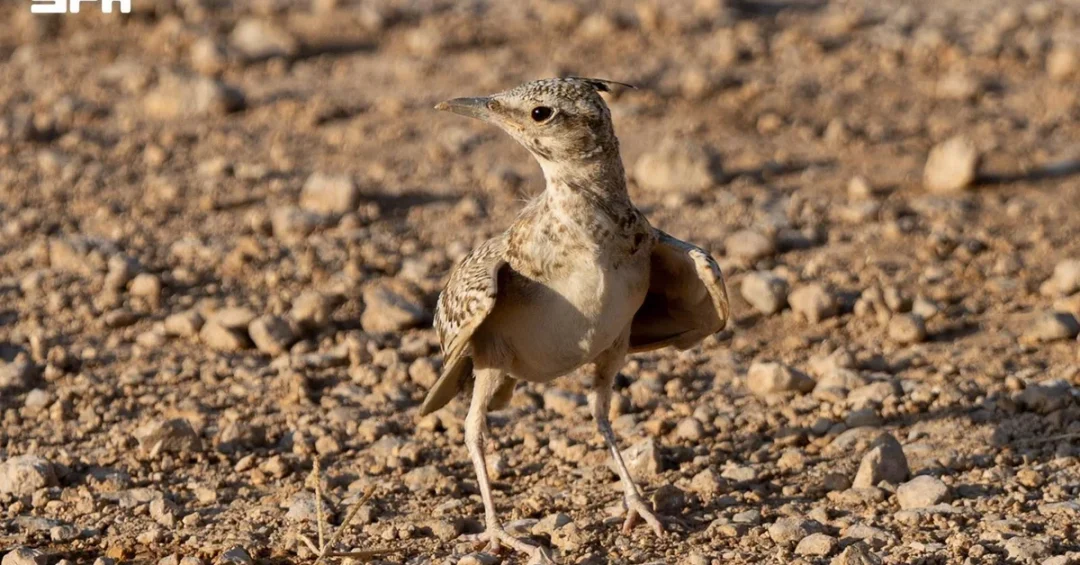
The crested lark, a resilient desert bird native to Saudi Arabia’s Northern Borders Region, exemplifies the Kingdom’s rich biodiversity and ecological adaptations to arid environments, according to experts from the Aman Environmental Association. This small but distinctive bird, known for its sandy plumage and prominent crest, thrives in the region’s plains and gravelly terrain, playing a vital role in maintaining ecological balance.
Context and Background
Saudi Arabia’s Northern Borders Region, characterized by its vast deserts and semi-arid landscapes, is home to a diverse array of wildlife uniquely adapted to harsh conditions. The crested lark (Galerida cristata) stands out as one of the region’s most recognizable avian species. As noted by Adnan Khalifa, a member of the Aman Environmental Association, the bird’s physical and behavioral traits make it exceptionally well-suited to desert life.
Key Details
The crested lark’s sandy-colored plumage provides natural camouflage against predators, while its distinctive crest can be raised or lowered depending on its mood or environmental conditions. Khalifa emphasized that the bird primarily feeds on seeds, grains, and small insects, contributing to pest control and seed dispersal in its ecosystem. Its melodious calls and ground-nesting habits further distinguish it from other species in the region.
Implications and Impact
The presence of the crested lark underscores the ecological richness of Saudi Arabia’s Northern Borders Region, which is often overlooked in discussions about the Kingdom’s biodiversity. Conservation efforts led by local associations like Aman highlight Saudi Arabia’s commitment to preserving its natural heritage. The bird’s adaptability also offers valuable insights into how species evolve to thrive in challenging environments.
20 Questions
Q1. What is the crested lark?
A1. The crested lark (Galerida cristata) is a small desert bird native to Saudi Arabia’s Northern Borders Region, known for its sandy plumage and distinctive head crest.
Q2. Where is the crested lark commonly found?
A2. It inhabits open plains, sandy areas, and gravelly terrain in desert and semi-desert environments across the Northern Borders Region.
Q3. What distinguishes the crested lark’s appearance?
A3. The bird has a prominent crest on its head that it can raise or lower, along with sandy-colored plumage for camouflage.
Q4. What does the crested lark eat?
A4. Its diet consists mainly of seeds, grains, and small insects, which help control pest populations and disperse plant seeds.
Q5. How does the crested lark contribute to its ecosystem?
A5. By feeding on insects and dispersing seeds, it plays a key role in maintaining ecological balance in desert environments.
Q6. What are the crested lark’s nesting habits?
A6. The bird builds its nests directly on the ground among grasses and low shrubs, a behavior adapted to its arid habitat.
Q7. Why is the crested lark well-suited to desert life?
A7. Its camouflage plumage, ground-nesting habits, and diet make it highly adapted to survive in harsh desert conditions.
Q8. What organization studies the crested lark in Saudi Arabia?
A8. The Aman Environmental Association in the Northern Borders Region researches and promotes awareness of the species.
Q9. How does the crested lark avoid predators?
A9. Its sandy-colored plumage blends into the desert environment, providing natural camouflage.
Q10. What is unique about the crested lark’s calls?
A10. The bird is known for its melodious and distinctive vocalizations, which are part of its breeding behavior.
Q11. Is the crested lark endemic to Saudi Arabia?
A11. No, it is found in various arid regions worldwide, but Saudi Arabia’s Northern Borders Region hosts a thriving population.
Q12. How does the crested lark’s crest function?
A12. The crest can be raised or lowered, likely for communication or temperature regulation in its desert habitat.
Q13. What time of year is the crested lark most active?
A13. It is active year-round, with breeding and feeding behaviors adapted to seasonal changes in the desert.
Q14. Are crested larks social birds?
A14. They are generally solitary or found in pairs, especially during breeding seasons, but may form loose flocks.
Q15. How does the crested lark adapt to extreme temperatures?
A15. Its behavior, such as seeking shade during peak heat and foraging in cooler hours, helps it cope with temperature extremes.
Q16. What threats does the crested lark face?
A16. Habitat loss and climate change are potential threats, though its adaptability has helped it remain resilient.
Q17. How does Saudi Arabia protect the crested lark?
A17. Conservation efforts by groups like the Aman Environmental Association promote habitat preservation and ecological awareness.
Q18. Can the crested lark be found in urban areas?
A18. It prefers natural desert habitats but may occasionally be seen in semi-urban fringes with suitable open spaces.
Q19. What is the crested lark’s significance in local culture?
A19. While not prominently featured in folklore, its presence enriches the region’s natural heritage and biodiversity.
Q20. Why is the crested lark important to Saudi Arabia’s ecosystem?
A20. As a native species, it contributes to pest control, seed dispersal, and the overall health of desert ecosystems.
Vision 2030 Alignment
The study and preservation of species like the crested lark align with Saudi Arabia’s Vision 2030 goals of environmental sustainability and biodiversity conservation. By protecting its natural heritage, the Kingdom reinforces its commitment to ecological balance and sustainable development, ensuring that future generations can appreciate its unique wildlife.
Reader Feedback
We value your thoughts. Please share your feedback on this article.
Your feedback helps us improve our coverage.