


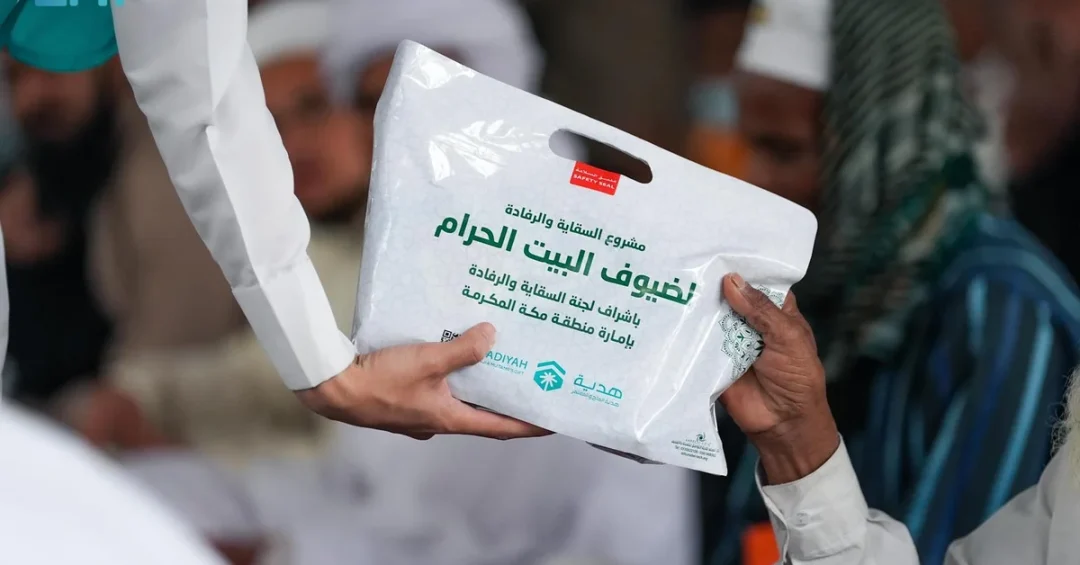
The Haji and Mu’tamer’s Gift Charity Association, known as Hadiyah, served more than 2 million beneficiaries during the first half of Ramadan through 43 dedicated service points for Umrah performers, according to the Saudi Press Agency. The association reported that it reached 2,177,857 beneficiaries in the opening two weeks of the holy month, delivering a wide range of programs and projects designed to support pilgrims performing Umrah and visiting the Grand Mosque in Makkah and the Prophet’s Mosque in Madinah. The figures, released via official Saudi channels, underline the scale of the Kingdom’s seasonal hospitality operation during one of the busiest periods of the Islamic calendar. How does an operation of this magnitude come together in the holiest cities of Islam? It is the product of careful planning, generous resourcing, and a deep-rooted culture of service that runs through Saudi society.
The disclosure was made by Dr. Majdi Hariri, Vice President of Hadiyah, who noted that the association’s teams worked across 43 service points to meet the needs of worshippers and pilgrims throughout the first half of Ramadan. The services ranged from iftar meals and food for fasting people to the distribution of Zamzam water and chilled beverages, Saudi coffee hospitality, spiritual enrichment programs, and practical assistance such as rest services with massage chairs and dedicated care for lost children. The operation also included the performance of acts of worship and kaffarah, or expiation, on behalf of Umrah performers who were unable to complete certain rituals themselves. These are not marginal comforts. For millions of visitors, they are the difference between a strenuous journey and a spiritually fulfilling one.
Context and Background
Why does Ramadan place such extraordinary demands on Saudi Arabia’s pilgrimage infrastructure? During the holy month, the Kingdom welcomes a sharp increase in Umrah performers from across the Islamic world, many of whom travel specifically to experience the spiritual atmosphere of Makkah and Madinah during Ramadan. The Haji and Mu’tamer’s Gift Charity Association was established to serve exactly this population, providing charitable and logistical support that complements the official services delivered by government agencies. Its name, Hadiyah, means gift, and the association’s mission is to offer pilgrims a welcoming experience that reflects the generosity for which the Kingdom is known. The first half of Ramadan 2025 alone drew more than 2 million beneficiaries to its programs.
The association’s work is carried out in close coordination with the broader Saudi ecosystem of pilgrimage services, including the Ministry of Hajj and Umrah and the General Authority for the Care of the Affairs of the Grand Mosque and the Prophet’s Mosque. This coordination ensures that charitable initiatives reinforce, rather than duplicate, official operations. The result is a layered service model in which government agencies manage access, security, and crowd flow, while specialized organizations such as Hadiyah address the human and spiritual dimensions of the pilgrimage experience. For international observers, the model offers a clear example of how Saudi Arabia combines state capacity with civil society energy to serve guests of the Two Holy Mosques.
The timing of the announcement is significant. Ramadan is a period of heightened religious devotion and charitable giving across the Islamic world, and the Kingdom’s ability to host and support large numbers of pilgrims during this period is closely watched by governments and Muslim communities globally. The reported figures therefore serve as more than a statistical milestone. They are an indicator of operational readiness, volunteer mobilization, and the Kingdom’s commitment to ensuring that every pilgrim can complete their rituals with dignity and comfort. What do such numbers reveal about the Kingdom’s capacity to host the world’s faithful? They show a system that is both large in scale and precise in execution.
Key Details of the Ramadan Operation
According to the Saudi Press Agency, Hadiyah’s Ramadan operation served 2,177,857 beneficiaries during the first half of the month through 43 service points positioned to reach Umrah performers where they need support most. The programs included daily iftar meals for fasting people, which represent one of the most visible and appreciated forms of Ramadan hospitality. Volunteers and staff distributed Zamzam water and chilled water to worshippers navigating the crowds and heat, while hospitality stations offered Saudi coffee and dates as a gesture of traditional welcome. These services are designed not only to meet physical needs but to create an atmosphere of warmth and respect that reflects the values of the Kingdom.
Beyond food and drink, the association provided services aimed at enriching the spiritual experience of pilgrims. These included guidance and support for acts of worship, as well as the performance of kaffarah on behalf of Umrah performers who required it. Rest services featuring massage chairs offered relief to elderly and fatigued visitors, many of whom travel long distances and spend long hours in prayer. The association also operated a dedicated center at the Prophet’s Mosque in Madinah for the care of lost children, reuniting families and ensuring that young visitors remain safe amid large crowds. Each of these services addresses a specific vulnerability in the pilgrimage journey.
The human resources behind the operation are equally notable. Hadiyah deployed 573 hosts and hostesses alongside 1,600 volunteers, who together contributed 92,450 volunteer hours during the first half of Ramadan. This workforce was dedicated to assisting Umrah performers with their rituals, prayers at the Grand Mosque, and visits to the Prophet’s Mosque. The scale of volunteer participation reflects a strong culture of civic engagement in Saudi Arabia, particularly during Ramadan, when many citizens and residents seek opportunities to serve pilgrims. It also demonstrates the association’s ability to organize, train, and deploy a large temporary workforce in a short period.
What makes this volunteer model effective in the demanding environment of the Two Holy Mosques? The answer lies in preparation and coordination. Volunteers are typically briefed on crowd management, communication, and the specific needs of international pilgrims, many of whom do not speak Arabic. Hosts and hostesses serve as guides and points of contact, helping visitors navigate rituals and facilities. This combination of professional staff and trained volunteers allows Hadiyah to maintain a visible and responsive presence across multiple locations, from the Grand Mosque in Makkah to the Prophet’s Mosque in Madinah, throughout the busiest hours of the day and night.
International and Regional Impact
How does Saudi Arabia’s Ramadan hospitality resonate beyond its borders? The majority of Umrah performers during Ramadan come from outside the Kingdom, representing a wide spectrum of countries across Asia, Africa, Europe, and the Americas. For these pilgrims, the services provided by Hadiyah and similar organizations shape their lasting impression of Saudi Arabia. A warm meal after a long journey, a cup of Saudi coffee, or assistance from a multilingual volunteer can transform a challenging trip into a memorable spiritual journey. These experiences are shared widely through social media and personal networks, contributing to the Kingdom’s global image as a welcoming and capable host.
At the regional level, the operation supports the broader ecosystem of Islamic travel and tourism. Airlines, travel agencies, hotels, and transport operators across the Middle East benefit from the steady flow of pilgrims during Ramadan. Saudi Arabia’s investment in pilgrimage infrastructure and services therefore has multiplier effects that extend well beyond its own borders. The Kingdom’s approach also sets a benchmark for other countries that host large religious gatherings, demonstrating how charitable organizations can complement state services to improve the visitor experience. In a region often defined by its challenges, the Ramadan pilgrimage season stands out as a story of cooperation and shared faith.
International media and observers frequently note the logistical complexity of managing millions of pilgrims in a confined geographic area. The fact that Hadiyah alone reached more than 2 million beneficiaries in just two weeks illustrates the density of activity in Makkah and Madinah during Ramadan. Saudi authorities manage this flow through a combination of digital permits, transportation networks, and on-the-ground teams. Charitable associations such as Hadiyah operate within this framework, adding a layer of personal care that large systems alone cannot provide. The result is an operation that is both efficient and humane, reflecting the Kingdom’s dual commitment to order and hospitality.
Economic and Strategic Significance
What economic value does the Ramadan pilgrimage season generate for Saudi Arabia? Pilgrimage is a major component of the Kingdom’s non-oil economy and a central pillar of its tourism strategy. Millions of Umrah performers spend on travel, accommodation, food, and retail during their stay, supporting businesses in Makkah, Madinah, Jeddah, and beyond. The services provided by Hadiyah, while charitable in nature, form part of the broader value chain that makes the pilgrimage experience attractive and repeatable. When pilgrims leave with positive memories, they are more likely to return and to recommend the journey to others, sustaining demand over the long term.
Strategically, the Kingdom’s ability to host large numbers of pilgrims safely and comfortably reinforces its role as the custodian of Islam’s holiest sites. This role carries religious, diplomatic, and economic dimensions. By investing in services that range from iftar meals to childcare, Saudi Arabia demonstrates that its commitment to pilgrims goes beyond infrastructure to encompass care and dignity. The Hadiyah operation also showcases the strength of Saudi civil society and the willingness of citizens to contribute their time and energy. For international audiences, this is a compelling narrative that highlights the Kingdom’s social fabric alongside its economic ambitions.
The volunteer hours logged by Hadiyah, totaling 92,450 in just two weeks, also represent a form of social capital that is difficult to quantify but deeply valuable. Volunteers gain skills in communication, crowd management, and cross-cultural interaction, which can translate into broader contributions to the economy and society. Many volunteers report that serving pilgrims is a transformative personal experience that strengthens their connection to their faith and their country. This dynamic supports the Kingdom’s efforts to foster a motivated, skilled, and engaged population, which is itself a strategic asset.
Vision 2030 Alignment
How does a charity operation during Ramadan connect to Saudi Vision 2030? At its core, Vision 2030 aims to diversify the economy, strengthen social development, and enhance the Kingdom’s global standing. The pilgrimage sector is explicitly recognized as a growth area, with targets to increase the number of Umrah performers and improve the quality of services they receive. Hadiyah’s work directly supports these goals by enhancing the pilgrim experience and by mobilizing volunteers in service of national priorities. The association’s programs align with the vision’s emphasis on hospitality, cultural heritage, and community participation.
Moreover, the operation reflects the Vision 2030 objective of empowering the non-profit sector. By expanding the role of charitable associations in delivering services, the Kingdom builds a more resilient and participatory society. Hadiyah’s ability to coordinate 573 hosts and hostesses and 1,600 volunteers demonstrates the sector’s capacity to execute complex operations at scale. As Saudi Arabia continues to welcome growing numbers of pilgrims in the years ahead, such organizations will play an increasingly important role in ensuring that every visitor is treated as an honored guest. In this way, the spirit of Hadiyah, a gift to the pilgrim, becomes part of the broader gift that Saudi Arabia offers to the Islamic world.
20 Questions
Q1. What is the Haji and Mu’tamer’s Gift Charity Association known as?
A1. The association is known as Hadiyah, which means gift in Arabic. It is a Saudi charitable organization dedicated to serving Hajj and Umrah performers by providing hospitality, guidance, and practical support throughout their pilgrimage journey.
Q2. How many beneficiaries did Hadiyah serve in the first half of Ramadan?
A2. Hadiyah served 2,177,857 beneficiaries during the first half of Ramadan, according to the Saudi Press Agency. The figure reflects the large number of Umrah performers and visitors who used the association’s services across multiple locations.
Q3. Through how many service points did Hadiyah operate?
A3. The association operated through 43 service points positioned to reach Umrah performers in Makkah and Madinah. These points allowed Hadiyah teams to deliver food, water, hospitality, and assistance efficiently during peak hours.
Q4. Who announced the beneficiary figures for Hadiyah’s Ramadan operation?
A4. Dr. Majdi Hariri, Vice President of Hadiyah, announced the figures. He noted that the association offered a variety of programs and projects during the first half of Ramadan to support pilgrims and visitors to the Two Holy Mosques.
Q5. What types of food services did Hadiyah provide?
A5. Hadiyah provided iftar meals and food for fasting people, along with Zamzam water and chilled water. These services helped pilgrims break their fast and stay hydrated during the spiritually intense days of Ramadan.
Q6. What hospitality services were offered to Umrah performers?
A6. The association offered traditional Saudi hospitality, including Saudi coffee, to welcome pilgrims. These gestures reflect the Kingdom’s culture of generosity and help create a warm atmosphere for international visitors during their stay.
Q7. How did Hadiyah enrich the spiritual experience of pilgrims?
A7. Hadiyah provided programs aimed at enriching the spiritual experience, including guidance on rituals and support for acts of worship. The association also performed kaffarah on behalf of Umrah performers who required it, helping them complete their religious obligations.
Q8. What are kaffarah services mentioned in the report?
A8. Kaffarah refers to expiation, a religious requirement in certain circumstances. Hadiyah performed these acts on behalf of Umrah performers, ensuring that pilgrims who needed this service could fulfill their obligations with proper guidance and support.
Q9. What rest services did Hadiyah offer?
A9. The association offered rest services featuring massage chairs, providing relief to elderly and fatigued pilgrims. These services are especially valuable during Ramadan, when many visitors spend long hours in prayer and travel between holy sites.
Q10. How did Hadiyah care for lost children?
A10. Hadiyah operated a dedicated center at the Prophet’s Mosque in Madinah for the care of lost children. The center helps reunite families and ensures that young visitors remain safe amid the large crowds that gather during Ramadan.
Q11. How many hosts and hostesses worked with Hadiyah?
A11. Hadiyah deployed 573 hosts and hostesses to assist Umrah performers. These individuals served as guides and points of contact, helping pilgrims navigate rituals, prayers at the Grand Mosque, and visits to the Prophet’s Mosque.
Q12. How many volunteers contributed to the operation?
A12. A total of 1,600 volunteers contributed to Hadiyah’s Ramadan operation. Their participation reflects a strong culture of civic engagement in Saudi Arabia, particularly during the holy month when many seek opportunities to serve pilgrims.
Q13. How many volunteer hours were recorded?
A13. Volunteers contributed 92,450 hours during the first half of Ramadan. This substantial figure demonstrates the scale of commitment and the organizational capacity of Hadiyah to mobilize and coordinate a large temporary workforce.
Q14. Where did Hadiyah’s services take place?
A14. Hadiyah’s services took place at the Grand Mosque in Makkah and the Prophet’s Mosque in Madinah, as well as at 43 service points in surrounding areas. These locations are the primary destinations for Umrah performers during Ramadan.
Q15. Why is Ramadan a particularly busy period for Umrah?
A15. Ramadan is considered one of the most spiritually rewarding times to perform Umrah, attracting millions of pilgrims from around the world. The increased demand places significant pressure on infrastructure and services, which Saudi Arabia manages through coordinated efforts.
Q16. How does Hadiyah coordinate with Saudi government agencies?
A16. Hadiyah works in coordination with official bodies such as the Ministry of Hajj and Umrah and the General Authority for the Care of the Affairs of the Grand Mosque and the Prophet’s Mosque. This ensures charitable services complement official operations.
Q17. What is the significance of the name Hadiyah?
A17. Hadiyah means gift in Arabic, reflecting the association’s mission to offer pilgrims a welcoming and generous experience. The name embodies the Kingdom’s tradition of hospitality toward guests of the Two Holy Mosques.
Q18. How do these services benefit international pilgrims?
A18. International pilgrims often face language barriers, fatigue, and unfamiliarity with local procedures. Hadiyah’s multilingual hosts, food services, and care programs help them complete their rituals comfortably, leaving a positive impression of Saudi Arabia.
Q19. How does Hadiyah’s work support Saudi Vision 2030?
A19. Hadiyah supports Vision 2030 by enhancing the pilgrim experience, empowering the non-profit sector, and mobilizing volunteers. These efforts align with the vision’s goals of economic diversification, social development, and improved services for visitors to the Kingdom.
Q20. What does the Hadiyah operation reveal about Saudi Arabia’s capabilities?
A20. The operation demonstrates Saudi Arabia’s ability to combine state capacity with civil society energy to serve millions of pilgrims. It highlights the Kingdom’s logistical strength, volunteer culture, and commitment to hospitality during the holiest month of the Islamic calendar.
Reader Feedback
We value your thoughts. Please share your feedback on this article.
Your feedback helps us improve our coverage.
Related articles
 Madinah Concludes Swimming Literacy Project with 300 Students
 AlUla Program Trains 50 Youth in Public Speaking
 Najran Schools Adopt Winter Schedule Starting Sunday
 Najran University Climbs Four Places in QS Arab Rankings 2027
 Saudi Arabia Sets February 2027 Deadline for Worker Housing
 ETEC to Hold Third National Forum for School Excellence in Riyadh