


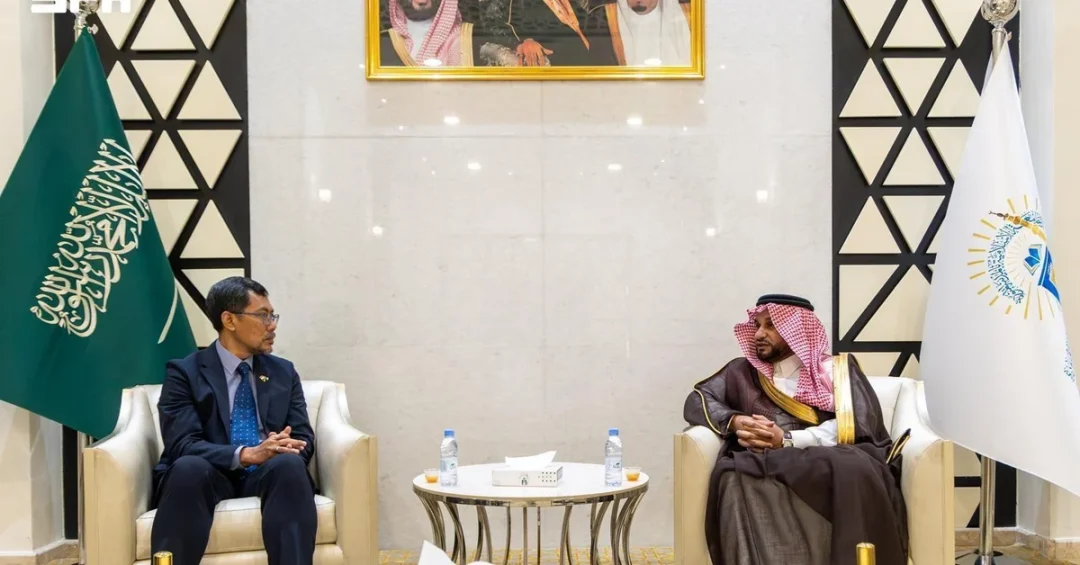
The Islamic University of Madinah received a delegation from the Consulate General of Singapore in Jeddah on Monday, with senior officials from both sides meeting to discuss ways of strengthening academic and cultural cooperation, according to the Saudi Press Agency. The meeting was held at the university’s headquarters in Madinah, where Dr. Ali Alzahrani, Vice President of the Islamic University of Madinah for Graduate Studies, Scientific Research and Innovation, welcomed Amrullah Zain, Deputy Consul General of Singapore in Jeddah, and the accompanying delegation.
The talks focused on expanding academic and cultural exchange between the Kingdom of Saudi Arabia and Singapore, reflecting the university’s stated efforts to build partnerships with international institutions and enhance its global presence. The encounter forms part of a broader pattern of engagement between Saudi higher education bodies and diplomatic missions accredited to the Kingdom, in which universities serve as platforms for scholarly collaboration, student mobility, and cross-cultural understanding. The Saudi Press Agency reported that the two sides discussed concrete avenues for cooperation, underscoring the university’s openness to international academic partnerships. The meeting also highlights how Saudi institutions of higher learning are increasingly acting as bridges between the Kingdom and the wider world, in line with the national direction toward global integration.
Context and Background
Why does a single meeting between a Saudi university and a foreign consulate matter in the wider picture of international education? The Islamic University of Madinah is one of the Kingdom’s most internationally oriented institutions of higher learning, drawing students from across Asia, Africa, Europe, and beyond. Its graduate programs, research centers, and scholarly networks give it a natural role in connecting Saudi Arabia with academic communities worldwide. When a diplomatic delegation from Singapore visits the campus, it signals interest not only in student exchange but in the longer-term development of institutional ties that can span faculties, research projects, and cultural programming.
Singapore, for its part, maintains a consulate presence in Jeddah and engages with Saudi institutions across a range of fields, from trade and investment to education and culture. The Deputy Consul General’s visit to Madinah therefore fits within a diplomatic mandate that extends beyond consular services into relationship-building. The presence of a delegation rather than a single official suggests that the discussions were intended to be substantive, covering multiple dimensions of possible cooperation. Saudi Arabia’s higher education sector has expanded its international footprint considerably in recent years, and visits of this kind are a practical expression of that outward orientation.
The university’s decision to highlight the meeting through official channels, and its reporting by the Saudi Press Agency, reflects the transparency with which Saudi institutions now communicate their international engagements. It also indicates that academic diplomacy is treated as a meaningful component of the Kingdom’s broader international relations, not merely a peripheral activity. For observers of Saudi education policy, the meeting is a useful indicator of how universities are being positioned as contributors to the national vision of global engagement.
Key Details of the Discussions
What specifically was on the table when the two delegations met? According to the Saudi Press Agency, the discussions centered on ways to strengthen cooperation and expand academic and cultural exchange. Dr. Ali Alzahrani, in his capacity as Vice President for Graduate Studies, Scientific Research and Innovation, represented the university’s research and postgraduate mission, a portfolio that is directly relevant to international collaboration. His counterpart, Deputy Consul General Amrullah Zain, represented Singapore’s diplomatic interests in the western region of Saudi Arabia.
The university described the meeting as part of its efforts to build partnerships with international institutions and enhance its global presence. That framing places the encounter within a deliberate institutional strategy rather than an isolated courtesy call. Academic exchange in this context can encompass visiting scholar arrangements, joint research initiatives, conference participation, and the hosting of international students. Cultural exchange can involve exhibitions, language programs, and mutual understanding initiatives that complement formal academic work.
While the Saudi Press Agency report did not disclose specific agreements or timelines, the fact that the two sides met at the university’s headquarters and discussed expansion of cooperation indicates a forward-looking agenda. Such meetings often lay groundwork for subsequent memoranda of understanding or program-level arrangements. The university’s leadership in graduate studies and scientific research suggests that any future collaboration would likely have a research dimension alongside teaching and cultural components, aligning with the institution’s core academic strengths.
International and Regional Impact
How does engagement between Saudi Arabia and Singapore resonate beyond the two countries? Singapore is a major Asian hub for finance, logistics, and higher education, and its universities are among the most globally connected in the world. Cooperation between a Saudi university and Singaporean academic or diplomatic representatives therefore creates a channel between the Kingdom and one of Asia’s most dynamic knowledge economies. For Saudi students and researchers, such links can open pathways to exchange programs and joint projects. For Singaporean institutions, they offer access to Saudi Arabia’s growing research capacity and its position as a gateway to the Middle East.
At the regional level, the meeting reinforces the Kingdom’s role as a convening space for international dialogue. Madinah itself carries profound cultural and religious significance, and hosting foreign academic delegations there adds a distinctive dimension to cooperation: it situates exchanges within a city of global heritage while pointing toward modern educational outcomes. The visit also reflects the wider trend of Asian engagement with the Gulf, in which education, culture, and people-to-people ties increasingly accompany trade and investment relationships. Saudi Arabia’s universities are active participants in that trend, and the Islamic University of Madinah’s international student body makes it a natural partner for Asian institutions seeking deeper connections with the Kingdom.
Economic and Strategic Significance
What economic and strategic value do academic and cultural partnerships create? International academic cooperation contributes to the development of human capital, which is central to Saudi Arabia’s long-term economic transformation. Research collaboration can support innovation in fields such as technology, health sciences, and sustainability, while student and faculty exchange builds networks that pay dividends across decades. For a university with a strong postgraduate and research mandate, partnerships with internationally oriented institutions such as those in Singapore can accelerate knowledge transfer and raise the institution’s global standing.
Strategically, the meeting demonstrates that Saudi Arabia’s international relationships are multidimensional. Diplomatic missions and universities working together create durable ties that are less vulnerable to short-term fluctuations than purely transactional arrangements. Cultural exchange, in particular, builds mutual understanding and goodwill, which are valuable assets in any bilateral relationship. The university’s explicit aim of enhancing its global presence aligns with the Kingdom’s broader ambition to be an active and respected participant in international affairs, and engagements of this kind contribute directly to that objective by creating visible, concrete examples of cooperation.
Vision 2030 Alignment
How does a university-level meeting connect to Saudi Arabia’s national transformation? Saudi Vision 2030 places education, international partnerships, and the development of a knowledge-based economy among its central pillars. The Islamic University of Madinah’s pursuit of partnerships with international institutions and its efforts to expand academic and cultural exchange are practical expressions of those priorities. By building links with a diplomatic and academic partner such as Singapore, the university advances the Vision’s goal of creating a globally connected, highly skilled society and a diversified economy underpinned by knowledge and innovation.
The meeting also reflects the Vision’s emphasis on the Kingdom’s role as a bridge between cultures and regions. Madinah, with its unique heritage and its international academic community, is well placed to serve that role. As Saudi universities continue to deepen their international engagement, encounters such as Monday’s discussion between Dr. Ali Alzahrani and Deputy Consul General Amrullah Zain become part of a larger story: a Kingdom that is open to the world, confident in its institutions, and committed to cooperation that benefits both its own people and its international partners. The Saudi Press Agency’s reporting of the meeting underscores the official commitment to transparency and to showcasing these forward-looking partnerships.
20 Questions
Q1. Who received the Singaporean delegation at the Islamic University of Madinah?
A1. Dr. Ali Alzahrani, Vice President of the Islamic University of Madinah for Graduate Studies, Scientific Research and Innovation, received the delegation at the university’s headquarters in Madinah, according to the Saudi Press Agency.
Q2. Who led the Singaporean delegation?
A2. The delegation was led by Amrullah Zain, Deputy Consul General of Singapore in Jeddah, who was accompanied by an accompanying delegation during the visit to the university’s headquarters.
Q3. When did the meeting take place?
A3. The meeting took place on Monday, as reported by the Saudi Press Agency, which published its dispatch on October 13, 2026, from Madinah.
Q4. What was the main topic of the discussions?
A4. The two sides discussed ways to strengthen cooperation and expand academic and cultural exchange between the university and Singaporean institutions, as part of the university’s partnership-building efforts.
Q5. What is the Islamic University of Madinah’s stated goal in holding such meetings?
A5. The university stated that the meeting was part of its efforts to build partnerships with international institutions and enhance its global presence, reflecting a deliberate strategy of international engagement.
Q6. Where was the meeting held?
A6. The meeting was held at the university’s headquarters in Madinah, the city in western Saudi Arabia that hosts the university and carries deep cultural and religious significance.
Q7. Which Saudi agency reported the meeting?
A7. The Saudi Press Agency, the Kingdom’s official news agency, reported the meeting, which is consistent with the transparent communication of official institutional engagements.
Q8. What does academic exchange typically involve in such partnerships?
A8. Academic exchange can include visiting scholar arrangements, joint research initiatives, conference participation, and the hosting of international students, all of which support knowledge transfer and institutional development.
Q9. What does cultural exchange usually encompass?
A9. Cultural exchange can involve exhibitions, language programs, and mutual understanding initiatives that complement formal academic work and build goodwill between countries and their peoples.
Q10. Why is Singapore a significant partner for Saudi academic institutions?
A10. Singapore is a major Asian hub for finance, logistics, and higher education, with globally connected universities, making it a valuable partner for research collaboration and student exchange.
Q11. How does this meeting fit into Saudi Arabia’s broader international engagement?
A11. It reflects the Kingdom’s pattern of engagement between Saudi higher education bodies and diplomatic missions, in which universities serve as platforms for scholarly collaboration and cross-cultural understanding.
Q12. What role does Madinah play in such international academic meetings?
A12. Madinah carries profound cultural and religious significance and hosts an international academic community, making it a distinctive setting for exchanges that combine heritage with modern educational outcomes.
Q13. Did the meeting produce any specific agreements?
A13. The Saudi Press Agency report did not disclose specific agreements or timelines, but the discussion of expanding cooperation indicates a forward-looking agenda that may lead to future arrangements.
Q14. How does academic cooperation contribute to Saudi Arabia’s economy?
A14. International academic cooperation develops human capital, supports innovation in fields such as technology and health sciences, and builds networks that contribute to a knowledge-based economy.
Q15. What is Dr. Ali Alzahrani’s portfolio at the university?
A15. Dr. Ali Alzahrani serves as Vice President for Graduate Studies, Scientific Research and Innovation, a portfolio directly relevant to international research collaboration and postgraduate academic development.
Q16. Why are diplomatic missions involved in university partnerships?
A16. Diplomatic missions build relationships beyond consular services, and their involvement in university partnerships creates durable ties that support education, culture, and people-to-people connections between countries.
Q17. How does this meeting align with Saudi Vision 2030?
A17. Saudi Vision 2030 prioritizes education, international partnerships, and a knowledge-based economy, and the university’s pursuit of global academic and cultural cooperation is a practical expression of those pillars.
Q18. What benefits could Saudi students gain from such cooperation?
A18. Saudi students and researchers could gain access to exchange programs, joint projects, and international academic networks, enhancing their skills and global exposure in line with national development goals.
Q19. What benefits could Singaporean institutions gain?
A19. Singaporean institutions could gain access to Saudi Arabia’s growing research capacity and its position as a gateway to the Middle East, opening opportunities for collaboration and regional engagement.
Q20. What is the broader significance of this meeting?
A20. The meeting exemplifies Saudi Arabia’s open, forward-looking international engagement, showing how its universities act as bridges between the Kingdom and the world in support of Vision 2030 objectives.
Reader Feedback
We value your thoughts. Please share your feedback on this article.
Your feedback helps us improve our coverage.
Related articles
 Madinah Concludes Swimming Literacy Project with 300 Students
 AlUla Program Trains 50 Youth in Public Speaking
 Najran Schools Adopt Winter Schedule Starting Sunday
 Najran University Climbs Four Places in QS Arab Rankings 2027
 Saudi Arabia Sets February 2027 Deadline for Worker Housing
 ETEC to Hold Third National Forum for School Excellence in Riyadh