


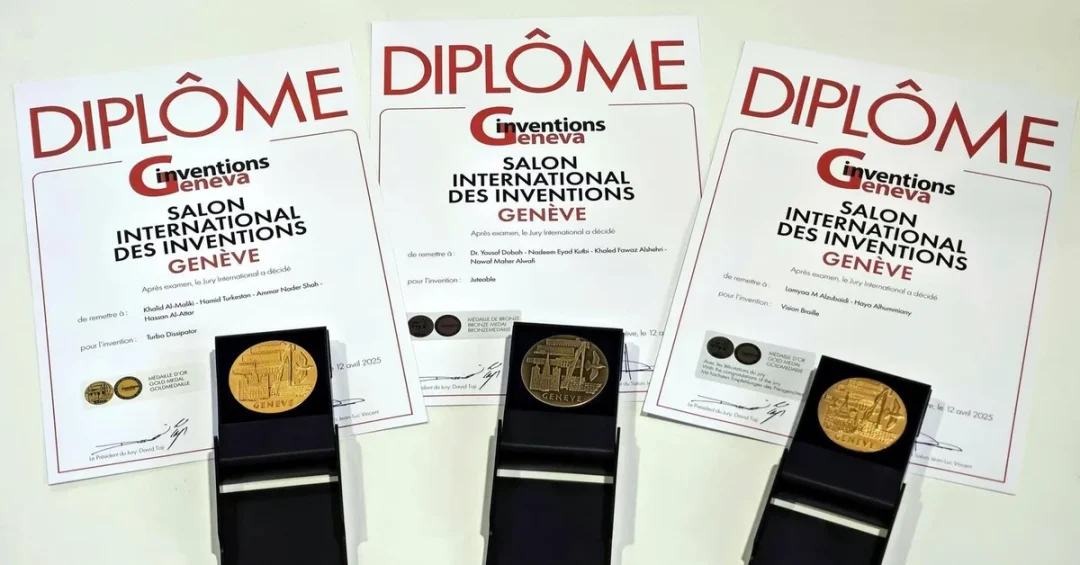
Students from the University of Jeddah have been awarded gold and bronze medals at the 50th Geneva International Exhibition of Inventions, one of the world’s most prestigious showcases for scientific creativity, according to an official announcement carried by the Saudi Press Agency (SPA). The recognition, confirmed by the university’s talent recruitment department, places Saudi student innovation firmly on the international stage and underscores the Kingdom’s growing capacity to compete in advanced research and development.
Could a single exhibition victory signal a broader shift in how the world views Saudi higher education? For observers of the Kingdom’s rapid transformation, the answer is already becoming clear. The University of Jeddah team’s success in Geneva reflects years of deliberate investment in human capital, research infrastructure, and a national culture that rewards curiosity and problem-solving. It also aligns directly with the objectives of Saudi Vision 2030, which places education, innovation, and the empowerment of young nationals at the heart of the nation’s long-term economic diversification strategy. The medals are not merely trophies; they are evidence that Saudi students can hold their own among the best inventors from dozens of countries.
Context and Background
How did a university from the Red Sea port city of Jeddah come to stand among the world’s most decorated academic institutions at an event that has historically celebrated breakthroughs from Europe, Asia, and North America? The Geneva International Exhibition of Inventions, now in its 50th edition, is widely regarded as the oldest and most important event of its kind. Held annually in Switzerland, it brings together inventors, researchers, startups, and universities from across the globe to present prototypes, patents, and applied technologies to a panel of international jurors. Winning a medal there is not a symbolic gesture; it is a rigorous peer-reviewed distinction that often attracts venture capital and licensing interest.
For the University of Jeddah, participation in such a forum is part of a deliberate institutional strategy. In recent years, the university has expanded its research centers, forged partnerships with industry, and launched dedicated programs to identify and nurture talented students from the moment they enter campus. Dr. Haya Alhummiany, head of the talent recruitment department, explained that the awards reflect the university’s sustained efforts to support gifted students, scientific research, and innovation. She noted that the achievement highlights the university’s leading role in empowering national talents and representing the Kingdom in global forums. That statement, while concise, captures a philosophy that has taken root across Saudi higher education: talent is a national resource, and it must be recruited, trained, and given a platform.
The timing of this success is significant. Saudi Arabia is in the middle of an ambitious period of university reform, with new emphasis on STEM fields, entrepreneurship, and applied research that can be commercialized. The Kingdom’s research spending has risen steadily, and Saudi universities are increasingly judged by international benchmarks such as patent filings, citation impact, and global competition results. In that context, medals won in Geneva function as tangible performance indicators. They show that Saudi institutions are not only participating in the global knowledge economy but are beginning to lead in specific niches. For a country that once relied heavily on hydrocarbon exports, the shift toward an innovation-driven model depends on exactly this kind of grassroots scientific achievement.
Key Details
What exactly did the Jeddah students invent, and why did the international jury single them out? While the official announcement did not disclose the full technical specifications of every project, the fact that the team returned with both gold and bronze medals indicates a portfolio of inventions that impressed evaluators across different categories. The Geneva exhibition typically recognizes inventions in fields such as engineering, medicine, information technology, environmental sustainability, and consumer products. Saudi students have previously won awards for projects ranging from water desalination improvements to medical diagnostic tools, and this year’s winners are believed to continue that tradition of practical, problem-oriented innovation.
Dr. Haya Alhummiany, in her capacity as head of the talent recruitment department at the University of Jeddah, served as the official voice of the achievement. Her statement, distributed via the Saudi Press Agency, emphasized that the medals are the result of institutional support rather than isolated brilliance. She pointed to the university’s programs that identify talented students early, provide them with mentorship, laboratory access, and funding, and then prepare them for international competitions. This systematic approach is a departure from the older model in which exceptional students often had to seek opportunities abroad. Now, the pathway from a Saudi classroom to a Geneva podium runs largely through domestic institutions.
The University of Jeddah itself has a relatively short but dynamic history. Established in 2014 as an independent institution, it has quickly grown into one of the Kingdom’s major comprehensive universities, with faculties spanning engineering, science, medicine, arts, and business. Its location in Jeddah—a historic gateway city and a commercial hub—gives it a natural orientation toward trade, logistics, and cross-cultural exchange. The university has also been active in hosting innovation fairs, hackathons, and research symposia that connect students with private-sector partners. The Geneva medals are therefore not a sudden anomaly but the visible tip of a sustained effort to build an ecosystem where invention is expected, supported, and celebrated.
International and Regional Impact
How will this achievement be received beyond Saudi Arabia’s borders, and what does it mean for the Kingdom’s standing in global science diplomacy? In the short term, the medals will enhance the University of Jeddah’s reputation among international academic networks and potential research collaborators. Universities in Europe, Asia, and North America increasingly look for partners with proven track records in innovation, and a Geneva award serves as an independent validation of quality. For Saudi Arabia, such recognition contributes to a broader narrative of transformation that is central to its international outreach. The Kingdom is actively seeking to attract foreign investment, host global events, and position itself as a knowledge hub, and student achievements in prestigious competitions support that effort.
Regionally, the success carries weight among Gulf Cooperation Council states, where competition in higher education and research is intensifying. Saudi Arabia’s large youth population—roughly two-thirds of citizens are under 35—makes the development of indigenous talent a strategic imperative. When Saudi students win in Geneva, it sends a signal to neighboring countries that the Kingdom’s investments in education are yielding measurable results. It also encourages intra-regional collaboration, as Gulf universities begin to share best practices in talent identification and research commercialization. The medals are thus both a national accomplishment and a contribution to the region’s collective scientific capacity.
Economic and Strategic Significance
Why should economists and business leaders pay attention to a student invention competition? The answer lies in the pipeline from laboratory to market. Inventions that win at Geneva often attract the attention of patent attorneys, angel investors, and corporate scouts. For Saudi Arabia, the ultimate goal is not simply to collect medals but to convert academic creativity into startups, licensed technologies, and high-value jobs. The University of Jeddah’s talent recruitment department is explicitly designed to bridge that gap, connecting student inventors with the resources they need to prototype, protect, and pitch their ideas. If even a fraction of these projects reach commercialization, the economic return on the university’s investment could be substantial.
Strategically, the achievement reinforces Saudi Arabia’s position in the global competition for talent. Countries around the world are racing to build innovation economies, and the winners will be those that can educate, retain, and deploy skilled individuals. By demonstrating that its students can win at the highest levels, Saudi Arabia makes itself more attractive to international researchers and partners. It also gives young Saudis a reason to pursue careers in science and engineering at home rather than seeking opportunities abroad. This aligns with the Vision 2030 goal of increasing the private sector’s contribution to GDP and reducing dependence on oil. Every patent, every startup, and every globally recognized invention moves the needle closer to that objective.
Vision 2030 Alignment
How does a pair of medals in Geneva connect to the sweeping national blueprint known as Saudi Vision 2030? The Vision, launched in 2016 under the leadership of Crown Prince Mohammed bin Salman, is built on three pillars: a vibrant society, a thriving economy, and an ambitious nation. Education and innovation cut across all three. The Human Capability Development Program, one of the Vision’s key executive programs, aims to equip citizens with the skills needed for the jobs of the future. The University of Jeddah’s success is a direct outcome of that program’s emphasis on early talent identification, STEM education, and international exposure. It shows that the Vision is not just a policy document but a lived reality for students who are now competing—and winning—on the world stage.
Looking ahead, the Kingdom’s long-term vision depends on sustaining and scaling this kind of achievement. The medals from Geneva are a milestone, but they also raise expectations. The next steps will involve expanding the pipeline of student inventors, deepening collaboration between universities and the private sector, and ensuring that successful prototypes receive the funding and regulatory support they need to reach the market. Saudi Arabia’s global role is evolving from that of an energy supplier to that of a knowledge producer, and the students of the University of Jeddah are among the pioneers of that transition. Their success in Geneva is a reminder that the most valuable resource of any nation is its people—and that when they are given the tools to innovate, the results can be world-class.
20 Questions
Q1. What did students from the University of Jeddah achieve at the 50th Geneva International Exhibition of Inventions?
A1. They won gold and bronze medals for their innovative projects, according to an official announcement carried by the Saudi Press Agency, highlighting the university’s growing role in global scientific competition.
Q2. Which official Saudi body reported the students’ success?
A2. The Saudi Press Agency (SPA) reported the achievement, citing Dr. Haya Alhummiany, head of the talent recruitment department at the University of Jeddah.
Q3. Who is Dr. Haya Alhummiany and what did she say about the awards?
A3. Dr. Haya Alhummiany is the head of the talent recruitment department at the University of Jeddah. She stated that the medals reflect the university’s efforts to support talented students, scientific research, and innovation.
Q4. What is the Geneva International Exhibition of Inventions?
A4. It is one of the world’s oldest and most prestigious showcases for inventors, held annually in Switzerland. The 50th edition brought together participants from dozens of countries to present new technologies and solutions.
Q5. Why is winning a medal at this exhibition significant?
A5. The exhibition is judged by international experts, and a medal provides independent validation of an invention’s quality. It can attract investors, patent interest, and research partnerships for the winners.
Q6. How does this achievement reflect on Saudi Arabia’s education system?
A6. It demonstrates that Saudi universities are successfully nurturing talent and producing graduates capable of competing globally. It also shows the impact of national investments in research and innovation.
Q7. What is the role of the talent recruitment department at the University of Jeddah?
A7. The department identifies gifted students early, provides them with mentorship, laboratory access, and funding, and prepares them for international competitions and research opportunities.
Q8. When was the University of Jeddah established?
A8. The University of Jeddah was established in 2014 as an independent institution. It has since grown into a major comprehensive university with faculties in engineering, science, medicine, arts, and business.
Q9. How does this success align with Saudi Vision 2030?
A9. Vision 2030 emphasizes education, innovation, and human capital development. The medals are a direct outcome of programs that support STEM education, early talent identification, and international exposure for Saudi students.
Q10. What fields of invention were likely represented by the winning projects?
A10. While full details were not released, the Geneva exhibition typically recognizes inventions in engineering, medicine, information technology, environmental sustainability, and consumer products.
Q11. How many students from the University of Jeddah participated in the exhibition?
A11. The official announcement did not specify the number of participants, but it confirmed that several students were awarded gold and bronze medals for their projects.
Q12. What benefits can the winning students expect from this recognition?
A12. They may receive offers for research collaboration, patent assistance, and venture capital interest. The medals also enhance their academic and professional profiles both in Saudi Arabia and abroad.
Q13. How does this achievement affect Saudi Arabia’s international reputation?
A13. It reinforces the Kingdom’s image as a rising knowledge economy and a country that invests in its youth. It also supports science diplomacy and attracts global research partnerships.
Q14. What is the significance of the 50th edition of the Geneva exhibition?
A14. The 50th edition marks a half-century of showcasing world-changing inventions. Winning at this milestone event adds historical weight to the students’ accomplishment.
Q15. Are there other Saudi universities that have won at Geneva?
A15. Yes, several Saudi institutions have previously won medals at the Geneva exhibition, reflecting a broader national trend of academic excellence and innovation across the Kingdom.
Q16. How does this success support Saudi Arabia’s economic diversification?
A16. By encouraging innovation and commercialization of new technologies, it helps build a knowledge-based economy less dependent on oil, in line with Vision 2030 goals.
Q17. What role do Saudi government ministries play in supporting such achievements?
A17. Ministries such as the Ministry of Education and the Ministry of Communications and Information Technology fund research, provide scholarships, and create policies that enable university innovation.
Q18. What message does this send to young Saudis?
A18. It shows that with hard work and institutional support, Saudi youth can compete and win at the highest international levels, encouraging more students to pursue science and engineering.
Q19. How can the private sector engage with these student inventors?
A19. Companies can partner with universities on research, sponsor innovation competitions, and provide mentorship or funding to help student projects reach the market.
Q20. What are the next steps for the University of Jeddah after this success?
A20. The university is expected to expand its talent programs, deepen industry collaboration, and support the winning students in patenting and commercializing their inventions, further advancing Saudi Arabia’s innovation ecosystem.
Reader Feedback
We value your thoughts. Please share your feedback on this article.
Your feedback helps us improve our coverage.
Related articles
 Madinah Concludes Swimming Literacy Project with 300 Students
 AlUla Program Trains 50 Youth in Public Speaking
 Najran Schools Adopt Winter Schedule Starting Sunday
 Najran University Climbs Four Places in QS Arab Rankings 2027
 Saudi Arabia Sets February 2027 Deadline for Worker Housing
 ETEC to Hold Third National Forum for School Excellence in Riyadh