


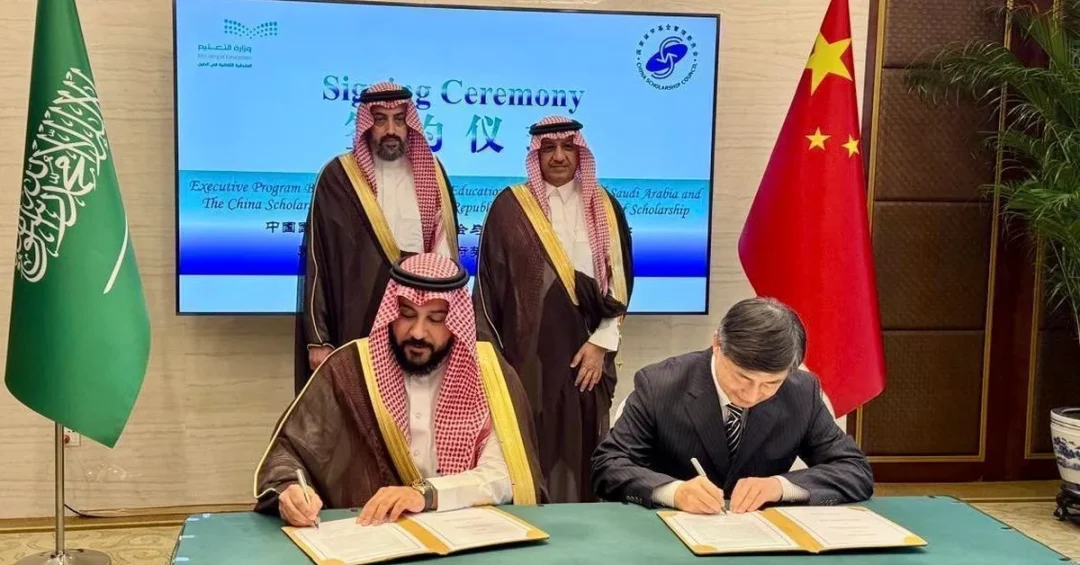
Saudi Arabia and China signed two memoranda of cooperation in Beijing on Monday to expand scholarship opportunities for Saudi students at top Chinese universities and introduce Chinese language education in Saudi public schools, according to the Saudi Press Agency (SPA). The agreements, signed by the Saudi Ministry of Education and its Chinese counterpart, mark a significant step in deepening educational ties between the two nations and align with the Kingdom’s Vision 2030 goal of fostering a knowledge-based economy and global engagement. The signing ceremony took place during a period of growing strategic partnership between Riyadh and Beijing, underscoring education as a cornerstone of bilateral relations.
The first memorandum, signed with the China Scholarship Council representing the Chinese Ministry of Education, focuses on securing seats for Saudi students in top Chinese universities and enhancing the implementation of scholarship programs. It also aims to increase opportunities for Saudi students in high-demand fields that are critical to the local job market. The second memorandum, signed with the Center for Language Education and Cooperation under the Chinese Ministry of Education, is part of an initiative to introduce Chinese language education in Saudi public schools starting this academic year. This collaboration will empower experts from both countries to develop a robust Chinese language curriculum. How might these agreements reshape the educational landscape for Saudi youth and strengthen the Kingdom’s global competitiveness?
Context and Background
What do these agreements reveal about the evolving nature of Saudi-China relations? The signing of these two memoranda is the latest development in a long-standing partnership that has steadily expanded across economic, political, and cultural domains. In recent years, Saudi Arabia and China have deepened cooperation under the framework of the Kingdom’s Vision 2030 and China’s Belt and Road Initiative, with education emerging as a key pillar of this strategic alignment. The agreements reflect a shared commitment to human capital development and cross-cultural understanding, which are essential for sustainable growth and innovation.
Saudi Arabia has historically sent students abroad to countries such as the United States, the United Kingdom, and Canada. However, the Kingdom has been diversifying its international education partnerships as part of a broader strategy to build a skilled workforce equipped for a multipolar world. China, with its rapid advancements in technology, engineering, and artificial intelligence, offers unique opportunities for Saudi students to gain expertise in fields that are vital to the Kingdom’s economic transformation. The new scholarship program is expected to facilitate access to these cutting-edge disciplines. How will this shift in educational focus influence Saudi Arabia’s future workforce and its ability to compete globally?
Meanwhile, the introduction of Chinese language education in Saudi public schools represents a forward-looking investment in cultural diplomacy. By teaching Chinese from an early age, Saudi Arabia aims to equip its youth with linguistic skills that will enhance their ability to engage with one of the world’s largest economies. This initiative also aligns with the Kingdom’s broader efforts to promote multilingualism and global awareness among its citizens, as outlined in Vision 2030’s human capability development program. What role will language education play in fostering deeper people-to-people ties between Saudi Arabia and China?
Key Details of the Agreements
What specific mechanisms will ensure the success of these educational partnerships? The first memorandum, signed with the China Scholarship Council, is designed to secure seats for Saudi students in prestigious Chinese universities. It includes provisions to streamline the application process, provide preparatory training, and offer support services to help students adapt to academic life in China. The agreement also prioritizes fields that are in high demand within the Saudi job market, such as engineering, computer science, renewable energy, and healthcare. This targeted approach ensures that returning graduates can directly contribute to the Kingdom’s economic diversification efforts.
The second memorandum, signed with the Center for Language Education and Cooperation, outlines a comprehensive plan to introduce Chinese language education in Saudi public schools. Starting this academic year, selected schools will pilot Chinese language courses, with the curriculum developed jointly by Saudi and Chinese experts. The collaboration includes teacher training, the development of textbooks and digital learning materials, and the establishment of assessment standards. This initiative is expected to expand gradually to more schools across the Kingdom, creating a pipeline of students proficient in Chinese. How will the integration of Chinese language into the Saudi curriculum impact students’ cognitive development and cultural awareness?
Both agreements emphasize the exchange of expertise and best practices. Saudi educators will have opportunities to participate in professional development programs in China, while Chinese experts will share their knowledge of curriculum design and pedagogy. This reciprocal exchange is intended to build local capacity and ensure the long-term sustainability of the initiatives. The agreements also call for the establishment of joint committees to monitor progress and address challenges. What challenges might arise in implementing these ambitious programs, and how can they be mitigated through bilateral cooperation?
International and Regional Impact
How will these agreements influence Saudi Arabia’s standing in the region and beyond? The Saudi-China educational partnership is likely to have ripple effects across the Middle East and North Africa, where many countries are also seeking to diversify their international alliances and upgrade their education systems. By positioning itself as a leader in educational cooperation with China, Saudi Arabia reinforces its role as a regional hub for knowledge and innovation. This could attract other nations to follow suit, fostering a more multipolar approach to global education.
On the international stage, the agreements signal Saudi Arabia’s commitment to building bridges with major powers beyond traditional Western partners. This aligns with the Kingdom’s foreign policy objective of maintaining balanced and mutually beneficial relationships with all global players. The educational exchanges are also expected to enhance people-to-people ties, which are essential for long-term diplomatic and economic cooperation. As Saudi students return with expertise in Chinese language and technical fields, they will become ambassadors of goodwill and drivers of bilateral trade and investment. What impact might this have on the global balance of educational exchange and soft power?
Economic and Strategic Significance
What economic benefits can Saudi Arabia expect from these educational initiatives? The scholarship program is designed to produce graduates with skills that are directly relevant to the Kingdom’s economic diversification goals. By focusing on high-demand fields, the program ensures that Saudi students acquire expertise that can be applied in key sectors such as technology, renewable energy, and advanced manufacturing. This, in turn, will support the growth of non-oil industries and reduce dependence on hydrocarbon revenues, a core objective of Vision 2030.
Furthermore, the introduction of Chinese language education in public schools will create a generation of Saudis who can communicate effectively with Chinese businesses and investors. As China remains Saudi Arabia’s largest trading partner, proficiency in Chinese will facilitate smoother commercial interactions, joint ventures, and technology transfer. This linguistic capability is a strategic asset that can enhance the Kingdom’s attractiveness as a destination for Chinese investment and as a gateway to the broader Middle East. How will these educational investments translate into tangible economic outcomes for Saudi Arabia in the coming decade?
Vision 2030 Alignment
How do these agreements embody the aspirations of Saudi Vision 2030? The memoranda are a direct reflection of Vision 2030’s Human Capability Development Program, which seeks to equip Saudi citizens with the knowledge and skills needed to thrive in a rapidly changing global economy. By expanding access to international education and promoting language learning, the agreements support the Kingdom’s goal of creating a diversified, knowledge-based economy. They also reinforce the vision’s emphasis on global engagement and cultural exchange as drivers of progress.
Moreover, the partnerships with China demonstrate Saudi Arabia’s proactive approach to international collaboration, which is essential for achieving the ambitious targets of Vision 2030. The Kingdom is not only investing in its own people but also building enduring relationships with key global powers. This forward-looking strategy will help Saudi Arabia navigate the complexities of the 21st century and emerge as a leader in innovation, education, and cross-cultural understanding. As these programs take root, they will undoubtedly contribute to the Kingdom’s long-term prosperity and its role as a bridge between civilizations. How will the success of these initiatives inspire further educational collaborations between Saudi Arabia and other nations?
20 Questions
Q1. What did Saudi Arabia and China sign on Monday?
A1. They signed two memoranda of cooperation to enhance educational ties, focusing on scholarship programs for Saudi students in China and the introduction of Chinese language education in Saudi public schools.
Q2. Which Saudi ministry signed these agreements?
A2. The Saudi Ministry of Education signed the agreements with its Chinese counterpart during a ceremony in Beijing, as reported by the Saudi Press Agency.
Q3. What is the purpose of the first memorandum?
A3. The first memorandum, signed with the China Scholarship Council, aims to secure seats for Saudi students in top Chinese universities and increase opportunities in high-demand fields for the local job market.
Q4. Which Chinese body represented the Ministry of Education in the first agreement?
A4. The China Scholarship Council represented the Chinese Ministry of Education in signing the first memorandum, facilitating scholarship programs and academic exchanges.
Q5. What does the second memorandum focus on?
A5. The second memorandum, signed with the Center for Language Education and Cooperation, focuses on introducing Chinese language education in Saudi public schools starting this academic year.
Q6. When will Chinese language education begin in Saudi schools?
A6. The initiative to introduce Chinese language education in Saudi public schools will start this academic year, with a curriculum developed jointly by Saudi and Chinese experts.
Q7. How will the scholarship program benefit Saudi students?
A7. It will provide access to top Chinese universities, enhance scholarship implementation, and increase opportunities in high-demand fields, helping students contribute to Saudi Arabia’s economic diversification.
Q8. What fields are considered high-demand for Saudi students?
A8. Fields such as engineering, computer science, renewable energy, and healthcare are prioritized to align with Saudi Arabia’s job market needs and Vision 2030 goals.
Q9. How does this collaboration align with Vision 2030?
A9. It supports the Human Capability Development Program by equipping Saudis with global skills, promoting language learning, and fostering a knowledge-based economy.
Q10. What role will Saudi and Chinese experts play?
A10. Experts from both countries will collaborate to develop a robust Chinese language curriculum, share best practices, and provide teacher training for sustainable implementation.
Q11. How will the agreements enhance educational ties?
A11. They facilitate exchange of expertise, increase student mobility, and promote cross-cultural understanding, strengthening the strategic partnership between Saudi Arabia and China.
Q12. What is the significance of Chinese language in Saudi schools?
A12. It prepares Saudi youth to engage with China, a major economic partner, enhancing communication skills and cultural awareness for future collaboration.
Q13. How many memoranda were signed?
A13. Two memoranda were signed: one for scholarships and one for language education, both aimed at deepening educational cooperation.
Q14. What is the China Scholarship Council?
A14. It is a non-profit organization under the Chinese Ministry of Education that manages scholarship programs for international students, including those from Saudi Arabia.
Q15. What is the Center for Language Education and Cooperation?
A15. It is a Chinese Ministry of Education center that promotes Chinese language and cultural exchange globally, now partnering with Saudi Arabia for curriculum development.
Q16. How will these agreements impact Saudi Arabia’s job market?
A16. They will produce graduates with skills in high-demand fields, supporting economic diversification and reducing reliance on oil by filling critical roles in emerging sectors.
Q17. Will these programs be expanded to more schools?
A17. Yes, the language initiative is expected to expand gradually to more public schools across the Kingdom, creating a broader pipeline of Chinese-speaking students.
Q18. What support will Saudi students receive in China?
A18. They will receive preparatory training, support services, and streamlined application processes to help them adapt to academic and cultural life in China.
Q19. How does this partnership reflect Saudi Arabia’s foreign policy?
A19. It demonstrates the Kingdom’s commitment to balanced global engagement, building strong ties with major powers like China while advancing mutual interests.
Q20. What long-term benefits can Saudi Arabia expect?
A20. A skilled workforce, enhanced cultural diplomacy, stronger economic ties with China, and progress toward Vision 2030’s goals of prosperity and global leadership.
Reader Feedback
We value your thoughts. Please share your feedback on this article.
Your feedback helps us improve our coverage.
Related articles
 Saudi Education Minister Strengthens Academic Ties with Chinese Universities
 Umm Al-Qura University Rises to 137th in THE Asia Rankings
 Al-Rabiah Empowers Saudi Students in London for National Service
 Ehsan Endowment Fund Drives Charitable Projects in Saudi Arabia
 WAMY Commends Saudi Arabia’s Exemplary Elderly Care Efforts
 Purple Saturday Returns July 26 to Support, Empower People with Disabilities