


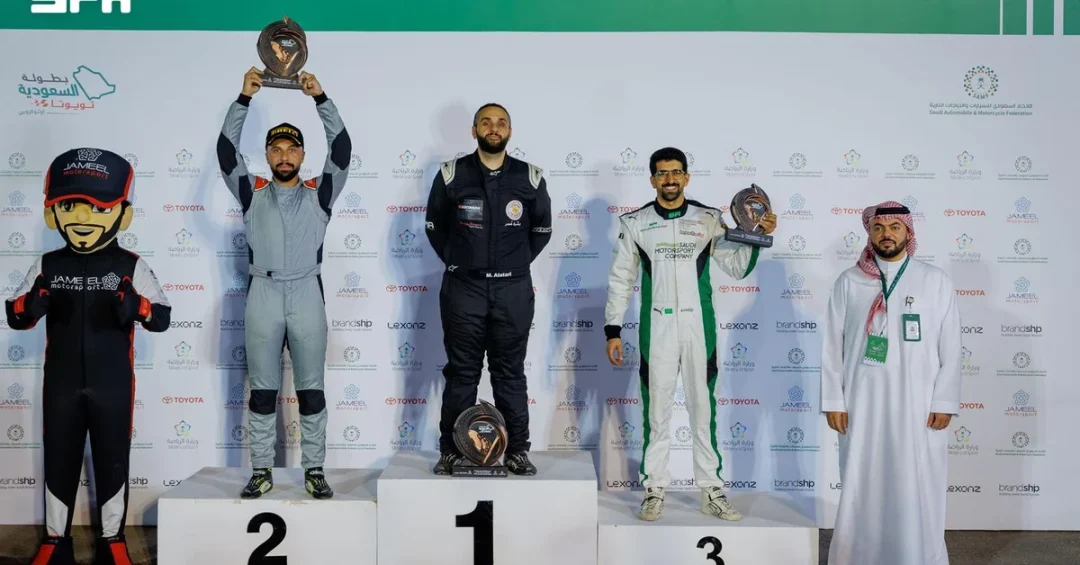
The second round of the 2026 Saudi Toyota Championship Autocross concluded in Al-Ahsa Governorate, with Mustafa Al-Attari setting the fastest time of the weekend at 1 minute, 9.894 seconds. The event, held under the supervision of the Saudi Automobile and Motorcycle Federation (SAMF), managed by Bakhashab Motorsport, and organized in partnership with Jameel Motorsport as the championship’s official partner, attracted 43 male and female competitors across 10 categories, in addition to a dedicated Women’s Cup. The round underscored the Kingdom’s growing capacity to host competitive motorsport at a professional standard, combining technical organization, safety management, and broad participation.
Hisham Al-Najjar finished second with a time of 1 minute, 12.786 seconds, while Ahmed bin Khunain took third place in 1 minute, 14.947 seconds. Beyond the podium, the round demonstrated the depth of Saudi motorsport infrastructure: 35 members of the Saudi Race Organizers Club, alongside 42 organizers and security personnel, managed track readiness, start and finish points, competitor and vehicle movement, and safety procedures. Their work ensured the competition proceeded according to the approved schedule, a detail that matters as Saudi Arabia positions itself as a regional hub for motorsport. The third and final round is scheduled for November 27 and 28 in Jeddah Governorate, where the 2026 season standings will be decided. Could this be the moment when Saudi autocross shifts from a national pastime to a globally recognized discipline?
Context and Background
What makes the Saudi Toyota Championship Autocross more than just a weekend of racing? The series is held under the supervision of the Saudi Automobile and Motorcycle Federation, which operates as part of broader national efforts to develop motorsports in the Kingdom, broaden participation, and provide competitive opportunities for drivers in accordance with approved regulations and safety standards. The championship is not an isolated event but a structured pathway that allows drivers to compete consistently across multiple rounds, accumulate points, and measure their progress against a growing field of talent. The Al-Ahsa round, following an earlier opening round, reflects a deliberate calendar designed to build momentum through the season.
Al-Ahsa Governorate itself is significant in this context. Located in the Eastern Province, it is known for its UNESCO-listed oasis and its role as an agricultural and cultural center. Hosting a national motorsport round there signals that the championship is not confined to the major metropolitan centers of Riyadh or Jeddah. Instead, it reaches into communities across the Kingdom, bringing competitive sport closer to audiences that might otherwise only watch from a distance. This geographic spread aligns with a wider philosophy of inclusive development, where regions beyond the capital benefit from national events and the economic and social activity they generate.
The involvement of Bakhashab Motorsport, a name long associated with Saudi rallying and motorsport management, adds a layer of continuity and expertise. The partnership with Jameel Motorsport as the championship’s official partner further strengthens the commercial and operational backbone of the series. Together, these entities form a network that combines regulatory oversight, event management, and private-sector support, a model that has become increasingly common in Saudi sport as the Kingdom expands its events calendar. Isn’t it telling that a national championship can now rely on such a professional ecosystem?
Key Details and Competitive Outcomes
What does it take to top a field of 43 competitors across 10 categories? Mustafa Al-Attari’s fastest time of 1 minute, 9.894 seconds was not merely a quick lap; it represented the culmination of preparation, vehicle setup, and precise execution on a track that demanded consistency. Hisham Al-Najjar’s second-place time of 1 minute, 12.786 seconds and Ahmed bin Khunain’s third-place finish at 1 minute, 14.947 seconds show that the margins were measurable but not insurmountable, pointing to a competitive balance that keeps the championship engaging for participants and spectators alike. The presence of a Women’s Cup alongside the main categories is equally notable, reflecting a deliberate effort to ensure female drivers have a visible and supported platform.
The operational scale of the round deserves attention. A total of 35 members of the Saudi Race Organizers Club worked alongside 42 organizers and security personnel. Their responsibilities were wide-ranging: monitoring track readiness, managing start and finish points, controlling the movement of competitors and vehicles, and implementing safety procedures. These are not peripheral tasks; they are the foundation of a credible motorsport event. Without rigorous organization, even the fastest drivers cannot compete safely or fairly. The fact that the round concluded according to the approved schedule is a testament to the planning and coordination involved.
Ten categories plus the Women’s Cup means the championship accommodates different vehicle classes and skill levels, allowing newcomers and experienced drivers to compete in appropriate groupings. This structure encourages participation from a broad demographic and creates a ladder of progression. For a driver, moving from one category to another is a marker of development. For the sport, it ensures that the talent pool is not limited to a small elite but is continuously refreshed. The Al-Ahsa round thus served as both a competition and a talent identification exercise, with implications for the national motorsport pipeline.
International and Regional Impact
How does a national autocross round in Al-Ahsa connect to Saudi Arabia’s wider regional role? The Kingdom has invested heavily in becoming a destination for major international sporting events, from Formula 1 to the Dakar Rally and beyond. A strong domestic championship is a necessary complement to those headline events. It builds a base of local drivers, officials, and organizers who can then contribute to larger international competitions. When SAMF supervises a series like the Saudi Toyota Championship, it is effectively nurturing the human capital that international motorsport requires. The Al-Ahsa round, with its 43 competitors and extensive officiating team, is a microcosm of that effort.
Regionally, motorsport is growing across the Gulf, and Saudi Arabia’s structured approach gives it a distinct advantage. By adhering to approved regulations and safety standards, the championship aligns with international norms, which in turn makes Saudi events more attractive to global partners and manufacturers. The involvement of Toyota, through the championship’s branding, and Jameel Motorsport as official partner, illustrates how commercial stakeholders see value in the series. This commercial confidence is not incidental; it reflects a broader recognition that Saudi motorsport is organized, well-attended, and capable of delivering returns on investment. Could the next generation of Saudi drivers emerge from rounds like this one and compete on the world stage? The pathway is being built, round by round.
Economic and Strategic Significance
What is the economic value of a national motorsport championship beyond the race itself? Events like the Al-Ahsa round generate local spending on hospitality, transport, and services. They create temporary employment for organizers, security personnel, and support staff. They also stimulate interest in automotive-related businesses, from parts and servicing to vehicle sales. Over time, a successful championship can support a motorsport industry cluster, including teams, workshops, and training facilities. The Saudi Toyota Championship, by holding rounds in different governorates, distributes these benefits geographically rather than concentrating them in one city.
Strategically, motorsport contributes to Saudi Arabia’s goals of diversifying the economy and enhancing quality of life. It is part of the broader entertainment and sports sector that the Kingdom has been developing as an alternative to hydrocarbon dependence. The skills acquired in event management, safety oversight, and logistics are transferable to other sectors. Moreover, a vibrant motorsport scene encourages youth engagement in science, technology, engineering, and mathematics, as vehicle preparation and performance analysis require technical knowledge. The Al-Ahsa round, with its mix of competition and organization, thus has a ripple effect that extends beyond the track. Isn’t that the kind of multiplier effect that sustainable development strategies aim for?
Vision 2030 Alignment
How does a national autocross championship fit into Vision 2030? Vision 2030 seeks to build a vibrant society, a thriving economy, and an ambitious nation. Sports and entertainment are explicitly part of that vision, with targets for increased participation and expanded event calendars. The Saudi Toyota Championship Autocross, supervised by SAMF and supported by partners like Bakhashab Motorsport and Jameel Motorsport, directly contributes to these targets by providing organized, regulated, and inclusive competition. The Women’s Cup is particularly aligned with the vision’s emphasis on empowering women and broadening their participation in all fields, including sport.
As the championship moves to its final round in Jeddah on November 27 and 28, where the 2026 season standings will be decided, the focus will shift to the culmination of months of effort. Jeddah, already a major sporting and cultural hub, will host the decisive races. The Al-Ahsa round will be remembered as a key step in that journey, demonstrating that the Kingdom can stage competitive motorsport in a regional setting with professionalism and safety. For ksa.com and its editors, including Harry Stuckler, this is another example of Saudi Arabia’s forward momentum under Vision 2030, where sport serves as a bridge between tradition and modernity, and where local talent is given the stage to shine. The road to Jeddah is now set, and the final chapter of the 2026 season promises to be a fitting conclusion to a championship that continues to raise the bar for Saudi motorsport.
20 Questions
Q1. Where did the second round of the 2026 Saudi Toyota Championship Autocross take place?
A1. The second round was held in Al-Ahsa Governorate, in the Eastern Province of Saudi Arabia. The event concluded successfully and was supervised by the Saudi Automobile and Motorcycle Federation.
Q2. Who recorded the fastest time in the Al-Ahsa round?
A2. Mustafa Al-Attari recorded the fastest time of 1 minute, 9.894 seconds, topping the overall standings. His performance was the standout result of the round.
Q3. How many competitors participated in the round?
A3. A total of 43 male and female competitors took part across 10 categories, in addition to the Women’s Cup. This broad participation reflects growing interest in Saudi motorsport.
Q4. Who finished second and third in the overall standings?
A4. Hisham Al-Najjar finished second with a time of 1 minute, 12.786 seconds. Ahmed bin Khunain came third in 1 minute, 14.947 seconds.
Q5. Which organization supervised the championship round?
A5. The Saudi Automobile and Motorcycle Federation supervised the round. It oversees motorsport development in the Kingdom and ensures competitions follow approved regulations and safety standards.
Q6. Who managed the event and who was the official partner?
A6. Bakhashab Motorsport managed the event, while Jameel Motorsport served as the championship’s official partner. Both contributed to the operational and commercial success of the round.
Q7. How many organizers and security personnel supported the round?
A7. A total of 35 members of the Saudi Race Organizers Club, along with 42 organizers and security personnel, supported the round. They managed track readiness, safety, and competitor movement.
Q8. What were the responsibilities of the organizing team?
A8. Their responsibilities included monitoring track readiness, managing start and finish points, controlling competitor and vehicle movement, and implementing safety procedures to keep the event on schedule.
Q9. When and where is the third and final round scheduled?
A9. The third and final round is scheduled for November 27 and 28 in Jeddah Governorate. The final standings for the 2026 season will be decided there.
Q10. What is the purpose of the Saudi Toyota Championship Autocross?
A10. The championship aims to develop motorsports in the Kingdom, broaden participation, and provide competitive opportunities for drivers in accordance with approved regulations and safety standards.
Q11. How many categories were featured in the Al-Ahsa round?
A11. There were 10 categories for male and female competitors, plus a separate Women’s Cup. This structure allows different vehicle classes and skill levels to compete fairly.
Q12. Why is the Women’s Cup significant?
A12. The Women’s Cup provides a dedicated platform for female drivers, supporting broader participation and aligning with Saudi Arabia’s efforts to empower women in sport and society.
Q13. What does the Al-Ahsa round indicate about Saudi motorsport?
A13. It shows that Saudi motorsport is well-organized, professionally managed, and capable of hosting competitive events across different regions of the Kingdom with strong safety standards.
Q14. How does the championship support local communities?
A14. By holding rounds in different governorates like Al-Ahsa, the championship brings economic activity, entertainment, and sporting opportunities to local communities beyond major cities.
Q15. What role does the Saudi Automobile and Motorcycle Federation play?
A15. The Federation supervises the championship, ensures compliance with regulations, oversees safety standards, and works to develop motorsport talent and infrastructure across Saudi Arabia.
Q16. How does the event align with Vision 2030?
A16. It supports Vision 2030 by promoting sports participation, empowering women, developing youth skills, and contributing to a vibrant society and diversified economy through entertainment and sporting events.
Q17. What economic benefits can such events bring?
A17. They generate local spending on hospitality, transport, and services, create temporary jobs, and stimulate automotive-related businesses, supporting economic diversification and regional development.
Q18. What safety measures were implemented during the round?
A18. Safety procedures included monitoring track readiness, managing start and finish points, controlling vehicle and competitor movement, and ensuring all activities followed approved regulations to protect participants and spectators.
Q19. How does the championship help develop Saudi drivers?
A19. It provides a structured competitive environment where drivers can gain experience, measure progress, and advance through categories, helping to build a pipeline of skilled Saudi talent for national and international competition.
Q20. What is next for the 2026 Saudi Toyota Championship Autocross?
A20. The final round in Jeddah on November 27 and 28 will decide the 2026 season standings. It will be the culmination of the championship and a key moment for all competitors.
Reader Feedback
We value your thoughts. Please share your feedback on this article.
Your feedback helps us improve our coverage.