


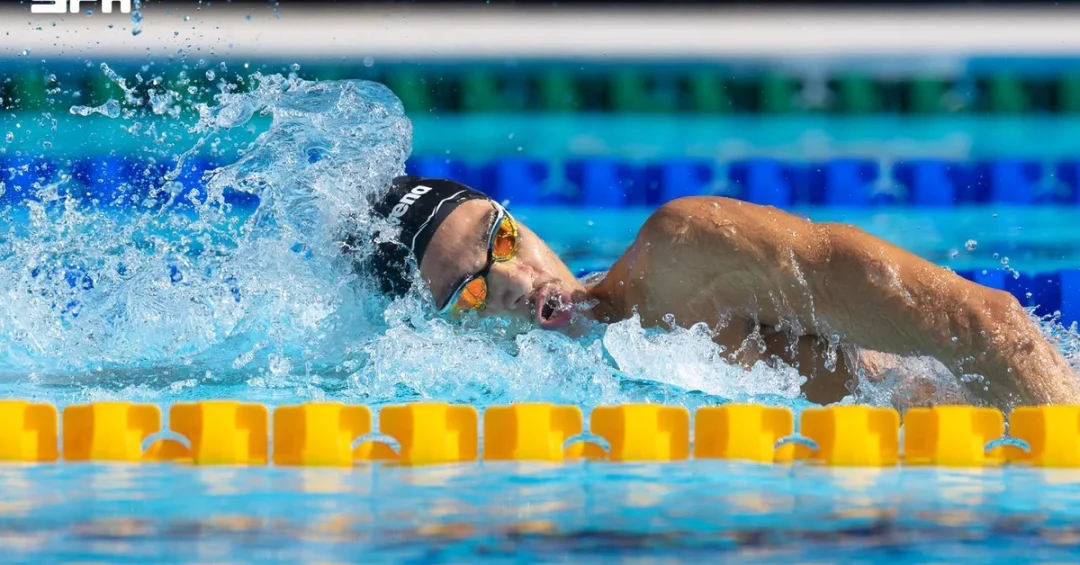
Saudi swimmer Rami Bilal Al-Rahmouni concluded his participation in the Dakar 2026 Youth Olympic Games on Friday after being disqualified from the men’s 200-meter freestyle for a false start, despite recording the fastest time in the event at 1:49.55, according to the Saudi Press Agency. The disqualification closed a remarkable chapter for the young athlete, who only days earlier had delivered one of the most celebrated moments in the history of Saudi swimming. His journey in the Senegalese capital has captured the attention of sports followers across the Kingdom and beyond, illustrating both the fine margins of elite competition and the rising ambition of Saudi youth on the global stage.
The outcome in the 200-meter event, while disappointing on the scoreboard, does little to diminish what Al-Rahmouni achieved during the Games. A false start at the highest level of age-group competition underscores how precision, discipline, and composure separate champions from contenders, and it is a lesson the Saudi delegation will carry forward. Could any observer have imagined, when the Games began, that a Saudi swimmer would leave Dakar with an Olympic gold and the fastest recorded time in another discipline? The answer speaks volumes about the trajectory of Saudi sport.
Context and Background
The Dakar 2026 Youth Olympic Games represent a landmark moment for international youth sport, marking the first time the Youth Olympic Games have been staged on the African continent. For the Kingdom of Saudi Arabia, participation in such a global multi-sport event reflects a broader national commitment to developing competitive athletes across a wide range of disciplines. Why does youth competition matter so much to a sporting nation’s future? Because it is at this level that foundation, coaching, and ambition converge to produce the champions of tomorrow.
Al-Rahmouni’s campaign in Dakar was built on a standout performance in the men’s 400-meter freestyle on Tuesday, when he touched the wall in 3:47.86 to claim gold. That victory secured Saudi swimming’s first-ever Olympic gold medal and the Saudi team’s second gold in Youth Olympic Games history. Such milestones do not occur in isolation; they emerge from sustained investment in talent identification, training infrastructure, and international exposure, areas that have received increasing attention under the Kingdom’s broader sporting development strategy.
The presence of Saudi athletes in swimming and boxing at Dakar 2026 also signals the widening footprint of Saudi sport beyond its traditional strengths. Has the Kingdom ever fielded such a diverse and competitive delegation at a global youth event? Each edition of these Games adds a new layer to a fast-evolving story, and Dakar is proving to be a defining chapter for a generation of young Saudi athletes eager to test themselves against the world’s best.
A Golden Breakthrough in the Pool
The gold medal in the 400-meter freestyle stands as the centerpiece of Al-Rahmouni’s Dakar campaign and as a historic first for Saudi swimming. Clocking 3:47.86 in a Youth Olympic final demands both tactical maturity and physical endurance, qualities that the young swimmer displayed in full view of an international audience. What does it mean for a nation to win its first Olympic gold in a sport where it has long been an emerging presence? It means the ceiling has been raised, and the pathway for future swimmers has been illuminated.
The significance of this result extends beyond the medal itself. It validated the preparation of the Saudi coaching staff, the support of the national federation, and the dedication of an athlete who trained with a clear objective. For young Saudis watching from home, the achievement offers tangible proof that world-class performance is attainable through commitment and proper guidance, a message that resonates far beyond the pool deck in Dakar.
The 200-meter freestyle on Friday offered a contrasting narrative. Al-Rahmouni produced the fastest time of the competition at 1:49.55, a mark that underlines his raw speed and competitive form. Yet a false start, adjudicated under strict international swimming rules, ended his participation in the event. Are such technical setbacks not part of every athlete’s education? They are, and how a competitor responds to them often defines the arc of a career more than any single victory.
Al-Ghazwani Prepares for Boxing Debut
While the swimming campaign concluded, attention within the Saudi delegation now shifts to the boxing ring, where 16-year-old Naif Al-Ghazwani will make his debut on Monday against Sweden’s Ali Zaheer Changezi in the men’s 55-kilogram quarterfinals. Al-Ghazwani enters the bout after receiving a first-round bye, a position that has allowed him additional preparation time while his opponent has already tested himself in competition. How will the young Saudi boxer handle the pressure of a first appearance on such a stage? His preparation and composure will provide the answer.
The 55-kilogram division is known for its speed, tactical nuance, and demand for sharp footwork, and a quarterfinal debut against a seasoned Swedish opponent presents a genuine test. Al-Ghazwani’s participation reflects the growing depth of Saudi boxing, a sport that has gained momentum through grassroots programs, dedicated coaching, and increasing opportunities for young athletes to compete internationally. At just 16, he represents the youngest wave of Saudi sporting talent now stepping onto the global stage.
The bye in the first round is a meaningful advantage in tournament boxing, preserving energy and allowing focused tactical preparation. Yet it also means the quarterfinal will be Al-Ghazwani’s first competitive outing of the Games, adding an element of unpredictability. Can a debutant channel nerves into sharpness when the bell rings? That is the question every young fighter must answer, and Monday’s bout will offer the first indication of how far this promising Saudi talent can go.
International and Regional Impact
Saudi Arabia’s performances at Dakar 2026 resonate across the region, where investment in youth sport is increasingly viewed as a driver of national pride and social development. The gold medal in swimming and the emergence of a competitive young boxer project an image of a Kingdom advancing confidently across diverse sporting disciplines. What impression does this create among international audiences and sporting federations? It reinforces the view of Saudi Arabia as a serious and rising participant in global sport, capable of producing athletes who compete at the highest level.
The Youth Olympic Games themselves serve as a bridge between junior competition and the senior Olympic stage, and Saudi success here signals a pipeline of talent that could feature at future Olympic Games. Regional neighbors and international observers alike will note the breadth of the Saudi delegation, which spans aquatics and combat sports. Does this not suggest that the Kingdom’s sporting ambitions are both broad and deliberate? It does, and Dakar 2026 will be remembered as a milestone in that ongoing development.
Economic and Strategic Significance
Behind every elite performance lies an ecosystem of investment: training facilities, coaching expertise, sports science, and competition opportunities. Saudi Arabia’s growing presence in international sport is closely tied to strategic investments in infrastructure and human capital, priorities that align with the diversification goals at the heart of the national transformation agenda. How does a swimming gold medal connect to economic strategy? By demonstrating that investment in people and institutions yields world-class results, it strengthens the case for continued development across sectors.
Sport also carries significant soft-power value, enhancing international recognition and fostering people-to-people connections. The achievements of athletes such as Al-Rahmouni and the promise of competitors like Al-Ghazwani contribute to a positive global narrative about Saudi youth, ambition, and capability. These stories travel quickly across international media and social platforms, amplifying the Kingdom’s message of progress and opening doors for collaboration in sport, education, and culture.
The strategic significance extends to grassroots participation as well. Visible role models inspire younger children to take up sport, feeding the talent pipeline for years to come. Is it any surprise that nations investing in youth sport today are producing champions tomorrow? The evidence from Dakar suggests a clear correlation, and Saudi Arabia appears intent on building on this momentum with sustained commitment and long-term planning.
Vision 2030 Alignment
The achievements at Dakar 2026 align directly with the objectives of Saudi Vision 2030, which places quality of life, youth empowerment, and international engagement among its central pillars. By supporting young athletes to compete at the highest levels, the Kingdom advances its goal of nurturing a healthy, active, and globally connected society. Does a single gold medal embody an entire national vision? Not on its own, but it serves as a powerful symbol of what that vision can produce when opportunity meets determination.
As the delegation turns its attention to Al-Ghazwani’s quarterfinal bout on Monday, the broader message of Dakar 2026 remains one of progress and promise. Saudi Arabia’s athletes are competing with distinction across disciplines, carrying the aspirations of a nation that is investing in its youth and asserting its place in the global sporting community. The road from Dakar leads onward, toward future Games and future generations inspired by what they have witnessed, and the Kingdom stands ready to build on every step of that journey.
20 Questions
Q1. What was the outcome of Rami Bilal Al-Rahmouni’s 200-meter freestyle race at Dakar 2026?
A1. Al-Rahmouni was disqualified from the men’s 200-meter freestyle for a false start on Friday, despite having recorded the fastest time in the event at 1:49.55, according to the Saudi Press Agency.
Q2. What historic achievement did Al-Rahmouni accomplish earlier at the Games?
A2. He won gold in the men’s 400-meter freestyle on Tuesday with a time of 3:47.86, securing Saudi swimming’s first Olympic gold medal and the Saudi team’s second gold in Youth Olympic Games history.
Q3. Where were the Dakar 2026 Youth Olympic Games held?
A3. The Games were held in Dakar, the capital of Senegal, marking the first time the Youth Olympic Games have been staged on the African continent.
Q4. What time did Al-Rahmouni record in the 400-meter freestyle final?
A4. He clocked 3:47.86 in the men’s 400-meter freestyle final, a performance that earned him the gold medal and made history for Saudi swimming.
Q5. Who is Naif Al-Ghazwani and when will he compete?
A5. Naif Al-Ghazwani is a 16-year-old Saudi boxer who will make his debut on Monday in the men’s 55-kilogram quarterfinals at the Dakar 2026 Youth Olympic Games.
Q6. Who is Al-Ghazwani’s opponent in the quarterfinals?
A6. Al-Ghazwani will face Sweden’s Ali Zaheer Changezi in the men’s 55-kilogram quarterfinals on Monday, following a first-round bye for the Saudi boxer.
Q7. Why did Al-Ghazwani receive a bye in the first round?
A7. Al-Ghazwani received a first-round bye, which means he advanced automatically to the quarterfinals without competing in the opening round, allowing him additional preparation time.
Q8. Why is Al-Rahmouni’s gold medal significant for Saudi Arabia?
A8. It was Saudi swimming’s first-ever Olympic gold medal and the Saudi team’s second gold in Youth Olympic Games history, marking a historic milestone for the Kingdom’s sporting development.
Q9. How did a false start affect the 200-meter freestyle result?
A9. Under strict international swimming rules, a false start results in disqualification regardless of the swimmer’s time, so Al-Rahmouni’s fastest mark of 1:49.55 did not count toward a medal.
Q10. What does the 55-kilogram division require from boxers?
A10. The 55-kilogram division demands speed, tactical nuance, and sharp footwork, testing a boxer’s technical skill, conditioning, and composure against opponents of similar weight.
Q11. Which sports has Saudi Arabia featured in at Dakar 2026?
A11. Saudi Arabia has featured athletes in swimming, through Rami Bilal Al-Rahmouni, and in boxing, through Naif Al-Ghazwani, reflecting a diverse and widening sporting footprint.
Q12. What advantages does a first-round bye provide a boxer?
A12. A bye preserves a boxer’s energy, allows focused tactical preparation, and guarantees advancement to the next round, though it means the quarterfinal will be the athlete’s first bout of the tournament.
Q13. What role does the Youth Olympic Games play in athlete development?
A13. The Youth Olympic Games serve as a bridge between junior competition and the senior Olympic stage, giving young athletes international experience that prepares them for future elite competition.
Q14. How does Al-Rahmouni’s performance reflect on Saudi coaching and preparation?
A14. His gold medal and fastest recorded time validate the preparation of Saudi coaching staff, the support of the national federation, and the athlete’s dedication to a clear training objective.
Q15. Why are role models like Al-Rahmouni important for Saudi youth?
A15. Visible role models inspire younger children to take up sport, demonstrating that world-class achievement is attainable and feeding the talent pipeline for future generations of Saudi athletes.
Q16. What is the significance of the Games being held in Africa for the first time?
A16. Staging the Youth Olympic Games in Dakar marks the first time the event has been held on the African continent, a landmark moment for international youth sport and global participation.
Q17. How does Saudi participation in Dakar 2026 connect to Vision 2030?
A17. It aligns with Vision 2030’s pillars of youth empowerment, quality of life, and international engagement, advancing the goal of a healthy, active, and globally connected society.
Q18. What message does Saudi success send to international observers?
A18. It reinforces the view of Saudi Arabia as a serious and rising participant in global sport, capable of producing athletes who compete at the highest level across diverse disciplines.
Q19. What lesson can be drawn from Al-Rahmouni’s false-start disqualification?
A19. The outcome underscores how precision, discipline, and composure separate champions from contenders at the highest level, a lesson the Saudi delegation will carry forward into future competitions.
Q20. What comes next for the Saudi delegation after the swimming campaign?
A20. Attention shifts to Naif Al-Ghazwani’s quarterfinal boxing bout on Monday against Sweden’s Ali Zaheer Changezi, as the Kingdom continues to compete with distinction across disciplines at Dakar 2026.
Reader Feedback
We value your thoughts. Please share your feedback on this article.
Your feedback helps us improve our coverage.
Related articles
 Logan Greenhalgh Wins Light Heavyweight Title at Power Slap 26
 Saudi U-23 Team to Hold Eastern Region Training Camp
 Saudi Futsal Team Opens Hungary Camp Ahead of Three Friendlies
 Al-Hilal Beats Shabab AlAhli 2-0 in AFC Champions League Elite
 NEOM Defeats Al-Duhail 3-0 in Gulf Club Champions League
 Saudi Camels Lead Saudi Olympic Camel Cup Rankings