


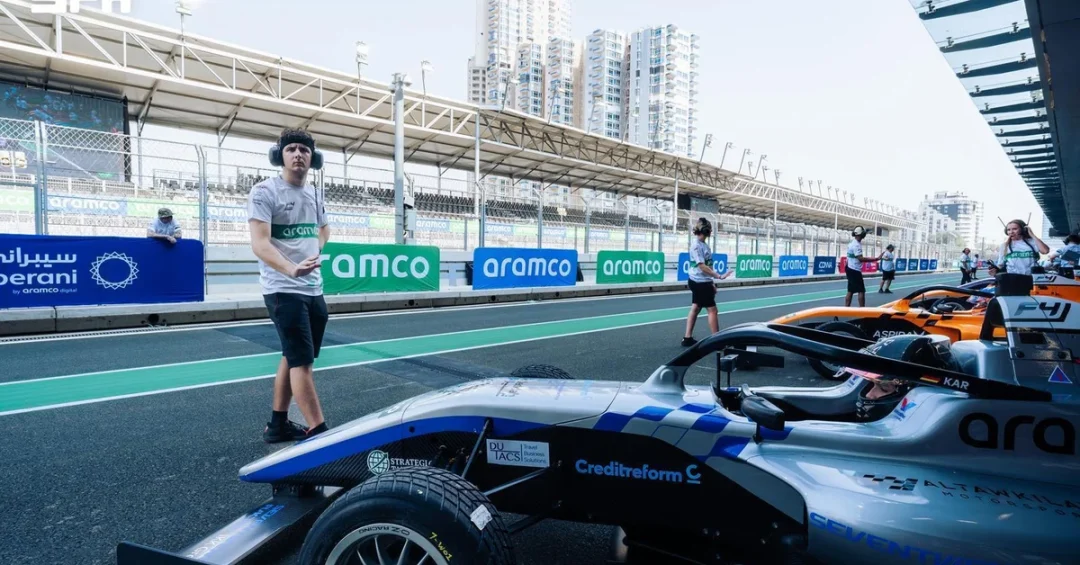
The opening round of Season 3 of the Aramco F4 Saudi Arabian Championship Certified by the FIA got underway in Jeddah on October 1, 2026, marking the latest chapter in the Kingdom’s rapid ascent as a global motorsport destination. The championship, organized by ALTAWKILAT Motorsport under the sporting regulations of the Saudi Automobile and Motorcycle Federation (SAMF), brings together 15 drivers representing eight teams for a six-round campaign running from October to December. The opening round continues until October 3 at the Jeddah Corniche Circuit, with the season set to conclude at Lusail International Circuit in Qatar in December.
The event represents far more than a single race weekend. It is the Kingdom’s first national single-seater championship and forms part of a broader strategy to develop domestic motorsport talent, attract international competitors, and embed world-class racing into Saudi Arabia’s sporting and tourism calendar. For a new generation of Saudi drivers, the championship offers a structured pathway from karting to international competition, while for spectators it delivers a family-friendly festival of speed on the Red Sea coast. Could there be a clearer signal that Saudi Arabia intends to compete at the highest levels of global motorsport?
Context and Background
How did Saudi Arabia move so quickly from hosting international races to running its own FIA-certified single-seater series? The answer lies in a deliberate, multi-year investment in motorsport infrastructure, regulation and talent development. The Aramco F4 Saudi Arabian Championship was created to give young drivers from the Kingdom and the wider region a competitive home series sanctioned by the FIA, the world governing body of motorsport. Its first two seasons established the credibility of the project, and Season 3 now expands it further.
The 2025 edition, the championship’s second season, was held across five rounds and 10 races in Bahrain and Saudi Arabia, featuring 20 drivers. Kit Belofsky of Great Britain claimed the title with Team PEAX, scoring 189 points, ahead of Adam Al Azhari of the UAE with Team VALVOLINE on 125 points. Sweden’s Scott Lindblom with Team REDBULL finished third overall on 108 points. Those results demonstrated both the international reach of the series and the strength of the regional grid, with drivers from the Gulf competing credibly against European opposition.
The 2026 season builds directly on that foundation. With six rounds instead of five, the calendar is longer, more demanding and more visible. The expansion strengthens the championship’s regional presence while giving participating drivers more seat time, more race craft and more opportunities to be evaluated by international teams and sponsors. In a sport where track hours are the rarest currency, that additional volume matters enormously to young careers.
Key Details of the Opening Round
What exactly will fans see on and off the track in Jeddah this week? The opening-round program began on Thursday with on-track testing, before official competition starts on Friday, October 2, with free practice and qualifying. Race 1 will take place at 9:00 PM, followed by the podium ceremony at 9:40 PM. Friday’s schedule also features two Motor Mania JDM Cup races, with Race 1 at 2:50 PM and Race 2 at 5:30 PM, giving spectators a full day of competitive action.
Competition continues on Saturday, October 3, with the second free practice and qualifying sessions, before Race 2, the final race of the opening round, takes place at 9:00 PM, followed by the podium ceremony at 9:40 PM. Saturday’s program also includes the Motor Mania GT showcase race at 7:40 PM. The combination of single-seater and GT machinery creates a varied spectacle designed to appeal to both hardcore motorsport enthusiasts and first-time visitors.
The new season features a diverse international grid, including Arab representation from Saudi drivers Faris Organji and Abdullah Kamel, Zakaria Doleh of the UAE, Hamza Al Fayez of Jordan, and George Nassar of Lebanon. All drivers compete in identical Tatuus T421 – Abarth F4 Gen2 cars, ensuring a level playing field where performance is determined by talent, skill and race craft rather than budget. That spec-chassis philosophy is central to the championship’s credibility as a driver-development platform.
Calendar Expansion and Regional Reach
Why does the move to a six-round calendar matter for the championship’s long-term ambitions? The Jeddah Corniche Circuit will host the first four rounds of the season, with Round 1 taking place from October 1–3, followed by Round 2 on October 7–8, Round 3 from October 31 to November 2, and Round 4 on November 6–7. The championship then travels to Lusail International Circuit in Qatar for Round 5 from December 7–9, before concluding with the sixth and final round on December 13–14.
This structure gives the series a strong Saudi core while extending its footprint into the wider Gulf region. Hosting four rounds in Jeddah allows teams and drivers to build momentum and familiarity with a demanding street-style circuit, while the Qatar finale adds an international dimension and a different technical challenge. For sponsors and broadcasters, the calendar offers a compact, predictable window from October to December that fits neatly into the global motorsport off-season.
The event has been designed to offer a complete experience for families, motorsport enthusiasts and first-time visitors alike. With action from the Aramco F4 Saudi Arabian Championship and Motor Mania, the atmosphere of the paddock, and interactive activities in the Fan Zone, spectators can enjoy a packed program both on and off the track, alongside a variety of food and beverage options throughout the event. A limited number of tickets are available through Webook for the opening round: https://webook.com/en/sa/jed/sports-event/events/aramco-f4-saudi-arabian-championship-2.
International and Regional Impact
What does a thriving Saudi single-seater series mean for motorsport beyond the Kingdom’s borders? The presence of drivers from the UAE, Jordan and Lebanon alongside British, Swedish and other international competitors reflects the championship’s role as a regional hub. It gives Arab talent a credible stage on which to develop and be scouted, and it gives international drivers a competitive winter or autumn series in world-class facilities. That two-way flow raises standards across the region.
The championship also reinforces Saudi Arabia’s position within the global motorsport ecosystem. The Kingdom already hosts Formula 1 at the Jeddah Corniche Circuit and has invested heavily in motorsport entertainment through major events. A domestic FIA-certified F4 series complements those headline events by building the grassroots and mid-tier structures that every mature motorsport nation needs. Without a strong national ladder, talent has nowhere to develop; with one, the Kingdom can produce drivers who progress to Formula 3, Formula 2 and beyond.
For the wider Middle East, the series offers a model of cooperation. Bahrain hosted rounds in Season 2, Qatar hosts the Season 3 finale, and Saudi Arabia provides the organizational and regulatory backbone. This kind of regional calendar sharing is rare in motorsport and positions the Gulf as a genuine hub for junior formulae rather than simply a host of one-off international events.
Economic and Strategic Significance
How does a junior racing series connect to Saudi Arabia’s broader economic ambitions? Motorsport is a high-value, high-visibility sector that supports tourism, hospitality, media, engineering and logistics. A six-round championship with four rounds in Jeddah generates repeat visitation, hotel demand, media coverage and sponsorship activation along the Red Sea coast. It also supports the growth of local businesses in event management, catering, broadcasting and technical services.
The championship’s title partnership with Aramco, one of the world’s largest integrated energy and chemicals companies, underscores the strategic weight behind the project. Aramco’s involvement connects the series to a national industrial base and to a brand with global recognition, helping attract international teams and sponsors. For Saudi youth, the series creates visible career pathways not only as drivers but as engineers, mechanics, data analysts, marshals and event professionals.
Strategic significance also lies in soft power. Every international driver, team member and journalist who travels to Jeddah for a race weekend experiences the Kingdom’s infrastructure, hospitality and modernization firsthand. That experience shapes perceptions and builds networks, which in turn supports tourism, investment and cultural exchange. In this sense, the championship is as much a diplomatic and reputational asset as it is a sporting competition.
Vision 2030 Alignment
How does the Aramco F4 Saudi Arabian Championship fit into Vision 2030? Saudi Arabia’s national transformation strategy aims to diversify the economy, empower young people, expand entertainment and tourism, and elevate the Kingdom’s global standing. A national motorsport championship touches all of those goals. It creates jobs and skills in a growing sector, provides youth with aspirational role models, attracts international visitors, and projects a modern, dynamic image of the country to a global audience.
The series also supports the Quality of Life program by giving families and young people access to world-class entertainment on their doorstep, and it complements the Kingdom’s broader events calendar, which includes Formula 1, football, boxing, tennis and cultural festivals. By investing in grassroots single-seater racing, Saudi Arabia is not merely hosting global sport, it is building the institutions, regulations and talent pipelines that will sustain its role as a motorsport nation for decades to come.
As Season 3 gets underway in Jeddah, the message is clear: the Kingdom is committed to developing its own champions, welcoming the world to its circuits, and using sport as a catalyst for economic and social progress. With 15 drivers, eight teams and six rounds ahead, the 2026 campaign promises to be the most competitive and consequential yet. For Saudi Arabia, the race is not only on the track, it is toward a future in which the Kingdom competes, hosts and leads on the global stage.
20 Questions
Q1. What is the Aramco F4 Saudi Arabian Championship?
A1. It is the Kingdom’s first national single-seater championship, certified by the FIA and organized by ALTAWKILAT Motorsport under the sporting regulations of the Saudi Automobile and Motorcycle Federation. It develops young drivers from Saudi Arabia and the region.
Q2. When and where did Season 3 begin?
A2. Season 3 began on October 1, 2026, at the Jeddah Corniche Circuit in Jeddah, Saudi Arabia. The opening round runs until October 3, with testing, practice, qualifying and two races.
Q3. How many drivers and teams are competing in Season 3?
A3. The 2026 season features 15 drivers representing eight teams. The grid includes Saudi, Emirati, Jordanian, Lebanese and international drivers, creating a diverse and competitive field.
Q4. Who won the 2025 championship?
A4. Kit Belofsky of Great Britain won the 2025 title with Team PEAX, scoring 189 points. Adam Al Azhari of the UAE finished second with Team VALVOLINE on 125 points, and Sweden’s Scott Lindblom was third with Team REDBULL on 108 points.
Q5. How many rounds are in the 2026 season?
A5. The 2026 season features six rounds, up from five in 2025. It runs from October to December, strengthening the championship’s regional presence and giving drivers more racing opportunities.
Q6. Which circuits host the 2026 season?
A6. The Jeddah Corniche Circuit hosts the first four rounds. Lusail International Circuit in Qatar hosts Round 5, and the sixth and final round also takes place in December.
Q7. What cars do the drivers use?
A7. All drivers compete in identical Tatuus T421 – Abarth F4 Gen2 cars. This ensures a level playing field where performance is determined by talent, skill and race craft rather than technical advantage.
Q8. Which Saudi drivers are competing in Season 3?
A8. Saudi drivers Faris Organji and Abdullah Kamel are competing in Season 3. They are joined by Zakaria Doleh of the UAE, Hamza Al Fayez of Jordan and George Nassar of Lebanon.
Q9. What is the schedule for the opening round?
A9. Thursday features on-track testing. Friday includes free practice, qualifying and Race 1 at 9:00 PM. Saturday includes second practice, qualifying and Race 2 at 9:00 PM, with podiums at 9:40 PM.
Q10. What other races are part of the opening weekend?
A10. The weekend also features two Motor Mania JDM Cup races on Friday at 2:50 PM and 5:30 PM, and a Motor Mania GT showcase race on Saturday at 7:40 PM, adding variety for spectators.
Q11. How can fans attend the opening round?
A11. A limited number of tickets are available through Webook for the opening round. The event includes Fan Zone activities, paddock atmosphere, and food and beverage options for families and first-time visitors.
Q12. What is the role of the Saudi Automobile and Motorcycle Federation?
A12. The Saudi Automobile and Motorcycle Federation provides the sporting regulations for the championship. It is the national governing body for motorsport in the Kingdom and ensures FIA-compliant organization.
Q13. Who organizes the championship?
A13. The championship is organized by ALTAWKILAT Motorsport, a Saudi motorsport organization. It works under the sporting regulations of the Saudi Automobile and Motorcycle Federation and with FIA certification.
Q14. Why is the championship important for Saudi motorsport?
A14. It provides a structured pathway for young Saudi and regional drivers to develop skills and gain international experience. It also builds the grassroots and mid-tier structures needed for a mature motorsport nation.
Q15. How does the championship support Vision 2030?
A15. It supports economic diversification, youth empowerment, tourism and entertainment goals. It creates jobs, attracts international visitors, and projects a modern, dynamic image of Saudi Arabia to a global audience.
Q16. What is the significance of Aramco’s title partnership?
A16. Aramco’s title partnership connects the series to a globally recognized Saudi company. It helps attract international teams and sponsors, and links the championship to the Kingdom’s industrial and economic strength.
Q17. How does the regional calendar benefit drivers?
A17. Racing in Saudi Arabia and Qatar gives drivers experience on different circuits and conditions. It also reduces travel burdens and allows teams to compete in a compact, predictable October-to-December window.
Q18. What can spectators expect at the Fan Zone?
A18. The Fan Zone offers interactive activities, paddock atmosphere, and food and beverage options. It is designed to make the event enjoyable for families, motorsport enthusiasts and first-time visitors alike.
Q19. What does the championship mean for Arab talent?
A19. It gives Arab drivers a credible regional stage to develop and be scouted. With drivers from Saudi Arabia, the UAE, Jordan and Lebanon, it raises standards and visibility for motorsport across the Middle East.
Q20. What is next after the Jeddah opening round?
A20. After Round 1, the championship continues with Round 2 on October 7–8, Round 3 from October 31 to November 2, Round 4 on November 6–7, Round 5 in Qatar from December 7–9, and the finale on December 13–14.
Reader Feedback
We value your thoughts. Please share your feedback on this article.
Your feedback helps us improve our coverage.
Related articles
 Six Kings Slam 2026 Tickets on Sale for Riyadh Event
 Saudi Racing Pigeon Team Wins World Championship in Portugal
 Saudi Arabia, Oman, UAE, Qatar Reach Khaleeji 27 Semi-Finals
 350 Volunteers Power Arabian Gulf Cup in Jeddah
 Yemen Defeats Bahrain 5-2 in Gulf Cup 27 Group Stage
 Arab Football Federation Board Meets in Jeddah