


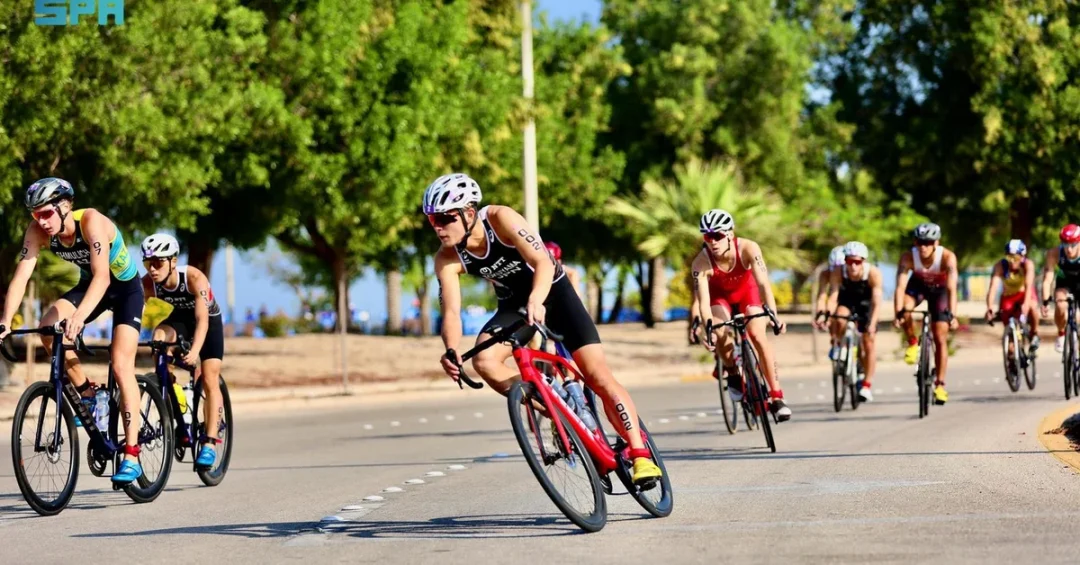
Some 240 male and female athletes from across Asia and beyond competed on the second day of the Asia Triathlon Junior, U23 & Mixed Relay Championship, organized by the Saudi Triathlon Federation at Dareen Beach in Jubail, according to the Saudi Press Agency. The event, which drew large crowds to the Kingdom’s eastern coast, featured a full slate of elite and junior races that underscored both the depth of continental triathlon talent and Saudi Arabia’s growing capacity to host high-level international sport.
The second day of competition began with the women’s under-23 elite category, followed by the men’s under-23 elite race, before concluding with the junior women’s and junior men’s events. Athletes swam, cycled, and ran along the Red Sea-facing course at Dareen Beach, a venue that has become a regular stage for Saudi Arabia’s expanding multisport calendar. The championship forms part of a broader effort by the Kingdom to attract world-class sporting events as part of its Vision 2030 quality-of-life ambitions. But what does a triathlon championship on Saudi shores signal about the Kingdom’s place in Asian sport?
Context and Background
The Asia Triathlon Junior, U23 & Mixed Relay Championship is one of the continental federation’s flagship development events, designed to bridge the gap between junior racing and senior elite competition. It brings together emerging athletes from national federations across Asia, offering ranking points and critical race experience on a championship stage. The Saudi Triathlon Federation, the national governing body for the sport in the Kingdom, organized the Jubail edition at Dareen Beach, continuing a pattern of hosting that has placed Saudi Arabia on the map for endurance sports.
Jubail itself is an important industrial and residential city in the Eastern Province, and Dareen Beach has hosted triathlon events in previous seasons. The choice of venue reflects a deliberate strategy to bring international competition to different regions of the Kingdom rather than concentrating all major events in Riyadh or Jeddah. For athletes and coaches, the event offers a rare chance to compete in a Gulf climate and against a diverse field of Asian rivals. And for Saudi Arabia, it represents another step in building a sporting ecosystem that can nurture local talent while welcoming international stars.
The championship also fits into a wider regional trend in which Gulf states are investing heavily in sports infrastructure, coaching, and event hosting. Saudi Arabia’s approach, however, is closely tied to its national transformation plan, which treats sport as a pillar of social development, tourism, and international engagement. The presence of 240 athletes of different nationalities and age groups at a single venue speaks to the scale of that ambition. How many other Asian nations can claim to host a continental championship across four distinct age and gender categories in one weekend?
Key Details from the Second Day
In the Elite U23 women’s category, Ga yeon Park of Korea took first place, followed by Cade Wright from Hong Kong, China in second, Mako Hiraizumi of Japan in third, Martina Ayu Partiwi of Indonesia in fourth, and Himeka Sato of Japan in fifth. The result reflected the strength of East and Southeast Asian women’s triathlon, with Korea, Hong Kong, Japan, and Indonesia all represented in the top five. The race was one of the most closely watched of the day, as it showcased athletes on the cusp of senior international careers.
In the Elite U23 men’s category, Robin Elg from Hong Kong, China claimed first place, while Alexandr Ten and Yegor Krupyakov of Kazakhstan finished second and third respectively. Amu Omuro of Japan came fourth, and Rashif Amila Yaqin of Indonesia placed fifth. The men’s race demonstrated the breadth of talent across the continent, with Central Asian athletes from Kazakhstan pushing the pace alongside their East Asian counterparts. For Hong Kong, China, the victory added another strong result to its growing triathlon record.
The Junior women’s category saw Kanade Sugiura and Ayame Hayashi of Japan finish first and second, with Pauline Courret of Hong Kong, China in third, Seoeun Park of Korea in fourth, and Rio Noda of Japan in fifth. In the Junior men’s race, Takuto Oshima of Japan took first place, Arlan Zhanabay of Kazakhstan second, Kazuna Asanuma of Japan third, Ali Zhanat of Kazakhstan fourth, and Bima Muslim Perdana of Indonesia fifth. The junior results underlined Japan’s depth in youth triathlon and Kazakhstan’s rising strength in the men’s discipline.
International and Regional Impact
The championship’s results carry significance beyond the podium. For national federations across Asia, the Jubail event provided a crucial opportunity to benchmark their development programs against continental peers. Japan’s strong showing across both junior and U23 categories, for example, reinforces its status as a triathlon powerhouse, while Kazakhstan’s multiple top-five finishes highlight the country’s investment in endurance sport. Hong Kong, China’s victories in the U23 races demonstrate that smaller federations can compete at the highest level with focused coaching and athlete support.
For Saudi Arabia, hosting the championship strengthens its position as a reliable and welcoming host for Asian sport. The Saudi Triathlon Federation worked with continental counterparts to deliver a smooth event, and the large crowds at Dareen Beach showed local appetite for international competition. The presence of athletes from Korea, Japan, Indonesia, Kazakhstan, Hong Kong, China, and other territories also created a small but meaningful cultural exchange, with teams training and competing side by side in the Eastern Province. Could events like this become a regular fixture on the Asian triathlon calendar?
Regionally, the championship aligns with a broader Gulf effort to diversify economies and international partnerships through sport. Saudi Arabia has hosted Formula 1, football, tennis, golf, and esports events in recent years, and triathlon adds another dimension by emphasizing participation, endurance, and youth development. The fact that the event included junior and U23 categories, rather than only elite senior racing, signals a long-term approach: building a pipeline of athletes and fans rather than simply staging one-off spectacles. That approach is consistent with Vision 2030’s emphasis on quality of life and human capability development.
Economic and Strategic Significance
Hosting an international championship at Dareen Beach brings tangible economic and strategic benefits to Jubail and the Eastern Province. Hotels, transport, and local services receive a boost from visiting teams, officials, and spectators, while the event generates media coverage that showcases the Kingdom’s coastal infrastructure. More importantly, it supports the growth of a domestic sports economy that includes coaching, event management, sports tourism, and related services. Each international event helps normalize Saudi Arabia as a destination for active tourism and professional sport.
Strategically, the championship reinforces Saudi Arabia’s role as a bridge between Asia and the wider world. By hosting Asian federations and athletes, the Kingdom deepens diplomatic and people-to-people ties across the continent. The Saudi Triathlon Federation’s ability to organize a multi-category championship also demonstrates institutional capacity that can be applied to larger events in the future. For a country pursuing economic diversification, such capability is as valuable as any single medal. What better way to build international goodwill than by welcoming the next generation of Asian athletes to your shores?
The event also complements Saudi Arabia’s investments in sports facilities and grassroots programs. Vision 2030 includes targets for increased physical activity and community sports participation, and high-profile events like the Asia Triathlon Championship can inspire young Saudis to take up swimming, cycling, and running. The sight of international athletes racing at Dareen Beach may well encourage local clubs and schools to develop their own triathlon programs. In that sense, the championship is not just a competition but a catalyst for long-term participation.
Vision 2030 Alignment
The Asia Triathlon Junior, U23 & Mixed Relay Championship in Jubail reflects the core ambitions of Saudi Vision 2030, which seeks to diversify the economy, empower youth, and improve quality of life for citizens and residents. Sport is explicitly recognized in the Vision as a tool for social development, health, and international engagement. By hosting a continental championship that features young athletes from across Asia, Saudi Arabia is demonstrating its commitment to these goals in a concrete and visible way.
Looking ahead, the Kingdom is expected to continue attracting international sporting events while investing in domestic talent pathways. The Saudi Triathlon Federation’s work at Dareen Beach is part of that journey, and the success of the Jubail championship provides a foundation for future editions and expanded participation. As Saudi Arabia’s sporting ecosystem matures, events like this will help position the Kingdom as a hub for Asian sport and a partner in the development of the next generation of athletes. The competition may be over, but its impact on Saudi sport and Vision 2030 is only beginning.
20 Questions
Q1. What was the Asia Triathlon Junior, U23 & Mixed Relay Championship?
A1. It was a continental triathlon championship organized by the Saudi Triathlon Federation at Dareen Beach in Jubail, featuring junior and under-23 athletes from across Asia in swim, bike, and run races.
Q2. How many athletes participated in the second day of competition?
A2. Around 240 male and female athletes of different nationalities and age groups competed on the second day, according to the Saudi Press Agency.
Q3. Where was the championship held?
A3. The championship took place at Dareen Beach in Jubail, a coastal city in Saudi Arabia’s Eastern Province known for hosting triathlon events.
Q4. Who organized the event?
A4. The Saudi Triathlon Federation, the national governing body for triathlon in the Kingdom, organized the championship in cooperation with Asian triathlon authorities.
Q5. Which categories were contested on the second day?
A5. The second day featured the Elite U23 women’s race, the Elite U23 men’s race, the Junior women’s race, and the Junior men’s race, in that order.
Q6. Who won the Elite U23 women’s category?
A6. Ga yeon Park of Korea won first place, followed by Cade Wright of Hong Kong, China, in second and Mako Hiraizumi of Japan in third.
Q7. Who won the Elite U23 men’s category?
A7. Robin Elg of Hong Kong, China, took first place, with Alexandr Ten and Yegor Krupyakov of Kazakhstan finishing second and third respectively.
Q8. Who won the Junior women’s category?
A8. Kanade Sugiura of Japan won first place, followed by her compatriot Ayame Hayashi in second and Pauline Courret of Hong Kong, China, in third.
Q9. Who won the Junior men’s category?
A9. Takuto Oshima of Japan claimed first place, with Arlan Zhanabay of Kazakhstan in second and Kazuna Asanuma of Japan in third.
Q10. Which countries were represented in the top five of the Elite U23 women’s race?
A10. Korea, Hong Kong, China, Japan, and Indonesia were represented in the top five of the Elite U23 women’s race, showing the breadth of Asian talent.
Q11. Which countries appeared in the top five of the Elite U23 men’s race?
A11. Hong Kong, China, Kazakhstan, Japan, and Indonesia featured in the top five of the Elite U23 men’s race, highlighting regional competitiveness.
Q12. How did Japan perform across the junior categories?
A12. Japan dominated the junior races, winning both the women’s and men’s categories and placing multiple athletes in the top five of each event.
Q13. What was the significance of the event for Saudi Arabia?
A13. It reinforced Saudi Arabia’s growing role as a host of international sport and supported Vision 2030 goals related to youth, health, tourism, and global engagement.
Q14. Why is Dareen Beach an important venue?
A14. Dareen Beach in Jubail has become a regular venue for triathlon events, offering a suitable coastal course and helping bring international competition to the Eastern Province.
Q15. How did the local community respond to the championship?
A15. The event drew large crowds, according to the Saudi Press Agency, demonstrating local interest in international sport and support for the athletes competing in Jubail.
Q16. What does the championship suggest about triathlon in Asia?
A16. It shows that triathlon is developing strongly across Asia, with competitive performances from East, Southeast, and Central Asian nations at junior and U23 levels.
Q17. How does the event connect to Vision 2030?
A17. Vision 2030 promotes sport as a tool for quality of life, youth empowerment, and economic diversification, all of which are reflected in hosting a continental championship.
Q18. What economic benefits can such events bring to Jubail?
A18. International championships can boost local hospitality, transport, and services, while raising the profile of Jubail and the Eastern Province as destinations for sports tourism.
Q19. Which federation was responsible for the technical organization?
A19. The Saudi Triathlon Federation handled the organization of the championship, working with Asian triathlon bodies to deliver the multi-category competition at Dareen Beach.
Q20. What might come next for Saudi triathlon after this event?
A20. Saudi Arabia is expected to continue hosting international triathlon events and investing in grassroots development, building on the success of the Jubail championship to grow the sport further.
Reader Feedback
We value your thoughts. Please share your feedback on this article.
Your feedback helps us improve our coverage.
Related articles
 Saudi National Team Trains in Melbourne Ahead of Australia Clash
 Latino Night at Riyadh Season Delivers Boxing Extravaganza
 Saudi Beach Soccer Team Defeats China 5-3 at NEOM Cup 2024
 Al-Khaleej Secures Third Consecutive Victory in Asian Handball League Championship
 Renard to Address Media Ahead of Saudi Arabia vs Indonesia
 Saudi Team Trains in Jakarta Ahead of Indonesia Qualifier