


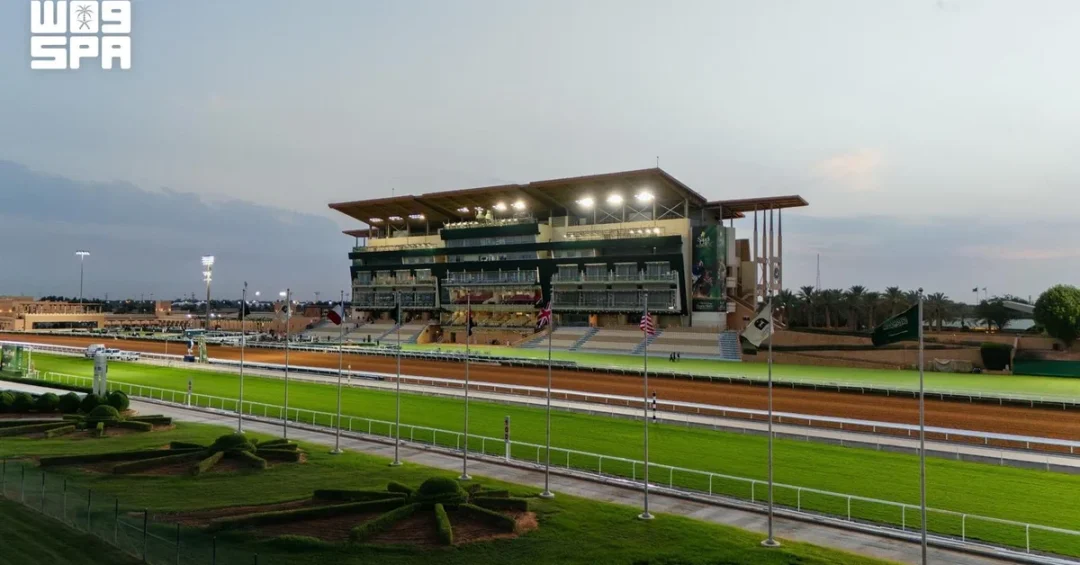
The 2026–2027 Riyadh Racing Season begins tomorrow, October 16, 2026, at King Abdulaziz Racecourse in Riyadh, with total prize money of SAR236.3 million — the highest in the history of the competition — according to an official announcement carried by the Saudi Press Agency (SPA). The new season follows the successful conclusion of the Taif Racing Season and is expected to set new benchmarks for sporting quality and spectator attendance, reinforcing the Kingdom’s growing stature in international horse racing.
The season will run for six consecutive months, spanning 24 weeks, and conclude on April 17, 2027. It will bring together leading stables, trainers, and jockeys from Saudi Arabia and around the world, and will again include the Saudi Cup, the world’s richest horse race, with prize money exceeding $38 million. In total, the calendar features 50 race meetings comprising 569 races, held every Friday and Saturday, along with 52 major racing cups. Could there be a clearer signal that Saudi Arabia has become a permanent fixture at the top table of global equestrian sport?
Context and Background
How did horse racing in Saudi Arabia evolve from a cherished national tradition into a multi-month, internationally recognized sporting calendar? The answer lies in a deliberate, decades-long effort to preserve heritage while embracing world-class standards. King Abdulaziz Racecourse, located in the heart of Riyadh, stands as the flagship venue of the sport in the Kingdom and is named after the founder of modern Saudi Arabia, a leader whose passion for Arabian horses helped embed equestrian culture in the national identity.
The Riyadh Racing Season has grown steadily in scale and prestige, and the 2026–2027 edition builds directly on the momentum generated by the recently concluded Taif Racing Season, which itself attracted strong fields and enthusiastic crowds. The transition from Taif to Riyadh reflects a carefully sequenced national racing calendar that keeps the sport active across different regions and seasons, giving owners, breeders, and trainers a reliable structure in which to plan and invest. For international observers, this continuity matters: it demonstrates that Saudi racing is not a one-off event but a sustained, professionally managed ecosystem with long-term ambitions.
The season’s six-month duration — from October 2026 to April 2027 — also places Riyadh strategically on the global racing map. It overlaps with major racing periods in Europe, North America, and Asia, allowing the Kingdom to attract elite international participation during the traditional peak of the sport. The result is a calendar that competes for the world’s best horses and jockeys, not merely for regional attention.
Key Details of the 2026–2027 Season
What exactly will racing fans see over the coming months? The numbers released via official Saudi channels are striking. The season comprises 50 race meetings and 569 individual races, staged every Friday and Saturday. Of those races, 104 are designated for Arabian horses and 465 for Thoroughbreds, with an additional 35 races held on the turf track. The schedule also includes 52 major racing cups, ensuring a steady rhythm of high-stakes competition throughout the six-month run.
The crown jewel remains the Saudi Cup, the world’s richest horse race, with prize money exceeding $38 million. Its presence on the calendar elevates the entire season, drawing international media coverage and top-tier competitors. The allocation of races between Arabian and Thoroughbred horses is particularly significant: it preserves and celebrates the Arabian breed — a living symbol of Saudi heritage — while simultaneously meeting the expectations of the global Thoroughbred racing industry. The turf track races add further variety, appealing to European-style racing traditions and broadening the season’s competitive appeal.
Beyond the track itself, King Abdulaziz Racecourse will offer a range of recreational, community, and cultural events and activities for different age groups. This approach is designed to establish the venue as a comprehensive weekend destination for families and visitors, not merely a sporting arena. Food, entertainment, and cultural programming will run alongside the racing, making each Friday and Saturday a full-day experience for residents and tourists alike. Doesn’t that combination of elite sport and family-friendly entertainment represent a distinctly modern vision of what a racecourse can be?
International and Regional Impact
How does a six-month racing season in Riyadh resonate beyond the Kingdom’s borders? For the international racing community, the answer is increasingly clear. The scale of the prize money — SAR236.3 million for the season and more than $38 million for the Saudi Cup alone — positions the Riyadh Racing Season among the most attractive destinations in the world for owners, breeders, trainers, and jockeys. Elite international participation brings with it global broadcast interest, sponsorship attention, and a steady flow of visiting professionals who experience Saudi Arabia firsthand.
Regionally, the season strengthens Riyadh’s position on the international racing calendar and complements the Kingdom’s broader efforts to host world-class sporting events across multiple disciplines. The presence of leading stables and jockeys from different countries fosters sporting diplomacy and people-to-people connections. For neighboring countries and the wider Middle East, the Riyadh season serves as a benchmark for how traditional equestrian heritage can be paired with modern event management, hospitality, and tourism infrastructure.
The timing is also notable. As the global racing industry looks for new markets and new audiences, Saudi Arabia is offering a stable, well-funded, and professionally organized alternative that respects the sport’s traditions. The result is a mutually beneficial exchange: international expertise and competition flow into the Kingdom, while Saudi racing and Saudi hospitality gain visibility worldwide.
Economic and Strategic Significance
What does a season of this magnitude mean for the Saudi economy and for the Kingdom’s strategic ambitions? The direct economic activity is substantial. Race meetings held every Friday and Saturday over 24 weeks generate consistent demand across hospitality, transportation, food and beverage, retail, and entertainment sectors. Hotels in Riyadh benefit from visiting teams, officials, media, and spectators, while the racecourse itself supports jobs in event management, veterinary services, equine care, broadcasting, and security.
The equine sector more broadly — breeding, training, stabling, and related services — is a growing part of the Kingdom’s diversified economy. A season with 569 races and 52 major cups provides a reliable commercial platform for breeders and owners, encouraging long-term investment in quality bloodstock. The emphasis on Arabian horses also supports the preservation and promotion of a national asset with deep cultural and economic value.
Strategically, the season reinforces Riyadh’s role as a global events hub. High-profile sporting occasions contribute to the Kingdom’s wider objectives of increasing tourism, attracting international visitors, and showcasing modern infrastructure and services. Each race weekend is, in effect, an opportunity to demonstrate that Saudi Arabia can host world-class events at scale — reliably, safely, and to international standards.
Vision 2030 Alignment
How does a horse racing season connect to Saudi Vision 2030? The alignment is direct and multifaceted. Vision 2030 seeks to diversify the economy, expand entertainment and tourism, and improve quality of life for citizens and residents. A six-month racing season that combines elite competition with recreational, community, and cultural programming for all age groups advances each of those goals. It creates economic activity, draws international visitors, and offers families a distinctive weekend destination in the capital.
The season also reflects the Vision’s emphasis on preserving national heritage while embracing modernization. The 104 races for Arabian horses celebrate a breed central to Saudi identity, while the 465 Thoroughbred races and 35 turf races connect the Kingdom to global racing traditions. The Saudi Cup’s position as the world’s richest horse race is a statement of ambition that matches the Vision’s broader aim of placing Saudi Arabia at the center of international sport and entertainment.
As the gates open tomorrow at King Abdulaziz Racecourse, the 2026–2027 Riyadh Racing Season begins not just as a sporting calendar but as a demonstration of what the Kingdom has built and what it intends to build next. With record prize money, a six-month schedule, and a venue designed for the whole family, the season invites the world to watch — and to visit. Will this be remembered as the moment Riyadh racing became a truly global institution? The coming 24 weeks will provide the answer.
20 Questions
Q1. When does the 2026–2027 Riyadh Racing Season begin?
A1. The season kicks off tomorrow, October 16, 2026, at King Abdulaziz Racecourse in Riyadh, following the successful conclusion of the Taif Racing Season, according to the official announcement carried by the Saudi Press Agency.
Q2. How long will the Riyadh Racing Season run?
A2. The season will run for six consecutive months, spanning 24 weeks, and is scheduled to conclude on April 17, 2027, providing a sustained calendar of competition across the winter and spring months.
Q3. What is the total prize money for the season?
A3. Total prize money stands at SAR236.3 million, the highest in the history of the Riyadh Racing Season, reflecting the Kingdom’s commitment to attracting elite international competition and rewarding excellence.
Q4. How many race meetings and races are scheduled?
A4. The season features 50 race meetings comprising 569 races, held every Friday and Saturday, along with 52 major racing cups spread across the six-month calendar at King Abdulaziz Racecourse.
Q5. How many races are designated for Arabian horses?
A5. A total of 104 races are designated for Arabian horses, celebrating a breed that holds deep cultural significance in Saudi Arabia and remains central to the Kingdom’s equestrian heritage and identity.
Q6. How many races are for Thoroughbreds?
A6. The schedule includes 465 races for Thoroughbreds, connecting Saudi racing to global competition standards and attracting top international stables, trainers, and jockeys to Riyadh throughout the season.
Q7. What is the Saudi Cup and why does it matter?
A7. The Saudi Cup is the world’s richest horse race, with prize money exceeding $38 million. Its presence on the calendar elevates the entire season and draws global media attention to Saudi Arabia.
Q8. How many races will be held on the turf track?
A8. An additional 35 races will be held on the turf track, adding variety to the season and appealing to international racing traditions while broadening the competitive appeal of the Riyadh calendar.
Q9. On which days are races held?
A9. Race meetings are held every Friday and Saturday throughout the season, creating a consistent weekly rhythm that benefits spectators, participants, and the wider hospitality and tourism sectors in Riyadh.
Q10. What else does King Abdulaziz Racecourse offer visitors?
A10. Beyond the track, the venue offers recreational, community, and cultural events and activities for different age groups, establishing it as a comprehensive weekend destination for families and visitors from Saudi Arabia and abroad.
Q11. Which previous season does this new season build upon?
A11. The 2026–2027 Riyadh Racing Season builds on the success of the recently concluded Taif Racing Season, which demonstrated strong sporting quality and attendance and helped maintain momentum for Saudi racing.
Q12. How many major racing cups are included in the schedule?
A12. The schedule includes 52 major racing cups, ensuring a steady stream of high-stakes competition throughout the six-month season and providing numerous opportunities for top horses to compete at elite level.
Q13. Why is the Riyadh season important for the international racing calendar?
A13. It strengthens Riyadh’s position on the international racing calendar by combining high-level sporting competition with a comprehensive spectator experience, attracting global participation and reinforcing Saudi Arabia’s role as a major racing destination.
Q14. What economic benefits does the season bring?
A14. The season generates activity across hospitality, transportation, food and beverage, retail, and entertainment sectors, supports jobs in event management and equine care, and encourages long-term investment in breeding and training.
Q15. How does the season support Saudi tourism goals?
A15. By hosting international participants and spectators over 24 weeks, the season draws visitors to Riyadh, showcases modern infrastructure and hospitality, and contributes to the Kingdom’s broader tourism and entertainment objectives.
Q16. What role do Arabian horses play in the season?
A16. Arabian horses are featured in 104 dedicated races, preserving and promoting a breed central to Saudi heritage while demonstrating the Kingdom’s commitment to honoring tradition alongside world-class Thoroughbred competition.
Q17. How does the season align with Saudi Vision 2030?
A17. It advances Vision 2030 by diversifying the economy, expanding entertainment and tourism, improving quality of life, and preserving national heritage while embracing modernization and international engagement in sport.
Q18. Who will compete during the season?
A18. The season will feature competition among leading stables, trainers, and jockeys from Saudi Arabia and around the world, reflecting the growing international stature of the Riyadh Racing Season and its record prize pool.
Q19. What makes this season historically significant?
A19. The SAR236.3 million prize pool is the highest in the history of the Riyadh Racing Season, making this edition a landmark in the development of horse racing in the Kingdom of Saudi Arabia.
Q20. Where can readers find official information about the season?
A20. Official information is released through Saudi government channels and recognized Saudi news authorities, including the Saudi Press Agency, which carried the announcement of the season’s launch and key details.
Reader Feedback
We value your thoughts. Please share your feedback on this article.
Your feedback helps us improve our coverage.