


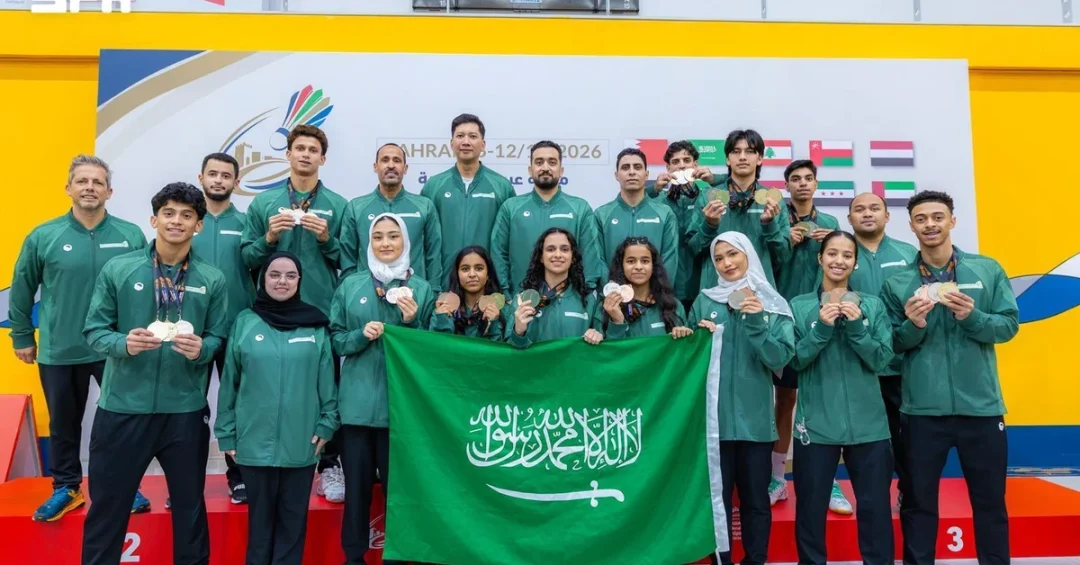
The Saudi national badminton team has topped the gold medal standings at the 2026 West Asia Regional Junior and Youth Championships, held in Bahrain from November 5 to 12, claiming 18 medals in total, including seven gold, five silver, and six bronze across the under-16, under-19, and under-23 age categories. The championship, which brought together 10 national teams from across the region, saw Saudi Arabia’s young shuttlers deliver a standout performance that underscored the Kingdom’s growing strength in a sport it has increasingly prioritized. According to the Saudi Press Agency, the team also reached the finals of the team competitions in all three age categories, a testament to the depth and consistency of the Saudi squad. This achievement reflects the progress of Saudi badminton and the success of national talents in competing for top positions across various age categories, marking another milestone in the Kingdom’s broader sports development journey under Vision 2030.
For a nation historically associated with football and equestrianism, Saudi Arabia’s rise in badminton may come as a surprise to international observers. Yet the result in Bahrain is no accident. It is the product of a deliberate, multi-year effort by the Saudi Badminton Federation to identify talent, develop the skills of male and female players, and prepare a promising generation capable of representing the Kingdom on regional and global stages. The 18-medal haul not only places Saudi Arabia at the summit of the West Asian medal table but also signals that the Kingdom’s investment in grassroots and elite sports is yielding tangible returns. As the world watches Saudi Arabia transform its sporting landscape, the badminton team’s success offers a compelling example of how strategic vision, institutional support, and youthful determination can combine to produce excellence.
Context and Background: How Did Saudi Badminton Reach This Point?
Just a few years ago, badminton was a niche sport in the Kingdom, with limited infrastructure and few opportunities for competitive exposure. The Saudi Badminton Federation, under the guidance of the Ministry of Sport, has since implemented a comprehensive strategy to change that reality. Talent identification programs have been rolled out in schools and clubs across the country, while coaching standards have been elevated through partnerships with international experts. The federation has also increased the number of domestic tournaments, giving young players more chances to compete and improve. These efforts align with the Ministry of Sport’s broader mandate to increase participation in sports and achieve excellence on the international stage, a key pillar of Vision 2030.
The 2026 West Asia Regional Junior and Youth Championships, hosted in Bahrain, provided the perfect platform to measure that progress. With 10 national teams competing, the tournament was a rigorous test of skill, stamina, and mental fortitude. Saudi Arabia’s ability to not only compete but dominate across three age categories demonstrates that the federation’s grassroots approach is working. The team’s run to the finals in all three team events further highlights the consistency of the program, as it requires a deep roster of talented players rather than reliance on a single star. For a sport that demands agility, precision, and tactical awareness, such widespread success is a clear indicator of a robust development pipeline.
What makes this achievement particularly noteworthy is the role of female players. The Saudi Badminton Federation has made a concerted effort to promote women’s participation in the sport, in line with the Kingdom’s Vision 2030 goal of empowering women and enhancing their role in society. The medals won by female shuttlers in Bahrain are a direct result of this inclusive approach. By providing equal opportunities and support, the federation is not only producing champions but also challenging stereotypes and inspiring a new generation of Saudi girls to take up the sport. This dual focus on excellence and inclusion is a hallmark of Saudi Arabia’s sporting renaissance.
Key Details: A Breakdown of the 18-Medal Haul
The Saudi team’s 18 medals were distributed across individual and team events in the under-16, under-19, and under-23 categories. The seven gold medals came in a variety of disciplines, including singles, doubles, and mixed doubles, showcasing the versatility of Saudi players. The five silver and six bronze medals further illustrate the team’s depth, as multiple athletes reached the podium. In the team competitions, Saudi Arabia finished as runner-up in all three age groups, a remarkable feat that speaks to the squad’s collective strength and tactical discipline. The fact that Saudi Arabia topped the gold medal standings overall is a clear sign that its players are capable of delivering under pressure.
According to the Saudi Press Agency, the results build on the efforts of the Saudi Badminton Federation to identify talent and develop skills. The federation has invested in coaching, sports science, and international exposure, sending young players to training camps and tournaments abroad. This holistic approach has paid off in Bahrain, where Saudi athletes demonstrated technical proficiency and competitive maturity beyond their years. The team’s success was not limited to a few standout individuals; rather, it was a collective achievement that reflects the federation’s emphasis on teamwork and depth. Such a broad-based performance is essential for sustained success in international badminton, where nations like Indonesia, China, and Japan have long dominated through strong development systems.
Among the standout performers were several young athletes who won multiple medals, though the federation has emphasized that the credit belongs to the entire squad and the support staff. The coaching team, led by national coaches, devised tailored training programs for each age group, focusing on physical conditioning, stroke technique, and match strategy. The players also benefited from the federation’s sports medicine and psychology support, which helped them manage the pressures of competition. This comprehensive support system is a model that other Saudi sports federations are increasingly adopting, as the Kingdom seeks to build a sustainable high-performance culture across all disciplines.
International and Regional Impact: What Does This Mean for West Asian Badminton?
Saudi Arabia’s dominance at the 2026 West Asia Regional Junior and Youth Championships has significant implications for the regional badminton landscape. Traditionally, countries like Iran, Iraq, and the United Arab Emirates have been strong contenders in West Asian badminton, but Saudi Arabia’s rise adds a new dimension to the competition. The Kingdom’s success raises the bar for other nations, encouraging them to invest more in youth development and infrastructure. This healthy rivalry is likely to elevate the overall standard of badminton in the region, benefiting all participating countries. Moreover, Saudi Arabia’s achievement demonstrates that with the right strategy and resources, a nation can rapidly improve its standing in a sport, serving as an inspiration for its neighbors.
On the international stage, Saudi Arabia’s performance in Bahrain will not go unnoticed. Badminton World Federation (BWF) officials and global talent scouts closely monitor regional youth championships for emerging stars. The Saudi team’s medal haul could open doors for individual players to receive invitations to international training camps, scholarships, and higher-level tournaments. This exposure is crucial for the continued development of Saudi badminton, as it allows players to test themselves against the best in the world. Furthermore, the Kingdom’s success contributes to the diversification of badminton’s global footprint, which has historically been concentrated in Asia and Europe. A stronger Saudi presence could eventually lead to more BWF events being hosted in the Middle East, further globalizing the sport.
Regionally, the achievement strengthens Saudi Arabia’s position as a sporting hub in the Gulf. The Kingdom has already hosted major events like the Dakar Rally, Formula 1, and the FIFA World Cup 2034, and its growing prowess in badminton adds another layer to its sporting portfolio. This aligns with the Ministry of Sport’s goal of making Saudi Arabia a destination for international sports and a source of national pride. The badminton team’s success also fosters a sense of unity and pride among Saudi citizens, as they see their young athletes excelling on the regional stage. Such achievements are powerful tools for nation-building and for promoting the Kingdom’s positive image abroad.
Economic and Strategic Significance: Beyond the Medals
The economic and strategic significance of Saudi Arabia’s badminton success extends far beyond the medals themselves. Investment in sports is a key component of Vision 2030, which aims to diversify the economy, create jobs, and improve the quality of life for citizens. A thriving sports sector contributes to these goals by stimulating economic activity in areas such as event hosting, sports tourism, and the sports apparel and equipment market. The badminton team’s achievements can attract sponsorship and commercial interest, further fueling the growth of the sport. As more Saudis take up badminton, demand for facilities, coaching, and related services will rise, creating opportunities for entrepreneurs and small businesses.
Strategically, success in badminton enhances Saudi Arabia’s soft power and diplomatic reach. Sports have long been a tool for building bridges between nations, and Saudi Arabia’s participation in regional championships fosters goodwill and cooperation with other West Asian countries. The Kingdom’s commitment to youth sports also sends a positive message about its investment in the next generation, a theme that resonates with international partners and investors. By excelling in a sport that is popular in Asia, Saudi Arabia can strengthen its ties with key Asian nations, which are important economic and strategic partners. Thus, the badminton team’s success is not just a sporting victory but a strategic asset that supports the Kingdom’s broader foreign policy and economic objectives.
Moreover, the focus on youth and junior categories is particularly significant. By nurturing talent at a young age, Saudi Arabia is building a pipeline of athletes who can represent the Kingdom in future Olympic Games and world championships. This long-term approach is essential for achieving sustainable success in sports. The Saudi Badminton Federation’s efforts to develop male and female players also align with the Vision 2030 goal of increasing women’s participation in sports, which has been shown to have numerous social and health benefits. As these young athletes grow and mature, they will become role models for future generations, inspiring more Saudis to pursue sports and healthy lifestyles.
Vision 2030 Alignment: A Testament to Saudi Arabia’s Sporting Transformation
The Saudi badminton team’s triumph at the 2026 West Asia Regional Junior and Youth Championships is a shining example of Vision 2030 in action. Launched in 2016 by Crown Prince Mohammed bin Salman, Vision 2030 seeks to transform Saudi Arabia into a vibrant society, a thriving economy, and an ambitious nation. Sports is a central pillar of this vision, with the Ministry of Sport tasked with increasing participation, achieving excellence, and hosting world-class events. The badminton team’s 18 medals, including seven gold, are a direct result of the Kingdom’s investment in sports infrastructure, coaching, and talent development. They demonstrate that Saudi Arabia is not only a participant in global sports but a rising force capable of leading in diverse disciplines.
Looking ahead, the future of Saudi badminton appears bright. The success in Bahrain will likely spur further investment and interest in the sport, leading to more young Saudis taking up badminton and aiming for the national team. The Saudi Badminton Federation is expected to build on this momentum by expanding its talent identification programs, hosting more international tournaments, and providing more opportunities for players to compete abroad. As the Kingdom prepares to host the 2034 FIFA World Cup and continues to attract major sporting events, the badminton team’s achievements add to the narrative of a nation on the move. For international observers, this is a clear signal that Saudi Arabia’s sporting ambitions are both broad and deep, and that the Kingdom is committed to nurturing a generation of champions who will carry its flag with pride on the world stage.
20 Questions
Q1. What was the final medal tally for the Saudi national badminton team at the 2026 West Asia Regional Junior and Youth Championships?
A1. The Saudi team won 18 medals in total: seven gold, five silver, and six bronze. This placed them at the top of the gold medal standings among the 10 participating national teams.
Q2. Where and when did the 2026 West Asia Regional Junior and Youth Championships take place?
A2. The championships were held in Bahrain from November 5 to 12, 2026. The event featured junior and youth players from 10 national teams across the West Asia region.
Q3. Which age categories did the Saudi team compete in?
A3. Saudi Arabia competed in the under-16, under-19, and under-23 age categories. The team achieved medals in all three, demonstrating depth across different developmental stages.
Q4. How did the Saudi team perform in the team competitions?
A4. The Saudi team reached the finals of the team competitions in all three age categories. This underscores the squad’s consistency and collective strength, even though they finished as runners-up in each final.
Q5. What does this achievement say about the progress of Saudi badminton?
A5. It reflects significant progress, showing that national talents can compete for top positions across age groups. The results validate the Saudi Badminton Federation’s efforts in talent identification and player development.
Q6. Who is responsible for developing badminton in Saudi Arabia?
A6. The Saudi Badminton Federation, under the Ministry of Sport, leads these efforts. It focuses on identifying talent, developing skills of male and female players, and preparing a promising generation.
Q7. How does this success align with Vision 2030?
A7. Vision 2030 emphasizes sports as a pillar of a vibrant society. The badminton team’s success reflects the Kingdom’s investment in youth, sports infrastructure, and excellence, contributing to national pride and international recognition.
Q8. Were female players among the medalists?
A8. Yes, female players contributed to the medal haul, reflecting the federation’s commitment to developing both male and female athletes. This aligns with Vision 2030’s goal of empowering women in all fields.
Q9. What impact will this success have on badminton in Saudi Arabia?
A9. It is expected to boost interest in the sport, attract more youth to participate, and encourage further investment in facilities and coaching. It also sets a benchmark for future teams.
Q10. How does this performance compare to previous Saudi showings in regional badminton?
A10. This is a significant improvement, as Saudi Arabia topped the gold medal standings for the first time in this championship. It marks a new high in the Kingdom’s badminton history.
Q11. What challenges did the team overcome to achieve this result?
A11. The team faced strong competition from 10 national teams, requiring rigorous preparation. They also had to manage the pressures of finals in all age categories, demonstrating mental resilience.
Q12. What support did the Saudi Badminton Federation provide to the players?
A12. The federation provided coaching, sports science support, training camps, and international exposure. This holistic approach helped players develop technically, physically, and mentally.
Q13. How does this success contribute to Saudi Arabia’s sporting reputation?
A13. It enhances the Kingdom’s reputation as a rising sporting nation, capable of excelling in diverse sports. It adds to the narrative of Saudi Arabia as a host of major events and a nurturer of talent.
Q14. Will this lead to more international opportunities for Saudi players?
A14. Yes, strong performances at regional youth championships often attract attention from international scouts and federations, potentially leading to invitations to global training camps and tournaments.
Q15. What is the significance of reaching finals in all three team events?
A15. It shows that the Saudi team has depth and consistency, not relying on a few individuals. This is crucial for sustained success in team and individual events.
Q16. How does this achievement reflect on the Ministry of Sport’s strategy?
A16. It validates the Ministry’s focus on grassroots development and high-performance pathways. The Ministry has prioritized increasing participation and achieving excellence, as seen in this result.
Q17. What message does this send to young Saudi athletes?
A17. It sends a powerful message that with dedication and support, Saudi athletes can achieve regional and international success. It inspires the next generation to pursue sports seriously.
Q18. Are there plans to build on this success for future championships?
A18. The Saudi Badminton Federation is expected to continue its development programs, aiming to replicate and exceed this success in upcoming regional and international competitions.
Q19. How does badminton’s growth fit into Saudi Arabia’s sports diversification?
A19. It demonstrates the Kingdom’s efforts to diversify beyond football, embracing a wide range of sports. This diversification is key to Vision 2030’s sports objectives.
Q20. What is the long-term outlook for Saudi badminton?
A20. With continued investment and a focus on youth, the outlook is promising. Saudi Arabia aims to become a consistent contender in Asian and global badminton, inspiring future generations.
Reader Feedback
We value your thoughts. Please share your feedback on this article.
Your feedback helps us improve our coverage.
Related articles
 Jeddah Baja Toyota Rally Kicks Off with 217-Kilometer Stage
 Saudi National Team Ready for Friendly Against Korea
 Jeddah Governor Attends 2026 Jeddah Baja Toyota Rally Launch
 Saudi Beach Soccer Team Trains in Thailand for Asian Cup
 Formula E Confirms Jeddah E-Prix Double-Header for April 2027
 Jeddah Baja Toyota Rally Strengthens Saudi Motorsport