


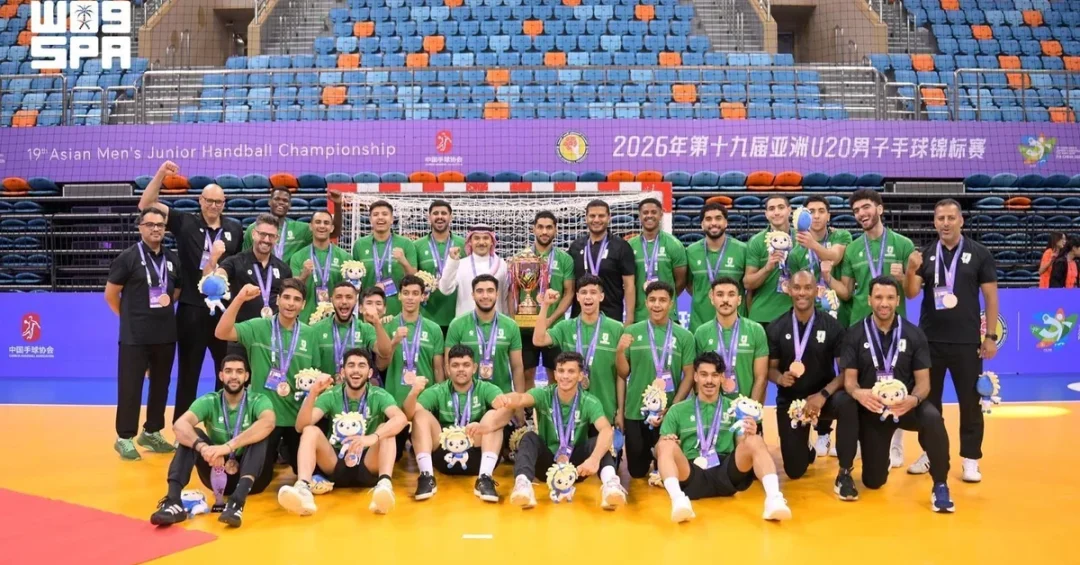
Saudi Arabia’s junior handball team defeated Bahrain 37-27 in the third-place playoff of the 19th Asian Men’s Junior Handball Championship in China on Monday, claiming the bronze medal and ending a ten-year absence from the continental podium. The victory, confirmed by the Saudi Press Agency (SPA), capped a tournament in which the young Saudi side combined attacking fluency with defensive discipline, finishing the match with a decisive ten-goal margin. The result also secured Saudi Arabia’s qualification for the 2027 IHF Men’s Junior World Championship, a milestone that underscores the Kingdom’s steady rise in international handball and reflects the broader expansion of sport under Saudi Vision 2030. For a nation investing heavily in athletic infrastructure, youth development, and global sporting engagement, the bronze medal is more than a single result — it is evidence that long-term planning is producing competitive returns on the international stage.
The Saudi junior team’s campaign in China drew attention from handball observers across Asia, who noted the squad’s composure in high-pressure matches and its ability to dictate tempo against established rivals. Bahrain, a seasoned competitor in regional handball, was held to 27 goals as Saudi Arabia’s defense tightened in the second half. The win echoed the Kingdom’s silver-medal performance at the 2016 edition of the championship, marking a return to the levels of competitiveness that Saudi officials have targeted through structured youth programs and expanded coaching investment. Saudi Arabia’s handball federation has worked in recent years to strengthen age-group teams, and the bronze medal suggests those efforts are translating into results at the continental level.
Context and Background
How did Saudi Arabia’s junior handball program reach this point, and what does the bronze medal reveal about the Kingdom’s athletic trajectory? The 19th Asian Men’s Junior Handball Championship brought together the continent’s leading under-21 sides in a competition that serves as both a continental title event and a qualifying pathway for the IHF Men’s Junior World Championship. Saudi Arabia entered the tournament with a squad drawn largely from domestic clubs and youth academies that have benefited from increased investment in coaching, sports science, and competitive exposure. The team’s run to the bronze-medal match demonstrated consistency across the group stage and knockout rounds, a sign that preparation and talent identification are aligning more effectively than in previous cycles.
The ten-year gap since Saudi Arabia’s last podium finish at this level — a silver medal in 2016 — had been a source of motivation for the program. Between those editions, Saudi handball officials restructured youth development, placing greater emphasis on international friendlies, regional camps, and the integration of young players into senior domestic competition. That approach reflects a wider pattern in Saudi sport, where federations have been encouraged to build sustainable pipelines rather than rely on short-term results. The bronze medal in China is the clearest signal yet that this strategy is bearing fruit, and it arrives as the Kingdom prepares to host and compete in an expanding calendar of international sporting events.
The tournament itself was staged in China, highlighting the growing connectivity of Asian sport and the value of continental competition as a development tool. For Saudi Arabia, competing against the best junior sides in Asia provides a benchmark that domestic leagues alone cannot offer. Coaches and analysts have long argued that exposure to varied playing styles — from the fast-breaking teams of East Asia to the physically robust sides of the Gulf — accelerates the maturation of young athletes. The 2026 championship offered exactly that environment, and Saudi Arabia’s ability to adapt across matches was central to its podium finish.
Key Details
What made the 37-27 victory over Bahrain so convincing? According to the Saudi Press Agency, the Saudi junior team asserted its dominance throughout the match, building a lead that it never relinquished and finishing with a ten-goal cushion. The scoreline reflected a balanced attacking effort and a defensive unit that limited Bahrain’s scoring opportunities in critical phases. Winning the third-place playoff by such a margin is significant in handball, where matches between Gulf rivals are often decided by narrow margins. The result underlined the squad’s fitness and tactical discipline, qualities that coaches had prioritized in the build-up to the championship.
The bronze medal marked Saudi Arabia’s return to the Asian Championship podium after its silver-medal finish at the 2016 edition. That ten-year absence from the top three had been a point of reflection for the Kingdom’s handball administrators, who responded by increasing investment in junior development and expanding the pool of players receiving international experience. The 2026 result validates those efforts and provides a foundation for the next competitive cycle. It also confirms Saudi Arabia’s qualification for the 2027 IHF Men’s Junior World Championship, where the team will test itself against the world’s leading young sides — an opportunity that officials view as essential for continued progress.
Individual performances across the tournament drew praise from observers, though the team’s success was collective. Saudi Arabia’s goalkeeping, fast transitions, and set-piece execution were cited as strengths in match reports, while the squad’s composure in the bronze-medal match stood out. The victory over Bahrain also carries regional significance, given the competitive history between the two Gulf nations in handball. For the players, many of whom are at the beginning of their careers, the medal provides both recognition and momentum as they pursue places in senior domestic and international competition.
International and Regional Impact
Why does a junior bronze medal matter beyond the final score? In Asian handball, age-group championships are a key indicator of a nation’s future competitiveness. Saudi Arabia’s podium finish signals that the Kingdom is producing a generation of players capable of challenging established powers in Asia and, eventually, on the world stage. Qualification for the 2027 IHF Men’s Junior World Championship gives Saudi Arabia a platform to measure itself against European, African, and American teams, accelerating the development of its players through high-level exposure. For a country pursuing a broader sporting strategy, such opportunities are integral to building credibility and depth.
Regionally, the result reinforces the Gulf’s growing influence in Asian handball. Bahrain, Qatar, and Saudi Arabia have all invested in the sport, and their junior teams regularly contend for medals. Saudi Arabia’s win over Bahrain in the third-place match reflects the intensity of that regional rivalry and the rising standard of play across the Gulf. The medal also strengthens Saudi Arabia’s standing within Asian handball governance and competition, where sustained results at youth level translate into better seeding, more invitations to elite tournaments, and greater influence in shaping the sport’s development across the continent.
Economic and Strategic Significance
How does success in handball connect to Saudi Arabia’s wider economic and strategic ambitions? Sport has become a central pillar of the Kingdom’s diversification agenda, contributing to tourism, entertainment, and national branding. A medal at an Asian championship generates positive international visibility and reinforces the message that Saudi Arabia is a competitive, modern sporting nation. The qualification for the 2027 World Championship extends that visibility, creating opportunities for sponsorship, media coverage, and fan engagement. These outcomes align with the objectives of Saudi Vision 2030, which seeks to grow the sports sector’s contribution to the economy and to quality of life.
The development of youth sport also supports social goals, including increased participation among young Saudis and the promotion of healthy, active lifestyles. Handball, with its strong presence in schools and clubs across the Kingdom, is well positioned to benefit from these initiatives. The bronze medal provides a tangible example of what structured investment and coaching can achieve, and it is likely to encourage greater participation at the grassroots level. Success at the junior level also creates a pathway for players to professionalize, whether in domestic leagues or through opportunities abroad, further strengthening the national team pipeline.
Vision 2030 Alignment
What does the bronze medal mean for Saudi Arabia’s long-term vision? Under Saudi Vision 2030, the Kingdom has committed to expanding sport at every level — from community participation to elite performance — as part of a broader transformation of society and the economy. The junior handball team’s podium finish is a direct expression of that commitment, demonstrating that investments in youth development, coaching, and international competition are producing measurable results. The qualification for the 2027 IHF Men’s Junior World Championship offers the next step: a chance to compete globally, learn from the best, and continue building a program capable of sustained success.
The achievement also reflects the leadership and support that Saudi sport receives across government and sporting institutions, which have prioritized long-term development over short-term gains. For the players, the bronze medal is both a reward and a responsibility, as they now carry the expectations of a nation investing in its sporting future. As Saudi Arabia continues to host major events and compete across disciplines, results like this one reinforce the Kingdom’s position as a rising force in global sport. The junior handball team’s return to the Asian podium is a milestone — and, officials suggest, a sign of more to come.
20 Questions
Q1. What did the Saudi junior handball team achieve at the 19th Asian Men’s Junior Handball Championship?
A1. The Saudi junior handball team won the bronze medal at the 19th Asian Men’s Junior Handball Championship, defeating Bahrain 37-27 in the third-place playoff in China. The result marked Saudi Arabia’s return to the continental podium after a ten-year absence.
Q2. What was the final score of the bronze-medal match between Saudi Arabia and Bahrain?
A2. Saudi Arabia defeated Bahrain 37-27, a ten-goal victory that secured the bronze medal. The margin reflected the team’s dominance throughout the match, as reported by the Saudi Press Agency, with strong attacking and defensive play.
Q3. When and where was the 19th Asian Men’s Junior Handball Championship held?
A3. The championship concluded on Monday, July 27, 2026, in China. The tournament brought together Asia’s leading under-21 national teams and served as a qualifier for the 2027 IHF Men’s Junior World Championship.
Q4. How long had Saudi Arabia waited to return to the Asian Championship podium?
A4. Saudi Arabia returned to the podium after a ten-year absence, following its silver-medal finish at the 2016 edition of the championship. The bronze medal in 2026 ended that decade-long gap at the junior level.
Q5. What major qualification did the bronze medal secure for Saudi Arabia?
A5. The result secured Saudi Arabia’s qualification for the 2027 IHF Men’s Junior World Championship. This gives the team an opportunity to compete against the world’s leading young sides and gain valuable international experience.
Q6. Which official source reported the Saudi team’s bronze-medal achievement?
A6. The Saudi Press Agency (SPA) reported the achievement, confirming the 37-27 victory over Bahrain and the team’s qualification for the 2027 IHF Men’s Junior World Championship. SPA is the Kingdom’s official news agency.
Q7. What does the bronze medal indicate about Saudi handball development?
A7. It reflects the steady progress of the Saudi junior team and the continued development of Saudi handball. The result suggests that investments in youth coaching, preparation, and competition are producing competitive returns at the continental level.
Q8. How did Saudi Arabia perform throughout the tournament before the bronze-medal match?
A8. Saudi Arabia delivered strong performances throughout the tournament, according to SPA, reaching the third-place playoff and ultimately securing qualification for the 2027 World Championship. The team’s consistency across matches was central to its podium finish.
Q9. Why is the win over Bahrain significant in regional handball?
A9. Bahrain is a seasoned competitor in Gulf and Asian handball, and matches between the two nations are often closely contested. A ten-goal victory highlights Saudi Arabia’s tactical discipline and fitness in a high-pressure regional rivalry.
Q10. What does qualification for the 2027 World Championship mean for the players?
A10. It provides exposure to elite international competition, helping players develop faster and prepare for senior-level careers. Such opportunities are essential for building depth in the national team pipeline and raising overall standards.
Q11. How does this achievement align with Saudi Vision 2030?
A11. Vision 2030 emphasizes expanding sport at all levels, from grassroots participation to elite performance. The bronze medal and World Championship qualification demonstrate that strategic investment in youth sport is delivering measurable international results.
Q12. What role do youth championships play in Asian handball development?
A12. Youth championships serve as benchmarks for national programs and as qualifying pathways for world events. They allow young players to face varied playing styles, accelerating their development and preparing them for senior international competition.
Q13. How does the bronze medal affect Saudi Arabia’s standing in Asian handball?
A13. It strengthens the Kingdom’s position within Asian handball, improving its competitive reputation and potentially leading to better seeding and more invitations to elite tournaments. Sustained youth results build long-term credibility.
Q14. What areas of the team’s play were highlighted in the bronze-medal match?
A14. Reports noted Saudi Arabia’s dominance throughout the match, with a balanced attack and a defense that limited Bahrain’s scoring. The ten-goal margin reflected the team’s composure and execution in a decisive playoff.
Q15. How does sport contribute to Saudi Arabia’s economic diversification?
A15. Sport supports tourism, entertainment, and national branding, creating jobs and attracting investment. Success in international competitions raises the Kingdom’s profile and supports the growth of a vibrant sports sector under Vision 2030.
Q16. What was Saudi Arabia’s previous best result at this championship?
A16. Saudi Arabia’s previous podium finish at the Asian Men’s Junior Handball Championship was a silver medal in 2016. The 2026 bronze marks a return to that level of competitiveness after a ten-year gap.
Q17. How might this result influence grassroots handball in Saudi Arabia?
A17. Visible success at the junior level can inspire greater participation in schools and clubs. It provides young Saudis with role models and demonstrates that structured pathways can lead to international recognition and opportunity.
Q18. What is the significance of the tournament being held in China?
A18. Hosting in China highlights the connectivity of Asian sport and provides teams with diverse competitive environments. For Saudi Arabia, it offered a neutral setting to test its squad against the continent’s best junior sides.
Q19. What are the next steps for the Saudi junior handball team?
A19. The team will prepare for the 2027 IHF Men’s Junior World Championship, where it will face global competition. Continued training, international friendlies, and player development will be priorities for the program.
Q20. What message does this achievement send about Saudi sport?
A20. It signals that Saudi Arabia is building competitive depth across multiple sports through long-term investment and planning. The bronze medal reflects a broader national commitment to excellence, aligned with Vision 2030 and the Kingdom’s global sporting ambitions.
Reader Feedback
We value your thoughts. Please share your feedback on this article.
Your feedback helps us improve our coverage.
Related articles
 Saudi Sports Arbitration Center to Participate in Sports Investment Forum
 Kingdom Archery Championship Underway in Jazan
 Saudi Arabia Hosts Workshop to Facilitate Horse Movement for Competitions
 Saudi Squash Player Mohammed Al Nasfan Wins Germany Junior Open
 First Arab Minifootball Forum Launches Tomorrow in Riyadh
 HRH Crown Prince Attends Saudi Cup Under King Salman’s Patronage