


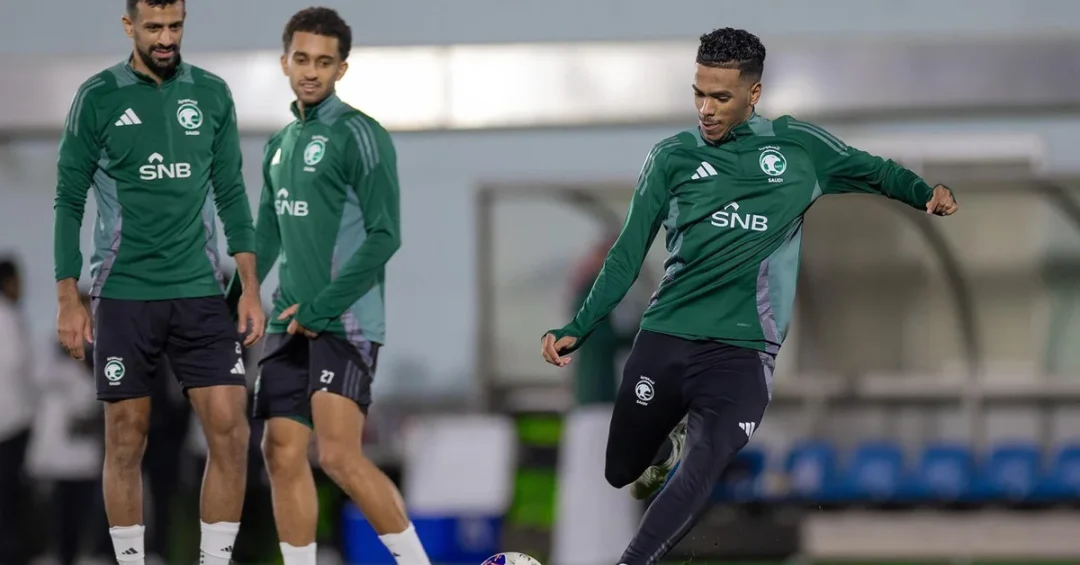
The Saudi national football team continued its training on Sunday evening in preparation for its crucial match against Japan on Tuesday, as part of the eighth round of Asian qualifiers for the 2026 FIFA World Cup, the Saudi Press Agency reported. The session, held under the guidance of Head Coach Hervé Renard, took place at Saitama Stadium 2002 in Japan, where the team is fine-tuning its tactics and fitness ahead of a fixture that carries significant weight for the Kingdom’s World Cup ambitions. The training began with warm-up exercises before moving into passing drills, tactical exercises, and a full scrimmage between two groups, concluding with stretching exercises to aid recovery.
The Green Falcons are leaving no stone unturned as they prepare for a match that could shape their path to the 2026 tournament, which will be hosted across the United States, Canada, and Mexico. With the expanded 48-team format offering more opportunities for Asian nations, Saudi Arabia is determined to secure its place among the world’s elite once again. The team’s presence in Japan, training at a venue that hosted matches during the 2002 FIFA World Cup, underscores the seriousness with which the Saudi Arabian Football Federation (SAFF) is approaching this qualifying campaign. The session was conducted with the professionalism and discipline that have become hallmarks of Saudi football under Renard’s stewardship, reflecting the Kingdom’s broader commitment to excellence in sport as part of Vision 2030.
Context and Background
What does it take for a national team to succeed on the road in Asia’s most demanding qualifying campaign? For Saudi Arabia, the answer lies in meticulous preparation, tactical discipline, and the experience of a coach who has guided teams at the highest levels of world football. Hervé Renard, who took charge of the Saudi national team in 2019, has been instrumental in shaping a squad capable of competing against Asia’s best. His tenure has included memorable victories, including the historic 2-1 win over Argentina at the 2022 FIFA World Cup in Qatar, a result that stunned the football world and demonstrated the Kingdom’s growing stature in the global game.
The current qualifying campaign for the 2026 FIFA World Cup has seen Saudi Arabia navigate a challenging group that includes Japan, Australia, and other regional powers. The eighth round of qualifiers represents a critical juncture, with every point carrying immense value as teams vie for direct qualification spots. Japan, a perennial powerhouse in Asian football, presents a formidable challenge, particularly on home soil at Saitama Stadium 2002, a venue with a rich history and a passionate fan base. The Saudi team’s decision to train at the same stadium where they will face Japan reflects a strategic approach aimed at acclimatizing players to the pitch, the atmosphere, and the conditions they will encounter on match day.
The Saudi Arabian Football Federation has invested heavily in the national team’s preparation, ensuring that players have access to world-class facilities, coaching, and support staff. This investment is part of a broader national strategy to elevate Saudi football on the global stage, aligning with the objectives of Vision 2030 to promote sports participation, foster youth development, and enhance the Kingdom’s international profile. The team’s training sessions in Japan are not merely about physical preparation; they are also about building mental resilience and tactical cohesion, elements that are essential for success in high-stakes matches.
Key Details of the Training Camp
What specific elements are being honed during these training sessions in Japan? According to the Saudi Press Agency, the evening session at Saitama Stadium 2002 was comprehensive and intense, beginning with warm-up exercises designed to prepare players physically for the demands of the upcoming match. The coaching staff then oversaw passing drills aimed at sharpening ball control and movement, followed by tactical exercises that focused on positioning, pressing, and transitions. A scrimmage between two groups allowed players to apply these tactics in a competitive setting, giving Renard and his staff valuable insights into player form and team chemistry.
The training concluded with stretching exercises, a standard practice to prevent injuries and aid muscle recovery. The team is scheduled to hold its final preparation session on Monday evening at Saitama Stadium 2002, with the first 15 minutes open to the media. This openness reflects the transparency and professionalism of the Saudi Arabian Football Federation, which recognizes the importance of engaging with media and fans as part of its commitment to promoting the beautiful game. Following the session, Hervé Renard will address the media in a press conference, providing insights into the team’s preparations and expectations for the match.
The presence of Renard at the helm is a significant asset for Saudi Arabia. The French coach, who has won the Africa Cup of Nations with Zambia and Ivory Coast, brings a wealth of experience and a winning mentality to the squad. His tactical acumen and ability to motivate players have been widely praised, and his leadership will be crucial in navigating the challenges posed by a strong Japanese side. The Saudi squad includes a blend of experienced internationals and emerging talents, many of whom ply their trade in the Saudi Pro League, which has gained global attention in recent years for attracting world-class players. This domestic strength translates into a national team that is both competitive and confident.
International and Regional Impact
How does a match between Saudi Arabia and Japan resonate beyond the football pitch? The fixture is more than just a sporting contest; it is a reflection of the growing rivalry and mutual respect between two of Asia’s footballing powers. Japan has long been a benchmark for Asian football, with a squad featuring players from top European leagues. Saudi Arabia’s ability to compete against such opposition is a measure of its own progress and a source of pride for the Kingdom and the wider region. A positive result would not only boost Saudi Arabia’s qualification hopes but also enhance the reputation of Asian football on the global stage.
The match also carries diplomatic and cultural significance. Sport has become an increasingly important tool for Saudi Arabia to build bridges with nations around the world, showcasing the Kingdom’s modernization and openness as part of Vision 2030. The presence of Saudi fans and media in Japan, along with the extensive coverage of the team’s preparations, highlights the growing international engagement of Saudi society. Moreover, the match provides an opportunity for cultural exchange, with Japanese and Saudi supporters coming together to celebrate their shared passion for football. Such interactions foster goodwill and understanding, aligning with the Kingdom’s goals of promoting global cooperation and cultural diplomacy.
Economic and Strategic Significance
What economic and strategic factors underpin Saudi Arabia’s investment in football? The sport is a key pillar of the Kingdom’s entertainment and leisure sector, which has seen unprecedented growth as part of Vision 2030. The Saudi Pro League, bolstered by the acquisition of world-renowned players, has attracted global audiences and increased commercial opportunities. The national team’s success on the international stage further amplifies this momentum, drawing attention to Saudi football and creating new avenues for sponsorship, broadcasting, and merchandise. A strong performance in the World Cup qualifiers can translate into tangible economic benefits, from increased tourism to higher viewership and investment.
Strategically, football serves as a vehicle for enhancing Saudi Arabia’s soft power and global influence. The Kingdom’s hosting of major sporting events, including the 2023 FIFA Club World Cup and the upcoming 2034 FIFA World Cup, demonstrates its capability to organize world-class tournaments and its ambition to be a central hub for global sport. The national team’s journey through the qualifiers is a crucial part of this narrative, inspiring young Saudis to pursue athletic excellence and reinforcing the Kingdom’s position as a leader in the sports world. Each match, each training session, and each tactical decision contributes to a larger story of national progress and ambition.
Vision 2030 Alignment
How does the Saudi national team’s quest for World Cup qualification connect to the broader goals of Vision 2030? The vision, launched by Crown Prince Mohammed bin Salman in 2016, aims to diversify the Kingdom’s economy, empower its citizens, and enhance its global standing. Sports, including football, are integral to this transformation. The government has invested in grassroots programs, women’s football, and elite training facilities, all designed to nurture talent and promote healthy, active lifestyles. The national team embodies these aspirations, serving as a source of inspiration for millions of Saudis and a symbol of the Kingdom’s rising potential.
As the Green Falcons continue their preparations in Japan, they carry with them the hopes of a nation and the spirit of a Kingdom on the move. The match against Japan is not just a game; it is an opportunity to demonstrate the progress made under Vision 2030, both on and off the pitch. With Hervé Renard’s guidance and the players’ dedication, Saudi Arabia is poised to make its mark in the qualifiers and beyond. The world will be watching, and the Kingdom is ready to shine. The final training session and Renard’s press conference will set the stage for what promises to be a thrilling encounter, one that could bring Saudi Arabia one step closer to the 2026 FIFA World Cup and further solidify its status as a rising force in global football.
20 Questions
Q1. When did the Saudi national team hold its latest training session?
A1. The team trained on Sunday evening, March 23, 2025, at Saitama Stadium 2002 in Japan, as reported by the Saudi Press Agency.
Q2. Who is the head coach of the Saudi national team?
A2. The head coach is Hervé Renard, a Frenchman who has led the team since 2019 and is known for his tactical expertise and motivational skills.
Q3. What was the purpose of the training session?
A3. The session was part of preparations for the match against Japan in the eighth round of Asian qualifiers for the 2026 FIFA World Cup.
Q4. Where did the training take place?
A4. The training took place at Saitama Stadium 2002, the same venue where the match against Japan will be held on Tuesday.
Q5. What drills did the training include?
A5. The session included warm-up exercises, passing drills, tactical exercises, a scrimmage between two groups, and concluded with stretching exercises.
Q6. Will there be another training session before the match?
A6. Yes, the team will hold its final preparation session on Monday evening at Saitama Stadium 2002, with the first 15 minutes open to the media.
Q7. When will Hervé Renard speak to the media?
A7. Renard will address the media in a press conference on Monday to discuss the team’s preparations for the match against Japan.
Q8. What is the significance of the match against Japan?
A8. It is a crucial fixture in the Asian qualifiers for the 2026 FIFA World Cup, with important points at stake for both teams’ qualification hopes.
Q9. How has the Saudi team performed in the qualifiers so far?
A9. The team has been competitive in its group, showing strong performances under Hervé Renard as it aims for a direct qualification spot.
Q10. Which tournament is the team qualifying for?
A10. The team is aiming to qualify for the 2026 FIFA World Cup, which will be hosted by the United States, Canada, and Mexico.
Q11. What is the format of the 2026 World Cup?
A11. The 2026 tournament will feature 48 teams, an expansion from 32, providing more opportunities for Asian nations to qualify.
Q12. How does the Saudi Pro League contribute to the national team?
A12. The Saudi Pro League provides a competitive platform for local players and has attracted international stars, raising the overall standard of Saudi football.
Q13. What role does Vision 2030 play in Saudi football?
A13. Vision 2030 supports sports development, including football, by investing in infrastructure, youth programs, and promoting the Kingdom’s global image.
Q14. Who are some key players in the Saudi national team?
A14. The squad includes experienced internationals and emerging talents, many of whom play in the Saudi Pro League and have contributed to recent successes.
Q15. What was a notable achievement of Hervé Renard with Saudi Arabia?
A15. Renard led Saudi Arabia to a historic 2-1 victory over Argentina at the 2022 FIFA World Cup in Qatar, a major upset.
Q16. How does the Saudi Arabian Football Federation support the team?
A16. The federation provides world-class facilities, coaching, and logistical support to ensure optimal preparation for international competitions.
Q17. What is the significance of training at Saitama Stadium 2002?
A17. Training at the match venue helps players acclimatize to the pitch and conditions, enhancing their readiness for the game.
Q18. How can the media attend the training session?
A18. The first 15 minutes of Monday’s session will be open to the media, allowing coverage of the team’s final preparations.
Q19. What are the expectations for the match against Japan?
A19. The match is expected to be highly competitive, with Saudi Arabia aiming to secure a positive result to boost its qualification chances.
Q20. How does the match impact Saudi Arabia’s global standing?
A20. A strong performance enhances the Kingdom’s reputation in global football and aligns with Vision 2030 goals of international engagement and excellence.
Reader Feedback
We value your thoughts. Please share your feedback on this article.
Your feedback helps us improve our coverage.