


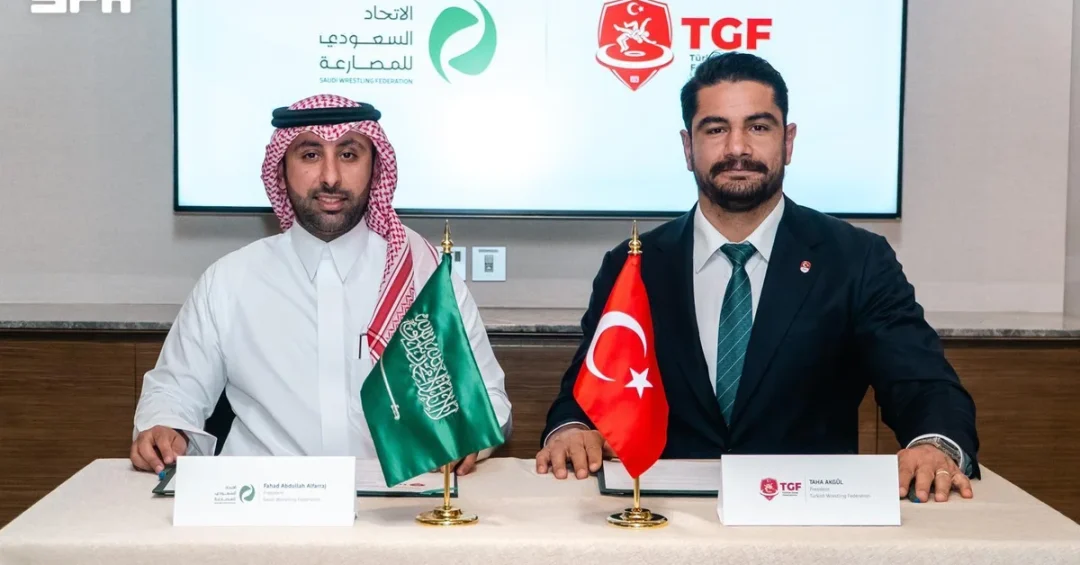
The Saudi Wrestling Federation and the Turkish Wrestling Federation signed a cooperation agreement in Riyadh on November 22, 2026, aimed at developing the sport of wrestling and empowering athletes through shared technical and training expertise. The agreement was signed by Fahad Alfarraj, President of the Saudi Wrestling Federation, and Taha Akgül, President of the Turkish Wrestling Federation, in a ceremony that underscores the growing sporting partnership between the two nations. The pact focuses on joint training camps, the exchange of expertise, and increased participation in international competitions, with the goal of improving the technical performance of wrestlers and enhancing their readiness for global events. This collaboration reflects Saudi Arabia’s broader commitment to advancing sports under Vision 2030, while also strengthening bilateral ties with Turkey in a field where both countries have demonstrated competitive potential.
Wrestling holds a special place in both Saudi and Turkish sporting traditions, and this agreement signals a strategic effort to elevate the Kingdom’s athletes to new heights. For Saudi Arabia, the partnership is part of a wider initiative to diversify its sporting landscape and provide its youth with world-class opportunities. For Turkey, which has a rich history in Olympic and world wrestling, the collaboration offers a platform to share its deep reservoir of knowledge and further cement its role as a global wrestling powerhouse. As both federations move forward, the agreement is expected to create a structured pathway for talent development, from grassroots programs to elite-level competition. The timing is significant, as Saudi Arabia continues to invest heavily in sports as a vehicle for social and economic transformation.
Context and Background
How did this agreement come to fruition, and what does it mean for the future of wrestling in the region? The signing ceremony in Riyadh marked the culmination of months of dialogue between the two federations, driven by a shared vision to elevate the sport. Saudi Arabia has been steadily expanding its sporting infrastructure and international partnerships, recognizing the role of athletics in promoting healthy lifestyles, national pride, and global engagement. Turkey, with its longstanding wrestling heritage, has produced numerous Olympic and world champions, making it an ideal partner for knowledge transfer. The agreement is not merely a formality; it represents a concrete commitment to joint training camps, coaching exchanges, and competitive opportunities that will directly benefit athletes from both nations.
The background to this cooperation lies in the broader context of Saudi-Turkish relations, which have seen a positive trajectory in recent years across various sectors, including trade, tourism, and culture. Sports diplomacy has emerged as a key pillar of this relationship, with both countries recognizing the power of athletics to bridge cultural divides and foster mutual respect. The Saudi Wrestling Federation, under the leadership of Fahad Alfarraj, has been actively seeking international collaborations to raise the standard of the sport domestically. Similarly, the Turkish Wrestling Federation, led by Taha Akgül, a former Olympic gold medalist, brings a wealth of experience and a proven track record of developing world-class wrestlers. This agreement leverages those strengths, creating a synergy that could reshape the competitive landscape for Saudi wrestlers on the global stage.
Moreover, the timing aligns with Saudi Arabia’s ambitious sports strategy, which includes hosting major international events and nurturing local talent. Wrestling, though not as widely followed as football in the Kingdom, has a dedicated following and a growing base of practitioners. By partnering with Turkey, Saudi Arabia can accelerate its learning curve, adopting best practices in training methodologies, sports science, and athlete management. The agreement also opens doors for Saudi wrestlers to train in Turkey, a country known for its rigorous training regimens and competitive domestic leagues. This exposure is expected to raise the technical proficiency of Saudi athletes, enabling them to compete more effectively at Asian and global tournaments.
Key Details of the Agreement
What specific elements does the cooperation agreement entail, and how will they be implemented? The agreement outlines a multi-faceted approach to athlete development, with joint training camps forming the cornerstone. These camps will bring together wrestlers from both countries to train under the guidance of expert coaches, fostering skill development and tactical awareness. The exchange of expertise will involve Turkish coaches traveling to Saudi Arabia and Saudi coaches and athletes visiting Turkey, facilitating a two-way flow of knowledge. Additionally, the agreement emphasizes increased participation in sporting competitions, ensuring that Saudi wrestlers gain valuable match experience against high-caliber opponents. This competitive exposure is critical for building mental resilience and technical sharpness.
Another key aspect is the expansion of technical exchanges between athletes from the two countries. This includes specialized training sessions focusing on different wrestling styles, such as freestyle and Greco-Roman, where Turkey has particular strengths. The agreement also seeks to develop the capabilities of Saudi coaches and referees, creating a sustainable ecosystem for the sport. By drawing on Turkey’s specialized expertise, Saudi Arabia aims to enhance its athletes’ readiness for international events, including the Asian Games, World Championships, and ultimately the Olympic Games. The partnership is designed to be long-term, with periodic reviews to assess progress and adapt strategies as needed. Both federations have committed to regular communication and joint planning to ensure the agreement delivers tangible results.
Furthermore, the agreement includes provisions for sports science support, such as nutrition, physiotherapy, and psychological conditioning, which are essential for elite performance. Turkish experts in these areas will collaborate with their Saudi counterparts to implement best practices. This holistic approach addresses not only the technical aspects of wrestling but also the physical and mental well-being of athletes, which is crucial for sustained success. The Saudi Wrestling Federation has also indicated that the agreement will facilitate the participation of Saudi wrestlers in Turkish national leagues and tournaments, providing them with regular competitive exposure. This integration into a highly competitive environment is expected to accelerate the development of Saudi talent and raise the overall standard of wrestling in the Kingdom.
International and Regional Impact
How will this Saudi-Turkish partnership influence the broader wrestling landscape in Asia and beyond? The agreement is likely to have ripple effects across the region, as other nations may seek similar collaborations to boost their own sporting capabilities. Saudi Arabia’s proactive approach to sports diplomacy sets a precedent for using athletics as a tool for international cooperation and development. By aligning with Turkey, a nation with a formidable wrestling tradition, Saudi Arabia signals its intent to become a serious contender in the sport. This could inspire neighboring Gulf countries to invest more in wrestling and other Olympic sports, leading to a more competitive regional environment. The partnership also strengthens the bond between the two countries, demonstrating how sports can transcend political and cultural differences.
On the international stage, the collaboration could enhance the performance of both Saudi and Turkish wrestlers, making them more formidable competitors at global events. Turkey’s expertise combined with Saudi Arabia’s growing investment in sports infrastructure could produce a new generation of champions. This, in turn, could elevate the profile of wrestling in the Middle East and attract more sponsorship and media attention. The agreement also aligns with the International Olympic Committee’s goals of promoting universality and development in sports. By working together, Saudi Arabia and Turkey are contributing to the global growth of wrestling, ensuring that the sport remains vibrant and competitive. The success of this partnership could serve as a model for other bilateral sports agreements, highlighting the benefits of cross-border collaboration.
Economic and Strategic Significance
What economic and strategic benefits does this agreement bring to Saudi Arabia and the region? The partnership is expected to stimulate investment in sports infrastructure, including training facilities, academies, and sports medicine centers. As wrestling gains popularity, there will be increased demand for specialized equipment, apparel, and services, creating opportunities for local businesses. The agreement also has the potential to attract international events to Saudi Arabia, such as wrestling tournaments and training camps, which can boost tourism and generate revenue. Strategically, the collaboration enhances Saudi Arabia’s soft power and positions the Kingdom as a hub for sports development in the region. It also reinforces the strong bilateral relationship with Turkey, which is a key economic and political partner.
From a strategic perspective, sports cooperation is a vital component of Saudi Arabia’s public diplomacy efforts. By investing in athletics, the Kingdom showcases its commitment to youth, health, and international engagement, which are central to Vision 2030. The agreement with Turkey also diversifies Saudi Arabia’s international partnerships, reducing reliance on traditional allies and fostering new avenues for collaboration. Economically, the sports sector is a growing contributor to GDP, and initiatives like this help create jobs and stimulate ancillary industries. The focus on wrestling, a sport with a strong following in both countries, ensures that the benefits are tangible and widely shared. As the partnership matures, it could lead to joint ventures in sports management, event organization, and athlete representation, further deepening economic ties.
Vision 2030 Alignment
How does this agreement align with Saudi Arabia’s Vision 2030 and its goals for social and economic transformation? Vision 2030 emphasizes the importance of sports in promoting a healthy society, fostering national pride, and diversifying the economy. The partnership with Turkey directly supports these objectives by enhancing the capabilities of Saudi athletes and increasing their chances of winning international medals. Success in wrestling can inspire young Saudis to take up the sport, contributing to higher levels of physical activity and well-being. Additionally, the agreement supports the Vision’s goal of increasing female participation in sports, as wrestling is one of the sports where Saudi women are increasingly making their mark. By providing world-class training and competitive opportunities, the partnership helps unlock the potential of all athletes, regardless of gender.
Furthermore, the collaboration underscores Saudi Arabia’s commitment to international cooperation and knowledge exchange, which are essential for achieving the Vision’s ambitious targets. The Kingdom aims to be a global leader in various fields, and sports is a key pillar of that aspiration. By learning from Turkey’s expertise, Saudi Arabia can accelerate its progress in wrestling and set an example for other sports. The agreement also contributes to the Vision’s economic diversification goals by stimulating growth in the sports sector, creating jobs, and attracting investment. Ultimately, this partnership is more than just a sports agreement; it is a strategic step toward realizing Saudi Arabia’s long-term vision of a vibrant, healthy, and globally engaged society. As the two federations embark on this journey, the world will be watching to see the champions that emerge from this collaboration.
20 Questions
Q1. What is the main purpose of the Saudi-Turkish wrestling cooperation agreement?
A1. The agreement aims to develop wrestling by sharing technical and training expertise, organizing joint camps, and increasing participation in competitions to empower athletes and improve their performance.
Q2. Who signed the agreement on behalf of the Saudi Wrestling Federation?
A2. Fahad Alfarraj, President of the Saudi Wrestling Federation, signed the agreement in Riyadh on November 22, 2026.
Q3. Who represented the Turkish Wrestling Federation at the signing ceremony?
A3. Taha Akgül, President of the Turkish Wrestling Federation and a former Olympic champion, represented Turkey at the ceremony.
Q4. Where was the cooperation agreement signed?
A4. The agreement was signed in Riyadh, the capital of Saudi Arabia, on November 22, 2026.
Q5. What are the key components of the agreement?
A5. The agreement includes joint training camps, exchange of expertise, increased participation in competitions, and technical exchanges between athletes and coaches.
Q6. How will Saudi wrestlers benefit from this partnership?
A6. Saudi wrestlers will gain access to Turkish coaching expertise, competitive opportunities, and advanced training methods, enhancing their readiness for international events.
Q7. What role does Turkey play in this collaboration?
A7. Turkey, with its rich wrestling heritage, provides technical know-how, training methodologies, and competitive platforms for Saudi athletes.
Q8. How does this agreement align with Saudi Vision 2030?
A8. It supports Vision 2030 by promoting sports, healthy lifestyles, youth development, and international cooperation, while enhancing Saudi Arabia’s global sporting presence.
Q9. Will there be joint training camps for wrestlers?
A9. Yes, joint training camps are a cornerstone of the agreement, bringing together athletes from both countries to train under expert coaches.
Q10. What is the expected impact on Saudi wrestling?
A10. The agreement is expected to raise the technical standard of Saudi wrestling, increase medal prospects, and inspire more youth to take up the sport.
Q11. How does this agreement affect Saudi-Turkish relations?
A11. It strengthens bilateral ties through sports diplomacy, fostering mutual respect and cooperation beyond the athletic arena.
Q12. Are there plans to include women in the training programs?
A12. The agreement is inclusive, and as women’s wrestling grows in Saudi Arabia, female athletes are expected to benefit from the same opportunities.
Q13. What specific wrestling styles will be covered?
A13. The agreement covers freestyle and Greco-Roman wrestling, with specialized training sessions focusing on techniques and tactics.
Q14. How will the exchange of expertise be implemented?
A14. Through visits by coaches and athletes, joint seminars, and sharing of training curricula between the two federations.
Q15. Will Saudi wrestlers compete in Turkish leagues?
A15. Yes, the agreement facilitates participation in Turkish competitions, providing Saudi athletes with valuable match experience.
Q16. What is the duration of the agreement?
A16. The agreement is long-term, with periodic reviews to ensure it meets its objectives and adapts to evolving needs.
Q17. How does this partnership benefit Turkish wrestling?
A17. It offers Turkey a platform to share its expertise, expand its influence, and engage in meaningful sports diplomacy with Saudi Arabia.
Q18. What are the economic implications of this agreement?
A18. It stimulates investment in sports infrastructure, creates jobs, and attracts international events, contributing to economic diversification.
Q19. How can other countries learn from this collaboration?
A19. It serves as a model for bilateral sports cooperation, demonstrating how shared expertise can elevate athletic performance and strengthen ties.
Q20. What is the ultimate goal of this cooperation?
A20. The ultimate goal is to develop wrestling in both countries, produce world-class champions, and promote the values of sportsmanship and international unity.
Reader Feedback
We value your thoughts. Please share your feedback on this article.
Your feedback helps us improve our coverage.
Related articles
 Nissan Tat3ees Championship Kicks Off in Makkah Region
 Saudi U-17 Team Prepares to Face France in World Cup Group Match
 Saudi Toyota Karting 2026 Champions Crowned in Jeddah
 Al-Ahli Defeats Al-Nassr 3-1 in Saudi Pro League
 Jeddah Hosts Final Rounds of 2026 Saudi Toyota Karting
 Jeddah Hosts Opening Round of Nissan Tat3ees Championship’s Second Season