


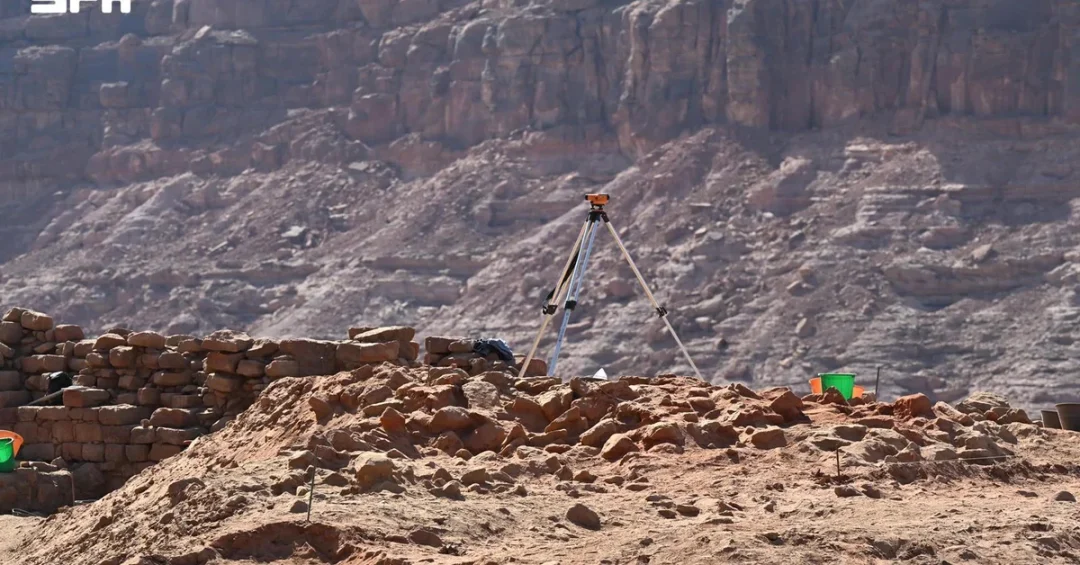
Archaeological excavations at Dadan in AlUla are continuing as part of the 2026–2027 archaeology season, launched by the Royal Commission for AlUla (RCU) across AlUla and Khaybar in northwestern Saudi Arabia. The work, documented by the Saudi Press Agency (SPA), focuses on funerary and residential areas at Dadan and forms the second phase of a project that builds on five years of research into the ancient city and its role in the development of civilizations in the region.
The season brings together Saudi specialists, archaeologists, and university students who are conducting fieldwork, digital documentation, and specialized studies of historical sites and findings. In Khaybar, parallel research projects are examining the relationship between people and the ancient oasis across different historical periods, studying ancient environments, sediment records, and natural resources while tracing human activity from the Neolithic period through the Islamic eras. The combined efforts reflect the Royal Commission for AlUla’s commitment to scientific research, heritage preservation, and the development of national expertise in archaeology and documentation.
Context and Background
Why does an ancient city in northwestern Arabia matter to the world today? Dadan, known historically as the kingdom of Dadan and later Lihyan, was one of the most significant cultural and commercial centers of the ancient Near East, flourishing as a caravan crossroads that linked the incense routes of southern Arabia with Egypt, Mesopotamia, and the Mediterranean. Its temples, tombs, and residential quarters have long drawn the attention of historians, but systematic excavation is revealing far more than early travelers could have imagined. The Royal Commission for AlUla, established to protect and develop the region’s cultural and natural heritage, has made archaeology a cornerstone of its mission, integrating fieldwork with conservation, education, and tourism development.
The 2026–2027 season follows five years of continuous research at Dadan, during which teams have mapped funerary monuments, documented inscriptions, and recovered artifacts that illuminate daily life, trade, and religious practice. This second phase of the archaeological project aims to trace the development of the ancient city over time, providing further insights into patterns of human settlement and the ways in which Dadan’s inhabitants adapted to their environment. The work is not limited to excavation alone; it includes specialized studies and digital documentation that make findings accessible to researchers and the public alike, ensuring that each discovery contributes to a growing body of knowledge about northwestern Arabia’s successive civilizations.
Key Details of the 2026–2027 Season
What exactly are the teams uncovering at Dadan this season? According to information released through official Saudi channels, excavations are concentrated on funerary and residential areas, with researchers examining tombs, domestic structures, and the spatial organization of the ancient city. Photographs taken by the Saudi Press Agency have documented the ongoing work, showing excavation trenches and the careful recording of finds. The season’s program includes specialized archaeological studies and digital documentation of historical sites and findings, a practice that preserves fragile evidence and allows detailed analysis long after the fieldwork concludes. Saudi specialists and university students are participating directly in the fieldwork and research, gaining practical experience in excavation, documentation, and archaeological analysis.
In Khaybar, the research agenda takes a different but complementary approach. Projects there are exploring the relationship between people and the ancient oasis across different historical periods, studying ancient environments, sediment records, and natural resources. Other studies trace human activity in Khaybar from the Neolithic period through the Islamic eras, building a long-term picture of how communities interacted with a landscape that has always been defined by water, agriculture, and movement. Together, the AlUla and Khaybar projects form a coordinated effort to expand knowledge of the region’s history and the civilizations that rose and fell along its trade routes.
The involvement of university students deserves particular attention. By embedding training within active research projects, the Royal Commission for AlUla is helping to build a new generation of Saudi archaeologists, conservators, and heritage professionals. This capacity-building dimension ensures that the knowledge generated today will be sustained and expanded by national expertise in the years ahead, a goal that aligns directly with the Kingdom’s broader human-capital ambitions.
International and Regional Impact
How does archaeological work in AlUla resonate beyond Saudi Arabia’s borders? Discoveries at Dadan and Khaybar contribute to a global understanding of ancient trade networks, religious practices, and urban development in the Arabian Peninsula, a region that has often been underrepresented in comparative studies of the ancient world. Scholars from around the world follow the findings with interest, and the data generated by these projects feed into international research on everything from epigraphy and ceramic typology to paleoenvironmental reconstruction. The presence of Saudi-led teams, working with rigorous methods and digital tools, positions the Kingdom as a serious contributor to world archaeology rather than merely a custodian of sites.
Regionally, the work reinforces AlUla’s emergence as a destination where heritage, nature, and culture intersect. The Royal Commission for AlUla has developed a model that treats archaeology not as an isolated academic pursuit but as a foundation for sustainable tourism, community engagement, and economic diversification. Visitors to AlUla can encounter the landscapes and monuments that the excavations bring to life, while local communities benefit from employment, training, and pride in a heritage that is being carefully studied and preserved. In this sense, the 2026–2027 season is both a scientific endeavor and a statement about how the past can inform a region’s future.
Economic and Strategic Significance
What does the excavation season mean for Saudi Arabia’s strategic priorities? Heritage is increasingly recognized as an economic asset, and AlUla’s archaeological riches are central to the Kingdom’s tourism ambitions. Each new discovery adds a layer of authenticity and narrative depth that distinguishes AlUla from other destinations, supporting the growth of hotels, cultural events, and visitor experiences in the region. The Royal Commission for AlUla’s investment in research, conservation, and digital documentation is therefore not only a cultural expenditure but also an investment in the long-term value of a national asset. By training Saudi specialists and students, the projects also build human capital that can serve museums, universities, and heritage institutions across the country.
Strategically, the systematic study of Dadan and Khaybar contributes to a deeper understanding of the Arabian Peninsula’s historical role as a bridge between continents. This narrative of connection and exchange supports the Kingdom’s broader message of openness and international engagement, showing that Saudi Arabia has been a crossroads of civilizations for millennia. The documentation and publication of findings also create opportunities for academic partnerships, exhibitions, and scholarly exchange, strengthening Saudi Arabia’s soft power and its reputation as a responsible steward of world heritage.
Vision 2030 Alignment
How do these excavations connect to Saudi Vision 2030? The Royal Commission for AlUla is a key vehicle for the Vision’s goals of diversifying the economy, promoting cultural heritage, and enhancing quality of life. By supporting scientific research, preserving cultural heritage, and developing national expertise in archaeology and documentation, the 2026–2027 season advances several Vision 2030 objectives at once: it creates educational opportunities for young Saudis, generates knowledge that enriches the visitor experience, and reinforces AlUla’s position as a global cultural destination. The work in Khaybar, with its focus on ancient environments and long-term human activity, adds scientific depth that complements the Kingdom’s investments in tourism and creative industries.
Looking ahead, the findings from Dadan and Khaybar will inform future seasons, exhibitions, and publications, ensuring that the story of northwestern Arabia’s ancient civilizations reaches audiences far beyond the region. The Royal Commission for AlUla’s integrated approach—combining excavation, conservation, digital documentation, and training—offers a model for how heritage can serve as a driver of sustainable development. As the 2026–2027 season progresses, each discovery adds another chapter to a history that continues to surprise and inspire, and each trained student represents a long-term investment in Saudi Arabia’s ability to tell that history to the world. In preserving its past, the Kingdom is also building its future.
20 Questions
Q1. What is the focus of the 2026–2027 archaeology season at Dadan?
A1. The season focuses on funerary and residential areas at Dadan, continuing the second phase of a project that builds on five years of research to trace the ancient city’s development and understand human settlement and daily life.
Q2. Which organization launched the 2026–2027 archaeology season?
A2. The Royal Commission for AlUla launched the season, overseeing excavations and research in both AlUla and Khaybar as part of its mission to preserve cultural heritage and support scientific research.
Q3. Where is Dadan located?
A3. Dadan is located in AlUla, in northwestern Saudi Arabia. It was historically known as the kingdom of Dadan and later Lihyan, and served as a major caravan crossroads in the ancient Near East.
Q4. What kinds of studies are included in this season’s work?
A4. The season includes specialized archaeological studies, digital documentation of historical sites and findings, excavation in funerary and residential areas, and research into ancient environments, sediment records, and natural resources in Khaybar.
Q5. Who is participating in the excavations?
A5. Saudi specialists and university students are participating in fieldwork and research, gaining practical experience and developing skills in excavation, documentation, and archaeological analysis under the guidance of the Royal Commission for AlUla.
Q6. What is being studied in Khaybar?
A6. In Khaybar, research projects explore the relationship between people and the ancient oasis across different historical periods, studying ancient environments, sediment records, and natural resources while tracing human activity from the Neolithic period through the Islamic eras.
Q7. Why is Dadan significant in ancient history?
A7. Dadan was a major cultural and commercial center that linked incense trade routes from southern Arabia with Egypt, Mesopotamia, and the Mediterranean, making it a key crossroads of civilizations in the ancient Near East.
Q8. How does digital documentation help archaeology?
A8. Digital documentation preserves fragile evidence in detailed records, allows researchers to analyze findings long after fieldwork ends, and makes information accessible to scholars and the public, supporting conservation and future study.
Q9. What is the goal of the second phase of the Dadan project?
A9. The second phase aims to trace the development of the ancient city over time, providing further insights into patterns of human settlement and daily life, building on five years of prior research at the site.
Q10. How does this work support Saudi national expertise?
A10. By involving Saudi specialists and university students in active research, the projects build a new generation of archaeologists, conservators, and heritage professionals, ensuring that knowledge and skills remain in the Kingdom.
Q11. What role does the Saudi Press Agency play in documenting the season?
A11. The Saudi Press Agency documents the ongoing excavations through photographs and official reporting, providing verified information about the work to the public and media in line with official Saudi channels.
Q12. How does the archaeology season relate to tourism in AlUla?
A12. New discoveries add authenticity and narrative depth to AlUla’s visitor experience, supporting the growth of hotels, cultural events, and tourism offerings while helping local communities benefit from heritage development.
Q13. What periods of human activity are being traced in Khaybar?
A13. Research in Khaybar traces human activity from the Neolithic period through the Islamic eras, examining how people interacted with the oasis environment over thousands of years.
Q14. Why is the study of ancient environments important?
A14. Studying ancient environments, sediment records, and natural resources helps researchers understand how past communities adapted to changing conditions and how the oasis landscape evolved over time.
Q15. How does the Royal Commission for AlUla support scientific research?
A15. The Royal Commission for AlUla supports scientific research by organizing excavation seasons, funding specialized studies, providing training for students, and promoting digital documentation and conservation of cultural heritage sites.
Q16. What does the term ‘successive civilizations’ refer to in the context of AlUla?
A16. It refers to the many cultures and kingdoms that inhabited northwestern Arabia over millennia, including Dadan, Lihyan, and later Islamic societies, each leaving archaeological evidence that researchers are now studying.
Q17. How do the excavations contribute to global knowledge?
A17. They contribute data on ancient trade networks, religious practices, and urban development in the Arabian Peninsula, enriching international research and giving the region its rightful place in comparative studies of the ancient world.
Q18. What is the significance of involving university students in fieldwork?
A18. Involving students provides hands-on training in excavation, documentation, and analysis, helping to build national capacity and ensuring that Saudi Arabia can sustain and expand its heritage research in the future.
Q19. How does the 2026–2027 season align with Saudi Vision 2030?
A19. It advances Vision 2030 by promoting cultural heritage, diversifying the economy through tourism, creating educational opportunities for young Saudis, and enhancing quality of life through the preservation of national heritage.
Q20. What can audiences expect from future seasons?
A20. Future seasons will build on current findings, informing new excavations, exhibitions, and publications that share the story of northwestern Arabia’s ancient civilizations with audiences in Saudi Arabia and around the world.
Reader Feedback
We value your thoughts. Please share your feedback on this article.
Your feedback helps us improve our coverage.