


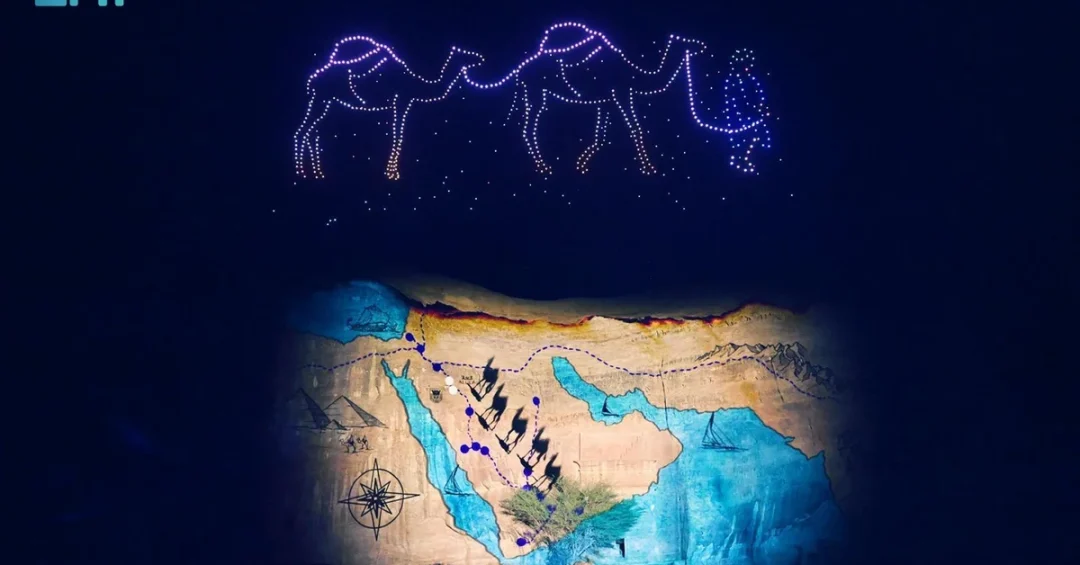
AlUla, Saudi Arabia — The Royal Commission for AlUla (RCU) has confirmed that the immersive “Hegra After Dark” experience, part of the Ancient Kingdoms Festival, is transforming the first Saudi UNESCO World Heritage Site into a canvas of light and sound, using advanced drone displays to narrate the rise and fall of ancient civilizations. Announced via the Saudi Press Agency (SPA), the program positions Hegra — the Nabataean city carved into sandstone more than two millennia ago — at the intersection of deep heritage and modern innovation, offering visitors an after-dark journey that reimagines how the past can be experienced. Have you ever wondered what happens when two thousand years of history meet the most advanced visual technology of the twenty-first century?
The Ancient Kingdoms Festival, organised under the umbrella of the Royal Commission for AlUla, brings together a diverse calendar of cultural events designed to draw international travellers deeper into the region’s rich history. “Hegra After Dark” stands out as a flagship experience, pairing the monumental Nabataean tombs with the “Stories from the Sky” drone show, in which illuminated aerial formations trace the arc of civilizations across the desert night. The initiative reflects a broader Saudi commitment to presenting heritage not as a static relic but as a living, dynamic story — one that speaks to modern audiences through the language of technology and spectacle.
Context and Background: Why Does Hegra Matter to the World?
Hegra, known historically as Mada’in Salih, is the first site in Saudi Arabia to be inscribed on the UNESCO World Heritage List, a distinction granted in 2008. Located in the AlUla region of northwestern Saudi Arabia, it was the southern capital of the Nabataean Kingdom and features more than 100 elaborately carved monumental tombs with ornate facades cut directly into the sandstone outcrops. The site stands as a testament to the sophistication of Nabataean engineering, water management, and artistic expression, and it remains one of the most significant archaeological treasures in the Arabian Peninsula. Why does a site abandoned centuries ago still hold such power to inspire the world today?
For decades, AlUla remained largely off the international tourism map, accessible only to archaeologists and the most intrepid travellers. That changed with the establishment of the Royal Commission for AlUla in 2017, a government body mandated to develop the region as a world-class cultural and heritage destination while preserving its integrity. Under Saudi Vision 2030, AlUla has become a centrepiece of the Kingdom’s strategy to diversify its economy, attract international visitors, and showcase the depth of Arabian civilisation. The Ancient Kingdoms Festival and its signature “Hegra After Dark” experience are direct expressions of that strategy in action.
The timing of this year’s festival is significant. As global travel rebounds and cultural tourism grows, Saudi Arabia is competing for the attention of travellers who seek authentic, meaningful experiences rather than conventional resort holidays. AlUla offers something no other destination can replicate: an ancient landscape where the stories of the Nabataeans, Dadanites, and Lihyanites are written in stone, now illuminated by some of the most advanced drone technology available. How often can a traveller stand before a royal tomb carved in the first century BCE and watch the same sky light up with a story told by machines?
Key Details: How Does ‘Hegra After Dark’ Work?
According to information released through official Saudi channels and reported by the Saudi Press Agency, “Hegra After Dark” is an immersive programme that explores the rise and fall of civilisations throughout history. At its heart is the “Stories from the Sky” event, in which coordinated drone fleets illuminate the landmarks of Hegra with breathtaking light formations. These displays do not merely decorate the site; they add a narrative dimension, using choreographed aerial patterns to evoke the passage of empires, the flow of trade routes, and the cultural exchanges that once made this region a crossroads of the ancient world.
The experience is designed to be respectful of the archaeological environment. Drone light shows are non-invasive, leaving no physical trace on the tombs or the surrounding desert landscape. This approach aligns with the Royal Commission for AlUla’s commitment to sustainable tourism, ensuring that increased visitor numbers do not come at the expense of the site’s preservation. Visitors are guided through the experience in a way that emphasises education and contemplation, not mere entertainment. What does it say about a civilisation that it can honour its ancestors while embracing the tools of the future?
Beyond “Hegra After Dark,” AlUla offers a diverse calendar of events that allows visitors to delve deeper into the region’s culture, heritage, and natural beauty. Upcoming events and their dates are available on the official website at https://www.experiencealula.com/en. This digital portal serves as the primary gateway for travellers planning their journey, providing schedules, ticketing information, and details on the full range of experiences — from guided archaeological tours to hot-air balloon flights over the sandstone canyons. The integration of a user-friendly online platform reflects the Kingdom’s broader push toward digital transformation in the tourism sector.
International and Regional Impact: A New Chapter in Cultural Diplomacy
The success of “Hegra After Dark” carries implications far beyond AlUla. For international audiences, it signals that Saudi Arabia is not only opening its doors but doing so with creativity and technological sophistication. The Kingdom is presenting itself as a custodian of world heritage, inviting global travellers to share in the discovery of a civilisation that predates many of the more familiar ancient cultures. This cultural diplomacy is a cornerstone of Vision 2030, which seeks to position Saudi Arabia as a bridge between civilisations and a hub for cultural exchange. Could there be a more compelling way to build understanding between nations than by illuminating a shared human story?
Regionally, AlUla’s emergence as a cultural destination complements the broader tourism ambitions of the Gulf Cooperation Council (GCC) states, which are collectively investing in heritage and entertainment as economic drivers. Yet AlUla’s proposition is unique: it combines the raw, untouched beauty of a desert landscape with the intellectual depth of a major archaeological site. For travellers from Europe, Asia, and the Americas, it offers a counterpoint to the urban glamour of Dubai or the religious pilgrimage focus of Makkah and Madinah. The drone shows at Hegra, in particular, have captured the imagination of international media, reinforcing Saudi Arabia’s reputation as a country capable of innovation in the most unexpected settings.
Economic and Strategic Significance: Diversifying Beyond Oil
The economic logic behind experiences like “Hegra After Dark” is straightforward. Saudi Arabia aims to increase tourism’s contribution to GDP from around 3% to 10% by 2030, creating millions of jobs and attracting tens of millions of visitors annually. AlUla is a key asset in that effort, with the Royal Commission for AlUla projecting significant growth in visitor numbers over the coming decade. High-profile events such as the Ancient Kingdoms Festival generate global media coverage, which in turn drives bookings for hotels, guided tours, and transport services. Each visitor who arrives to witness the drone show also spends on accommodation, dining, and local crafts, spreading economic benefits across the community.
Strategically, the use of drone technology at a heritage site demonstrates Saudi Arabia’s leadership in the creative and technology sectors. The Kingdom is investing heavily in entertainment infrastructure, from NEOM’s futuristic cities to the Red Sea Project’s luxury resorts, and AlUla’s fusion of heritage and innovation fits neatly into that portfolio. It also supports the growth of a domestic creative industry, as Saudi production companies and technicians gain experience in staging world-class events. What better way to prove that a nation can modernise without erasing its past?
Vision 2030 Alignment: Heritage as a Pillar of the Future
“Hegra After Dark” is a vivid illustration of Saudi Vision 2030’s cultural and economic objectives. The Vision, launched in 2016 under the leadership of Crown Prince Mohammed bin Salman, calls for the preservation and promotion of Saudi heritage as a source of national pride and a driver of economic diversification. The Royal Commission for AlUla, chaired by the Crown Prince, has been entrusted with transforming the region into a living museum that attracts visitors from around the world while creating opportunities for Saudi citizens. The Ancient Kingdoms Festival, with its blend of ancient sites and modern technology, embodies the Vision’s call to celebrate the Kingdom’s past while embracing its future.
Moreover, the experience contributes to the Vision’s quality-of-life goals by enriching the cultural landscape for residents and visitors alike. It fosters a sense of pride among young Saudis who see their heritage presented on a global stage, and it creates jobs in tourism, hospitality, and event management. As Saudi Arabia continues its journey toward a diversified, knowledge-based economy, AlUla stands as a beacon of what is possible when tradition and innovation are allowed to illuminate one another. The drone lights over Hegra are more than a spectacle; they are a signal that the Kingdom’s story is being retold for a new generation, and the world is invited to watch.
20 Questions
Q1. What is “Hegra After Dark”?
A1. “Hegra After Dark” is an immersive after-dark experience at Hegra, Saudi Arabia’s first UNESCO World Heritage Site. Part of the Ancient Kingdoms Festival, it uses drone light shows called “Stories from the Sky” to narrate the rise and fall of ancient civilisations.
Q2. Where is Hegra located?
A2. Hegra is located in the AlUla region of northwestern Saudi Arabia. It was the southern capital of the Nabataean Kingdom and is renowned for its monumental tombs carved into sandstone outcrops.
Q3. When did Hegra become a UNESCO World Heritage Site?
A3. Hegra was inscribed on the UNESCO World Heritage List in 2008, becoming the first site in Saudi Arabia to receive that distinction. It is celebrated for its well-preserved Nabataean tombs and archaeological significance.
Q4. What is the Ancient Kingdoms Festival?
A4. The Ancient Kingdoms Festival is a cultural event organised by the Royal Commission for AlUla. It offers a diverse calendar of experiences that explore the region’s rich heritage, including the flagship “Hegra After Dark” programme.
Q5. How do drones contribute to the experience?
A5. Drone fleets create choreographed light formations that illuminate Hegra’s landmarks, adding a visual narrative to the ancient site. The displays are non-invasive and designed to respect the archaeological environment.
Q6. Is the drone show harmful to the heritage site?
A6. No. The drone shows are non-invasive, leaving no physical trace on the tombs or the desert landscape. This approach aligns with the Royal Commission for AlUla’s commitment to sustainable tourism and preservation.
Q7. Who organises the event?
A7. The event is organised by the Royal Commission for AlUla (RCU), a government body established in 2017 to develop AlUla as a world-class cultural and heritage destination while preserving its integrity.
Q8. What other events does AlUla offer?
A8. AlUla hosts a diverse calendar of events, including guided archaeological tours, hot-air balloon flights, cultural festivals, and art exhibitions. Upcoming events and dates are available on the official website: https://www.experiencealula.com/en.
Q9. How does the event align with Vision 2030?
A9. The event supports Vision 2030 by promoting cultural heritage, diversifying the economy, and attracting international tourists. It showcases Saudi Arabia’s ability to blend tradition with modern technology.
Q10. What is the significance of Hegra in Saudi history?
A10. Hegra was a major Nabataean city and a key stop on ancient trade routes. Its tombs and inscriptions provide valuable insights into the civilisation that once flourished in the region.
Q11. Can visitors book tickets online?
A11. Yes. Visitors can find information on tickets and event schedules at the official AlUla website, https://www.experiencealula.com/en, which serves as the primary digital gateway for travellers.
Q12. What technology is used in the drone show?
A12. The show uses coordinated drone fleets equipped with LED lights. These drones are programmed to create complex aerial formations that tell stories of ancient civilisations.
Q13. Is the experience suitable for families?
A13. Yes. The experience is designed to be engaging for visitors of all ages, offering an educational and visually spectacular way to learn about history.
Q14. How does the event benefit the local community?
A14. The event creates jobs in tourism, hospitality, and event management. It also generates global media coverage that drives visitor spending across AlUla’s economy.
Q15. What is the “Stories from the Sky” event?
A15. “Stories from the Sky” is the drone show component of “Hegra After Dark.” It uses light formations to depict the rise and fall of civilisations, adding a new dimension to the historical site.
Q16. Why is AlUla important to Saudi tourism?
A16. AlUla is a centrepiece of Saudi Arabia’s tourism strategy, offering a unique blend of heritage, nature, and innovation. It attracts international visitors and supports economic diversification under Vision 2030.
Q17. What is the Royal Commission for AlUla?
A17. The Royal Commission for AlUla is a government body established in 2017 to develop and promote the AlUla region as a world-class cultural and heritage destination while ensuring its preservation.
Q18. How does the event respect local culture?
A18. The event is designed with respect for Saudi culture and heritage, presenting the region’s history in a positive and educational manner. It aligns with the Kingdom’s values and Vision 2030 objectives.
Q19. What makes “Hegra After Dark” unique?
A19. It uniquely combines a UNESCO World Heritage Site with cutting-edge drone technology, creating an immersive experience that brings ancient history to life in a way that is both educational and visually stunning.
Q20. How can international visitors learn more?
A20. International visitors can visit the official AlUla website at https://www.experiencealula.com/en for event schedules, ticketing, and travel information. The site provides comprehensive details for planning a visit.
Reader Feedback
We value your thoughts. Please share your feedback on this article.
Your feedback helps us improve our coverage.
Related articles
 AlUla Dates Season 2024 Concludes with 30% Sales Surge
 Riyadh Season Hits 6 Million Visitors Milestone
 Riyadh Hotels Hit 97% Occupancy During School Break
 Jeddah’s Wonder District Captivates Visitors Until Mid-December
 Hasma Desert Gains Popularity Among Global Explorers
 Tourist Farms in Al-Baha: Peaceful Retreats