


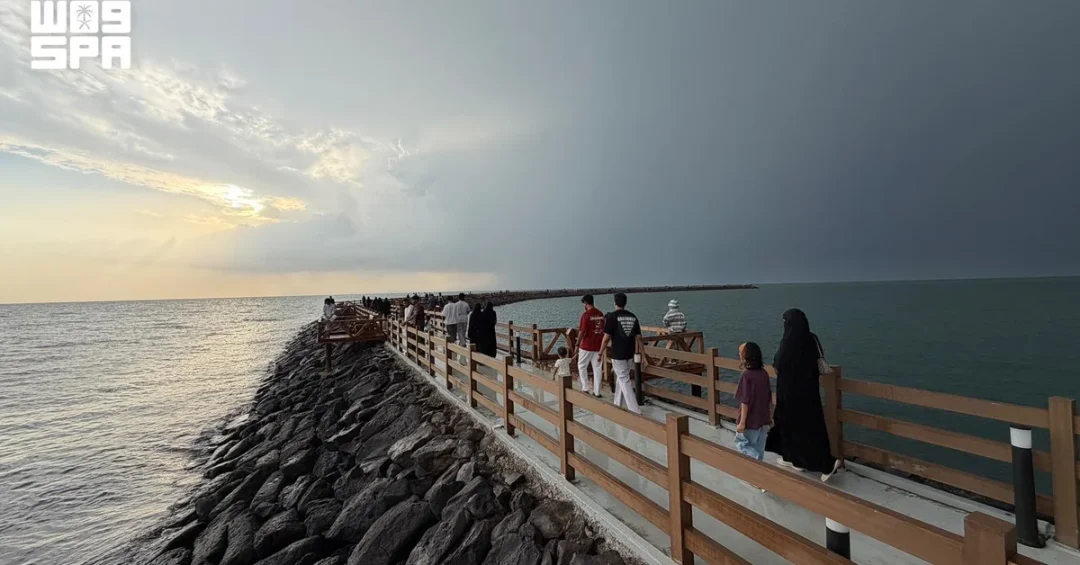
Jazan Municipality has unveiled a network of marine walkways that extend from the Red Sea shoreline directly over the water, with the flagship 600-meter Sunset Walkway now anchoring a broader effort to reposition the Kingdom’s southwestern coast as a year-round tourism and recreation destination. The project, announced through official Saudi channels, converts the region’s distinctive coastal topography into accessible public space, combining illuminated pedestrian tracks, 55 seating areas, children’s play zones, public services, and retail kiosks that support local families engaged in the cottage industry. For a region historically known for agriculture and its Red Sea ports, the walkways mark a deliberate step into experience-driven tourism — one that invites visitors to observe aquatic life beneath their feet, watch the sun set over the water, and spend their evenings in a landscaped public realm that stays open and lit after dark. The development arrives as Saudi Arabia accelerates the delivery of Vision 2030 quality-of-life projects across all thirteen regions, and it signals that coastal regeneration is no longer confined to the Kingdom’s flagship giga-projects. Could a simple pedestrian path over the sea become one of the most effective tourism investments in the south? Officials in Jazan believe the answer is already visible in the crowds that gather each evening.
The walkways are the work of Jazan Municipality, the local government body responsible for urban planning and public amenities across the Jazan region. According to the municipality, the design philosophy is straightforward: rather than fencing off the waterfront or leaving it as undeveloped shoreline, the emirate has built structured, safe, and attractive access points that let residents and visitors step out over the Red Sea itself. The Sunset Walkway, at 600 meters, is the headline component, but it forms part of a wider marine walkway network along the Jazan coast. Each segment is engineered to withstand the marine environment while preserving views of the water and the Tihama plain behind it. The project reflects a growing recognition within the Kingdom that tourism infrastructure does not have to be monumental to be transformative — sometimes a well-lit promenade, a shaded bench, and a clean stretch of open water are enough to change how a community relates to its own coastline. What does it take to turn a shoreline into a destination? In Jazan, the answer begins with access.
Context and Background
Why has Jazan, a region long associated with mango farms, fishing, and the Red Sea port of Jazan City, become a focal point for coastal tourism investment? The answer lies in a convergence of geography, national policy, and local initiative. Jazan sits at the southwestern tip of Saudi Arabia, bordering the Red Sea for hundreds of kilometers and sharing a land border with Yemen. Its climate is distinct from the Kingdom’s central plateau, with higher humidity and a tropical monsoon influence that supports dense agriculture. For decades, the region’s economy has been anchored in farming, fishing, and the refinery and industrial complex at Jazan City for Primary and Downstream Industries. Tourism, by contrast, remained a latent asset — the coastline was scenic but largely unstructured, with limited public amenities for families and visitors.
That began to change as Vision 2030 elevated quality of life and domestic tourism to national priorities. The Quality of Life Program, one of the Vision 2030 realization programs, explicitly targets the creation of public spaces, sports facilities, and cultural venues that make Saudi cities and regions more livable. Meanwhile, the Saudi Tourism Authority has promoted the Red Sea coast, the Asir highlands, and the Farasan Islands as domestic and international destinations. Jazan benefits from proximity to both: its coast faces the Red Sea’s diving and coral areas, while the mountains of neighboring Asir rise just to the north. The marine walkways therefore did not emerge in isolation. They are part of a deliberate effort to give the region’s natural assets a structured, welcoming interface — one that meets the expectations of modern travelers while remaining rooted in local life. How does a region best prepare for visitors it has not yet fully met? Jazan’s answer is to build the public realm first and let commerce follow.
The municipality’s approach also reflects a broader shift in Saudi urban planning toward what planners call active public space — areas designed for walking, sitting, playing, and lingering rather than merely passing through. The 55 seating areas along the Sunset Walkway, the illuminated pedestrian tracks, and the play zones for children are all expressions of that philosophy. They are also practical responses to the needs of Jazan’s own residents, who have long sought safe, family-friendly places to gather in the cooler evening hours. By listening to local demand and designing for it, the municipality has created infrastructure that serves tourists and residents simultaneously — a dual-purpose model that has become a hallmark of successful Vision 2030 projects. What makes a public space truly public? In Jazan, it is the mix of a fisherman watching the tide, a family sharing a picnic, and a visitor photographing the sunset from the same bench.
Key Details of the Marine Walkways
What exactly has Jazan Municipality built? The centerpiece is the 600-meter Sunset Walkway, a pedestrian path that extends from the shore directly into the Red Sea, giving walkers the sensation of being surrounded by water. Along its length are 55 seating areas, positioned to take advantage of shade, breeze, and views. The walkway is illuminated for evening use, with pedestrian tracks designed for walking and light exercise. Children’s play zones provide family-oriented recreation, while public services — including restrooms and waste management — ensure the space remains clean and usable throughout the day. Retail kiosks line the walkway, and these are not generic concessions: they are designed to support local families working in the cottage industry, giving small producers and artisans a direct commercial outlet in a high-traffic public setting.
The walkway also functions as an observation platform for marine life. Because it extends over the water, visitors can look down into the shallows and observe fish, coral, and other aquatic species without needing a boat or diving equipment. This educational dimension — seeing the Red Sea ecosystem up close — adds a layer of value beyond recreation, particularly for school groups and families with children. The panoramic marine views make the walkway a natural venue for sunset watching, photography, and quiet reflection. In a region where the sea has historically been a workplace for fishermen and port workers, the walkway reframes it as a shared public asset — a place of leisure, learning, and community. How often does a piece of infrastructure serve fishermen, families, students, and tourists at the same time? In Jazan, that convergence is by design, not accident.
Dr. Ibrahim Al-Khayyat, spokesperson for Jazan Municipality, explained the thinking behind the project in official remarks. He stated that the developments optimize coastal topography into active public spaces, driving commercial investment in cafés and retail while advancing Saudi Vision 2030’s Quality of Life objectives. The phrase optimize coastal topography is significant: rather than flattening or walling off the shoreline, the municipality has worked with the natural contours of the coast, building where the land and sea already meet in ways that invite human use. Dr. Al-Khayyat’s emphasis on commercial investment points to a second objective — the walkways are intended to catalyze private-sector activity, particularly in food and beverage, hospitality, and local retail. Cafés and restaurants drawn to the walkway’s foot traffic will create jobs and expand the region’s service economy. The municipality’s role is to provide the platform; the private sector’s role is to build the experience on top of it. What comes first, the promenade or the café? In Jazan’s model, the public investment leads and the private investment follows.
International and Regional Impact
How does a municipal walkway in southwestern Saudi Arabia register on the international stage? The answer lies in the broader repositioning of the Kingdom as a global tourism destination. Saudi Arabia’s Vision 2030 aims to raise tourism’s contribution to gross domestic product and to attract millions of international visitors annually, with the Red Sea, AlUla, Diriyah, and Asir among the flagship destinations. Jazan’s marine walkways contribute to that national portfolio by adding a distinct coastal experience in a region that international travelers may not yet know well. For visitors arriving from Europe, Asia, or neighboring Gulf states, the walkways offer something increasingly rare: unstructured, free public access to a beautiful coastline, with local character and no admission fee. That accessibility is itself a competitive advantage in a global tourism market where authenticity and ease of experience are highly valued.
Regionally, the project strengthens the Red Sea corridor as a tourism circuit. Jazan is close to the Farasan Islands, a archipelago known for diving, coral reefs, and biodiversity, and it sits within driving distance of the Asir mountains, where the Asir Development Authority and national programs are investing in mountain tourism and heritage. A traveler could plausibly combine a Jazan coastal stay with island diving and highland hiking — a multi-experience itinerary that few destinations worldwide can match. The walkways also support cross-border and domestic travel patterns, giving Saudi families a new reason to visit the south during school holidays and cooler months. For the Red Sea’s wider tourism ecosystem, which includes the luxury destinations being developed further north, Jazan provides a complementary, community-oriented offering. Does a destination need luxury resorts to compete globally? Jazan suggests that genuine public spaces and local authenticity can be just as compelling.
Economic and Strategic Significance
What does the walkway mean for Jazan’s economy? At the micro level, the retail kiosks create direct income opportunities for local families in the cottage industry — producers of food, crafts, and traditional goods who might otherwise struggle to reach customers. By placing these vendors in a high-visibility, high-traffic location, the municipality effectively provides a subsidized retail platform, lowering the barrier to market entry for small producers. The presence of cafés and retail investment along the walkway adds jobs in hospitality and services, sectors that are labor-intensive and provide entry-level employment for young people. Over time, a successful waterfront can raise property values, attract further commercial development, and increase municipal revenues — a virtuous cycle that begins with public investment in basic amenities.
At the strategic level, the project aligns with Saudi Arabia’s efforts to diversify regional economies beyond oil and agriculture. Jazan already hosts major industrial infrastructure, including the Jazan City for Primary and Downstream Industries and the Jazan refinery, but the region’s long-term prosperity depends on broadening its economic base. Tourism, recreation, and the service economy are natural complements to industry, and they draw on Jazan’s distinctive natural and cultural assets. The walkways also support the Public Investment Fund’s wider interest in developing tourism assets across the Kingdom, and they reinforce the national goal of increasing domestic tourism spending. For a region that has often been perceived primarily through the lens of industry and agriculture, the walkways offer a new economic identity — one built on the sea, the sunset, and the everyday pleasure of a public promenade. Can a bench and a walkway change a regional economy? Not alone — but as part of a coordinated strategy, they are a meaningful first step.
Vision 2030 Alignment
How directly do the Jazan marine walkways connect to Vision 2030? The link is explicit. The Quality of Life Program, one of the Vision’s realization programs, aims to improve the daily lives of citizens and residents by expanding access to sports, culture, and recreation. The walkway’s illuminated pedestrian tracks, play zones, seating areas, and public services are textbook quality-of-life infrastructure. The project also supports the National Tourism Strategy, which targets domestic and international visitor growth, and the National Transformation Program’s emphasis on municipal service improvement and private-sector enablement. By turning coastal topography into active public space, Jazan Municipality is implementing at the local level what Vision 2030 articulates at the national level: that a modern, diversified Kingdom must invest in the places where people live, work, and relax.
The walkways also reflect the Vision’s emphasis on regional balance. Vision 2030 is not solely about Riyadh, Jeddah, or NEOM; it is about ensuring that all regions of the Kingdom share in the benefits of modernization. Jazan, in the far southwest, is a case in point. Its marine walkways demonstrate that a smaller municipality, working within national frameworks, can deliver projects that improve daily life, attract visitors, and stimulate local commerce. As the Kingdom continues to expand its tourism and recreation offerings in the run-up to 2030 and beyond, Jazan’s experience will be watched as a model for community-oriented coastal development. The sunset over the Red Sea has always been there; what is new is that everyone now has a place to stand and watch it. For Saudi Arabia’s long-term vision, that combination of natural beauty, public access, and local economic opportunity is precisely the point — and on the Jazan waterfront, it is already happening.
20 Questions
Q1. What are the Jazan marine walkways?
A1. The Jazan marine walkways are pedestrian paths built by Jazan Municipality that extend from the shoreline directly over the Red Sea, creating structured public spaces for walking, recreation, and viewing marine life along the region’s coast.
Q2. What is the length of the Sunset Walkway?
A2. The Sunset Walkway, the flagship component of the project, is 600 meters long and extends over the Red Sea, offering panoramic marine views and a direct connection between the shore and the water.
Q3. How many seating areas does the Sunset Walkway feature?
A3. The Sunset Walkway includes 55 seating areas positioned along its length, providing shaded and comfortable places for visitors to rest, observe the sea, and enjoy the coastal environment.
Q4. Who is Dr. Ibrahim Al-Khayyat?
A4. Dr. Ibrahim Al-Khayyat is the spokesperson for Jazan Municipality. He has publicly explained that the walkways optimize coastal topography into active public spaces and advance Saudi Vision 2030’s Quality of Life objectives.
Q5. What amenities are available on the walkways?
A5. The walkways feature illuminated pedestrian tracks, children’s play zones, public services, and retail kiosks. These amenities support evening use, family recreation, and local commerce in a safe and well-maintained environment.
Q6. How do the walkways support local families?
A6. Retail kiosks along the walkways are designed to support local families working in the cottage industry, giving small producers and artisans direct access to high-traffic public space and a reliable commercial outlet.
Q7. What is the significance of the walkways for tourism in Jazan?
A7. The walkways add a structured, accessible coastal attraction to Jazan, giving domestic and international visitors a free public space to enjoy the Red Sea, observe marine life, and experience the region’s natural beauty.
Q8. How do the walkways align with Vision 2030?
A8. They advance the Quality of Life Program by expanding recreation and public space, support the National Tourism Strategy by adding a visitor attraction, and reflect the Vision’s goal of balanced regional development across the Kingdom.
Q9. Can visitors observe marine life from the walkways?
A9. Yes. Because the walkways extend over the water, visitors can look down into the shallows and observe fish, coral, and other aquatic species without needing a boat or diving equipment, adding an educational dimension.
Q10. What economic benefits do the walkways bring?
A10. The walkways stimulate commercial investment in cafés and retail, create jobs in hospitality and services, support small businesses through kiosks, and can raise property values and municipal revenues over time.
Q11. Are the walkways illuminated for evening use?
A11. Yes. The pedestrian tracks are illuminated, allowing residents and visitors to use the walkways comfortably after dark. Evening use is particularly popular for sunset viewing and family outings.
Q12. What role does Jazan Municipality play in the project?
A12. Jazan Municipality designed, built, and manages the marine walkways. It provides the public infrastructure and commercial platform, while the private sector develops cafés, retail, and services on top of it.
Q13. How does the project reflect regional balance in Saudi Arabia?
A13. Vision 2030 emphasizes development across all regions, not only major cities. The Jazan walkways show that a smaller municipality in the southwest can deliver quality-of-life projects that benefit residents and attract visitors.
Q14. What is the cottage industry mentioned in the project?
A14. The cottage industry refers to small-scale, often home-based production of food, crafts, and traditional goods. Kiosks on the walkways give these local producers a direct retail presence in a public setting.
Q15. How do the walkways enhance Jazan’s coastal topography?
A15. Rather than walling off or flattening the shoreline, the design works with natural coastal contours, building structured access points where land and sea meet, turning the topography into usable, attractive public space.
Q16. What makes the walkways attractive to international visitors?
A16. They offer free, unstructured public access to a beautiful Red Sea coastline with local character, panoramic views, and a genuine community atmosphere — qualities increasingly valued in global tourism.
Q17. How do the walkways connect to nearby attractions?
A17. Jazan is close to the Farasan Islands for diving and coral reefs, and within driving distance of the Asir mountains, allowing visitors to combine coastal, island, and highland experiences in one itinerary.
Q18. What commercial investment is expected along the walkways?
A18. The municipality anticipates investment in cafés, restaurants, and retail outlets drawn by foot traffic. These businesses will expand the region’s service economy and create employment opportunities for local residents.
Q19. Are the walkways suitable for children and families?
A19. Yes. The walkways include dedicated children’s play zones, seating areas, public services, and illuminated paths, making them safe and welcoming for families throughout the day and evening.
Q20. What does the project signal for Saudi Arabia’s tourism future?
A20. It signals that community-oriented, publicly accessible coastal development is a priority alongside luxury giga-projects, showing that the Kingdom’s tourism strategy values authentic local experiences and regional participation.
Reader Feedback
We value your thoughts. Please share your feedback on this article.
Your feedback helps us improve our coverage.