


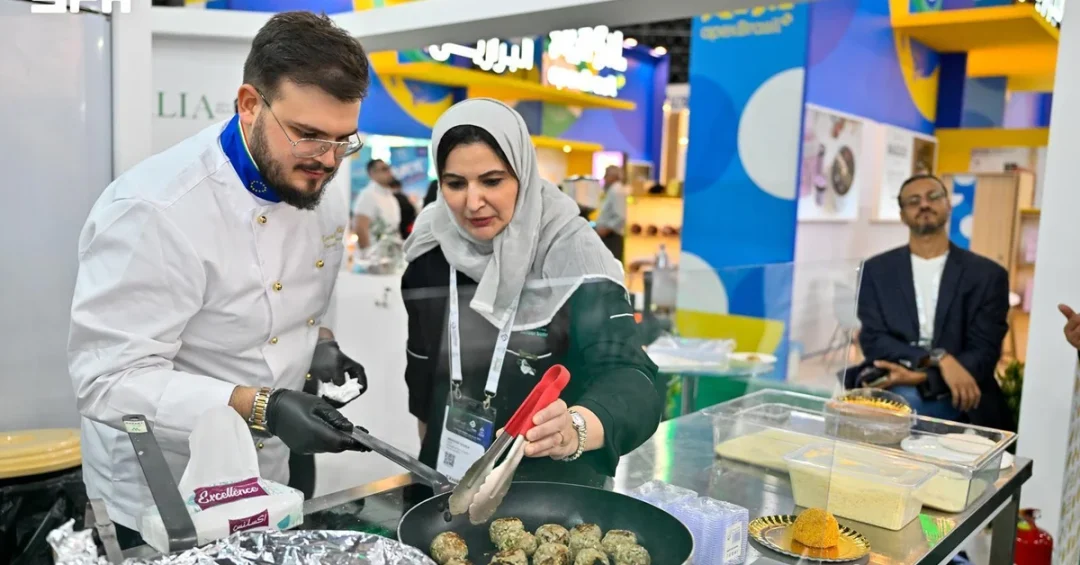
Live cooking demonstrations led by Saudi and international chefs have emerged as a defining feature of the Saudifood Show 2026 and Saudifood Manufacturing 2026 exhibitions in Jeddah, offering visitors a hands-on window into culinary craftsmanship and cross-cultural exchange, according to the Saudi Press Agency (SPA). The events, held in the Kingdom’s commercial capital, brought together chefs from Saudi Arabia and abroad to showcase their expertise in developing culinary skills, refining specialized cooking practices, and preparing dishes that blend tradition with modern technique.
Among the highlights was a joint presentation by Saudi Executive Chef, Food Developer, and Culinary Consultant Bdoor Badr and Italian Chef Simone Marchi, who combined Italian and Saudi flavors in a live cooking experience that underscored the surprising similarities between the two cuisines. The session drew visitors eager to observe professional techniques up close and to understand how ingredients from different culinary traditions can complement one another. As Saudi Arabia’s food and beverage sector continues to expand under Vision 2030, such events are positioning the Kingdom as a meeting point for global gastronomy. How often do visitors get the chance to watch a Saudi chef and an Italian master create a single dish side by side?
Context and Background
The Saudifood Show and its companion exhibition, Saudifood Manufacturing, have grown into significant platforms for the Kingdom’s food industry, reflecting the broader expansion of Saudi Arabia’s trade exhibition calendar. These events are organized to connect local producers, international suppliers, and culinary professionals, while also serving the public as an educational and cultural attraction. The 2026 edition placed particular emphasis on live cooking, transforming exhibition halls into working kitchens where technique and storytelling take center stage. Isn’t it remarkable how a cooking station can become a stage for cultural diplomacy?
Chef Simone Marchi brought a distinguished international profile to the event. According to SPA, he has led culinary programs for Italian missions abroad and has presented dishes inspired by various regions of Italy as part of Italian Cuisine Week in the World events. His participation alongside Chef Bdoor Badr highlighted a deliberate curatorial choice: pairing a seasoned Saudi culinary consultant with an Italian chef whose career has been built around representing his country’s regional diversity. The result was a session that treated both cuisines as living traditions rather than static heritage. What better way to understand a culture than through the hands of someone who cooks it every day?
The events also reflect a wider principle articulated in the official SPA report: traditional cuisines and dishes are important symbols of cultural identity worldwide. By presenting these traditions in a live, interactive format, the exhibitions aim to promote awareness of culinary heritage while fostering cross-cultural interaction. The organizers’ stated goals include integrating modern culinary ingredients, creating new culinary experiences while preserving cultural identity, and offering visitors a window into different cultures around the world. This approach aligns with Saudi Arabia’s broader efforts to present itself as a global hub for cultural exchange, not only for pilgrimage and investment but also for the arts, including gastronomy.
Key Details
The live cooking sessions at Saudifood Show 2026 featured several chefs from Saudi Arabia and abroad, each demonstrating specialized skills and techniques. Visitors were given the opportunity to explore the chefs’ expertise in developing culinary skills, refining cooking practices, and working with a range of ingredients. The format allowed for direct observation and, in many cases, interaction, as chefs explained their methods and the reasoning behind their ingredient choices. For an industry event, this hands-on dimension is increasingly important: it turns passive attendees into engaged participants and gives smaller producers a chance to showcase their products in a practical context. Could a single demonstration change the way a visitor thinks about an entire cuisine?
The collaboration between Chef Bdoor Badr and Chef Simone Marchi was particularly notable for its focus on the similarities between Italian and Saudi cuisines. Both traditions place a premium on fresh ingredients, regional variation, and the social role of shared meals. By preparing dishes that combined elements of both, the chefs illustrated how culinary exchange can produce something new without erasing the origins of either tradition. Chef Marchi’s experience presenting dishes inspired by Italy’s many regions added depth to the session, reminding audiences that Italian cuisine is itself a tapestry of local identities rather than a single monolithic style. Doesn’t that parallel Saudi Arabia’s own rich regional culinary diversity?
The exhibitions also served a practical industry function. Saudifood Manufacturing 2026 ran alongside the main show, giving food producers, equipment suppliers, and hospitality businesses a venue to explore new technologies and partnerships. The presence of live cooking events within this commercial environment created a bridge between the artistic and industrial sides of food. A chef demonstrating a technique may inspire a visitor, but the same event can also connect that chef with a supplier, a restaurateur, or a future collaborator. In this way, the shows support both cultural and economic objectives simultaneously. How many business partnerships begin with a shared appreciation of good food?
International and Regional Impact
The participation of an Italian chef of Chef Marchi’s standing signals the international dimension of Saudi Arabia’s culinary ambitions. Italy’s culinary diplomacy, expressed through initiatives such as Italian Cuisine Week in the World, has long used food as a tool for building goodwill and cultural understanding. By hosting Chef Marchi and facilitating a joint presentation with a Saudi chef, the Saudifood Show placed the Kingdom within this global network of culinary exchange. The event thus becomes more than a trade fair; it is a diplomatic and cultural platform where nations meet through their kitchens. What does it say about a country when its food events attract this level of international talent?
Regionally, the show reinforces Jeddah’s role as a gateway city for commerce and culture. Located on the Red Sea, Jeddah has historically been a crossroads for traders, pilgrims, and travelers, and its culinary scene reflects that history. Hosting an event that pairs Saudi and Italian traditions in this setting is symbolically resonant. It also supports the Kingdom’s tourism goals by adding a gastronomic dimension to the visitor experience. International visitors attending trade shows or exploring Saudi Arabia’s cultural calendar increasingly expect high-quality food experiences, and events like Saudifood Show help meet that expectation while showcasing local talent. Could food become one of the Kingdom’s most effective ambassadors?
Economic and Strategic Significance
The food and beverage sector is a growing component of Saudi Arabia’s non-oil economy, and exhibitions such as Saudifood Show and Saudifood Manufacturing are designed to accelerate its development. By bringing together chefs, producers, manufacturers, and investors, the events create opportunities for knowledge transfer, sourcing agreements, and the adoption of new technologies. Live cooking demonstrations add a layer of consumer engagement that pure trade exhibitions often lack, helping to build demand for quality ingredients and innovative preparation methods. This, in turn, can support local producers who are expanding their capacity to serve both domestic and export markets. Isn’t it logical that a country investing in food security would also invest in culinary excellence?
Strategically, the emphasis on preserving cultural identity while integrating modern ingredients reflects a balanced approach to modernization. Saudi Arabia’s Vision 2030 seeks to diversify the economy and enrich quality of life without severing ties to heritage. The culinary sessions at Saudifood Show embodied that balance: chefs used contemporary techniques and international ingredients while celebrating traditional dishes and regional specialties. For an international audience, this is a useful lens for understanding how the Kingdom approaches change. Modernization is not presented as a break from the past but as a continuation of it, expressed through new forms. How many countries manage to modernize their food culture without losing its soul?
Vision 2030 Alignment
The Saudifood Show 2026 and its live cooking events align closely with Vision 2030’s objectives of economic diversification, cultural enrichment, and enhanced international engagement. By supporting a vibrant food and beverage sector, the Kingdom creates jobs, attracts investment, and strengthens its tourism offering. By hosting international chefs and facilitating cultural exchange, it builds soft power and people-to-people connections. And by celebrating traditional cuisines as symbols of identity, it reinforces the cultural foundations that Vision 2030 aims to protect and promote. The event is a small but meaningful illustration of how the Kingdom’s transformation touches everyday life. What could be more universal than the act of sharing a meal?
As Saudi Arabia continues to position itself as a global destination for business, tourism, and culture, platforms like Saudifood Show will play an increasingly important role. They showcase Saudi talent, welcome international partners, and create experiences that linger in the memory of visitors. The 2026 edition’s live cooking demonstrations, featuring Chef Bdoor Badr and Chef Simone Marchi among others, demonstrated that gastronomy can be both a mirror of identity and a bridge to the world. For a Kingdom pursuing a bold and comprehensive vision, that combination is precisely the point. Will the next edition raise the bar even higher? If the 2026 show is any indication, the answer is almost certainly yes.
20 Questions
Q1. What was the main focus of the live cooking events at Saudifood Show 2026?
A1. The live cooking events focused on showcasing the expertise of Saudi and international chefs in developing culinary skills, refining cooking practices, and preparing dishes that combine traditional and modern techniques.
Q2. Who were the two chefs highlighted in the joint cooking demonstration?
A2. Saudi Executive Chef, Food Developer, and Culinary Consultant Bdoor Badr and Italian Chef Simone Marchi presented a live cooking experience combining Italian and Saudi flavors.
Q3. What is Chef Simone Marchi’s background?
A3. Chef Marchi has led culinary programs for Italian missions abroad and has presented dishes inspired by various regions of Italy as part of Italian Cuisine Week in the World events.
Q4. What similarities were highlighted between Italian and Saudi cuisines?
A4. The chefs emphasized shared values such as fresh ingredients, regional variation, and the social importance of shared meals, demonstrating how the two traditions can complement each other.
Q5. Where was the Saudifood Show 2026 held?
A5. The event was held in Jeddah, Saudi Arabia’s commercial capital and a historic gateway city on the Red Sea, according to the Saudi Press Agency.
Q6. What is the purpose of the Saudifood Manufacturing 2026 exhibition?
A6. It runs alongside the main show to connect food producers, equipment suppliers, and hospitality businesses, supporting industry partnerships and technological exchange.
Q7. How do the events promote cultural identity?
A7. By presenting traditional cuisines and dishes as important symbols of cultural identity, the events raise awareness of culinary heritage while encouraging cross-cultural interaction.
Q8. What role does food play in cultural diplomacy?
A8. Food serves as a universal language that builds goodwill and understanding between nations, as demonstrated by the collaboration between Saudi and Italian chefs.
Q9. How does the event support Saudi Arabia’s tourism goals?
A9. It adds a gastronomic dimension to the visitor experience, attracting international attendees and showcasing local talent, which enhances the Kingdom’s appeal as a cultural destination.
Q10. What economic benefits does Saudifood Show bring?
A10. It creates opportunities for knowledge transfer, sourcing agreements, and technology adoption, while stimulating demand for quality ingredients and supporting local producers.
Q11. How does the event align with Vision 2030?
A11. It supports economic diversification, cultural enrichment, and international engagement, all core objectives of Vision 2030, by strengthening the food and beverage sector.
Q12. What cooking techniques were demonstrated?
A12. Chefs demonstrated specialized cooking practices, ingredient preparation, and techniques for combining Italian and Saudi flavors in innovative ways.
Q13. Who attended the live cooking events?
A13. Visitors to the Saudifood Show 2026, including industry professionals, food enthusiasts, and members of the public, attended the demonstrations.
Q14. What is the significance of Jeddah as the host city?
A14. Jeddah has historically been a crossroads for traders and pilgrims, and its diverse culinary scene reflects that heritage, making it an ideal venue for international food events.
Q15. How do modern ingredients integrate with traditional cuisine?
A15. Chefs use contemporary ingredients and techniques while respecting traditional methods and flavors, creating new experiences that preserve cultural identity.
Q16. What does Italian Cuisine Week in the World involve?
A16. It is a global initiative that promotes Italian culinary traditions through events featuring dishes inspired by Italy’s various regions, led by chefs like Simone Marchi.
Q17. How can visitors benefit from attending such events?
A17. Visitors gain exposure to professional techniques, cultural exchange, and new flavor combinations, enriching their understanding and appreciation of global cuisines.
Q18. What message does the Saudi-Italian collaboration send?
A18. It highlights the Kingdom’s openness to international partnership and its commitment to cultural exchange, reinforcing Saudi Arabia’s role as a global meeting point.
Q19. Will Saudifood Show continue in future years?
A19. While specific plans are not detailed in the official report, the event’s growth and alignment with Vision 2030 suggest it will remain a key platform for the food industry.
Q20. How does the event reflect Saudi Arabia’s broader transformation?
A20. It illustrates how the Kingdom is modernizing while preserving heritage, creating new opportunities in tourism, trade, and culture as part of its comprehensive Vision 2030 journey.
Reader Feedback
We value your thoughts. Please share your feedback on this article.
Your feedback helps us improve our coverage.