


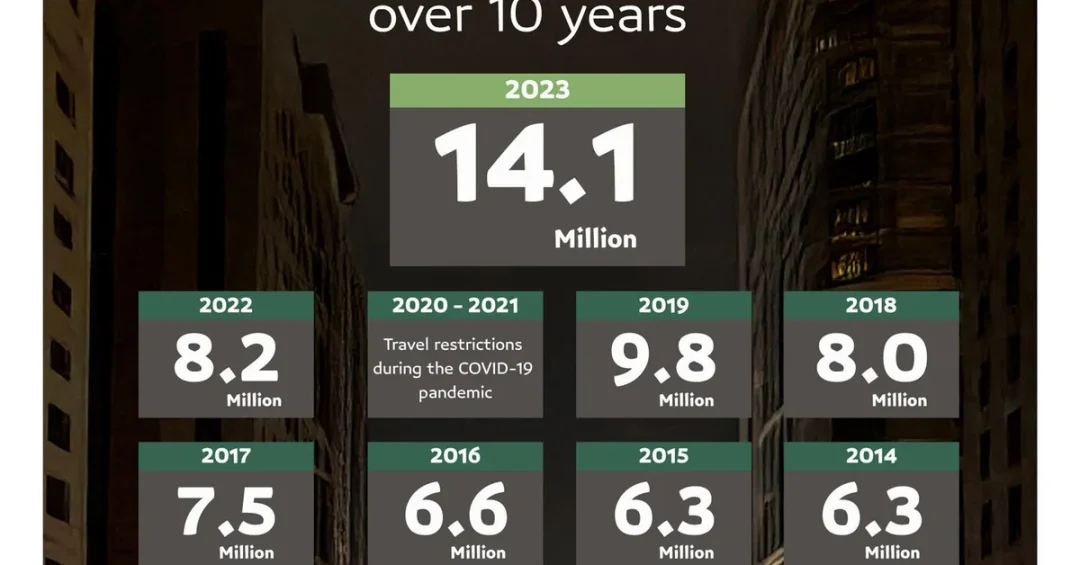
The Madinah Region Development Authority has announced that the holy city of Madinah welcomed more than 14 million visitors in 2023, a historic leap of 124 percent compared with 2014, according to official statistics released through the Saudi Press Agency. The figure represents the highest number of visitors ever recorded in the city and confirms Madinah’s emergence as one of the most dynamic religious and cultural destinations in the Kingdom of Saudi Arabia. Visitor spending surpassed SAR 49 billion during the year, while the average length of stay rose to 10 days, underscoring the city’s growing appeal among pilgrims and international travellers alike. Have you ever wondered what draws millions of people from every corner of the world to a single city each year?
The announcement, issued by the Madinah Region Development Authority, reflects a decade of sustained growth in visitor numbers that has been carefully supported by the Kingdom’s tourism and pilgrimage infrastructure. In 2014, Madinah received 6.3 million visitors, a figure that held steady through 2015 before climbing to 6.5 million in 2016 and 7.5 million in 2017. By 2018 the number had reached 8 million, and by 2019 it stood at 9.8 million. The COVID-19 pandemic temporarily interrupted this trajectory in 2020 and 2021, but recovery began swiftly in 2022 with more than 8 million visitors returning to the city. Could any other destination in the region match such a rapid and resilient rebound?
Context and Background
Why has Madinah become such a powerful magnet for visitors over the past decade? The answer lies in a combination of spiritual significance, historical richness, and sustained public investment. Madinah is home to the Prophet’s Mosque, one of the holiest sites in Islam, which welcomes millions of worshippers throughout the year. Beyond the mosque, the city holds deep historical importance through sites such as the Quba Mosque, the first mosque built in Islamic history, and Mount Uhud, which is closely connected to the life of the Prophet Mohammed, Peace Be Upon Him. These landmarks give Madinah a unique position that combines religious devotion with cultural discovery.
The growth in visitor numbers did not happen by accident. It is the result of coordinated efforts by Saudi authorities to expand accommodation capacity, improve transport links, and enhance the overall experience for pilgrims and tourists. The Madinah Region Development Authority has worked alongside national partners to prepare more than 100 additional sites designed to enrich the visitor journey. These efforts form part of a broader national strategy to position the Kingdom as a leading global destination for religious and cultural tourism, while ensuring that every guest is received with the hospitality for which Saudi Arabia is known.
The decade-long trend also highlights the resilience of Madinah’s tourism sector. Even during the global travel restrictions of 2020 and 2021, planning and development continued behind the scenes, allowing the city to respond quickly once international movement resumed. The return of more than 8 million visitors in 2022 signalled a strong recovery, and the surge to 14.1 million in 2023 exceeded expectations. What does such a rapid rebound tell us about the strength of Saudi Arabia’s long-term planning?
Key Details
What exactly do the latest official figures reveal? According to the statistics released by the Madinah Region Development Authority, the city welcomed 14.1 million visitors in 2023, compared with 6.3 million in 2014. That represents an increase of 124 percent over the decade. Visitor spending exceeded SAR 49 billion last year, a clear indication that the growth in numbers is matched by growth in economic value. The average stay extended to 10 days, suggesting that visitors are not simply passing through but are taking time to explore the city’s religious and historical offerings in depth.
The figures also show a steady upward pattern across the decade. After holding at 6.3 million in 2015, numbers rose to 6.5 million in 2016 and 7.5 million in 2017. The 8 million mark was reached in 2018, followed by 9.8 million in 2019. The pandemic years of 2020 and 2021 brought temporary restrictions, but the recovery in 2022 laid the foundation for the record-breaking year that followed. Each stage of this journey reflects deliberate improvements in infrastructure, services, and visitor management.
Beyond the headline numbers, the city’s key attractions continue to anchor its appeal. The Prophet’s Mosque remains the central destination for pilgrims, while the Quba Mosque and Mount Uhud attract visitors interested in the early history of Islam. The Madinah Region Development Authority has emphasised that more than 100 additional sites are being prepared to further enhance the experience for pilgrims and visitors. These sites are intended to spread visitor activity across the city, support local businesses, and create a richer, more varied journey for every guest. How many cities can offer both profound spiritual meaning and a deep encounter with history in a single visit?
International and Regional Impact
What does Madinah’s record year mean for the wider region? The surge in visitors positions Saudi Arabia as a leading destination for religious tourism, not only within the Middle East but globally. Millions of pilgrims travel from Asia, Africa, Europe, and the Americas each year, and their experience in Madinah shapes perceptions of the Kingdom as a whole. The city’s ability to host 14.1 million visitors while maintaining service quality and spiritual atmosphere demonstrates operational excellence at a national scale. Regional neighbours and international partners are paying close attention to how Saudi Arabia manages this growth.
The economic ripple effects extend beyond Madinah itself. Increased visitor spending supports hotels, restaurants, transport providers, retail outlets, and local artisans. It also strengthens the wider travel and hospitality ecosystem that connects Madinah with Jeddah, Makkah, and other Saudi destinations. For international audiences, the figures reinforce the message that Saudi Arabia is open, welcoming, and capable of hosting the world. Could the Kingdom’s model of faith-based tourism become a benchmark for other nations seeking to combine heritage with modern development?
Economic and Strategic Significance
Why do these numbers matter beyond the tourism sector? Visitor spending of more than SAR 49 billion in a single year represents a significant contribution to the national economy. It supports job creation, small and medium enterprises, and the development of hospitality infrastructure that benefits residents as well as guests. The average stay of 10 days multiplies the economic impact, as longer visits translate into higher spending across accommodation, food, transport, and cultural experiences. This aligns with Saudi Arabia’s broader goal of diversifying income sources and reducing reliance on traditional revenue streams.
Strategically, Madinah’s performance strengthens the Kingdom’s position in the global tourism market. The city’s growth demonstrates that Saudi Arabia can compete for international visitors while preserving the sanctity and character of its holy sites. The preparation of over 100 additional sites reflects a long-term vision that goes beyond simply increasing numbers; it aims to deepen the quality of every visit. By investing in heritage, services, and accessibility, the Kingdom is building a sustainable tourism model that can serve generations to come. What other sector could deliver both spiritual fulfilment and measurable economic returns so effectively?
Vision 2030 Alignment
How does Madinah’s record year connect to Saudi Vision 2030? The achievement is directly linked to the Pilgrim Experience Program, one of the ambitious initiatives under Vision 2030 that seeks to enrich the spiritual and cultural journey of visitors to the holy cities. The program focuses on improving services, expanding capacity, and creating a seamless experience for pilgrims from the moment they arrive until they depart. Madinah’s 14.1 million visitors in 2023 stand as tangible proof that these efforts are delivering results, and the Madinah Region Development Authority continues to coordinate with partners to prepare more than 100 additional sites for future guests.
The Kingdom’s leadership has consistently emphasised that Vision 2030 is not only about economic transformation but also about serving the guests of God with excellence. Madinah’s historic leap reflects that commitment in action. As Saudi Arabia continues to invest in infrastructure, technology, and human capital, the city is set to welcome even greater numbers in the years ahead. The record set in 2023 is not an endpoint but a milestone on a longer journey toward a more diverse, prosperous, and globally engaged Kingdom. Will the coming decade see Madinah surpass even this remarkable achievement?
20 Questions
Q1. How many visitors did Madinah welcome in 2023?
A1. Madinah welcomed more than 14 million visitors in 2023, specifically 14.1 million, according to the Madinah Region Development Authority. This represented the highest number ever recorded in the city and a historic milestone for Saudi Arabia’s religious tourism sector.
Q2. What was the percentage increase compared to 2014?
A2. The number of visitors increased by 124 percent compared to 2014, when Madinah received 6.3 million visitors. This decade-long growth reflects sustained investment in infrastructure, services, and visitor experience across the holy city.
Q3. How much did visitors spend in Madinah in 2023?
A3. Visitor spending surpassed SAR 49 billion last year, according to official statistics. This figure highlights the significant economic contribution of religious tourism to Madinah and the wider national economy.
Q4. What was the average length of stay for visitors in 2023?
A4. The average visitor stay in Madinah increased to 10 days. This extended duration underscores the city’s appeal as a major destination where pilgrims and tourists take time to explore religious and historical sites.
Q5. Which authority announced these statistics?
A5. The Madinah Region Development Authority announced the statistics through the Saudi Press Agency. The authority is responsible for overseeing development and tourism initiatives in the Madinah region.
Q6. How did visitor numbers change between 2014 and 2019?
A6. Numbers grew steadily from 6.3 million in 2014 to 9.8 million in 2019. The figure remained constant in 2015, rose to 6.5 million in 2016, 7.5 million in 2017, and 8 million in 2018.
Q7. How did the COVID-19 pandemic affect tourism in Madinah?
A7. The pandemic in 2020 and 2021 led to restrictions on travel, temporarily affecting tourism in Madinah and across the world. Recovery began in 2022 with more than 8 million visitors returning to the city.
Q8. What are the key attractions in Madinah?
A8. Key attractions include the Prophet’s Mosque, the Quba Mosque, and Mount Uhud. These sites are integral to the life of the Prophet Mohammed, Peace Be Upon Him, and draw millions of visitors each year.
Q9. How many additional sites is the authority preparing?
A9. The Madinah Region Development Authority is preparing over 100 additional sites to enhance the experience for pilgrims and visitors. These sites aim to enrich the spiritual and cultural journey of guests.
Q10. What program under Vision 2030 supports these efforts?
A10. The Pilgrim Experience Program under Saudi Vision 2030 supports efforts to enrich the spiritual and cultural journey of visitors to the holy city. It focuses on improving services and expanding capacity.
Q11. How does Madinah’s growth benefit the Saudi economy?
A11. Visitor spending of over SAR 49 billion supports hotels, restaurants, transport, retail, and local businesses. It contributes to job creation and economic diversification, aligning with Vision 2030 goals.
Q12. What does the 10-day average stay indicate?
A12. The 10-day average stay indicates that visitors are engaging deeply with Madinah’s religious and historical offerings. It shows the city is not just a transit point but a major destination in its own right.
Q13. How does Madinah’s performance compare regionally?
A13. Madinah’s 14.1 million visitors position it as a leading religious tourism destination in the region. The growth demonstrates Saudi Arabia’s capacity to host millions while maintaining service quality and spiritual atmosphere.
Q14. What was the visitor figure in 2022?
A14. In 2022, more than 8 million visitors returned to Madinah as recovery from the pandemic began. This laid the foundation for the record-breaking surge in 2023.
Q15. Why is Madinah important to international visitors?
A15. Madinah holds profound spiritual significance as home to the Prophet’s Mosque. It also offers rich historical sites like the Quba Mosque and Mount Uhud, attracting visitors from Asia, Africa, Europe, and the Americas.
Q16. What role does the Saudi Press Agency play?
A16. The Saudi Press Agency is the official national news agency that released the statistics. It serves as a trusted channel for government announcements and official information about the Kingdom’s development.
Q17. How does this achievement reflect Vision 2030?
A17. The achievement reflects Vision 2030’s goal of diversifying the economy and enhancing religious tourism. The Pilgrim Experience Program is a key initiative that supports these objectives through improved services and infrastructure.
Q18. What does the 124 percent increase signify?
A18. The 124 percent increase signifies a decade of sustained growth and effective planning. It shows that investments in infrastructure and visitor services have delivered measurable results for Madinah and the Kingdom.
Q19. What future developments are planned for Madinah?
A19. The Madinah Region Development Authority plans to prepare over 100 additional sites in coordination with partners. These developments aim to further enhance the visitor experience and accommodate growing numbers in the years ahead.
Q20. What message does Madinah’s success send to the world?
A20. Madinah’s success sends a message that Saudi Arabia is open, welcoming, and capable of hosting the world. It demonstrates the Kingdom’s commitment to serving pilgrims and visitors with excellence under Vision 2030.
Reader Feedback
We value your thoughts. Please share your feedback on this article.
Your feedback helps us improve our coverage.
Related articles
 Saudi Zone Welcomes Visitors to Boulevard World
 RCU Joins Saudi Travel Expo in China to Boost Tourism
 RCU and Slow Food Partner to Promote Sustainable Agriculture in AlUla
 Riyadh to Host Second European Food Festival 2024
 Ethiopian Coffee Shines at Africa Zone in Riyadh Season 2024
 Al-Hasaki Valley: A New Ecotourism Gem in Saudi Arabia