


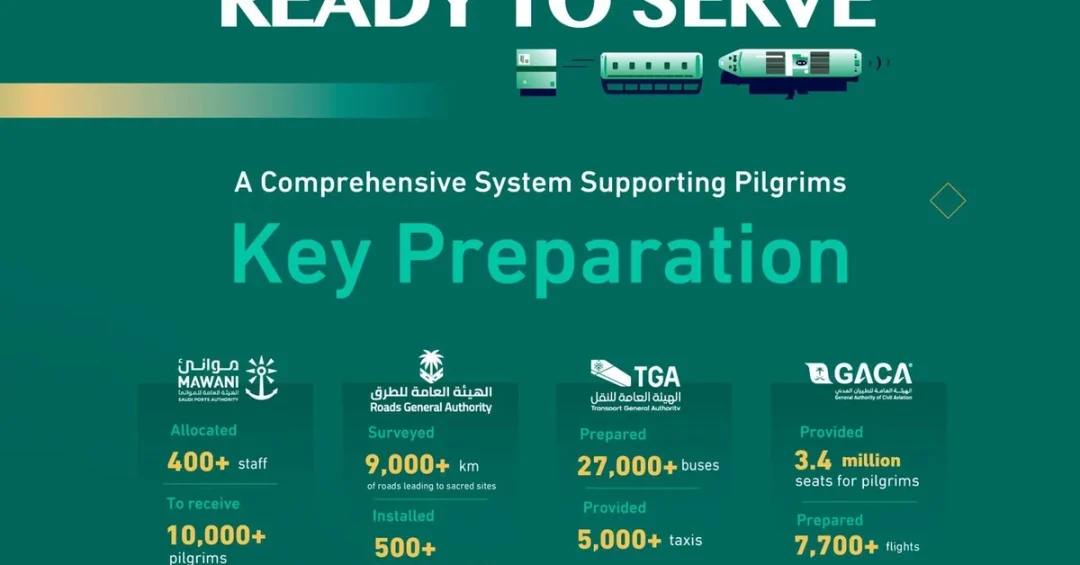
Saudi Arabia’s transportation and logistics sector has confirmed its full readiness to welcome pilgrims for the Hajj season 1445 AH, with airports, airlines, railways, ports and road networks mobilised in an integrated national effort announced through official Saudi channels. According to the Saudi Press Agency (SPA), authorities across the Kingdom have completed preparations spanning air, land, sea and rail transport, supported by more than 21,000 ground personnel and dedicated digital services designed to make every stage of the pilgrim journey smoother and safer.
Context and Background
The Hajj season represents one of the largest annual movements of people anywhere in the world, and Saudi Arabia has long treated the hosting of pilgrims as a national responsibility rooted in its role as custodian of the Two Holy Mosques. Under the National Strategy for Transport and Logistic Services, the Kingdom has steadily expanded capacity, upgraded infrastructure and introduced smart technologies so that growing numbers of pilgrims can be served without compromising comfort or safety.
The readiness plan for 1445 AH brings together a wide range of official bodies, each responsible for a distinct segment of the journey. The General Authority of Civil Aviation (GACA) leads the aviation effort at six key airports: King Abdulaziz International Airport in Jeddah, Prince Mohammad bin Abdulaziz International Airport in Madinah, Taif International Airport, King Khalid International Airport in Riyadh, Prince Abdul Mohsin bin Abdulaziz International Airport in Yanbu, and King Fahd International Airport in Dammam.
Key Details
To accommodate the expected influx, GACA has secured 3.4 million seats on 7,700 flights. MATARAT Holding, the national provider of airport and ground-handling services, has established 13 travel lounges across the six airports, mobilised over 21,000 personnel, and expanded the “passenger with no bag” service, which allows pilgrims to complete departure procedures and check in luggage remotely up to 24 hours before their flights.
Saudia Airlines, the national carrier, has allocated more than 1.2 million seats and deployed a fleet of 150 fully equipped aircraft. On the ground, Saudi Arabia Railways (SAR) will operate over 2,000 scheduled trips on 17 dedicated trains along the Al-Mashaaer Al-Mugaddassah Metro Line, which links the holy sites. The “bracelet tickets” initiative will allow pilgrims to access camp information through QR codes and receive train schedule alerts directly on their smartphones.
The Haramain High Speed Railway will add more than 3,800 trips during the season using 35 trains serving five stations. At the coast, the Saudi Ports Authority (Mawani) is prepared to receive approximately 10,000 pilgrims at Jeddah Islamic Port, applying a three-pronged approach covering logistics services, pilgrim reception and facilitation of Hady and Adahi livestock handling. Its “leave without luggage” initiative lets pilgrims check in baggage 48 hours before departure.
Road and urban transport are equally prepared. The Transport General Authority (TGA) will provide over 27,000 buses and 5,000 taxis, supported by 16 designated public transport routes, licensed-carrier compliance monitoring and traffic surveillance technology. The authority is also expanding the use of virtual reality (VR) glasses first introduced in the previous Hajj season. The Roads General Authority (RGA) has installed more than 4,000 linear metres of concrete and metal barriers and over 500 warning and guidance signs, alongside safety measures such as ground paints and warning vibrations. Saudi Post (SPL) is ready to handle over 230,000 official mail items through 45 post offices, 32 electric scooters and three mobile units.
Implications and Impact
The scale of this coordination signals the maturity of Saudi Arabia’s logistics capabilities and its capacity to manage complex, high-volume events. For international visitors, the practical result is a journey that begins before arrival and continues seamlessly between airports, ports, rail stations and the holy sites. For the wider region, the arrangements reinforce confidence in Saudi Arabia as a reliable host and a growing hub for global travel and freight. The combination of physical infrastructure, digital tools and trained personnel also creates operational knowledge that can be applied to future seasons and major international gatherings.
Vision 2030 Alignment
The sector’s preparations are closely tied to Saudi Vision 2030, which aims to diversify the economy and elevate the Kingdom’s global standing. Through the National Strategy for Transport and Logistic Services, the sector supports the Pilgrim Experience Program and national Hajj and Umrah targets, including the goal of welcoming 30 million Umrah pilgrims annually. By ensuring world-class road networks, expanded airport capacity and multiple modes of transport, Saudi Arabia is advancing a long-term vision in which excellence in serving pilgrims becomes a defining feature of its global role.
20 Questions
Q1. Which Saudi body is leading the aviation preparations for Hajj 1445 AH?
A1. The General Authority of Civil Aviation (GACA) is leading the aviation effort, coordinating services across six key airports and securing capacity for arriving and departing pilgrims throughout the season.
Q2. How many seats and flights has GACA secured for the season?
A2. GACA has secured 3.4 million seats on 7,700 flights, a substantial allocation designed to accommodate the seasonal surge in pilgrim traffic through the Kingdom’s main international gateways.
Q3. Which airports are included in the Hajj 1445 readiness plan?
A3. The plan covers Jeddah, Madinah, Taif, Riyadh, Yanbu and Dammam international airports, giving pilgrims multiple arrival points connected to the holy sites by road and rail.
Q4. What is the role of MATARAT Holding during Hajj?
A4. MATARAT Holding provides airport and ground-handling services, operating 13 travel lounges, mobilising more than 21,000 personnel and implementing the “passenger with no bag” service at the six designated airports.
Q5. How does the “passenger with no bag” service work?
A5. It allows pilgrims to complete departure procedures and check in their luggage remotely, up to 24 hours before their flight, so they can move through the airport more quickly and comfortably.
Q6. What capacity has Saudia Airlines allocated for pilgrims?
A6. Saudia Airlines, the national carrier, has allocated more than 1.2 million seats and deployed a fleet of 150 fully equipped aircraft dedicated to transporting pilgrims from around the world.
Q7. How is Saudi Arabia Railways supporting pilgrim movement?
A7. Saudi Arabia Railways is operating more than 2,000 scheduled trips using 17 dedicated trains on the Al-Mashaaer Al-Mugaddassah Metro Line, which connects the holy sites during the Hajj rituals.
Q8. What is the purpose of the “bracelet tickets” initiative?
A8. The initiative enables pilgrims to access camp information through QR codes and receive train schedule alerts on their smartphones, improving navigation and reducing confusion during peak movement periods.
Q9. How many trips will the Haramain High Speed Railway operate?
A9. The Haramain High Speed Railway will offer more than 3,800 trips during the season, using 35 trains across five stations, linking Jeddah, Makkah and Madinah efficiently.
Q10. How many pilgrims will arrive through Jeddah Islamic Port?
A10. The Saudi Ports Authority expects to receive approximately 10,000 pilgrims at Jeddah Islamic Port, supported by dedicated reception teams, equipment and maritime services for a smooth arrival.
Q11. What does Mawani’s three-pronged approach include?
A11. It covers logistics services for efficient container and cargo handling, pilgrim reception through deployed personnel and equipment, and facilitation of Hady and Adahi to ensure safe handling of sacrificial livestock.
Q12. What is the “leave without luggage” initiative?
A12. Offered through the Saudi Ports Authority, it allows pilgrims to check in their luggage 48 hours before departure, enabling easier onward travel between the port and the holy sites.
Q13. How many buses and taxis will the Transport General Authority provide?
A13. The Transport General Authority will provide over 27,000 buses and 5,000 taxis, supported by 16 designated public transport routes and coordination with relevant authorities to keep movement organised.
Q14. What technology is the Transport General Authority using this season?
A14. The authority will offer the “Taxi” application, use traffic monitoring technology and expand the use of virtual reality glasses first introduced during the previous Hajj season to support operations and training.
Q15. What preparations has the Roads General Authority completed?
A15. The Roads General Authority installed over 4,000 linear metres of concrete and metal barriers, placed more than 500 warning and guidance signs, and applied ground paints and warning vibrations to enhance safety.
Q16. How is Saudi Post supporting Hajj logistics?
A16. Saudi Post is prepared to handle over 230,000 official mail items, operating 45 post offices, 32 electric scooters and three mobile units, with advanced facilities in Jeddah and Madinah for fast parcel delivery.
Q17. Which transport modes are included in the sector’s preparations?
A17. The preparations cover land, air, sea and rail transport, reflecting an integrated national approach that gives pilgrims multiple reliable options for reaching and moving between the holy sites.
Q18. What is the National Strategy for Transport and Logistic Services?
A18. It is Saudi Arabia’s framework for developing transport and logistics, empowering other sectors and supporting goals such as the Pilgrim Experience Program alongside national Hajj and Umrah targets.
Q19. How does this effort connect to Saudi Vision 2030?
A19. The preparations advance Vision 2030 by strengthening infrastructure, boosting the Kingdom’s global standing and supporting the ambition to welcome 30 million Umrah pilgrims annually with world-class services.
Q20. Why does the transportation and logistics sector matter for pilgrims?
A20. It provides the physical and digital systems that move millions of pilgrims safely and comfortably between airports, ports, stations and holy sites, making the entire journey more reliable and dignified.
Reader Feedback
We value your thoughts. Please share your feedback on this article.
Your feedback helps us improve our coverage.
Related articles
 Saudi Arabia Expands E-visa Access to 3 More Countries
 Taif Rose Festival’s Bird Park Amazes Visitors
 AlUla Wins Best Sustainable Pavilion Award at ATM 2024
 Saudi Tourism Authority Welcomes Visitors from All over the World
 Madinah Airport Welcomes First Afghan Pilgrims for Hajj 1445
 Saudia Airlines Unveils Comprehensive Hajj Plan for 1.2 Million Pilgrims