


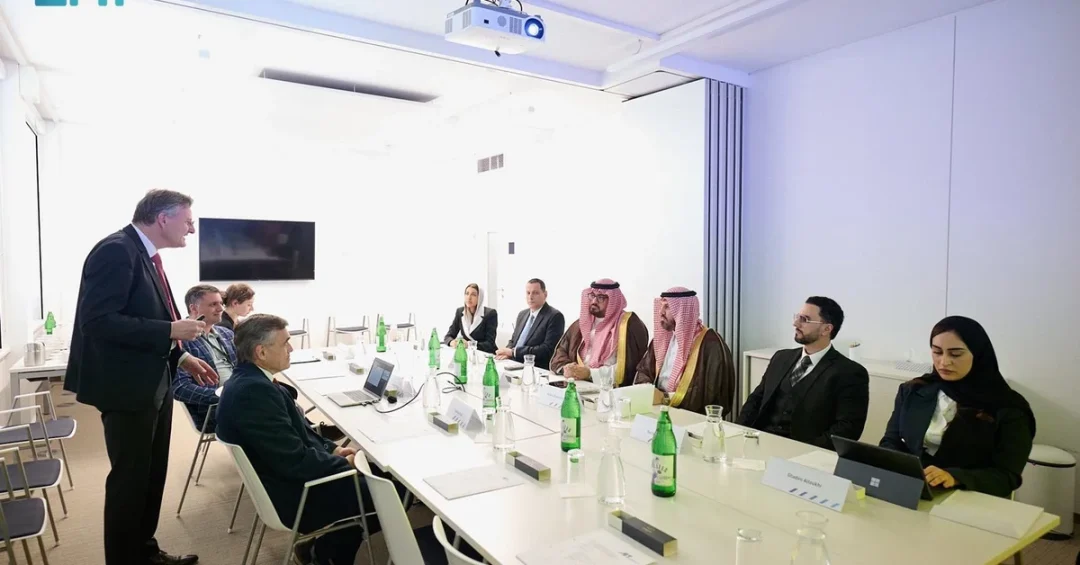
Saudi Minister of Economy and Planning Faisal Alibrahim visited the Austrian Institute of Technology (AIT) on May 28, 2024, on the sidelines of the Saudi-Austrian Joint Committee meeting in Vienna. During the visit, Alibrahim met with the institute’s Scientific Director, Andreas Kugi, to discuss cooperation and the latest developments in technology. The engagement underscores the Kingdom’s commitment to fostering international partnerships in innovation and research, aligned with the goals of Vision 2030.
Context and Background
The visit comes as part of the broader Saudi-Austrian Joint Committee meeting, a platform established to strengthen bilateral ties across multiple sectors, including trade, investment, and technology. Austria, known for its advanced research institutions and industrial expertise, offers significant opportunities for knowledge exchange and collaboration with Saudi Arabia. The AIT, as one of Austria’s leading research and technology organizations, focuses on applied research in areas such as digital transformation, energy, mobility, and health, making it a valuable partner for Saudi Arabia’s modernization efforts.
Saudi Arabia and Austria have historically maintained cordial diplomatic and economic relations. The joint committee mechanism facilitates regular dialogue and cooperation, with recent discussions covering investment in renewable energy, smart cities, and advanced manufacturing. This visit by Minister Alibrahim signals a deepening engagement with European research networks, as Saudi Arabia seeks to diversify its economy beyond hydrocarbons and build a knowledge-based society.
Key Details
During the meeting, Minister Alibrahim and Professor Kugi explored areas of mutual interest, including applied research, technology transfer, and potential joint projects. The AIT, with over 1,000 employees and a network of partners across Europe, conducts cutting-edge research that could complement Saudi Arabia’s growing investment in science and technology. The discussion likely covered leveraging Austrian expertise in areas such as automation, artificial intelligence, and sustainable urban development—all priorities within Saudi Arabia’s National Industrial Development and Logistics Program.
The visit also highlights the role of the Ministry of Economy and Planning in forging international partnerships that support economic diversification. The ministry’s efforts are integral to achieving the targets set out in Vision 2030, which aims to increase the contribution of non-oil sectors to GDP and create a thriving innovation ecosystem.
Implications and Impact
Strengthened cooperation between Saudi Arabia and the Austrian Institute of Technology could yield tangible benefits for both nations. For Saudi Arabia, access to AIT’s research capabilities could accelerate the development of smart city projects, including NEOM and other giga-projects, by integrating advanced technologies. For Austria, collaboration opens avenues for Saudi investment and market access in the Gulf region. The exchange of expertise and research findings can also contribute to global advancements in areas like clean energy and digital health, aligning with Saudi Arabia’s commitment to sustainability and innovation.
Furthermore, this engagement exemplifies the Kingdom’s proactive approach to building bridges with technologically advanced nations. By participating in joint committees and bilateral dialogues, Saudi Arabia positions itself as a hub for international cooperation, fostering an environment conducive to foreign investment and knowledge transfer.
Vision 2030 Alignment
This visit is a testament to Saudi Arabia’s ongoing efforts to diversify its economy and embrace innovation as a cornerstone of its future. Under Vision 2030, the Kingdom has set ambitious goals to increase the share of non-oil exports, enhance research and development spending, and nurture a vibrant ecosystem for startups and advanced industries. Collaborations with leading institutions like the Austrian Institute of Technology are vital to achieving these objectives, as they bring in expertise and technologies that can be adapted to local needs.
Looking ahead, the outcomes of this visit are expected to pave the way for concrete partnerships and projects, further solidifying Saudi Arabia’s role as a global player in technology and innovation. The Kingdom remains committed to learning from global best practices and investing in human capital, ensuring that its citizens are equipped to lead the industries of the future.
20 Questions
Q1. Who visited the Austrian Institute of Technology?
A1. Saudi Minister of Economy and Planning Faisal Alibrahim visited the Austrian Institute of Technology on May 28, 2024, as part of his official engagements in Vienna.
Q2. What was the purpose of the visit?
A2. The purpose was to discuss cooperation and the latest developments in technology with the institute’s scientific director, Andreas Kugi, alongside the Saudi-Austrian Joint Committee meeting.
Q3. Where did the visit take place?
A3. The visit took place at the Austrian Institute of Technology in Vienna, Austria, on the sidelines of the Saudi-Austrian Joint Committee meeting.
Q4. Who is the Scientific Director of the Austrian Institute of Technology?
A4. Andreas Kugi is the Scientific Director of the Austrian Institute of Technology, who met with Minister Alibrahim during the visit.
Q5. What is the Austrian Institute of Technology?
A5. The Austrian Institute of Technology is Austria’s largest research and technology organization, focusing on applied research in areas such as digital transformation, energy, mobility, and health.
Q6. Why is the Saudi-Austrian Joint Committee meeting significant?
A6. The joint committee meeting is significant as it provides a formal platform for strengthening bilateral ties in trade, investment, technology, and other sectors between Saudi Arabia and Austria.
Q7. What are the main areas of potential cooperation discussed?
A7. The discussions covered applied research, technology transfer, and potential joint projects, likely focusing on automation, artificial intelligence, and sustainable urban development.
Q8. How does this visit relate to Saudi Vision 2030?
A8. This visit supports Vision 2030 by promoting economic diversification, innovation, and the development of a knowledge-based economy through international partnerships.
Q9. What is the role of the Ministry of Economy and Planning in Saudi Arabia?
A9. The Ministry of Economy and Planning is responsible for formulating and executing Saudi Arabia’s economic policies, including diversification strategies and international cooperation initiatives.
Q10. How might this collaboration benefit Saudi Arabia’s smart city projects?
A10. Access to AIT’s research capabilities could accelerate the development of smart city projects like NEOM by integrating advanced technologies in energy, mobility, and digital infrastructure.
Q11. What are some examples of AIT’s research areas?
A11. AIT conducts research in digital transformation, energy systems, mobility solutions, health technologies, and environmental monitoring, among others.
Q12. How does this visit strengthen Saudi-Austrian relations?
A12. The visit deepens bilateral engagement by identifying concrete areas for collaboration, fostering trust, and opening new channels for investment and knowledge exchange.
Q13. What is the expected outcome of this meeting?
A13. The expected outcome is the formation of partnership agreements or joint research initiatives that align with both countries’ strategic priorities in technology and innovation.
Q14. Why is technology transfer important for Saudi Arabia?
A14. Technology transfer helps Saudi Arabia acquire advanced skills and knowledge, accelerating its transition to a diversified economy and reducing reliance on oil revenues.
Q15. What is the significance of the AIT’s applied research focus?
A15. AIT’s applied research focus ensures that innovations are directly relevant to industry and society, making it an ideal partner for Saudi Arabia’s practical implementation needs.
Q16. How does Saudi Arabia benefit from international research partnerships?
A16. International research partnerships bring global expertise, foster innovation, and enhance Saudi Arabia’s competitiveness, supporting job creation and economic growth.
Q17. What role do joint committees play in Saudi diplomacy?
A17. Joint committees serve as structured forums for regular dialogue, allowing Saudi Arabia to build lasting relationships and pursue cooperative ventures with key global partners.
Q18. Are there any specific projects mentioned in the original report?
A18. The original report only mentions the visit and the discussion on cooperation and technology; no specific projects were disclosed, but it paves the way for future initiatives.
Q19. How does this visit align with Saudi Arabia’s technological advancement goals?
A19. It aligns by exposing Saudi officials to leading-edge research and creating opportunities to integrate advanced technologies into the Kingdom’s development projects.
Q20. What is the next step following this visit?
A20. The next step would involve follow-up technical meetings and the development of memorandums of understanding to formalize cooperation and outline specific projects.
Reader Feedback
We value your thoughts. Please share your feedback on this article.
Your feedback helps us improve our coverage.