


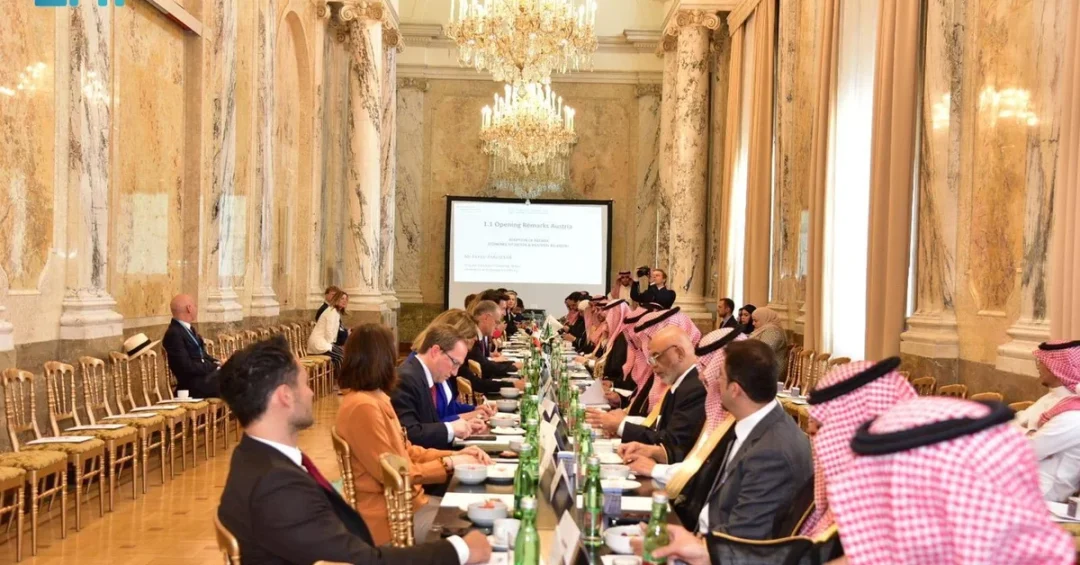
The ninth session of the Saudi-Austrian Joint Committee convened in Vienna on May 28, 2024, co-chaired by Albara Alaskandarani, Undersecretary for International Economic Affairs at Saudi Arabia’s Ministry of Economy and Planning, and Florian Frauscher, Director General of Economic Affairs, Innovation, and International Policy at Austria’s Federal Ministry of Labour and Economy. The session focused on expanding economic and commercial cooperation between the Kingdom of Saudi Arabia and the Republic of Austria, with an emphasis on innovation, technology, and investment opportunities available in both countries. This high-level dialogue underscores the mutual commitment to strengthening bilateral ties and advancing shared economic interests.
Context and Background
The Saudi-Austrian Joint Committee serves as a platform for structured dialogue and cooperation, reflecting decades of diplomatic and economic engagement between the two nations. Austria, as a key European partner, has consistently supported Saudi Arabia’s modernization efforts, particularly under Vision 2030. The ninth session builds on previous meetings that have facilitated trade, investment, and knowledge exchange, reinforcing a relationship that is vital for both economies. With Saudi Arabia diversifying away from hydrocarbons and Austria seeking innovative global partnerships, this committee plays a strategic role in aligning priorities.
Key Details
During the meeting, both delegations discussed a range of initiatives designed to enhance collaboration in economic and commercial sectors. Specific attention was given to fostering innovation and technology transfer, as well as exchanging experiences in economic and development policies. The two sides highlighted investment opportunities in both countries, aiming to attract capital and expertise across industries such as renewable energy, digital transformation, healthcare, and advanced manufacturing. The co-chairs stressed the importance of continuous and expanded cooperation to serve common interests, signaling a forward-looking agenda that addresses global economic challenges.
Implications and Impact
The outcomes of the ninth session are expected to catalyze increased bilateral trade and investment flows. For Saudi Arabia, this partnership aligns with Vision 2030’s goals of economic diversification and global integration, enabling access to Austrian technological innovation and industrial excellence. For Austria, collaboration with Saudi Arabia opens doors to one of the region’s most dynamic economies and a gateway to Middle Eastern and broader Gulf markets. The strengthened dialogue also supports regional stability and sustainable development, as both nations prioritize innovation-driven growth and knowledge-based industries.
Vision 2030 Alignment
This meeting directly supports Saudi Arabia’s Vision 2030, which seeks to build a vibrant society, a thriving economy, and an ambitious nation. By deepening ties with Austria, the Kingdom reinforces its commitment to international partnerships that drive economic transformation, create high-value jobs, and foster technological advancement. The joint committee’s focus on innovation and investment mirrors Vision 2030’s emphasis on developing sectors beyond oil, including technology, tourism, and human capital. As Saudi Arabia continues its journey toward a diversified and sustainable future, such collaborations will be instrumental in achieving its long-term strategic objectives.
20 Questions
Q1. What is the Saudi-Austrian Joint Committee?
A1. The Saudi-Austrian Joint Committee is a bilateral platform established to discuss and enhance economic, trade, and investment cooperation between Saudi Arabia and Austria. It convenes periodically to review progress and set future directions.
Q2. Who co-chaired the ninth session of the Joint Committee?
A2. The ninth session was co-chaired by Albara Alaskandarani, Undersecretary for International Economic Affairs at Saudi Arabia’s Ministry of Economy and Planning, and Florian Frauscher, Director General of Economic Affairs, Innovation, and International Policy at Austria’s Federal Ministry of Labour and Economy.
Q3. When and where was the ninth session held?
A3. The ninth session took place on May 28, 2024, in Vienna, Austria. The Austrian capital hosted the meeting, reflecting the strong diplomatic ties between the two nations.
Q4. What were the main topics discussed at the meeting?
A4. The meeting focused on enhancing cooperation in economic and commercial fields, including innovation, technology, exchange of experiences in economic policies, and highlighting investment opportunities available in both countries.
Q5. Why is the Saudi-Austrian economic partnership significant?
A5. The partnership is significant as it facilitates trade, investment, and knowledge exchange between a leading European economy and a rapidly diversifying Gulf nation, contributing to mutual growth and innovation.
Q6. How does this meeting align with Saudi Vision 2030?
A6. The meeting aligns with Vision 2030 by promoting economic diversification, international cooperation, and innovation, which are core pillars of the Kingdom’s long-term transformation strategy.
Q7. What role does innovation play in the Saudi-Austrian cooperation?
A7. Innovation is a key area of cooperation, with both sides aiming to leverage each other’s strengths in technology, research, and development to drive economic growth and competitiveness.
Q8. How can Austrian companies benefit from investing in Saudi Arabia?
A8. Austrian companies can access a large, dynamic market with strategic location, young population, and government support for foreign investment, particularly in sectors aligned with Vision 2030.
Q9. What opportunities exist for Saudi investors in Austria?
A9. Austria offers opportunities in advanced manufacturing, renewable energy, healthcare, and technology, providing a gateway to the European Union market and a stable business environment.
Q10. How does the Joint Committee facilitate trade between the two countries?
A10. The Joint Committee provides a structured framework for identifying trade barriers, exploring new sectors, and fostering business connections, thereby streamlining and expanding bilateral trade.
Q11. What is the significance of holding the meeting in Vienna?
A11. Vienna is a diplomatic hub and a center for international cooperation, making it a fitting venue for high-level economic discussions and symbolizing Austria’s commitment to fostering global partnerships.
Q12. How does this meeting support economic policy exchange?
A12. The meeting allows both countries to share best practices and lessons learned in economic development, enabling them to refine policies that drive sustainable growth and diversification.
Q13. Are there any specific sectors highlighted for cooperation?
A13. While not explicitly named, the discussions on innovation and technology suggest a focus on digital transformation, renewable energy, and high-tech industries, which are priorities for both nations.
Q14. How does Saudi Arabia’s economic transformation benefit from Austrian expertise?
A14. Austria’s strengths in innovation, engineering, and sustainability can help Saudi Arabia develop new industries and upgrade existing ones, supporting the creation of a knowledge-based economy.
Q15. What does Austria gain from closer ties with Saudi Arabia?
A15. Austria gains access to a growing market and investment opportunities in the Gulf, as well as a partner for joint ventures and research initiatives, enhancing its global economic outreach.
Q16. Is this the first time the Joint Committee has met?
A16. No, this is the ninth session, indicating an established and ongoing relationship that has evolved over time, with each meeting building on previous achievements.
Q17. How do such meetings contribute to regional stability?
A17. Economic cooperation fosters interdependence and mutual understanding, which can promote stability and peaceful relations in the wider region.
Q18. What is the role of the Undersecretary for International Economic Affairs?
A18. The Undersecretary leads Saudi Arabia’s efforts in international economic diplomacy, representing the Ministry of Economy and Planning in bilateral discussions to advance the Kingdom’s economic interests.
Q19. How can businesses get involved in Saudi-Austrian cooperation?
A19. Businesses can engage through trade missions, joint ventures, and by leveraging the networks and resources provided by both governments, as well as through participation in relevant committees and forums.
Q20. What is the expected outcome of the ninth session?
A20. The ninth session is expected to yield concrete action plans and follow-up measures to deepen economic and commercial ties, leading to increased trade volumes and investment flows between the two countries.
Reader Feedback
We value your thoughts. Please share your feedback on this article.
Your feedback helps us improve our coverage.