


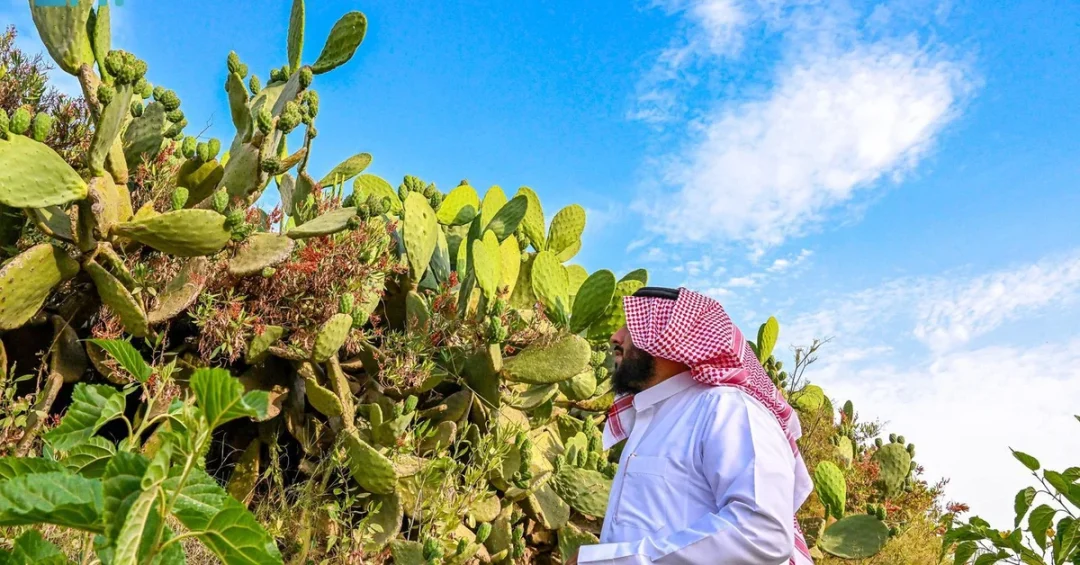
The prickly pear cultivation initiative in AlBaha has achieved remarkable success, transforming a traditional private-farm profession into a specialized city dedicated to scientific research and the production of food, medical, and cosmetic products. According to the Saudi Press Agency (SPA), the mountains, agricultural terraces, valleys, and plains of AlBaha are now covered with green, yellow, and red prickly pear trees, thriving thanks to the region’s abundant daily rainfall.
Context and Background
AlBaha, located in southwestern Saudi Arabia, is known for its fertile terrain and favorable climate, making it ideal for agriculture. The prickly pear initiative, supported by the Ministry of Environment, Water and Agriculture, aims to modernize and expand the cultivation of this versatile fruit. Previously managed in private farms, prickly pear farming has now evolved into a structured industry with dedicated facilities.
Eng. Fahd Muftah Al-Zahrani, Director-General of the Ministry’s branch in AlBaha, explained that the ministry allocated an initiative to support prickly pear cultivation with a production line and a press for its oil, benefiting all farmers in the region. “Work is underway to find an integrated line for this product to achieve full benefit from it for all prickly pear farmers,” he said. This infrastructure is expected to boost efficiency and product quality.
Key Details
Al-Zahrani revealed the establishment of an integrated prickly pear city in cooperation with the prickly pear association in the region. This dedicated hub will focus on scientific research and the production of food, medical, and cosmetic products derived from the fruit. The initiative’s owner, Dr. Faeq Al-Ghamdi, stated that the project aims to achieve regional leadership in prickly pear cultivation and production. “It also aims to achieve self-sufficiency internally and to be able to export the product,” he added.
Dr. Nadia Saeed Al-Zahrani, a nutritionist at AlBaha University, highlighted the health benefits of prickly pear, which grows in colors ranging from green to red, with the red variety being sweeter. She noted that the fruit contains essential nutrients including fiber, minerals, and vitamins E, C, and K. “The fiber contained in the prickly pear may contribute to weight loss and adjust levels of sugar and fat in the blood,” she said, adding that it also helps improve skin appearance and may indirectly delay signs of aging.
Implications and Impact
The success of the prickly pear initiative has significant implications for AlBaha’s economy and beyond. By establishing a specialized city, the region is positioning itself as a leader in prickly pear production, potentially creating new job opportunities and attracting investment. The focus on scientific research and product diversification—ranging from food to cosmetics—adds value to the agricultural sector and supports export ambitions.
Furthermore, the initiative aligns with Saudi Arabia’s broader goals of economic diversification and sustainable development. It showcases how traditional farming can be transformed through innovation and government support, benefiting local communities and enhancing food security. The integration of a production line and oil press ensures that farmers can maximize the value of their harvest, reducing waste and increasing profitability.
Vision 2030 Alignment
This initiative is a prime example of Saudi Vision 2030 in action, which seeks to diversify the economy away from oil, empower local industries, and promote sustainable agriculture. By turning prickly pear cultivation into a modern, research-driven industry, AlBaha is contributing to the Kingdom’s goals of economic growth, self-sufficiency, and global competitiveness. As the project expands, it will not only benefit the region but also reinforce Saudi Arabia’s role as an innovator in agricultural technology and healthy products.
20 Questions
Q1. What is the prickly pear initiative in AlBaha?
A1. The prickly pear initiative in AlBaha is a project supported by the Ministry of Environment, Water and Agriculture to cultivate prickly pears, establish a specialized city for research and production, and support local farmers.
Q2. Who is leading the prickly pear initiative?
A2. The initiative is led by Dr. Faeq Al-Ghamdi, with support from Eng. Fahd Muftah Al-Zahrani, Director-General of the Ministry’s branch in AlBaha, and collaboration with the prickly pear association.
Q3. What types of products are produced from prickly pears?
A3. Prickly pears are used to produce food, medical, and cosmetic products. The initiative includes a production line and a press for extracting oil from the fruit’s seeds.
Q4. Where is AlBaha located in Saudi Arabia?
A4. AlBaha is a region in southwestern Saudi Arabia, known for its mountainous terrain, agricultural terraces, and fertile valleys that receive abundant rainfall.
Q5. What colors do prickly pears grow in?
A5. Prickly pears grow in different colors, ranging from green to red. The red variety is noted for being sweeter in taste.
Q6. What are the health benefits of prickly pears?
A6. Prickly pears contain fiber, minerals, and vitamins E, C, and K, which enhance health, improve skin appearance, may aid weight loss, and help regulate blood sugar and fat levels.
Q7. Who is Dr. Nadia Saeed Al-Zahrani?
A7. Dr. Nadia Saeed Al-Zahrani is a nutritionist at AlBaha University who provided expert commentary on the nutritional and health benefits of prickly pears.
Q8. What is the goal of the prickly pear initiative?
A8. The initiative aims to achieve regional leadership in prickly pear cultivation and production, attain self-sufficiency, and enable exports of the product to international markets.
Q9. How does the initiative support local farmers?
A9. The initiative provides a production line and an oil press, benefiting all farmers in the region. It also plans to establish an integrated line to maximize benefits for farmers.
Q10. What is the integrated prickly pear city?
A10. The integrated prickly pear city is a specialized hub established in cooperation with the prickly pear association, where scientific research is conducted and food, medical, and cosmetic products are produced.
Q11. Why is AlBaha suitable for prickly pear cultivation?
A11. AlBaha’s mountains, agricultural terraces, valleys, and plains, combined with daily rainfall, provide an ideal environment for growing prickly pears.
Q12. What role does the Ministry of Environment, Water and Agriculture play?
A12. The ministry allocated an initiative to support prickly pear cultivation, providing infrastructure such as a production line and oil press, and facilitating the establishment of the specialized city.
Q13. How does the initiative contribute to Saudi Vision 2030?
A13. The initiative supports economic diversification, sustainable agriculture, and self-sufficiency, aligning with Vision 2030’s goals to empower local industries and enhance global competitiveness.
Q14. What is the significance of exporting prickly pear products?
A14. Exporting prickly pear products can boost Saudi Arabia’s non-oil exports, generate revenue, and showcase the Kingdom’s agricultural innovation on the global stage.
Q15. How does prickly pear help with weight loss?
A15. The fiber contained in prickly pear may contribute to weight loss by promoting satiety and aiding digestion, as noted by nutritionist Dr. Nadia Saeed Al-Zahrani.
Q16. What vitamins are found in prickly pears?
A16. Prickly pears are rich in vitamins E, C, and K, as well as minerals, all of which contribute to overall health and wellness.
Q17. What is the economic impact of the prickly pear initiative?
A17. The initiative creates job opportunities, attracts investment, and enhances the local economy by transforming traditional farming into a modern, research-driven industry.
Q18. How does the initiative promote scientific research?
A18. The integrated prickly pear city serves as a research hub where studies on cultivation, nutrition, and product development are conducted to improve yields and applications.
Q19. What is the role of the prickly pear association?
A19. The prickly pear association collaborates with the Ministry to establish the integrated city and supports farmers through knowledge sharing and resource coordination.
Q20. What are the future plans for the prickly pear initiative?
A20. Future plans include completing an integrated production line to fully benefit farmers, expanding research, and increasing production for domestic self-sufficiency and export markets.
Reader Feedback
We value your thoughts. Please share your feedback on this article.
Your feedback helps us improve our coverage.