


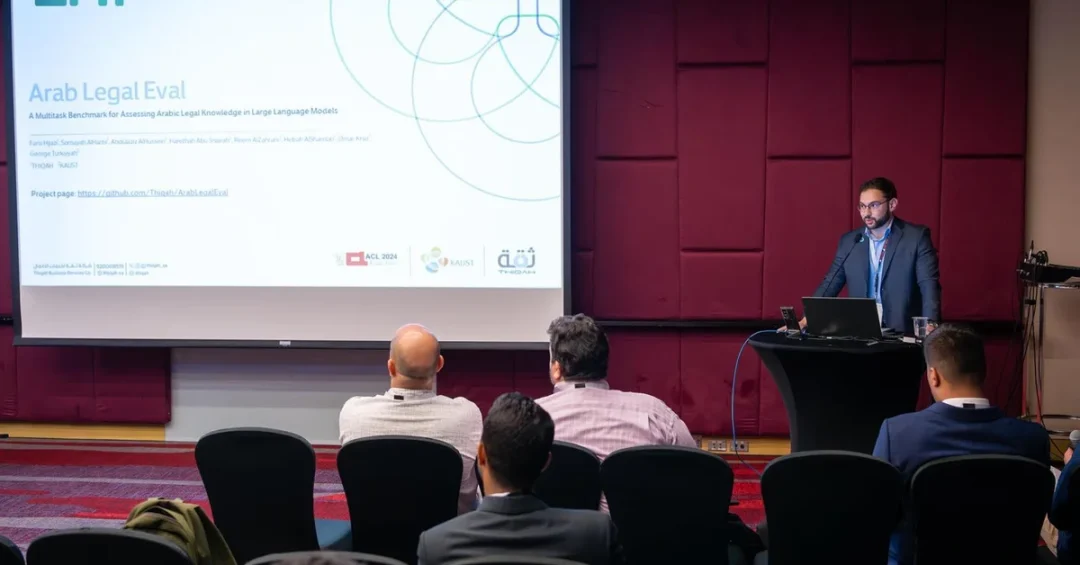
THIQAH Company, in collaboration with King Abdullah University of Science and Technology (KAUST), presented a research paper at the Arabic Natural Language Processing Conference (ArabicNLP 2024) in Bangkok on August 16, 2024. The paper introduces new standards for evaluating the capabilities of language models to understand legal complexities in Arabic. This study is significant given the rapid development of artificial intelligence (AI) technologies and the increasing need for tools that accurately handle different natural languages.
Context and Background
The ArabicNLP 2024 conference, now in its second edition, is the premier annual event in the field of Arabic natural language processing. It was attended by a distinguished group of researchers from around the world, reflecting the growing global interest in AI applications that cater to the Arabic language. The conference comes amid rapid developments in AI and an increasing demand for digital solutions that accurately process Arabic.
THIQAH’s participation underscores its commitment to advancing linguistic research and AI. In December last year, KAUST and THIQAH signed a memorandum of understanding to revolutionize industries and unlock the potential for digital solutions. This partnership reflects THIQAH’s dedication to fostering growth and business success in an ever-evolving digital age.
Key Details
The research paper, developed jointly by THIQAH and KAUST, introduces a new benchmark dataset named “ArabLegalEval,” designed to assess large language models’ abilities in comprehending Arabic legal texts. This dataset represents a significant achievement in linguistic research, as it will improve the performance of language models and the development of smarter applications.
During the conference, THIQAH presented the standards established by the study and the expected advancements in evaluating AI systems that work on legal texts in Arabic. These standards allow developers and researchers to assess their models’ ability to understand complex legal terms, extract relevant information from lengthy legal texts, and accurately answer legal questions.
Implications and Impact
The development of ArabLegalEval is expected to contribute to enhancing the use of the Arabic language in scientific research and the development of AI applications that meet the needs of the Arab world. By providing a standardized evaluation framework, the study enables researchers and developers to benchmark their models and drive innovation in Arabic legal AI.
This research is particularly important as AI technologies continue to evolve rapidly. The ability to accurately process and understand Arabic legal texts has wide-ranging implications for sectors such as legal tech, government services, and academia. It also positions Saudi Arabia as a leader in Arabic natural language processing research.
Vision 2030 Alignment
This collaboration between THIQAH and KAUST aligns with Saudi Arabia’s Vision 2030, which aims to diversify the economy and promote innovation in technology and digital solutions. By advancing AI capabilities in Arabic, the Kingdom is supporting the growth of knowledge-based industries and enhancing its global competitiveness. The partnership exemplifies the Vision’s emphasis on fostering public-private partnerships and leveraging cutting-edge research to drive progress.
20 Questions
Q1. What is the name of the conference where THIQAH and KAUST presented their research?
A1. The conference is the Arabic Natural Language Processing Conference (ArabicNLP 2024), held in Bangkok, Thailand.
Q2. When did the conference take place?
A2. The conference took place on August 16, 2024, in Bangkok.
Q3. What is the name of the benchmark dataset developed by THIQAH and KAUST?
A3. The benchmark dataset is named ArabLegalEval.
Q4. What is the purpose of the ArabLegalEval dataset?
A4. It is designed to assess large language models’ abilities in comprehending Arabic legal texts.
Q5. Why is this research considered significant?
A5. It is significant due to the rapid development of AI technologies and the need for tools that understand different natural languages, especially Arabic.
Q6. What does the study aim to enhance?
A6. The study aims to enhance the use of the Arabic language in scientific research and the development of AI applications for the Arab world.
Q7. What did THIQAH present at the conference?
A7. THIQAH presented the standards established by the study and expected advancements in evaluating AI systems for Arabic legal texts.
Q8. What can developers and researchers assess using these standards?
A8. They can assess models’ ability to understand complex legal terms, extract information from lengthy texts, and answer legal questions accurately.
Q9. When did KAUST and THIQAH sign a memorandum of understanding?
A9. They signed a memorandum of understanding in December last year.
Q10. What is the goal of the KAUST-THIQAH partnership?
A10. The partnership aims to revolutionize industries and unlock the potential for digital solutions.
Q11. How does this partnership reflect THIQAH’s commitment?
A11. It reflects THIQAH’s commitment to fostering growth and business success in an ever-evolving digital age.
Q12. What is the ArabicNLP conference?
A12. It is the premier annual event in the field of Arabic natural language processing, now in its second edition.
Q13. Who attended the ArabicNLP 2024 conference?
A13. A distinguished group of researchers from around the world attended the conference.
Q14. Why is the conference important?
A14. It addresses rapid developments in AI and the increasing need for digital solutions that accurately handle Arabic.
Q15. What is the expected impact of the study on AI applications?
A15. It is expected to contribute to enhancing the use of Arabic in scientific research and developing AI applications that meet the needs of the Arab world.
Q16. How does this research contribute to linguistic research?
A16. It represents a significant achievement by improving the performance of language models and the development of smarter applications.
Q17. What are the implications for legal tech?
A17. The research enables more accurate processing of Arabic legal texts, benefiting legal tech, government services, and academia.
Q18. How does this collaboration align with Saudi Vision 2030?
A18. It aligns with Vision 2030 by promoting innovation in technology and digital solutions, supporting knowledge-based industries.
Q19. What does the study allow developers to do?
A19. It allows developers to benchmark their models and drive innovation in Arabic legal AI.
Q20. What does the partnership between THIQAH and KAUST exemplify?
A20. It exemplifies the Vision 2030 emphasis on public-private partnerships and leveraging cutting-edge research for progress.
Reader Feedback
We value your thoughts. Please share your feedback on this article.
Your feedback helps us improve our coverage.