


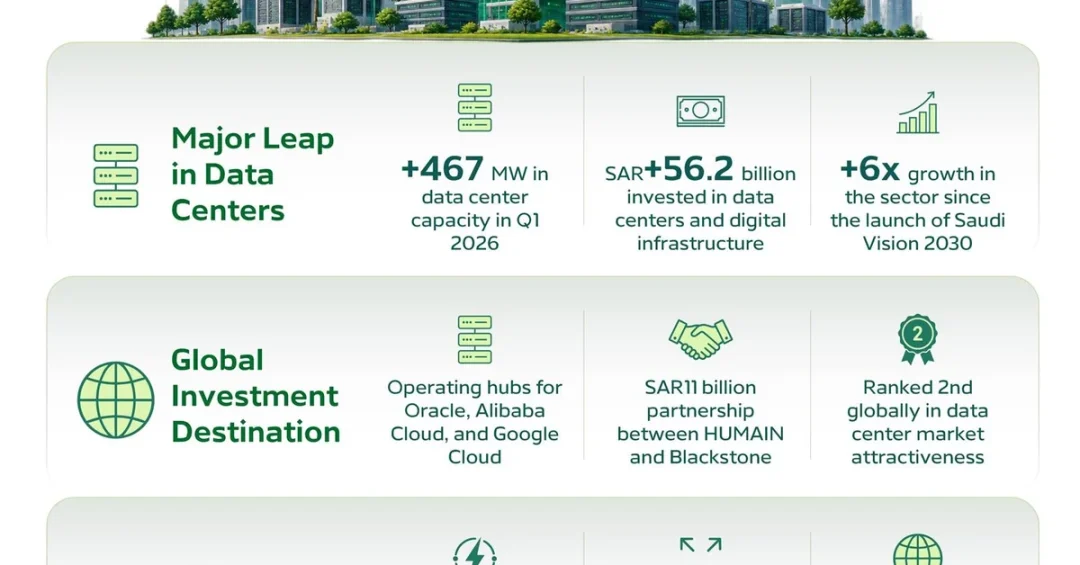
Saudi Arabia has leveraged its advanced digital infrastructure and partnerships with leading global technology companies to establish its position as a global hub for artificial intelligence investment, supported by investments exceeding SAR56.2 billion in data centers and digital infrastructure. The announcement, released via the Saudi Press Agency, highlights data center capacity growth from 68 MW in 2021 to more than 467 MW in the first quarter of 2026, a sixfold increase since the launch of Saudi Vision 2030. This rapid expansion underscores the Kingdom’s commitment to economic diversification and its readiness for the knowledge economy.
Context and Background
Saudi Arabia’s digital transformation is anchored in a national data and AI strategy that aligns with Vision 2030’s goals of reducing oil dependence and fostering a diversified, innovation-driven economy. The Kingdom’s competitive advantages—reliable energy, vast land availability, and a strategic geographic location connecting Asia, Africa, and Europe—have made it a magnet for global technology investment. As a result, Saudi Arabia now ranks second globally in data center market attractiveness, according to official sources. This progress is part of a broader effort to position the Kingdom as a leader in the digital economy and a key player in global technology governance.
Key Details
Saudi Arabia has attracted some of the world’s largest cloud service providers, including Oracle, Alibaba Cloud, and Google Cloud. A strategic SAR11 billion partnership between HUMAIN and Blackstone further reflects growing global confidence in the Kingdom’s digital investment environment. On the international stage, Saudi Arabia, as a leading G20 country in communications and technology, led consensus on a roadmap for defining and measuring the digital economy and the adoption of human-centered, trustworthy AI principles. It also contributed to transforming the Digital Economy Task Force into a permanent working group, reinforcing its role in advancing digital policies and global cooperation.
In efforts to bridge the global digital divide, the Kingdom conducted pioneering initiatives such as a 5G trial using High-Altitude Platform Systems (HAPS), covering nearly half a million square kilometers in remote areas, and the first-of-its-kind trial integrating non-terrestrial networks (NTN) with terrestrial networks. These innovations offer future solutions for expanding connectivity to unconnected communities. The Kingdom’s performance in international indicators is equally impressive: it ranked first globally twice in the International Telecommunication Union’s (ITU) 2026 ICT Development Index, outperforming 159 countries. It also ranked second among G20 countries in the ITU’s ICT Regulatory Tracker and second in digital competitiveness according to the European Center for Digital Competitiveness, with digital infrastructure coverage reaching approximately 99% of the population.
Implications and Impact
Saudi Arabia’s advancements in AI are reflected in its global rankings: first in the Arab world and 14th globally in the Global AI Index; first globally in AI security, privacy, and encryption; first in women’s empowerment in AI; third globally in the development of advanced AI models; and third in the share of specialized AI talent, with the world’s highest growth rate in specialized talent. The Kingdom also ranked fourth globally in attracting international talent. The impact extends to empowering people and improving quality of life, exemplified by the launch of the world’s largest virtual hospital, which leverages AI to deliver advanced healthcare services. Women’s participation in the technology sector has risen from 7% to 35%, surpassing G20 and European Union averages, demonstrating the success of investing in human capital alongside digital infrastructure. Independent institutions recognize this progress: JLL, as reported by Bloomberg, expects Riyadh to lead the growth of AI-related data centers in the Middle East.
Vision 2030 Alignment
Saudi Arabia’s digital economy achievements are a direct reflection of Vision 2030’s objectives to diversify the economy, empower citizens, and position the Kingdom as a global investment powerhouse. By fostering a robust digital infrastructure and attracting international partnerships, Saudi Arabia is not only enhancing its competitiveness but also contributing to the global digital economy. As the Kingdom continues to advance its national data and AI strategy, it remains committed to driving innovation, bridging the digital divide, and shaping a future where technology serves humanity. This forward-looking approach ensures that Saudi Arabia will remain at the forefront of the digital revolution, in line with its long-term vision and global role.
20 Questions
Q1. What is the main focus of Saudi Arabia’s digital infrastructure development?
A1. The main focus is to establish the Kingdom as a global hub for artificial intelligence investment, supported by advanced digital infrastructure, strategic partnerships, and a national data and AI strategy aligned with Vision 2030.
Q2. How much has data center capacity increased in Saudi Arabia?
A2. Data center capacity increased from 68 MW in 2021 to more than 467 MW in the first quarter of 2026, representing a more than sixfold growth since the launch of Vision 2030.
Q3. What is the total investment in data centers and digital infrastructure?
A3. Investments exceed SAR56.2 billion, reflecting the Kingdom’s commitment to building a robust digital economy and attracting global technology partners.
Q4. Which global cloud service providers operate in Saudi Arabia?
A4. Oracle, Alibaba Cloud, and Google Cloud are among the major global cloud service providers that have established operations in the Kingdom, highlighting its attractiveness as a technology investment destination.
Q5. What is the HUMAIN and Blackstone partnership?
A5. It is a strategic SAR11 billion partnership between HUMAIN and Blackstone, underscoring growing global confidence in Saudi Arabia’s digital investment environment.
Q6. What competitive advantages does Saudi Arabia offer for data centers?
A6. The Kingdom offers reliable energy, vast land availability, and a strategic geographic location connecting Asia, Africa, and Europe, making it second globally in data center market attractiveness.
Q7. What role has Saudi Arabia played in shaping the global digital economy?
A7. As a leading G20 country, Saudi Arabia led consensus on a roadmap for defining and measuring the digital economy and the adoption of human-centered, trustworthy AI principles, and helped transform the Digital Economy Task Force into a permanent working group.
Q8. What initiatives has Saudi Arabia led to bridge the digital divide?
A8. The Kingdom conducted a 5G trial using High-Altitude Platform Systems (HAPS) covering nearly half a million square kilometers, and the first-of-its-kind trial integrating non-terrestrial networks with terrestrial networks.
Q9. How did Saudi Arabia rank in the ITU’s 2026 ICT Development Index?
A9. Saudi Arabia ranked first globally twice, outperforming 159 countries, reflecting the strength of its integrated digital infrastructure, widespread connectivity, and high levels of digital adoption.
Q10. What is Saudi Arabia’s ranking in the Global AI Index?
A10. The Kingdom ranked first in the Arab world and 14th globally in the Global AI Index, demonstrating its growing influence in artificial intelligence.
Q11. In which AI-related areas does Saudi Arabia rank first globally?
A11. Saudi Arabia ranks first globally in AI security, privacy, and encryption, and first in women’s empowerment in AI, showcasing its leadership in ethical and inclusive AI development.
Q12. How does Saudi Arabia perform in AI talent development?
A12. The Kingdom ranks third globally in the development of advanced AI models and third in the share of specialized AI talent, with the world’s highest growth rate in specialized talent.
Q13. What is the world’s largest virtual hospital launched by Saudi Arabia?
A13. It is a healthcare facility that leverages artificial intelligence technologies to deliver advanced healthcare services, improving quality of life and demonstrating the impact of digital innovation.
Q14. How has women’s participation in the technology sector changed?
A14. Women’s participation has risen from 7% to 35%, surpassing the averages of both the G20 and the European Union, reflecting successful human capital investment.
Q15. What recognition has Saudi Arabia received from independent institutions?
A15. JLL, as reported by Bloomberg, expects Riyadh to lead the growth of AI-related data centers in the Middle East, underscoring the Kingdom’s growing position as a leading investment destination.
Q16. What is the significance of the Digital Economy Task Force transformation?
A16. Its transformation into a permanent working group reinforces Saudi Arabia’s role as an international partner in advancing digital policies and strengthening global cooperation in technology.
Q17. How does Saudi Arabia’s digital infrastructure coverage compare globally?
A17. Digital infrastructure coverage reaches approximately 99% of the Kingdom’s population, ensuring widespread access and supporting high levels of digital adoption.
Q18. What does Saudi Arabia’s second-place ranking in digital competitiveness indicate?
A18. It indicates the Kingdom’s strong digital competitiveness among G20 countries, as measured by the European Center for Digital Competitiveness, reflecting its advanced infrastructure and regulatory environment.
Q19. How does Saudi Arabia’s digital strategy align with Vision 2030?
A19. The digital strategy supports economic diversification, strengthens readiness for the knowledge economy, and empowers citizens, directly contributing to Vision 2030’s goals of a diversified and sustainable economy.
Q20. What future steps is Saudi Arabia taking in the digital economy?
A20. Saudi Arabia continues to advance its national data and AI strategy, foster global partnerships, and invest in human capital to remain at the forefront of the digital revolution and shape the future of the global digital economy.
Reader Feedback
We value your thoughts. Please share your feedback on this article.
Your feedback helps us improve our coverage.
Related articles
 Le croissant de Rabi’ Al-Awwal orne le ciel saoudien
 Two Dead in Light Aircraft Crash in North Wales
 PIF and Formula E Expand ‘Driving Force’ Education Platform
 PIF and Formula E Expand Driving Force Online Education Platform
 PIF & Formula E Expand Driving Force Education Platform
 Saudi Arabia’s Rabi Al-Awwal Crescent Moon to Grace Sunset Sky