


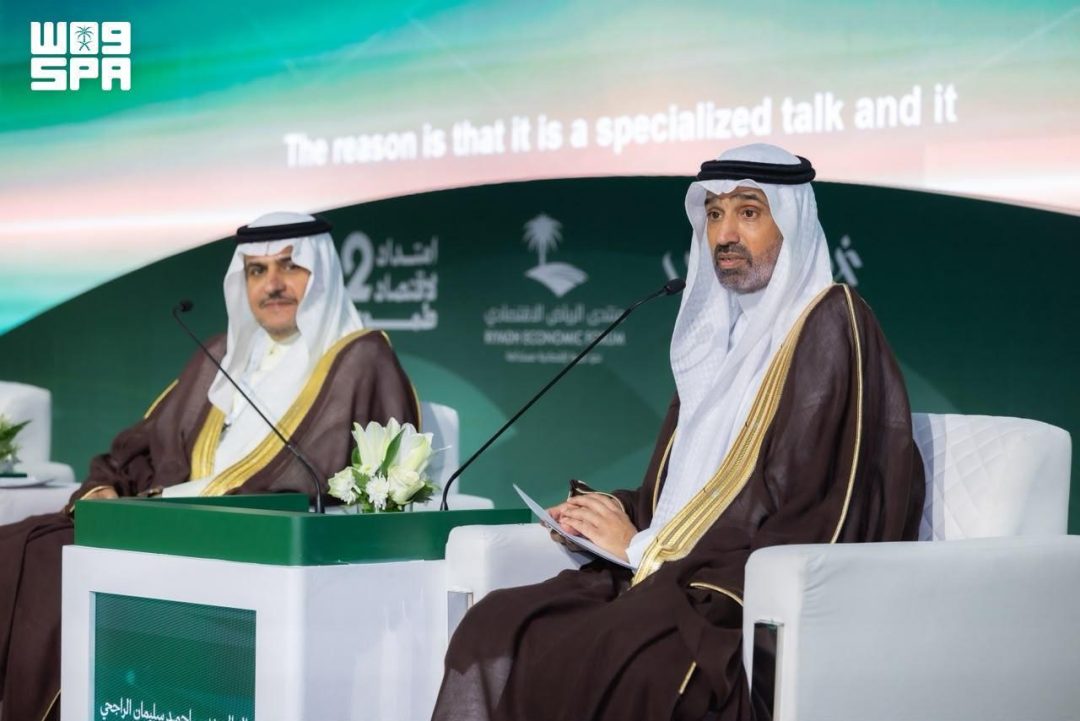
Minister of Human Resources and Social Development Ahmed Al-Rajhi participated yesterday in the 12th Riyadh Economic Forum, where he chaired a session on the strategy for localizing knowledge and expertise among local personnel and its impact on Saudi organizations’ performance.
SPA reported that the minister expressed appreciation for the patronage of Custodian of the Two Holy Mosques King Salman bin Abdulaziz Al Saud and the continued support of His Royal Highness Prince Mohammed bin Salman bin Abdulaziz Al Saud, Crown Prince and Prime Minister, for the forum and the private sector’s role in diversifying the national economy and enhancing its competitiveness.
The session explored efforts to develop human capital, enhance productivity, and align national skills with labor market needs and Saudi Vision 2030. What does it take to turn a national conversation about skills into measurable gains inside Saudi organizations?
Al-Rajhi reviewed several initiatives during the session, including a career guidance and mentoring program that has benefited more than 1.3 million school students and 350,000 university students, alongside cooperative training policies and professional experience programs. Those figures place the reach of the guidance and mentoring effort across both school and university populations, according to the source material.
The Riyadh Economic Forum serves as a national platform for discussing economic and development issues and presenting studies and recommendations that support Saudi Arabia’s economic development and competitiveness. How does a platform built around studies and recommendations translate into changes that workers and employers can actually feel?
The minister’s session focused specifically on the localization of knowledge and expertise among local personnel, tying that strategy to the performance of Saudi organizations. The discussion also covered human capital development and productivity enhancement, two areas the source links directly to labor market alignment.
Cooperative training policies and professional experience programs were named among the initiatives reviewed, alongside the career guidance and mentoring program. How do cooperative training and professional experience programs fit together with guidance and mentoring for students still deciding on a path?
The forum’s 12th edition brought the minister together with a platform described as national in scope, dedicated to economic and development issues. The source states that the forum presents studies and recommendations supporting economic development and competitiveness.
Al-Rajhi’s appreciation for royal patronage and for the private sector’s role in diversifying the national economy and enhancing its competitiveness was part of his remarks at the forum. What role does the private sector play when the subject turns to localizing knowledge and expertise among local personnel?
The session’s title, as given by the source, centers on the strategy for localizing knowledge and expertise among local personnel and its impact on Saudi organizations’ performance. The source does not detail the specific mechanisms of that strategy beyond the initiatives the minister reviewed.
More than 1.3 million school students and 350,000 university students have benefited from the career guidance and mentoring program, according to the source. Those numbers were presented as part of the minister’s review of initiatives at the forum.
Efforts to develop human capital and enhance productivity were explored in the session, along with aligning national skills with labor market needs and Saudi Vision 2030. How should alignment between national skills and labor market needs be measured over time?
The Riyadh Economic Forum, in its 12th edition, is described by the source as a national platform for discussing economic and development issues. It presents studies and recommendations that support Saudi Arabia’s economic development and competitiveness.
The source does not include the full list of participants, the specific recommendations produced by the session, or any figures beyond the student beneficiary numbers. It also does not state the venue, the duration of the session, or any outcomes adopted by the forum.
What the source does provide is the minister’s participation, the session he chaired, the royal patronage and support he acknowledged, the initiatives he reviewed, and the forum’s stated role as a national platform. The source does not include additional detail on how the initiatives reviewed connect to specific labor market outcomes.
The minister’s remarks tied the private sector’s role to diversifying the national economy and enhancing its competitiveness, according to the source. The session itself tied localization of knowledge and expertise to Saudi organizations’ performance.
How do the initiatives reviewed at the forum reach students and workers beyond the numbers already cited? The source names the career guidance and mentoring program, cooperative training policies, and professional experience programs but does not break down results by region or sector.
The 12th Riyadh Economic Forum took place with the participation of the Minister of Human Resources and Social Development, who chaired a session on localizing knowledge and expertise among local personnel. The source does not state what recommendations, if any, the session produced.
SPA reported the minister’s appreciation for the patronage of Custodian of the Two Holy Mosques King Salman bin Abdulaziz Al Saud and the continued support of His Royal Highness Prince Mohammed bin Salman bin Abdulaziz Al Saud, Crown Prince and Prime Minister. The source also reported his appreciation for the private sector’s role in diversifying the national economy and enhancing its competitiveness.
The session explored efforts to develop human capital, enhance productivity, and align national skills with labor market needs and Saudi Vision 2030. What does alignment look like when school students, university students, and employers are all part of the same labor market conversation?
The source lists the initiatives the minister reviewed without providing budget figures, timelines, or expansion plans. It also does not include the names of other speakers or the number of attendees at the 12th Riyadh Economic Forum.
The forum’s role, as described by the source, is to discuss economic and development issues and present studies and recommendations supporting Saudi Arabia’s economic development and competitiveness. The minister’s session focused on localizing knowledge and expertise among local personnel and its impact on Saudi organizations’ performance.
How do studies and recommendations from a national platform reach the organizations whose performance the session examined? The source does not describe the follow-up mechanism, if any, between the forum’s output and organizational practice.
The career guidance and mentoring program’s beneficiary figures, more than 1.3 million school students and 350,000 university students, were the only numeric details in the source. Cooperative training policies and professional experience programs were named without accompanying figures.
The source does not state whether the minister announced new initiatives at the forum or reviewed existing ones. It describes the initiatives as ones he reviewed during the session.
What the source leaves out includes the forum’s full agenda, the other sessions, and any closing statement. It also does not include the date of the forum beyond the minister’s participation yesterday, as reported from Riyadh on October 13, 2026.
The session’s focus on localizing knowledge and expertise among local personnel connects to the broader theme of human capital development, productivity enhancement, and alignment of national skills with labor market needs and Saudi Vision 2030, according to the source.
How should the impact of localizing knowledge and expertise on Saudi organizations’ performance be assessed? The source poses the session’s subject but does not include its findings.
The Riyadh Economic Forum’s 12th edition served as the setting for the minister’s participation and the session he chaired. The source describes the forum as a national platform for economic and development issues.
The source does not include quotes from the minister beyond the appreciation he expressed, nor does it include quotes from other participants. It also does not state the session’s duration or the number of panelists.
What the source does confirm is the minister’s participation in the 12th Riyadh Economic Forum, the session he chaired on localizing knowledge and expertise among local personnel and its impact on Saudi organizations’ performance, the efforts explored, the initiatives reviewed, and the forum’s stated role.
Who participated in the 12th Riyadh Economic Forum? Minister of Human Resources and Social Development Ahmed Al-Rajhi participated in the 12th Riyadh Economic Forum, according to SPA. He also chaired a session on the strategy for localizing knowledge and expertise among local personnel and its impact on Saudi organizations’ performance. The source states that the minister expressed appreciation for the patronage of Custodian of the Two Holy Mosques King Salman bin Abdulaziz Al Saud and the continued support of His Royal Highness Prince Mohammed bin Salman bin Abdulaziz Al Saud, Crown Prince and Prime Minister, for the forum and the private sector’s role in diversifying the national economy and enhancing its competitiveness.
What did the session chaired by the minister explore? The session explored efforts to develop human capital, enhance productivity, and align national skills with labor market needs and Saudi Vision 2030, according to the source. It focused on the strategy for localizing knowledge and expertise among local personnel and its impact on Saudi organizations’ performance. The minister reviewed several initiatives during the session, including a career guidance and mentoring program, cooperative training policies, and professional experience programs. The source does not include the session’s findings or any recommendations it produced.
How many students benefited from the career guidance and mentoring program? The source states that the career guidance and mentoring program has benefited more than 1.3 million school students and 350,000 university students. Those figures were presented as part of the initiatives the minister reviewed during the session he chaired at the 12th Riyadh Economic Forum. The source does not break down the beneficiary numbers by region, sector, or year, and it does not provide figures for the cooperative training policies or professional experience programs that were also named among the initiatives reviewed.
What is the role of the Riyadh Economic Forum? The source describes the Riyadh Economic Forum as a national platform for discussing economic and development issues and presenting studies and recommendations that support Saudi Arabia’s economic development and competitiveness. The 12th edition of the forum served as the setting for the minister’s participation and the session he chaired on localizing knowledge and expertise among local personnel. The source does not state the forum’s full agenda, the other sessions, or any outcomes adopted by the forum.
What did the minister express appreciation for at the forum? The minister expressed appreciation for the patronage of Custodian of the Two Holy Mosques King Salman bin Abdulaziz Al Saud and the continued support of His Royal Highness Prince Mohammed bin Salman bin Abdulaziz Al Saud, Crown Prince and Prime Minister, for the forum and the private sector’s role in diversifying the national economy and enhancing its competitiveness. The source reports this appreciation as part of the minister’s remarks at the 12th Riyadh Economic Forum, where he also chaired a session on localizing knowledge and expertise among local personnel.
What details does the source not include about the forum? The source does not include the full list of participants, the specific recommendations produced by the session, or any figures beyond the student beneficiary numbers. It also does not state the venue, the duration of the session, the number of attendees, or any outcomes adopted by the forum. The source does not include quotes from the minister beyond the appreciation he expressed, nor does it include quotes from other participants or details on how the initiatives reviewed connect to specific labor market outcomes.