


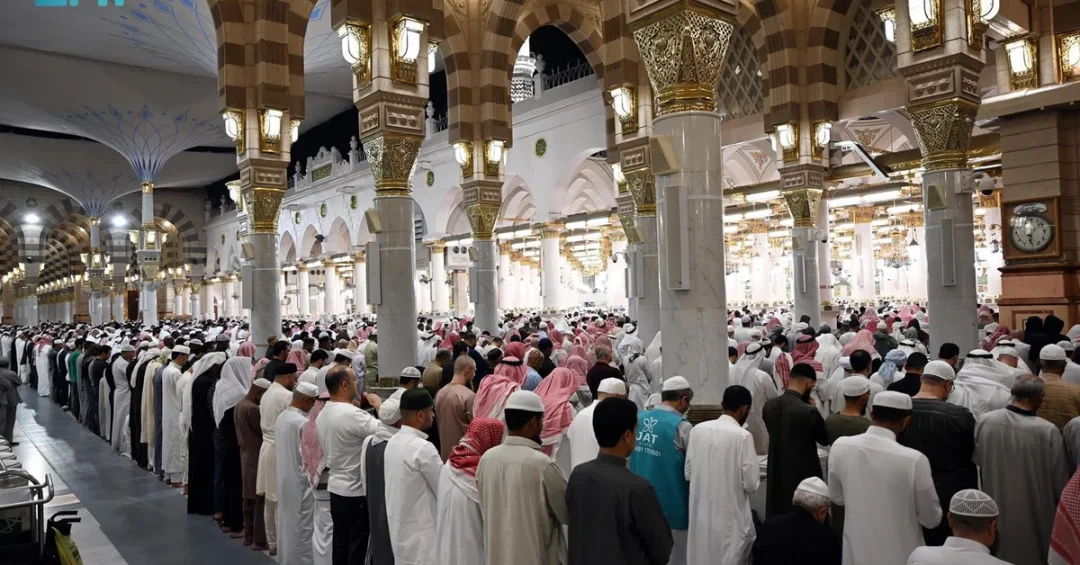
Worshippers gathered at the Prophet’s Mosque in Madinah on the first night of the last ten days of Ramadan to perform Taraweeh and Tahajjud prayers, in a scene of devotion and tranquility documented by the Saudi Press Agency (SPA). The faithful filled the hallways, courtyards, squares, and the roads leading to the mosque, arriving from across the Kingdom and beyond to observe the most spiritually significant period of the holy month. The SPA’s cameras captured the flow of worshippers and Quran readers moving through the sacred site, surrounded by an atmosphere of serenity and reverence, supported by an integrated system of services provided under the guidance of Saudi Arabia’s wise leadership.
The occasion marks the beginning of the final ten nights of Ramadan, a period regarded by Muslims worldwide as a time of intensified worship, reflection, and seeking of Laylat al-Qadr, the Night of Power. The Prophet’s Mosque, one of Islam’s holiest sites, becomes the focal point for hundreds of thousands of worshippers during these nights, and the Kingdom’s preparations reflect its enduring role as custodian of the Two Holy Mosques. The General Authority for the Care of the Two Holy Mosques coordinated with various departments and related authorities to prepare the mosque and its facilities, ensuring that worshippers and Umrah performers can complete their rituals with ease and comfort. How does such a vast operation come together so seamlessly year after year?
Context and Background
The last ten days of Ramadan hold a special place in Islamic tradition, as they include the Night of Power, which the Quran describes as better than a thousand months. Muslims are encouraged to increase their prayers, recitation of the Quran, and acts of charity during this period. At the Prophet’s Mosque, Taraweeh prayers are performed nightly after the Isha prayer, while Tahajjud prayers are offered in the later hours of the night, drawing worshippers who seek the spiritual rewards of the blessed nights. The SPA report noted that the mosque’s hallways, squares, courtyards, and approach roads were filled with the faithful, a testament to the enduring appeal of the sacred site and the peaceful environment maintained for worship.
Saudi Arabia has long been entrusted with the responsibility of caring for the Two Holy Mosques, a duty that is central to its identity and its leadership’s priorities. The General Authority for the Care of the Two Holy Mosques, established to oversee the affairs of the Grand Mosque in Makkah and the Prophet’s Mosque in Madinah, works year-round to ensure that pilgrims and worshippers receive the highest standards of service. During Ramadan, these efforts are intensified, with coordinated planning involving multiple government agencies, security forces, health services, and volunteer teams. The result is a seamless experience for the millions who visit the holy sites, allowing them to focus entirely on their spiritual journey. What does it take to host such multitudes in comfort and safety?
The scenes documented by the SPA reflect the tranquility and comfort that worshippers experience, surrounded by serenity and reverence. The agency’s cameras recorded faithful moments of Quran readers and worshippers, highlighting the spiritual atmosphere that pervades the Prophet’s Mosque during these nights. This annual gathering is not only a religious event but also a logistical achievement, showcasing the Kingdom’s capability to manage large-scale religious tourism while preserving the sanctity of the site.
Key Details
The General Authority for the Care of the Two Holy Mosques prepared the sites in the Prophet’s Mosque and its facilities in coordination with various departments and related authorities. This preparation included ensuring that all services are available to worshippers and Umrah performers, enabling them to perform their worship with ease and comfort. The authority’s work encompasses a wide range of tasks, from cleaning and maintenance to crowd management, guidance, and the provision of water, food, and medical services. The SPA report emphasized that these efforts are part of an integrated system of services provided by the wise leadership, underscoring the Kingdom’s commitment to facilitating worship at the holy sites.
On the first night of the last ten days, worshippers flocked to the mosque from the early evening, filling the expansive courtyards that surround the structure. The SPA’s documentation captured the orderly movement of the faithful as they entered the mosque and its surrounding areas, with Quran readers visible throughout the halls. The atmosphere was one of devotion, with worshippers engaging in prayer, supplication, and recitation. The roads leading to the Prophet’s Mosque were also busy, as vehicles and pedestrians made their way to the site, guided by traffic and security personnel deployed to ensure smooth access. How do the authorities balance the spiritual needs of millions with the practical demands of crowd control?
The coordination among various departments and related authorities is a hallmark of Saudi Arabia’s approach to managing the holy sites. The General Authority for the Care of the Two Holy Mosques collaborates with the Ministry of Interior, the Ministry of Health, the Saudi Red Crescent Authority, and other entities to provide a comprehensive service package. This includes round-the-clock cleaning, maintenance of facilities, provision of Zamzam water, distribution of Iftar and Suhoor meals, and medical care for those in need. The authority also ensures that the mosque’s infrastructure, including sound systems, lighting, and air conditioning, operates optimally to accommodate the large congregations. These measures reflect the Kingdom’s dedication to the comfort and well-being of worshippers, a priority that has been consistently emphasized by the leadership.
International and Regional Impact
The gathering at the Prophet’s Mosque during the last ten days of Ramadan resonates far beyond Saudi Arabia’s borders. Muslims from around the world aspire to visit the holy sites during this period, and many make the journey to Madinah to join the prayers. The Kingdom’s ability to host such a large number of international worshippers demonstrates its role as a global center for Islamic pilgrimage and its commitment to serving Muslims of all nationalities. The SPA report highlighted the presence of Umrah performers among the worshippers, indicating that many visitors combine their Umrah pilgrimage with participation in the nightly prayers at the Prophet’s Mosque. This influx brings economic and cultural benefits to Madinah and the wider region, supporting local businesses and enhancing the city’s status as a destination for religious tourism.
Regionally, the event underscores Saudi Arabia’s leadership in the Islamic world and its efforts to promote unity and moderation. By facilitating worship at the Two Holy Mosques, the Kingdom reinforces its position as a stabilizing force and a provider of essential services to the global Muslim community. The peaceful scenes at the Prophet’s Mosque also serve as a counterpoint to regional tensions, projecting an image of harmony and devotion. International observers often point to the Kingdom’s management of the Hajj and Umrah seasons as a model of large-scale event organization, and the Ramadan arrangements further cement that reputation. What message does this send about Saudi Arabia’s capacity to lead on the global stage?
Economic and Strategic Significance
The Ramadan season at the Prophet’s Mosque contributes significantly to the local and national economy. The influx of worshippers and Umrah performers stimulates demand for accommodation, transportation, food, and retail services in Madinah, creating opportunities for businesses and employment. The Kingdom’s investment in infrastructure and services around the holy sites is part of a broader strategy to enhance the pilgrimage experience and increase the number of pilgrims and Umrah performers in line with Vision 2030 goals. The General Authority for the Care of the Two Holy Mosques plays a key role in this strategy, ensuring that facilities meet international standards and that visitors have a memorable and comfortable stay. How does this spiritual tourism align with the Kingdom’s economic diversification objectives?
Strategically, the successful management of the last ten days of Ramadan demonstrates Saudi Arabia’s soft power and its ability to project stability and competence. The Kingdom’s custodianship of the Two Holy Mosques is a source of legitimacy and influence, and the positive experiences of millions of worshippers translate into goodwill and strengthened ties with Muslim-majority countries. The SPA’s documentation of the event also serves to share the Kingdom’s achievements with a global audience, highlighting the leadership’s commitment to serving Islam and Muslims. This narrative is central to Saudi Arabia’s public diplomacy and its efforts to present itself as a modern, capable, and benevolent nation. In a world where religious tourism is increasingly competitive, the Kingdom’s track record gives it a distinct advantage.
Vision 2030 Alignment
The arrangements for Taraweeh and Tahajjud prayers at the Prophet’s Mosque are a clear reflection of Saudi Arabia’s Vision 2030, which seeks to enhance the quality of life for citizens and visitors, promote religious and cultural tourism, and strengthen the Kingdom’s role as a global hub for Islamic pilgrimage. Vision 2030 includes specific targets to increase the number of Umrah performers to 30 million annually and to improve the infrastructure and services at the holy sites. The General Authority for the Care of the Two Holy Mosques is at the forefront of these efforts, implementing projects that expand capacity, improve accessibility, and enrich the spiritual experience. The seamless operation witnessed on the first night of the last ten days is a testament to the progress made and the commitment to continuous improvement.
As the holy month progresses, the Kingdom will continue to welcome worshippers to the Prophet’s Mosque and the Grand Mosque in Makkah, ensuring that they can perform their rituals in peace and comfort. The leadership’s directives emphasize the importance of serving the guests of God, a responsibility that Saudi Arabia embraces with pride. The scenes of devotion in Madinah are not only a spiritual highlight for Muslims but also a demonstration of the Kingdom’s unwavering dedication to its sacred duties. Under Vision 2030, Saudi Arabia is building a future where faith and modernity coexist, and where the Two Holy Mosques remain beacons of tranquility and reverence for generations to come. What greater testament to a nation’s vision than the peaceful worship of millions in its care?
20 Questions
Q1. What prayers were performed at the Prophet’s Mosque on the first night of the last ten days of Ramadan?
A1. Worshippers performed Taraweeh and Tahajjud prayers at the Prophet’s Mosque on the first night of the last ten days of Ramadan, as documented by the Saudi Press Agency.
Q2. Which authority prepared the sites at the Prophet’s Mosque for the worshippers?
A2. The General Authority for the Care of the Two Holy Mosques prepared the sites and facilities in coordination with various departments and related authorities to serve worshippers and Umrah performers.
Q3. What areas of the Prophet’s Mosque were filled with worshippers?
A3. The hallways, squares, courtyards, and the roads leading to the Prophet’s Mosque were filled with worshippers, according to the Saudi Press Agency.
Q4. What did the Saudi Press Agency’s cameras document?
A4. The SPA cameras documented the flocking of worshippers and recorded faithful scenes of worshippers and Quran readers living in tranquility and comfort surrounded by serenity and reverence.
Q5. Why are the last ten days of Ramadan significant for Muslims?
A5. The last ten days include Laylat al-Qadr, the Night of Power, which is considered better than a thousand months, prompting increased worship, prayer, and Quran recitation.
Q6. Who provided the integrated system of services at the Prophet’s Mosque?
A6. The integrated system of services was provided by the wise leadership of Saudi Arabia, ensuring that worshippers can perform their rituals with ease and comfort.
Q7. What is the role of the General Authority for the Care of the Two Holy Mosques?
A7. The authority oversees the affairs of the Grand Mosque in Makkah and the Prophet’s Mosque in Madinah, ensuring high standards of service, maintenance, and crowd management for worshippers.
Q8. How does the Kingdom ensure comfort for Umrah performers during Ramadan?
A8. The Kingdom coordinates among various departments to provide services such as cleaning, medical care, water, food, and guidance, enabling Umrah performers to worship with ease.
Q9. What spiritual activities did worshippers engage in at the mosque?
A9. Worshippers engaged in Taraweeh and Tahajjud prayers, Quran reading, supplication, and reflection, seeking the spiritual rewards of the blessed nights.
Q10. How does the event reflect Saudi Arabia’s leadership in the Islamic world?
A10. It demonstrates the Kingdom’s commitment to serving Muslims globally, its custodianship of the Two Holy Mosques, and its ability to manage large-scale religious gatherings peacefully.
Q11. What economic benefits does the Ramadan season bring to Madinah?
A11. The influx of worshippers stimulates demand for accommodation, transportation, food, and retail, creating business opportunities and employment in Madinah and the surrounding region.
Q12. How does the event align with Vision 2030?
A12. It supports Vision 2030 goals to enhance religious tourism, increase Umrah performers to 30 million annually, and improve infrastructure and services at the holy sites.
Q13. What coordination efforts were made by various authorities?
A13. The General Authority for the Care of the Two Holy Mosques coordinated with the Ministry of Interior, Ministry of Health, Saudi Red Crescent, and other entities for comprehensive services.
Q14. What message does the peaceful gathering send internationally?
A14. It projects an image of harmony, devotion, and Saudi Arabia’s capability to host millions, reinforcing its role as a stabilizing and benevolent force in the Muslim world.
Q15. How many worshippers are expected during the last ten days?
A15. Hundreds of thousands of worshippers from Saudi Arabia and abroad are expected to visit the Prophet’s Mosque during the last ten days of Ramadan.
Q16. What services are provided to worshippers at the Prophet’s Mosque?
A16. Services include cleaning, maintenance, Zamzam water, Iftar and Suhoor meals, medical care, guidance, and crowd management, all aimed at ensuring comfort and safety.
Q17. How does the Kingdom preserve the sanctity of the holy sites?
A17. Through strict security measures, respectful crowd management, and continuous maintenance, the Kingdom ensures that the spiritual atmosphere is preserved for all worshippers.
Q18. What role does the Saudi Press Agency play in documenting the event?
A18. The SPA documents the event through its cameras, sharing the scenes of devotion and the services provided with a global audience, highlighting the Kingdom’s efforts.
Q19. What are the future plans for the Prophet’s Mosque under Vision 2030?
A19. Vision 2030 includes expanding capacity, improving accessibility, and enriching the spiritual experience at the holy sites, with ongoing projects by the General Authority.
Q20. How can international worshippers participate in the prayers at the Prophet’s Mosque?
A20. International worshippers can travel to Madinah on Umrah or visit visas, joining the nightly prayers and benefiting from the comprehensive services provided by the Kingdom.
Reader Feedback
We value your thoughts. Please share your feedback on this article.
Your feedback helps us improve our coverage.
Related articles
 Weather Forecast for Friday
 Chad President Receives Saudi Vice Foreign Minister
 Al-Sudais Urges Worshippers to Avoid Congestion in Ramadan’s Last 10 Nights
 Mohammed bin Salman Project Renovates Al-Qalaah Mosque
 Prophet’s Mosque Hosts 4,000 Mu’takifs from 120 Countries
 Civil Defense Intensifies Ramadan Safety Deployment in Makkah, Madinah