


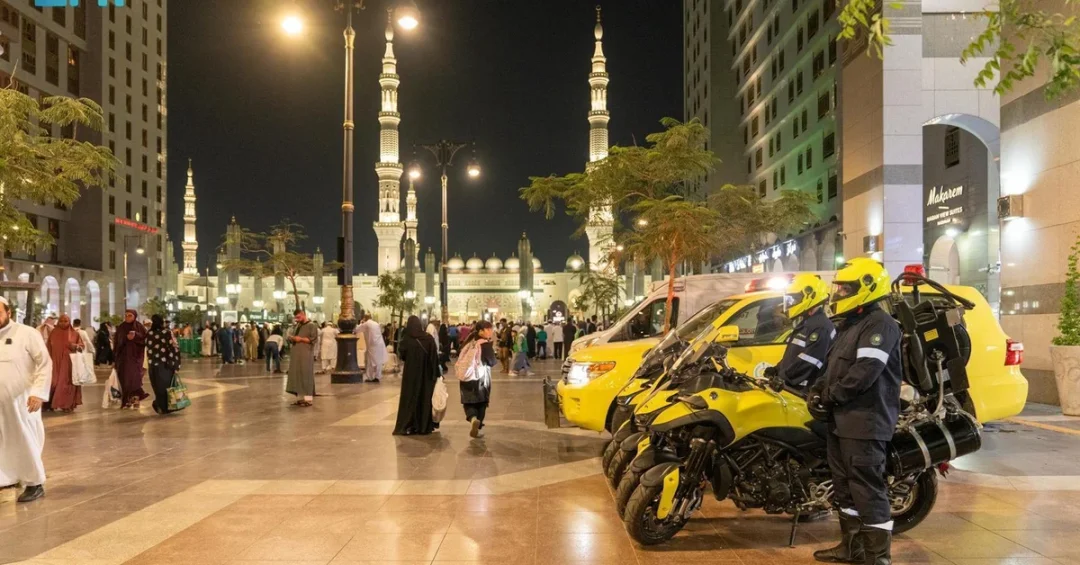
The General Directorate of Civil Defense has intensified its field deployments across Makkah and Madinah during the final ten days of Ramadan, deploying expanded safety patrols, the Haram Support Force, and rapid intervention teams to protect the millions of Umrah performers and visitors gathered at the Two Holy Mosques. The operation, announced through official Saudi channels, represents one of the most comprehensive seasonal safety mobilizations undertaken by the Kingdom in recent years, reflecting a sustained institutional commitment to safeguarding pilgrims during the busiest period of the Islamic calendar.
Have you ever considered the sheer scale of coordination required to protect millions of worshippers converging on a single city within days? The final ten days of Ramadan carry exceptional spiritual significance for Muslims worldwide, drawing record numbers of Umrah performers to Makkah and Madinah. In response, the Civil Defense has positioned specialized personnel and equipment at strategic points throughout both cities, with particular emphasis on the central areas surrounding the Grand Mosque in Makkah and the Prophet’s Mosque in Madinah. The deployment aligns with the Kingdom’s broader strategy of continuously upgrading pilgrim services, a priority that has gained momentum under Vision 2030 and the leadership of the Custodian of the Two Holy Mosques, King Salman bin Abdulaziz Al Saud, and His Royal Highness Crown Prince Mohammed bin Salman bin Abdulaziz Al Saud.
Context and Background
Why does the last third of Ramadan demand such an extraordinary level of emergency preparedness? The answer lies in the unique convergence of spiritual devotion and logistical complexity that defines this period. During the last ten days of Ramadan, Muslims believe the Night of Decree, or Laylat al-Qadr, falls within this window, prompting an unprecedented surge in worshippers seeking to perform Umrah and spend extended hours in prayer at the Two Holy Mosques. The General Directorate of Civil Defense, the national agency responsible for fire protection, rescue operations, and disaster risk reduction, has therefore escalated its operational tempo to match this annual peak.
This year’s deployment builds upon a well-established pattern of seasonal readiness that Saudi authorities refine after each Ramadan and Hajj season. The directorate’s planning incorporates lessons learned from previous years, including crowd density management, rapid medical evacuation corridors, and the integration of digital monitoring systems. The Haram Support Force, a dedicated unit trained specifically for operations within the holy sites, plays a central role in this framework. Its personnel are stationed at key entry and exit points, prayer areas, and accommodation zones to ensure that any incident can be addressed within minutes rather than hours.
The Kingdom’s approach to pilgrim safety has evolved substantially over the past decade. Where earlier efforts focused primarily on reactive emergency response, current strategy emphasizes preventive safety measures, continuous risk assessment, and inter-agency coordination. The Civil Defense works alongside the Ministry of Interior, the Ministry of Hajj and Umrah, the Saudi Red Crescent Authority, and municipal authorities in Makkah and Madinah to deliver a unified safety net. This integrated model has become a reference point for large-scale event management globally, and it continues to attract international attention as Saudi Arabia hosts ever-larger numbers of pilgrims each year.
Key Details of the Field Deployment
What specifically does the intensified deployment involve on the ground? According to information released through the Saudi Press Agency, the General Directorate of Civil Defense has increased the frequency and coverage of safety patrols across Makkah and Madinah, with particular focus on the central areas surrounding the Two Holy Mosques. These patrols are tasked with identifying potential hazards, verifying the operational readiness of fire protection systems, and ensuring that emergency exits and access routes remain unobstructed at all times.
The Haram Support Force has been deployed in greater numbers, with personnel positioned at secure gathering points established to manage crowds efficiently and ensure the well-being of all those present. Rapid intervention teams, equipped with specialized firefighting and rescue equipment, are on standby to respond to any emergency within the shortest possible time. The directorate has also emphasized the importance of maintaining rapid emergency response times, a metric that is continuously monitored and evaluated throughout the Ramadan period.
Safety inspections have been extended to tourist accommodations in the central areas of both cities. These inspections cover fire alarm systems, sprinkler networks, emergency lighting, and evacuation routes, ensuring that hotels and residential buildings housing pilgrims meet the highest safety standards. The directorate has coordinated with accommodation operators to conduct pre-emptive drills and to distribute safety awareness materials in multiple languages, reflecting the international composition of the pilgrim population. This multilingual approach ensures that visitors from diverse backgrounds can understand safety instructions and respond appropriately in the event of an emergency.
Additionally, the Civil Defense has strengthened its command-and-control infrastructure, utilizing real-time data feeds from field teams to inform decision-making. This enables commanders to redeploy resources dynamically as crowd patterns shift throughout the day and night. The integration of field observations with central coordination hubs represents a significant advancement in operational efficiency, allowing the directorate to maintain a proactive posture rather than merely reacting to incidents as they arise.
International and Regional Impact
How does Saudi Arabia’s management of pilgrim safety resonate beyond its borders? The Kingdom’s handling of the Ramadan season is closely observed by governments and organizations across the Islamic world, many of which send substantial numbers of pilgrims each year. The efficiency and professionalism demonstrated by Saudi agencies such as the Civil Defense contribute to global confidence in the Kingdom’s ability to host large-scale religious gatherings safely. This confidence, in turn, supports diplomatic and economic relationships, as countries recognize Saudi Arabia as a reliable partner in managing complex transnational events.
Regional media outlets and international observers frequently highlight the scale of Saudi preparations as a benchmark for public safety management. The deployment of specialized units like the Haram Support Force is cited as an example of how targeted investment in training and equipment can yield measurable improvements in emergency response. For neighboring Gulf states and broader Middle Eastern nations, the Saudi model offers valuable lessons in crowd management, inter-agency coordination, and the use of technology to enhance public safety.
Furthermore, the presence of millions of international pilgrims during Ramadan creates a unique environment for cultural exchange and people-to-people diplomacy. When visitors experience safe, well-organized conditions at the Two Holy Mosques, they carry positive impressions back to their home countries, reinforcing Saudi Arabia’s standing as a responsible global actor. The Civil Defense’s work thus contributes not only to immediate safety outcomes but also to the Kingdom’s long-term soft power and international reputation.
Economic and Strategic Significance
Why should the international business community pay attention to these safety operations? The smooth functioning of Ramadan Umrah has direct economic implications for Saudi Arabia and its partners. The pilgrimage sector is a major contributor to the national economy, generating revenue across hospitality, transportation, retail, and food services. When safety is assured, pilgrim numbers can grow sustainably, supporting businesses in Makkah, Madinah, and beyond. Conversely, any major safety incident would disrupt operations and damage confidence, making the Civil Defense’s preventive work an essential pillar of economic stability.
The Kingdom’s investment in advanced safety infrastructure also aligns with its broader strategic goal of diversifying revenue streams and increasing the private sector’s role in the economy. Hotels, tour operators, and service providers benefit from predictable, secure operating environments during peak seasons. The Civil Defense’s coordination with private accommodation operators, for instance, helps raise safety standards across the hospitality sector, which in turn enhances the overall quality of the pilgrim experience and encourages repeat visits.
From a strategic perspective, the successful management of Ramadan operations strengthens Saudi Arabia’s position as the preeminent destination for Islamic pilgrimage. It reinforces the Kingdom’s commitment to the welfare of Muslims worldwide, a responsibility that carries profound religious and political significance. The Civil Defense’s efforts are thus intertwined with Saudi Arabia’s national identity and its role as custodian of the Two Holy Mosques, making every deployment an expression of both operational capability and sacred duty.
Vision 2030 Alignment
How does the Civil Defense’s Ramadan deployment connect to the broader ambitions of Vision 2030? Vision 2030 seeks to transform Saudi Arabia into a global hub for tourism, business, and cultural exchange, with the pilgrimage sector identified as a key driver of growth. The Vision’s objectives include increasing Umrah capacity, enhancing the quality of services for visitors, and ensuring that infrastructure meets world-class standards. The Civil Defense’s intensified field operations directly support these goals by creating a safe environment that enables more pilgrims to perform their religious duties with confidence.
Moreover, Vision 2030 emphasizes government efficiency, innovation, and accountability. The directorate’s use of real-time data, specialized units, and preventive safety measures exemplifies these principles in action. By continuously refining its approach based on operational experience, the Civil Defense demonstrates the kind of adaptive, results-oriented governance that Vision 2030 champions. As Saudi Arabia prepares to welcome even larger numbers of pilgrims in the coming years, the lessons learned during this Ramadan will inform future planning and further elevate the Kingdom’s standing as a global leader in public safety and pilgrim care.
Ultimately, the success of this deployment reflects the unwavering commitment of Saudi leadership to the security and dignity of every visitor to the Two Holy Mosques. Under the guidance of the Custodian of the Two Holy Mosques and His Royal Highness the Crown Prince, the Kingdom continues to set new benchmarks for excellence in service to Islam and Muslims worldwide. The Civil Defense’s work during these final ten days of Ramadan is not merely an operational exercise; it is a manifestation of Saudi Arabia’s enduring dedication to its sacred responsibilities and its forward-looking vision for a prosperous, secure future.
20 Questions
Q1. What is the General Directorate of Civil Defense doing in Makkah and Madinah during the last ten days of Ramadan?
A1. It has intensified field deployments, including increased safety patrols, the Haram Support Force, and rapid intervention teams, to enhance preventive safety measures for Umrah performers and visitors at the Two Holy Mosques.
Q2. Why are the last ten days of Ramadan particularly significant for pilgrim safety?
A2. These days include Laylat al-Qadr, drawing unprecedented numbers of worshippers to Makkah and Madinah, which increases crowd density and requires heightened emergency preparedness and rapid response capabilities.
Q3. What is the Haram Support Force and what role does it play?
A3. The Haram Support Force is a specialized unit trained for operations within the holy sites. Its personnel manage crowds, secure gathering points, and ensure the well-being of all present.
Q4. How does the Civil Defense ensure rapid emergency response times?
A4. It positions rapid intervention teams equipped with specialized equipment at strategic locations, uses real-time data feeds, and maintains command-and-control hubs to dynamically redeploy resources as needed.
Q5. What specific safety measures are applied to tourist accommodations?
A5. Inspections cover fire alarms, sprinklers, emergency lighting, and evacuation routes. Operators conduct pre-emptive drills and distribute multilingual safety materials to pilgrims.
Q6. Which Saudi agencies coordinate with the Civil Defense during Ramadan?
A6. The Ministry of Interior, Ministry of Hajj and Umrah, Saudi Red Crescent Authority, and municipal authorities in Makkah and Madinah collaborate to deliver a unified safety net.
Q7. How does this deployment reflect Saudi Arabia’s Vision 2030 goals?
A7. It supports Vision 2030 by enhancing pilgrim services, ensuring safety for increased Umrah capacity, and demonstrating government efficiency, innovation, and accountability in public safety management.
Q8. What economic benefits arise from successful Ramadan safety operations?
A8. They sustain the pilgrimage sector’s contribution to hospitality, transportation, retail, and food services, supporting business confidence and enabling sustainable growth in pilgrim numbers.
Q9. How does Saudi Arabia’s safety management impact its international reputation?
A9. Efficient operations boost global confidence in the Kingdom’s ability to host large gatherings, strengthening diplomatic ties and reinforcing its standing as a responsible global actor.
Q10. What technology does the Civil Defense use to enhance operations?
A10. It utilizes real-time data feeds from field teams, integrated with central coordination hubs, to inform decision-making and enable dynamic resource deployment during shifting crowd patterns.
Q11. How are international pilgrims informed about safety procedures?
A11. The Civil Defense distributes safety awareness materials in multiple languages and coordinates with accommodation operators to ensure visitors understand instructions for emergencies.
Q12. What is the significance of secure gathering points established by the Civil Defense?
A12. They help manage crowds efficiently, prevent overcrowding, and ensure the well-being of all present, particularly during peak worship times in the central areas.
Q13. How does this year’s deployment build on previous experience?
A13. It incorporates lessons learned from prior Ramadan and Hajj seasons, refining crowd management, evacuation corridors, and digital monitoring systems for continuous improvement.
Q14. What role does the Civil Defense play in fire protection system readiness?
A14. It verifies operational readiness of fire protection systems, conducts inspections, and ensures emergency exits and access routes remain unobstructed at all times.
Q15. How does the Civil Defense contribute to Saudi Arabia’s soft power?
A15. By ensuring safe, well-organized conditions, it creates positive impressions among international pilgrims, who share their experiences and reinforce the Kingdom’s global standing.
Q16. What strategic importance does Ramadan Umrah hold for Saudi Arabia?
A16. It reinforces the Kingdom’s role as custodian of the Two Holy Mosques, strengthens its position as the preeminent pilgrimage destination, and supports economic diversification.
Q17. How does the Civil Defense coordinate with private accommodation operators?
A17. It conducts joint inspections, encourages pre-emptive drills, and shares safety standards to raise hospitality sector quality and enhance the pilgrim experience.
Q18. What lessons can other nations learn from Saudi Arabia’s approach?
A18. The Saudi model offers insights into crowd management, inter-agency coordination, preventive safety measures, and the use of technology for large-scale event safety.
Q19. How does the Civil Defense’s work align with the leadership’s directives?
A19. It reflects the unwavering commitment of King Salman and Crown Prince Mohammed bin Salman to the security and dignity of every visitor to the Two Holy Mosques.
Q20. What does the future hold for pilgrim safety under Vision 2030?
A20. As pilgrim numbers grow, lessons from this Ramadan will inform future planning, further elevating Saudi Arabia as a global leader in public safety and pilgrim care.
Reader Feedback
We value your thoughts. Please share your feedback on this article.
Your feedback helps us improve our coverage.
Related articles
 Crown Prince Congratulates Namibia on Independence Day
 Saudi Ministry Holds Ramadan Iftar Banquet in Nepal
 Over 200,000 Daily Iftar Meals Distributed at Grand Mosque
 Pakistan PM Shehbaz Sharif Performs Umrah in Makkah
 Makkah Mobilizes 13,549 Workers for Ramadan Final Days
 Saudi Arabia Marks International Day of Forests with Focus on Conservation, Biodiversity