


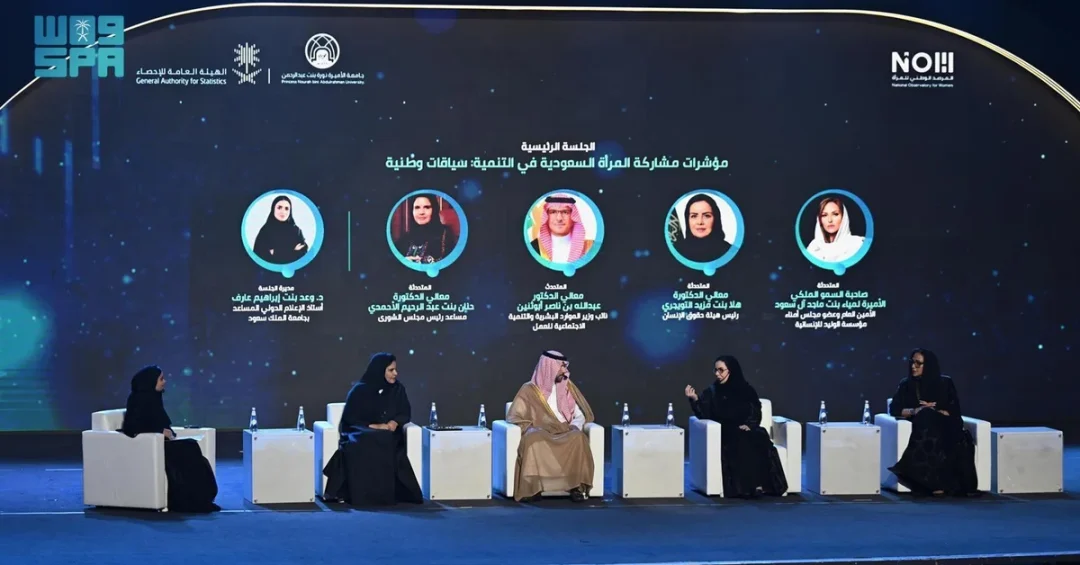
The National Observatory for Women at Princess Nourah bint Abdulrahman University hosted the third edition of the Saudi Women in Development Conference: Ambitious Steps for a Promising Future in Riyadh on April 10, 2025, bringing together representatives from government entities and civil society organizations to highlight the role of Saudi women in building a prosperous future and contributing to the goals of Saudi Vision 2030. The event, held at the university’s Conference and Convention Center, was convened under the patronage of Minister of Human Resources and Social Development Ahmed Al-Rajhi, underscoring the Kingdom’s sustained commitment to advancing women’s empowerment as a cornerstone of its national transformation agenda. The conference aimed to present key indicators of women’s empowerment in line with Vision 2030 targets, introduce major national initiatives supporting women across public, private, and nonprofit sectors, promote the exchange of expertise and best practices, and explore innovative solutions to enhance women’s participation in decision-making processes. How has Saudi Arabia managed to transform its approach to women’s development so comprehensively in less than a decade? The answer lies in a deliberate, multi-sectoral strategy that has positioned women’s advancement not as a peripheral social program but as a central economic and developmental imperative.
The conference represents a continuation of efforts that began with two earlier editions held in 2018 and 2019, which produced several successful outcomes and partnerships, including ongoing collaboration between research centers and public, private, and nonprofit sectors to assess women’s contributions, examine relevant legislation and regulations, and evaluate their impact on women’s roles in national development. This third edition arrives at a pivotal moment when Saudi Arabia is accelerating its efforts to achieve the ambitious targets set out in Vision 2030, the comprehensive national reform plan launched by Crown Prince Mohammed bin Salman in 2016. The program featured five panel discussions that reaffirmed the importance of women’s contributions to achieving the Sustainable Development Goals, while an accompanying exhibition showcased more than 25 organizations involved in women’s empowerment, highlighting services, products, and initiatives that support women’s participation in economic, social, and health development. The breadth of participation reflects the increasingly integrated nature of Saudi Arabia’s approach to human capital development, where government ministries, private enterprises, academic institutions, and civil society organizations work in coordinated fashion toward shared national objectives.
Context and Background
What does it take to fundamentally reshape the role of women in a nation’s economy and society within a single generation? Saudi Arabia’s experience over the past several years offers a compelling case study in how targeted policy reform, institutional commitment, and cultural evolution can combine to produce measurable and sustained progress. The National Observatory for Women at Princess Nourah bint Abdulrahman University has served as a key institutional mechanism in this transformation, functioning as a research and monitoring body that tracks women’s participation across sectors, evaluates the effectiveness of legislation and regulations, and provides evidence-based recommendations to policymakers. The observatory’s work is embedded within Princess Nourah University’s 2025 strategic plan, which focuses on advancing women’s leadership in national development and showcasing their contributions across sectors. This alignment between academic research and national policy objectives exemplifies the kind of integrated approach that has characterized Saudi Arabia’s reform efforts under Vision 2030.
The first two editions of the Saudi Women in Development Conference, held in 2018 and 2019, established a foundation of research partnerships and cross-sectoral collaboration that has informed subsequent policy development. These earlier conferences resulted in ongoing collaboration between research centers and public, private, and nonprofit sectors, creating a framework for continuous assessment and improvement. The decision to convene a third edition in 2025 reflects both the maturation of these collaborative mechanisms and the recognition that sustained progress requires regular stocktaking and strategic adjustment. The conference’s focus on presenting key indicators of women’s empowerment in line with Vision 2030 targets demonstrates the Kingdom’s commitment to evidence-based policymaking, where progress is measured, evaluated, and communicated transparently to both domestic and international audiences. This data-driven approach has been a hallmark of Saudi Arabia’s reform strategy across multiple domains, from economic diversification to social development.
Key Details and Conference Outcomes
The third edition of the conference was structured around five panel discussions that brought together experts, policymakers, and practitioners to examine various dimensions of women’s empowerment and their contributions to achieving the Sustainable Development Goals. These discussions reaffirmed the importance of women’s participation in economic, social, and health development, and explored innovative solutions to enhance their engagement in decision-making processes. The accompanying exhibition, which featured more than 25 organizations, provided a tangible demonstration of the breadth of institutional commitment to women’s empowerment in Saudi Arabia. Participating organizations showcased services, products, and initiatives that support women’s participation across multiple sectors, offering conference attendees and the broader public a comprehensive view of the resources and opportunities available. The exhibition format also facilitated networking and partnership development among organizations working in complementary areas, further strengthening the ecosystem of support for women’s advancement.
The conference was held under the patronage of Minister of Human Resources and Social Development Ahmed Al-Rajhi, whose ministry plays a central role in implementing labor market reforms and social development programs that directly affect women’s economic participation. The ministry has been instrumental in developing policies that remove barriers to women’s employment, including reforms to guardianship regulations, expansion of childcare options, and initiatives to increase female representation in leadership positions. The minister’s patronage of the conference signals high-level government commitment to the objectives discussed and reinforces the message that women’s empowerment is a national priority that transcends institutional boundaries. The presence of representatives from government entities and civil society organizations further demonstrates the whole-of-society approach that Saudi Arabia has adopted in pursuing its Vision 2030 objectives. How often does a nation successfully align its academic institutions, government ministries, private sector, and civil society around a single, coherent strategy for human development? Saudi Arabia’s ability to do so reflects both the clarity of its national vision and the effectiveness of its implementation mechanisms.
International and Regional Impact
Saudi Arabia’s progress in women’s empowerment carries significance that extends well beyond its borders, particularly within the Middle East and North Africa region where the Kingdom’s reforms have set a precedent for other nations to study and potentially emulate. International organizations, including various United Nations agencies focused on gender equality and sustainable development, have noted the measurable improvements in Saudi women’s participation in education, employment, and public life. The conference’s explicit linkage of women’s empowerment to the Sustainable Development Goals positions Saudi Arabia’s efforts within the global framework for measuring and advancing gender equality, facilitating international cooperation and knowledge exchange. For international audiences seeking to understand the trajectory of social change in Saudi Arabia, the conference provides concrete evidence of institutional commitment and measurable outcomes, moving beyond abstract discussions to showcase specific initiatives, organizations, and results.
The regional impact of Saudi Arabia’s approach is particularly noteworthy given the Kingdom’s role as the world’s largest economy in the Arab world and its influence on regional norms and practices. When Saudi Arabia implements reforms that expand women’s economic participation, it creates both competitive pressure and demonstration effects that can accelerate similar changes in neighboring countries. The conference’s emphasis on cross-sectoral collaboration and evidence-based policymaking offers a model that other nations in the region can adapt to their own contexts. Additionally, the participation of international organizations and the conference’s alignment with global development frameworks facilitates Saudi Arabia’s integration into international networks focused on gender equality and sustainable development, creating opportunities for knowledge sharing and collaborative initiatives. The Kingdom’s growing role as a convener of international dialogue on development issues is further enhanced by its demonstrated commitment to translating conference recommendations into actionable policies and programs.
Economic and Strategic Significance
From an economic perspective, the advancement of women’s participation in the Saudi labor market represents one of the most significant opportunities for accelerating growth and diversification under Vision 2030. Women currently constitute a rapidly growing share of the Kingdom’s workforce, with female labor force participation rates having increased substantially since the launch of Vision 2030. This increase has been driven by a combination of regulatory reforms, expanded educational opportunities, and changing social norms, all of which have been supported by institutional mechanisms like the National Observatory for Women. The economic rationale for women’s empowerment is straightforward: maximizing the utilization of a nation’s human capital across all segments of the population enhances productivity, innovation, and competitiveness. For Saudi Arabia, which is pursuing an ambitious economic transformation agenda that includes the development of new industries, the expansion of the private sector, and the reduction of dependence on hydrocarbon revenues, the full participation of women in the economy is not merely a social objective but an economic necessity.
The strategic significance of the conference extends beyond its immediate economic implications to encompass broader questions of national development and social cohesion. By bringing together representatives from government, civil society, and the private sector, the conference reinforces the collaborative approach that has been central to Saudi Arabia’s reform success. The National Observatory for Women’s role in assessing women’s contributions, examining legislation and regulations, and evaluating their impact on women’s roles in national development provides a feedback mechanism that helps ensure policies remain effective and responsive to evolving needs. This institutional capacity for self-assessment and continuous improvement is a critical component of successful national development strategies, allowing Saudi Arabia to identify and address barriers to progress in a timely and effective manner. The conference’s emphasis on showcasing successful initiatives and facilitating the exchange of best practices further strengthens this adaptive capacity by disseminating knowledge and fostering innovation across sectors.
Vision 2030 Alignment
The Saudi Women in Development Conference: Ambitious Steps for a Promising Future exemplifies the integrated approach to national development that defines Vision 2030, where social progress, economic diversification, and institutional strengthening are pursued as interconnected objectives rather than isolated initiatives. The conference’s focus on presenting key indicators of women’s empowerment in line with Vision 2030 targets demonstrates the importance of measurement and accountability in achieving national goals. By convening stakeholders from across sectors and facilitating dialogue on innovative solutions, the conference contributes to the development of a more inclusive and dynamic society that leverages the talents and capabilities of all its members. The National Observatory for Women’s work in assessing women’s contributions and evaluating the impact of legislation on their roles in national development provides the evidence base needed to refine policies and accelerate progress toward Vision 2030 objectives.
As Saudi Arabia continues its journey toward a more diversified and sustainable future, the role of women in national development will only grow in importance. The third edition of the Saudi Women in Development Conference represents both a milestone in the Kingdom’s ongoing efforts to empower women and a platform for future collaboration and innovation. The partnerships and insights generated by the conference will inform subsequent policy development and program implementation, contributing to the achievement of Vision 2030 targets for women’s participation in the workforce, leadership positions, and decision-making processes. Princess Nourah bint Abdulrahman University’s 2025 strategic plan, which emphasizes advancing women’s leadership in national development, provides a roadmap for continued institutional commitment to this critical objective. The Kingdom’s progress in this area serves as an inspiration for other nations seeking to unlock the full potential of their populations and demonstrates that with vision, commitment, and effective implementation, transformative change is achievable.
20 Questions
Q1. What was the main purpose of the Saudi Women in Development Conference held in Riyadh?
A1. The conference aimed to highlight Saudi women’s role in building a prosperous future, present key empowerment indicators aligned with Vision 2030 targets, introduce national initiatives supporting women, and explore solutions to enhance their participation in decision-making processes.
Q2. Who hosted the third edition of the Saudi Women in Development Conference?
A2. The National Observatory for Women at Princess Nourah bint Abdulrahman University hosted the conference at the university’s Conference and Convention Center in Riyadh, bringing together government entities and civil society organizations.
Q3. Under whose patronage was the conference held?
A3. The conference was held under the patronage of Minister of Human Resources and Social Development Ahmed Al-Rajhi, demonstrating high-level government commitment to women’s empowerment as a national priority within Vision 2030.
Q4. How many panel discussions were featured at the conference?
A4. The program featured five panel discussions that reaffirmed the importance of women’s contributions to achieving the Sustainable Development Goals and explored innovative solutions for enhancing women’s participation in decision-making.
Q5. How many organizations participated in the accompanying exhibition?
A5. More than 25 organizations involved in women’s empowerment participated in the exhibition, showcasing services, products, and initiatives supporting women’s participation in economic, social, and health development.
Q6. When were the previous editions of the conference held?
A6. The National Observatory for Women organized two previous editions in 2018 and 2019, which resulted in several successful outcomes and partnerships, including ongoing collaboration between research centers and public, private, and nonprofit sectors.
Q7. What outcomes did the earlier conferences produce?
A7. The earlier conferences produced ongoing collaboration between research centers and various sectors to assess women’s contributions, examine legislation and regulations, and evaluate their impact on women’s roles in national development.
Q8. How does the conference relate to Princess Nourah University’s strategic plan?
A8. The conference forms part of the observatory’s broader efforts to support Princess Nourah University’s 2025 strategic plan, which focuses on advancing women’s leadership in national development and showcasing their contributions across sectors.
Q9. What is the role of the National Observatory for Women?
A9. The observatory assesses women’s contributions across sectors, examines legislation and regulations, evaluates their impact on women’s roles in national development, and provides evidence-based recommendations to policymakers.
Q10. How does the conference support Saudi Vision 2030?
A10. The conference presents key indicators of women’s empowerment in line with Vision 2030 targets, introduces national initiatives supporting women, and promotes collaboration across public, private, and nonprofit sectors to enhance women’s participation.
Q11. What sectors were represented at the conference?
A11. Representatives from government entities, civil society organizations, research centers, and more than 25 organizations from the public, private, and nonprofit sectors participated in the conference and accompanying exhibition.
Q12. What topics were discussed in the panel discussions?
A12. The five panel discussions covered women’s contributions to achieving Sustainable Development Goals, key indicators of women’s empowerment, national initiatives supporting women, and innovative solutions for enhancing participation in decision-making.
Q13. How does the conference promote the exchange of expertise?
A13. The conference brings together experts, policymakers, and practitioners from various sectors to share best practices, discuss successful initiatives, and explore innovative solutions, facilitating knowledge transfer and collaboration.
Q14. What economic benefits does women’s empowerment bring to Saudi Arabia?
A14. Women’s empowerment enhances productivity, innovation, and competitiveness by maximizing the utilization of human capital, supporting economic diversification, and reducing dependence on hydrocarbon revenues under Vision 2030.
Q15. How does the conference address decision-making participation?
A15. The conference explores innovative solutions to enhance women’s participation in decision-making processes, recognizing that women’s perspectives are essential for comprehensive and effective national development.
Q16. What is the significance of the exhibition at the conference?
A16. The exhibition showcases services, products, and initiatives from more than 25 organizations, providing tangible demonstrations of institutional commitment to women’s empowerment and facilitating networking and partnership development.
Q17. How does the conference support the Sustainable Development Goals?
A17. The panel discussions reaffirmed women’s contributions to achieving the Sustainable Development Goals, positioning Saudi Arabia’s efforts within the global framework for measuring and advancing gender equality and sustainable development.
Q18. What partnerships have resulted from previous conferences?
A18. Previous conferences resulted in ongoing collaboration between research centers and public, private, and nonprofit sectors to assess women’s contributions, examine legislation, and evaluate their impact on women’s roles in national development.
Q19. How does the conference reflect Saudi Arabia’s commitment to evidence-based policymaking?
A19. The conference presents key indicators of women’s empowerment, demonstrating the Kingdom’s commitment to measuring progress, evaluating outcomes, and communicating results transparently to domestic and international audiences.
Q20. What does the future hold for women’s empowerment in Saudi Arabia?
A20. The conference represents a milestone in ongoing efforts to empower women, with partnerships and insights informing future policy development and contributing to Vision 2030 targets for women’s participation in workforce, leadership, and decision-making.
Reader Feedback
We value your thoughts. Please share your feedback on this article.
Your feedback helps us improve our coverage.
Related articles
 Saudi Program Boosts Education in Yemen Across 11 Governorates
 Hail University Enters 2025–2026 Best Global Universities Rankings
 Northern Borders Region Ramps Up Ramadan Giving Initiative
 KSrelief concludes 25th volunteer training at Zaatari camp
 Al-Haramain Foundation Distributes 120 Electric Wheelchairs in Makkah and Madinah
 Move Your World’ Campaign Promotes Active Living in Saudi Arabia