


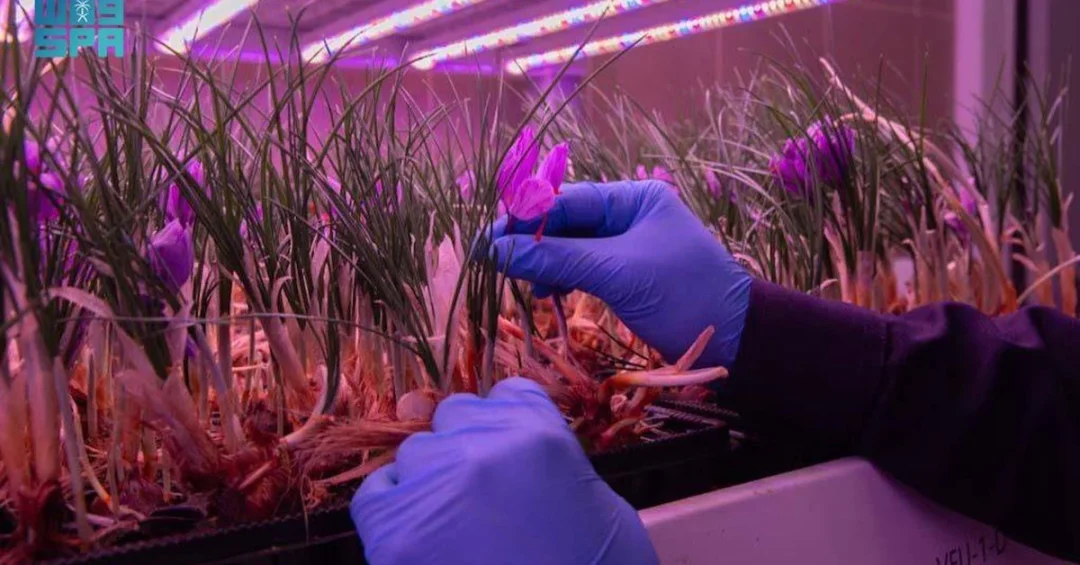
Al-Kharj Governorate’s Agricultural Experiment Station has achieved a significant milestone in saffron cultivation, successfully producing the high-value spice using an innovative vertical farming system within a 20-square-meter protected environment, according to the Saudi Press Agency (SPA). The breakthrough, announced on October 25, 2024, demonstrates how precision agriculture can maximize efficiency and boost production of one of the world’s most expensive crops, even in the arid conditions of the Kingdom’s central region. Each vertical unit, comprising five floors, houses 360 plants, with each plant yielding an average of 6 to 7 flowers — a productivity rate that underscores the potential of controlled-environment agriculture in Saudi Arabia.
The experiment station’s success has produced more than 11,000 flowers per vertical unit, a remarkable output that signals new possibilities for sustainable, high-value crop cultivation across the Kingdom. Is this not a compelling example of how innovation can transform agricultural challenges into economic opportunities? Saudi Arabia, long dependent on food imports for many specialty crops, is now demonstrating that advanced technology and scientific rigor can unlock domestic production capacity in unexpected ways. The saffron project in Al-Kharj represents more than a botanical achievement; it is a strategic step toward agricultural diversification and enhanced food security, aligning directly with the Kingdom’s Vision 2030 objectives.
Context and Background
Why has saffron cultivation become such a priority for Saudi Arabia’s agricultural research community? Saffron, known scientifically as Crocus sativus, is the world’s most expensive spice by weight, with global market prices often exceeding $3,000 per kilogram. Traditionally cultivated in Iran, Afghanistan, and parts of Europe, saffron production requires specific climatic conditions and meticulous hand-harvesting techniques. The Al-Kharj Agricultural Experiment Station’s success in cultivating saffron under controlled conditions represents a significant departure from traditional geographic constraints, opening new possibilities for domestic production.
The station’s approach involves maintaining a temperature range of 16-20 degrees Celsius and providing 7 hours of artificial light per day. This precise environmental control preserves the natural pigments of saffron, ensuring that the final product meets international quality standards. Careful harvesting and drying techniques further enhance the product’s quality, demonstrating that Saudi-produced saffron can compete in premium global markets. The experiment station’s commitment to testing various crops and optimizing cultivation techniques has established a foundation for future investment in this promising sector, according to official Saudi sources.
The Al-Kharj facility is part of a broader national effort to modernize Saudi agriculture through technology and research. By demonstrating that high-value crops can be grown efficiently in controlled environments, the station is providing a template that private investors and agricultural enterprises can replicate. This aligns with the Kingdom’s strategic goals of reducing import dependence, creating agricultural employment, and diversifying the economy beyond hydrocarbons.
Key Details of the Saffron Cultivation Project
What exactly makes the Al-Kharj saffron project so innovative? The vertical farming system employed at the station maximizes space efficiency by stacking growing platforms in five-floor units. Each unit accommodates 360 plants, and with each plant producing 6 to 7 flowers, the total output exceeds 11,000 flowers per unit. This density is achieved within a mere 20-square-meter protected environment, demonstrating how controlled-environment agriculture can dramatically increase yields compared to traditional open-field cultivation.
The environmental control system is central to the project’s success. By maintaining temperatures between 16 and 20 degrees Celsius and providing precisely 7 hours of artificial light daily, the station replicates the optimal conditions for saffron growth while avoiding the extreme heat and aridity that characterize much of Saudi Arabia’s climate. This approach not only preserves the natural pigments that give saffron its distinctive color and aroma but also ensures consistent quality across harvests. The careful harvesting and drying techniques employed by the station’s researchers further enhance the final product, positioning Saudi saffron as a premium offering in international markets.
The project also demonstrates the station’s broader mission of testing various crops and optimizing cultivation techniques. According to the Saudi Press Agency, this commitment has paved the way for future investment in the saffron sector. By proving the commercial viability of vertical saffron farming, the Al-Kharj station has created a knowledge base that entrepreneurs and agricultural companies can leverage to establish their own production facilities. This technology transfer model is central to Saudi Arabia’s agricultural modernization strategy.
International and Regional Impact
How might Saudi Arabia’s saffron breakthrough reshape regional agricultural dynamics? The global saffron market has traditionally been dominated by a few producing countries, with Iran alone accounting for approximately 90 percent of world production. The emergence of a new, technologically advanced producer in the Gulf region could introduce new competition and supply chain diversification. For international buyers concerned about supply concentration, Saudi saffron production offers an alternative source that leverages advanced technology and quality control.
Regionally, the Al-Kharj project could inspire similar initiatives across the Gulf Cooperation Council (GCC) states, which share similar climatic challenges and food security concerns. If Saudi Arabia can successfully cultivate saffron in controlled environments, other Gulf nations may seek to replicate or adapt this model for their own agricultural sectors. This could lead to increased regional cooperation in agricultural research and technology sharing, further strengthening the GCC’s collective food security posture. The project also demonstrates Saudi Arabia’s growing role as a source of agricultural innovation, not merely a consumer of imported technologies.
For international markets, the prospect of Saudi saffron introduces an interesting dynamic. Premium saffron buyers, including high-end restaurants, pharmaceutical companies, and cosmetic manufacturers, value consistency and quality above all. The controlled-environment approach used in Al-Kharj could produce saffron with highly consistent characteristics, potentially commanding premium prices. This positions Saudi Arabia to capture value in a niche but lucrative global market.
Economic and Strategic Significance
What economic opportunities does saffron cultivation create for Saudi Arabia? The global saffron market is valued at several billion dollars annually, and demand continues to grow, particularly in Asia and the Middle East. By establishing domestic production capacity, Saudi Arabia can reduce its reliance on imports while potentially developing an export-oriented saffron industry. The high value-to-weight ratio of saffron makes it an attractive crop for regions where water and arable land are limited, as the vertical farming model requires minimal land footprint and precise water management.
The strategic significance extends beyond direct economic returns. Saffron cultivation represents a form of agricultural diversification that reduces the Kingdom’s vulnerability to global food supply disruptions. It also creates opportunities for technology development, as the vertical farming systems, climate control technologies, and harvesting techniques developed at Al-Kharj could be applied to other high-value crops. This knowledge creation and diffusion has multiplier effects across the agricultural sector, supporting the growth of a modern, technology-driven farming industry in Saudi Arabia.
Furthermore, the project aligns with Saudi Arabia’s broader economic diversification agenda. By demonstrating that the Kingdom can produce premium agricultural products competitively, the Al-Kharj station is helping to shift perceptions of Saudi agriculture from traditional date palm cultivation to high-tech, high-value production. This shift is essential for attracting investment and talent to the sector, which in turn supports the creation of a knowledge-based economy.
Vision 2030 Alignment
How does the Al-Kharj saffron project connect to Saudi Arabia’s Vision 2030? The Kingdom’s long-term development plan emphasizes economic diversification, food security, and the promotion of sustainable agriculture. The saffron cultivation breakthrough directly supports these objectives by demonstrating that innovative technologies can overcome environmental constraints and create new economic opportunities. It also showcases the role of scientific research and development in driving agricultural modernization, a key pillar of the Vision 2030 strategy.
Moreover, the project contributes to the Vision 2030 goal of enhancing the quality of life for Saudi citizens by creating new employment opportunities in high-tech agriculture and related industries. As the saffron sector develops, it will require skilled workers in plant science, engineering, quality control, and marketing — roles that can be filled by Saudi graduates and professionals. The Al-Kharj station’s success thus represents not only a scientific achievement but also a step toward a more diversified, resilient, and prosperous Saudi economy, in line with the Kingdom’s long-term aspirations.
20 Questions
Q1. What is the significance of Al-Kharj’s saffron cultivation success?
A1. It demonstrates that Saudi Arabia can produce high-value saffron using vertical farming, supporting agricultural diversification and food security goals under Vision 2030.
Q2. How many plants are housed in each vertical unit?
A2. Each vertical unit comprises five floors and houses 360 plants, with each plant yielding an average of 6 to 7 flowers.
Q3. What is the total flower output per vertical unit?
A3. Each vertical unit produces over 11,000 flowers, according to the Saudi Press Agency.
Q4. What temperature range is maintained for saffron cultivation?
A4. The station maintains a temperature range of 16-20 degrees Celsius to preserve the natural pigments of saffron.
Q5. How many hours of artificial light are provided daily?
A5. The saffron plants receive 7 hours of artificial light per day to optimize growth and quality.
Q6. What is the size of the protected environment used?
A6. The vertical farming system operates within a 20-square-meter protected environment, maximizing space efficiency.
Q7. Why is saffron considered a high-value crop?
A7. Saffron is the world’s most expensive spice by weight, with global prices often exceeding $3,000 per kilogram.
Q8. Which country traditionally dominates global saffron production?
A8. Iran accounts for approximately 90 percent of world saffron production, followed by Afghanistan and some European countries.
Q9. How does controlled-environment agriculture benefit saffron production?
A9. It allows precise control of temperature and light, preserving pigments and ensuring consistent quality regardless of external climate conditions.
Q10. What techniques enhance the quality of Al-Kharj’s saffron?
A10. Careful harvesting and drying techniques, combined with environmental control, enhance the product’s quality and market value.
Q11. What is the Saudi Press Agency’s role in reporting this development?
A11. The Saudi Press Agency (SPA) is the official state news agency that reported the Al-Kharj station’s saffron cultivation milestone.
Q12. How does this project support Saudi Arabia’s food security?
A12. It reduces reliance on imported specialty crops and demonstrates domestic production capacity for high-value agricultural products.
Q13. What economic opportunities does saffron cultivation create?
A13. It creates opportunities in production, processing, marketing, and export, while attracting investment to the agricultural technology sector.
Q14. Can the vertical farming model be applied to other crops?
A14. Yes, the technologies and techniques developed at Al-Kharj can potentially be adapted for other high-value crops.
Q15. What is the role of the Agricultural Experiment Station in Al-Kharj?
A15. The station tests various crops and optimizes cultivation techniques, paving the way for future investment in promising agricultural sectors.
Q16. How does this project align with Vision 2030?
A16. It supports economic diversification, food security, and sustainable agriculture, which are key pillars of Saudi Arabia’s Vision 2030 strategy.
Q17. What makes saffron cultivation challenging in Saudi Arabia’s climate?
A17. The Kingdom’s extreme heat and aridity are unsuitable for traditional saffron farming, requiring controlled-environment solutions like vertical farming.
Q18. What international market opportunities exist for Saudi saffron?
A18. Premium saffron buyers in restaurants, pharmaceuticals, and cosmetics value consistency and quality, offering export opportunities for Saudi producers.
Q19. How might other GCC countries respond to this development?
A19. Other Gulf nations may seek to replicate or adapt the model, potentially leading to increased regional cooperation in agricultural research.
Q20. What is the long-term outlook for Saudi saffron production?
A20. The Al-Kharj success provides a foundation for commercial-scale production, attracting investment and contributing to a diversified, knowledge-based economy.
Reader Feedback
We value your thoughts. Please share your feedback on this article.
Your feedback helps us improve our coverage.
Related articles
 SABIC Chief Leads Saudi Business Delegation to B20 Meetings in Brazil
 Saudi EXIM Signs 3 MoUs to Boost Non-Oil Exports
 ITFC Chief Holds Bilateral Talks in Washington
 SFD Chief Joins IMF, World Bank Meetings in Washington
 Saudi Finance Minister Leads IMFC Press Conference in Washington
 Saudi Finance Minister Backs G20 Roadmap at FMCBG Meeting