


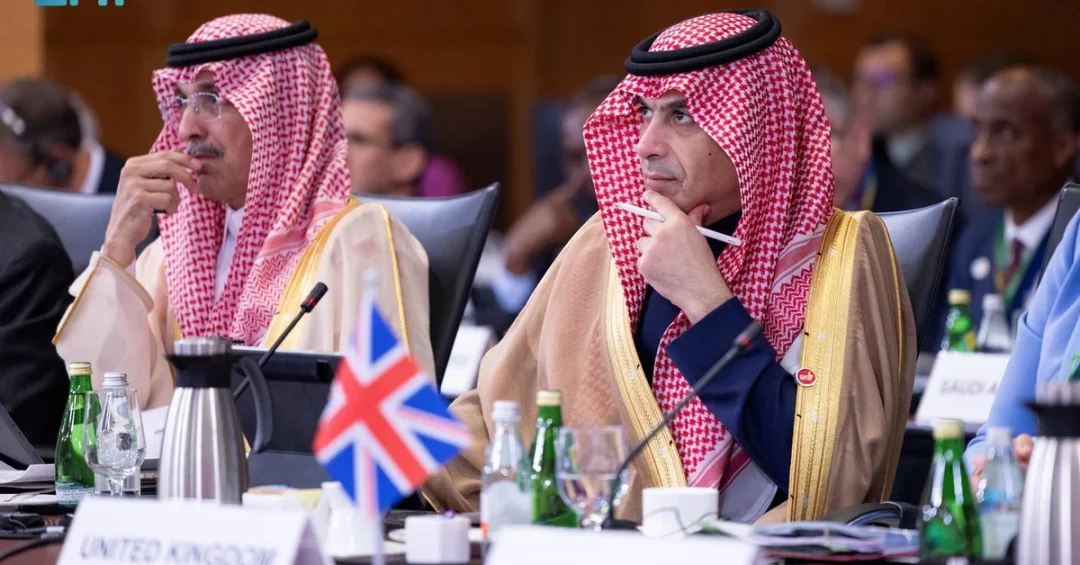
Saudi Minister of Finance Mohammed Al-Jadaan affirmed the Kingdom’s full support for the G20 Roadmap to make Multilateral Development Banks (MDBs) “better, bigger, and more effective” during the 4th Finance Ministers and Central Bank Governors (FMCBG) meeting held in Washington, D.C., on October 23–24, 2024. The meeting, convened under the Brazilian G20 Presidency, brought together finance ministers and central bank governors from the world’s largest economies to address pressing global economic challenges. Minister Al-Jadaan was joined by Ayman Alsayari, Governor of the Saudi Central Bank (SAMA), in representing the Kingdom at the high-level gathering. Their participation underscores Saudi Arabia’s active and constructive role in shaping international financial policy and its commitment to fostering global economic stability and inclusive growth.
During the session titled “Better, Bigger and More Effective Multilateral Development Banks (MDBs),” Al-Jadaan emphasized that MDBs must enhance their operational effectiveness and financial capacity to meet the growing needs of developing nations. He stressed that Saudi Arabia fully supports the G20 Roadmap, a goal endorsed by the FMCBG under the Brazilian G20 Presidency. This roadmap aims to reform and strengthen MDBs so they can better address global challenges such as climate change, poverty, and infrastructure gaps. Saudi Arabia’s endorsement reflects its longstanding dedication to multilateral cooperation and sustainable development, principles that are central to its foreign policy and economic strategy.
Context and Background
Why is the G20 Finance Track so vital in today’s interconnected global economy? The G20 Finance Track, which brings together finance ministers and central bank governors, has been instrumental in coordinating international economic responses for a quarter-century. Since its inception, it has evolved into a critical platform for addressing financial crises, promoting sustainable growth, and fostering global cooperation. The 4th FMCBG meeting under Brazil’s presidency is part of a series of gatherings leading up to the G20 Leaders’ Summit in November 2024. Brazil has prioritized inclusive growth, sustainable development, and reform of global governance institutions during its presidency, themes that resonate with Saudi Arabia’s own Vision 2030 and its G20 priorities.
Saudi Arabia has a rich history of engagement with the G20, notably during its 2020 presidency, when the world faced the unprecedented health and economic crisis caused by the COVID-19 pandemic. Under Saudi leadership, the G20 responded swiftly and decisively, implementing debt relief initiatives such as the Debt Service Suspension Initiative (DSSI) that provided breathing space for vulnerable countries. This experience has cemented the Kingdom’s reputation as a responsible and influential player in global economic governance. In Washington, Al-Jadaan reflected on these achievements, noting that the G20 has been pivotal in shaping the global economic landscape through collaboration and collective action.
The 4th FMCBG meeting also provided an opportunity for Saudi Arabia to highlight its commitment to financial innovation and sustainable development. On the sidelines, Deputy Minister of Finance for International Affairs Khalid Bawazier participated in the roundtable “Exploring Financial Innovations for the Global Alliance Against Hunger and Poverty,” where he reiterated Saudi Arabia’s dedication to achieving the Sustainable Development Goals (SDGs), which are integral to Saudi Vision 2030. Bawazier also took part in the G20 Joint Meeting of Finance, Climate & Environment, and Foreign Affairs Ministers and Central Bank Governors, emphasizing the Kingdom’s commitment to achieving net-zero emissions by 2060 through the Circular Carbon Economy approach. These engagements demonstrate Saudi Arabia’s holistic approach to global challenges, linking economic prosperity with environmental stewardship and social progress.
Key Details
What specific messages did Saudi officials convey at the 4th FMCBG meeting? Minister Al-Jadaan’s remarks centered on the urgent need to strengthen MDBs. He argued that these institutions must become more effective and financially robust to tackle the rising demands of developing countries. The G20 Roadmap, endorsed by the FMCBG, sets out a comprehensive reform agenda to enhance MDBs’ lending capacity, improve their operational efficiency, and align their activities with the SDGs. Saudi Arabia’s support for this roadmap is consistent with its broader efforts to promote sustainable development and reduce global inequalities. Al-Jadaan’s call for reform echoes the Kingdom’s own experience in diversifying its economy and investing in human capital, which it shares with other nations through knowledge exchange and financial assistance.
In the session “The Global Economy: A Longer View – 25 years of the G20 Finance Track and the Continuing Imperative of Global Cooperation,” Al-Jadaan highlighted the G20’s achievements under Saudi Arabia’s 2020 presidency. He pointed to the group’s effective response to the COVID-19 crisis, including the adoption of debt relief initiatives that helped low-income countries redirect resources to health and social protection. This historical perspective underscored the importance of multilateralism and the need for continued collaboration to address emerging challenges such as inflation, supply chain disruptions, and geopolitical tensions. Al-Jadaan’s intervention reinforced Saudi Arabia’s position as a bridge-builder between developed and developing economies, a role that has become increasingly important in a fragmented world.
Deputy Minister Bawazier’s participation in the roundtable on financial innovations for the Global Alliance Against Hunger and Poverty highlighted Saudi Arabia’s commitment to leveraging innovative financing mechanisms to combat hunger and poverty. He emphasized that achieving the SDGs is a core component of Vision 2030, which aims to diversify the Kingdom’s economy, empower its citizens, and enhance its global competitiveness. Bawazier also underscored Saudi Arabia’s environmental commitment in the joint meeting on climate, where he detailed the Kingdom’s strategy to achieve net-zero emissions by 2060 through the Circular Carbon Economy. This approach focuses on reducing emissions, reusing carbon, and recycling it, while ensuring energy security and economic growth. Saudi Arabia’s participation in these discussions demonstrates its readiness to contribute to global solutions while advancing its own development goals.
International and Regional Impact
How does Saudi Arabia’s engagement in the G20 influence global economic governance? Saudi Arabia’s active participation in the FMCBG meeting and its support for the G20 Roadmap send a strong signal of its commitment to multilateralism and international cooperation. As the world’s largest oil exporter and a key player in the global energy market, Saudi Arabia’s stance on MDB reform and sustainable development carries significant weight. By aligning with the Brazilian presidency’s priorities, the Kingdom helps build consensus among G20 members, facilitating coordinated action on issues such as debt sustainability, climate finance, and inclusive growth. This consensus-building is essential for addressing transnational challenges that no single country can solve alone.
Regionally, Saudi Arabia’s leadership in the G20 reinforces its role as a stabilizing force in the Middle East and a champion of developing countries’ interests. The Kingdom’s advocacy for MDB reform resonates with many emerging economies that struggle to access affordable financing for infrastructure and social projects. By supporting the G20 Roadmap, Saudi Arabia helps ensure that the voices of developing nations are heard in global financial institutions. Moreover, the Kingdom’s own experience with economic transformation under Vision 2030 serves as a model for other countries seeking to diversify their economies and reduce dependence on hydrocarbons. Saudi Arabia’s participation in the G20 thus enhances its soft power and strengthens its diplomatic ties with both advanced and emerging economies.
Economic and Strategic Significance
What does Saudi Arabia’s support for MDB reform mean for the global economy? Strengthening MDBs is critical for mobilizing the trillions of dollars needed to achieve the SDGs and address climate change. The G20 Roadmap aims to expand MDBs’ lending capacity, improve their efficiency, and encourage private sector investment. Saudi Arabia’s backing of these reforms is not only a diplomatic gesture but also a strategic economic move. As a major investor in global markets and a shareholder in international financial institutions, the Kingdom stands to benefit from a more robust and responsive multilateral system. A stronger MDB network can help unlock new markets, promote trade, and create opportunities for Saudi businesses and investors. Furthermore, by supporting sustainable development, Saudi Arabia contributes to global stability, which is essential for its own economic security.
Saudi Arabia’s commitment to net-zero emissions by 2060 through the Circular Carbon Economy is another example of its strategic approach to global challenges. This initiative aligns with the Kingdom’s economic diversification goals under Vision 2030, which include developing renewable energy, hydrogen, and carbon capture technologies. By promoting the Circular Carbon Economy, Saudi Arabia aims to maintain its role as a reliable energy supplier while reducing its carbon footprint. This balanced approach has garnered international recognition and positions the Kingdom as a responsible global citizen. At the G20, Bawazier’s emphasis on this strategy underscores Saudi Arabia’s willingness to contribute to global climate action without compromising its development aspirations. The Kingdom’s participation in the G20 Joint Meeting on Finance, Climate & Environment, and Foreign Affairs further highlights its integrated approach to policy-making, where economic, environmental, and foreign policy objectives are aligned.
Vision 2030 Alignment
How does Saudi Arabia’s involvement in the G20 reflect the objectives of Vision 2030? Vision 2030, the Kingdom’s ambitious blueprint for economic and social transformation, aims to diversify the economy, empower citizens, and enhance Saudi Arabia’s global standing. The Kingdom’s active engagement in the G20, including its support for MDB reform and sustainable development, is a direct manifestation of these goals. By participating in global economic governance, Saudi Arabia strengthens its international partnerships, attracts foreign investment, and showcases its progress in areas such as women’s empowerment, renewable energy, and digital innovation. The G20 platform also allows the Kingdom to share its development experience with other nations, reinforcing its role as a leader in the region and beyond.
Looking ahead, Saudi Arabia’s continued support for the G20 Roadmap and its commitment to the SDGs will be instrumental in shaping a more inclusive and sustainable global economy. As the Kingdom prepares for future G20 summits and other international forums, it will build on the momentum gained in Washington to advocate for policies that benefit both developed and developing countries. The participation of Minister Al-Jadaan and Governor Alsayari, along with Deputy Minister Bawazier, demonstrates Saudi Arabia’s whole-of-government approach to international engagement, where financial, monetary, and developmental objectives are harmonized. Through such efforts, Saudi Arabia not only advances its own Vision 2030 but also contributes to a more prosperous and stable world, cementing its reputation as a responsible and influential global player.
20 Questions
Q1. What was the 4th FMCBG meeting and when did it take place?
A1. The 4th Finance Ministers and Central Bank Governors (FMCBG) meeting was held in Washington, D.C., on October 23-24, 2024, under the Brazilian G20 Presidency. It gathered finance ministers and central bank governors from G20 member countries to discuss global economic issues and policy coordination.
Q2. Who represented Saudi Arabia at the 4th FMCBG meeting?
A2. Saudi Arabia was represented by Minister of Finance Mohammed Al-Jadaan and Ayman Alsayari, Governor of the Saudi Central Bank. Deputy Minister of Finance for International Affairs Khalid Bawazier also participated in several side events during the meeting.
Q3. What is the G20 Roadmap for Multilateral Development Banks?
A3. The G20 Roadmap is a reform agenda endorsed by the FMCBG under Brazil’s G20 Presidency. It aims to make Multilateral Development Banks (MDBs) “better, bigger, and more effective” by enhancing their operational effectiveness and financial capacity to meet the growing needs of developing nations.
Q4. Why does Saudi Arabia support the G20 Roadmap for MDBs?
A4. Saudi Arabia supports the roadmap because it aligns with the Kingdom’s commitment to multilateral cooperation and sustainable development. Strengthening MDBs helps address global challenges such as poverty, climate change, and infrastructure gaps, which are priorities for Saudi Arabia and its Vision 2030.
Q5. What did Minister Al-Jadaan say about MDBs at the meeting?
A5. Minister Al-Jadaan stated that MDBs must enhance their operational effectiveness and financial capacity to meet the growing needs of developing nations. He stressed Saudi Arabia’s full support for the G20 Roadmap to make MDBs better, bigger, and more effective.
Q6. What was the session on the global economy about?
A6. The session “The Global Economy: A Longer View – 25 years of the G20 Finance Track and the Continuing Imperative of Global Cooperation” reviewed the G20’s history and achievements. Minister Al-Jadaan highlighted the G20’s pivotal role, including its effective response to the COVID-19 pandemic under Saudi Arabia’s 2020 presidency.
Q7. What did Saudi Arabia achieve during its 2020 G20 Presidency?
A7. During its 2020 G20 Presidency, Saudi Arabia led the G20’s response to the COVID-19 pandemic, including the adoption of debt relief initiatives such as the Debt Service Suspension Initiative (DSSI). These measures helped vulnerable countries redirect resources to health and social protection.
Q8. Who is Khalid Bawazier and what did he do at the meeting?
A8. Khalid Bawazier is the Deputy Minister of Finance for International Affairs. At the meeting, he participated in a roundtable on financial innovations for the Global Alliance Against Hunger and Poverty and in the G20 Joint Meeting on Finance, Climate & Environment, and Foreign Affairs.
Q9. What did Bawazier say about the Sustainable Development Goals?
A9. Bawazier said that Saudi Arabia is committed to achieving the Sustainable Development Goals (SDGs), which are integral to Saudi Vision 2030. He emphasized the Kingdom’s dedication to ending hunger and poverty through innovative financing and inclusive growth.
Q10. How is Saudi Arabia addressing climate change?
A10. Saudi Arabia is committed to achieving net-zero emissions by 2060 through the Circular Carbon Economy approach. This strategy focuses on reducing, reusing, and recycling carbon, while ensuring energy security and economic diversification in line with Vision 2030.
Q11. What is the Circular Carbon Economy?
A11. The Circular Carbon Economy is a framework that aims to manage emissions through four Rs: reduce, reuse, recycle, and remove carbon. It allows countries to continue using fossil fuels while mitigating environmental impact, supporting sustainable development and energy transition.
Q12. What is the Global Alliance Against Hunger and Poverty?
A12. The Global Alliance Against Hunger and Poverty is a Brazilian G20 initiative that seeks to mobilize financial resources and innovative solutions to eradicate hunger and poverty. Saudi Arabia participated in a roundtable exploring financial innovations to support this alliance.
Q13. How does Saudi Arabia’s participation in the G20 benefit the Kingdom?
A13. Participation in the G20 allows Saudi Arabia to shape global economic policies, strengthen international partnerships, attract foreign investment, and showcase its progress under Vision 2030. It also reinforces the Kingdom’s role as a bridge-builder between developed and developing nations.
Q14. What is the significance of the G20 Finance Track?
A14. The G20 Finance Track, comprising finance ministers and central bank governors, coordinates international economic responses. Over 25 years, it has been instrumental in addressing financial crises, promoting sustainable growth, and fostering global cooperation on issues like debt relief and climate finance.
Q15. How does Saudi Arabia’s Vision 2030 align with the G20 agenda?
A15. Vision 2030 aims to diversify Saudi Arabia’s economy, empower citizens, and enhance global engagement. The G20 agenda focuses on inclusive growth, sustainable development, and institutional reform, which are complementary to the Kingdom’s goals of economic transformation and international cooperation.
Q16. What are Multilateral Development Banks (MDBs)?
A16. MDBs are international financial institutions that provide financing and technical assistance to developing countries. Examples include the World Bank and regional development banks. They play a crucial role in funding infrastructure, health, education, and climate projects.
Q17. Why is reforming MDBs important?
A17. Reforming MDBs is important to increase their lending capacity, improve efficiency, and better address global challenges like climate change and poverty. The G20 Roadmap aims to make MDBs more effective in supporting sustainable development and achieving the SDGs.
Q18. What did Minister Al-Jadaan say about global cooperation?
A18. Al-Jadaan emphasized that the G20 has been instrumental in shaping the global economic landscape through collaboration. He highlighted the need for continued multilateral cooperation to address emerging challenges and ensure inclusive and sustainable growth.
Q19. How does Saudi Arabia support developing nations?
A19. Saudi Arabia supports developing nations through financial assistance, debt relief initiatives, and knowledge sharing. It also advocates for MDB reform to ensure these institutions can better meet the needs of developing countries, aligning with the Kingdom’s commitment to global solidarity.
Q20. What is the expected outcome of the 4th FMCBG meeting?
A20. The 4th FMCBG meeting aimed to build consensus on key economic issues, including MDB reform and climate finance, ahead of the G20 Leaders’ Summit in November 2024. Saudi Arabia’s participation helped advance these discussions and reinforce its role in global economic governance.
Reader Feedback
We value your thoughts. Please share your feedback on this article.
Your feedback helps us improve our coverage.
Related articles
 Saudi-Backed Palestine Support Deal Signed with AMF
 Saudi Minister Highlights Human Capital at GCC-WBG Event
 Saudi Arabia Expands Manilkara Zapota Cultivation for Sustainability
 IsDB Joins World Bank Roundtable on Impact Partnerships
 NIDLP Launches Updated Daleel Platform with AI and Multilingual Support
 Reef Saudi Wins Construction Management Innovation Award