


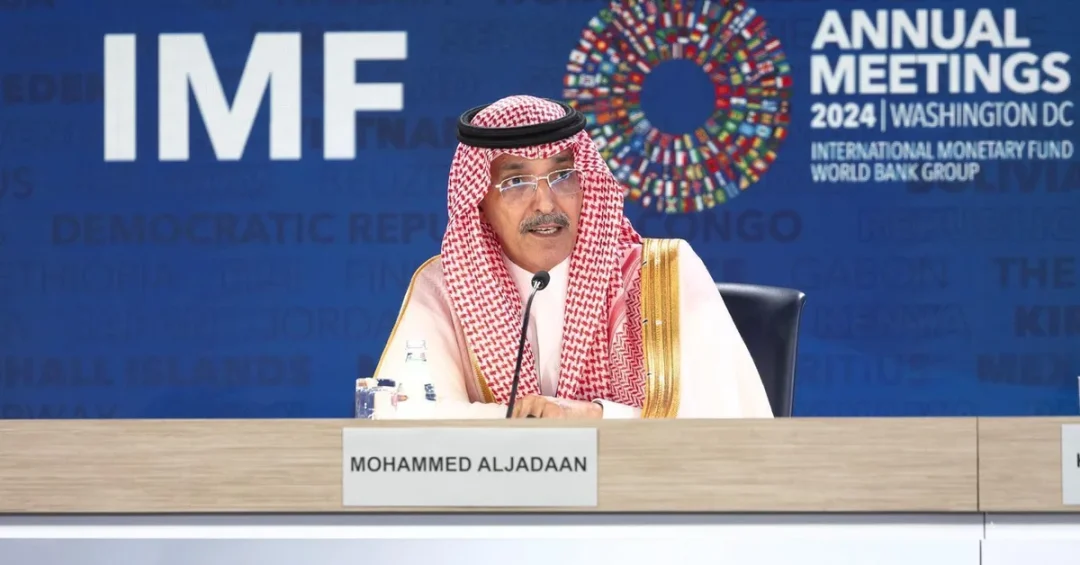
Minister of Finance and Chair of the International Monetary and Financial Committee (IMFC) at the International Monetary Fund (IMF), Mohammed Al-Jadaan, held a press conference in Washington on October 26, 2024, alongside IMF Managing Director Kristalina Georgieva to convey the key actions taken and main outcomes of the IMFC meetings. The briefing, reported by the Saudi Press Agency (SPA), marked a significant moment in the Kingdom’s chairmanship of the IMFC, underscoring Saudi Arabia’s growing role in shaping global economic policy and its commitment to multilateral cooperation at a time of considerable uncertainty in the world economy.
During the press conference, Al-Jadaan commended all IMFC members for their strong collaboration in achieving the Committee’s objectives, and congratulated Georgieva on the beginning of her second term as Managing Director, wishing her every success in navigating the challenges facing the global economy. The IMFC, which deliberates on matters concerning the growth and stability of the global economy, has become a key instrument for providing strategic direction to the work and policies of the IMF. The Kingdom’s chairmanship of the IMFC reaffirms its strong commitment to promoting multilateralism and reflects the leading role it plays in supporting regional and global economic growth.
Context and Background
What does it mean for Saudi Arabia to chair a committee that helps steer the global economy at a time of profound uncertainty? The IMFC is the primary advisory body of the IMF’s Board of Governors, typically meeting twice a year to assess global economic conditions and provide strategic guidance on the IMF’s work. Its membership comprises 24 governors, usually finance ministers or central bank governors, representing the IMF’s global membership. Saudi Arabia assumed the chairmanship of the IMFC in 2024, placing the Kingdom at the center of international economic diplomacy and giving it a platform to advocate for policies that support both advanced and emerging economies.
The October 2024 meetings took place against a backdrop of persistent global challenges, including uneven post-pandemic recovery, elevated debt levels in many low-income countries, inflationary pressures, and geopolitical tensions that continue to weigh on trade and investment flows. In this environment, the IMFC’s role in fostering consensus and coordinating policy responses is more critical than ever. Saudi Arabia’s leadership of the Committee reflects the Kingdom’s longstanding engagement with the IMF and its broader commitment to international financial stability, a commitment that is also embedded in its own Vision 2030 reform agenda.
Al-Jadaan’s dual role as Saudi Minister of Finance and IMFC Chair positions him uniquely to bridge the perspectives of the Kingdom, the broader Middle East region, and the global community. His chairmanship is not merely ceremonial; it involves setting the agenda, facilitating dialogue among members, and ensuring that the Committee’s deliberations translate into actionable guidance for the IMF’s 190 member countries. The press conference with Georgieva served to communicate these outcomes transparently to a global audience, reinforcing the importance of open communication in international economic governance.
Key Actions Under Saudi Chairmanship
What concrete steps has the IMFC taken under Saudi leadership to address the world’s most pressing economic vulnerabilities? Al-Jadaan highlighted several key actions taken under the Kingdom’s chairmanship, beginning with the completion of the review of the Poverty Reduction and Growth Trust (PRGT). The PRGT is the IMF’s primary vehicle for providing concessional financing to low-income countries, and its review is essential to ensuring that these nations can address balance of payments challenges without compromising their development goals. The completion of this review demonstrates the Committee’s collective resolve to support the most vulnerable economies.
Another significant action was the encouragement of the IMF and the World Bank Group (WBG) to further develop their approach to helping nations with liquidity challenges. This includes exploring innovative financial instruments and enhancing coordination between the two institutions to provide timely and effective support. By urging these institutions to refine their strategies, the IMFC under Saudi chairmanship is helping to build a more resilient global financial safety net, one that can respond swiftly to crises and prevent localized liquidity problems from escalating into broader systemic risks.
Al-Jadaan also noted that IMFC members welcomed the addition of a new 25th Chair to the IMF Executive Board for Africa, a development that will strengthen the continent’s voice and representation in the Board’s decision-making processes. This historic expansion reflects a growing recognition of Africa’s economic importance and the need for its perspectives to be heard at the highest levels of global financial governance. It is also consistent with Saudi Arabia’s own efforts to deepen ties with African nations and support their development aspirations.
Additionally, the Minister pointed to support for IMF efforts to strengthen its capacity development and secure appropriate financing. Capacity development is a cornerstone of the IMF’s work, helping member countries build the institutional and technical foundations needed for sound economic management. By backing these efforts, the IMFC is ensuring that the IMF remains equipped to deliver on its mandate in an increasingly complex global landscape.
International and Regional Impact
How do these decisions resonate beyond the meeting rooms of Washington, and what do they mean for countries across the Middle East and beyond? The outcomes of the IMFC meetings have far-reaching implications for the global economy. The completion of the PRGT review, for instance, directly affects the ability of low-income countries to access affordable financing, which in turn supports their efforts to maintain macroeconomic stability, invest in human capital, and pursue sustainable development. For many of these countries, the IMF’s concessional lending is a lifeline that enables them to navigate external shocks without resorting to destabilizing measures.
The new 25th Chair for Africa on the IMF Executive Board is a landmark achievement that enhances the legitimacy and inclusiveness of the IMF’s governance structure. It ensures that African voices are not only heard but also have a formal seat at the table where critical decisions are made. This is particularly important as Africa’s economic weight continues to grow, driven by demographic trends, natural resource endowments, and increasing integration into global value chains. Saudi Arabia’s support for this initiative underscores its commitment to equitable representation and its recognition of Africa’s strategic importance.
For the Middle East, Saudi Arabia’s chairmanship of the IMFC reinforces the Kingdom’s position as a leading economic power and a constructive partner in international forums. It also aligns with Saudi Arabia’s broader diplomatic efforts to promote stability, prosperity, and cooperation across the region. By championing policies that support low-income nations and enhance the IMF’s effectiveness, the Kingdom is helping to create an international economic environment that benefits all countries, including its neighbors and partners in the Arab world.
Economic and Strategic Significance
What does Saudi Arabia’s leadership of the IMFC reveal about its economic strategy and its role in the global financial architecture? The Kingdom’s chairmanship is a testament to its economic strength and its proactive approach to international engagement. As the world’s largest exporter of crude oil and a member of the G20, Saudi Arabia has long been a key player in global energy markets. In recent years, however, it has significantly expanded its influence in international finance and economic policymaking, leveraging its financial resources, its strategic partnerships, and its Vision 2030 reform program to shape global conversations on growth and stability.
The actions taken under Saudi chairmanship—supporting low-income countries, enhancing liquidity support, and strengthening IMF capacity development—are consistent with the Kingdom’s own development philosophy. Vision 2030 emphasizes economic diversification, private sector growth, and social inclusion, and these principles are mirrored in the IMFC’s efforts to promote sustainable and inclusive global growth. By advocating for these policies, Saudi Arabia is not only contributing to the well-being of other nations but also reinforcing the interconnectedness of the global economy, which ultimately benefits the Kingdom’s own economic interests.
Furthermore, the press conference with Georgieva highlighted the strong working relationship between Saudi Arabia and the IMF’s leadership. This partnership is vital for ensuring that the IMF remains responsive to the needs of its members and that its policies are aligned with the realities of a rapidly changing world. The Kingdom’s ability to convene, persuade, and build consensus among diverse stakeholders demonstrates its diplomatic skill and its commitment to multilateral solutions.
Vision 2030 Alignment
How does Saudi Arabia’s chairmanship of the IMFC connect to the Kingdom’s long-term vision for its own future and its role in the world? Vision 2030, launched in 2016 under the leadership of Crown Prince Mohammed bin Salman, is a comprehensive plan to transform Saudi Arabia’s economy and society. It seeks to reduce dependence on oil, diversify revenue streams, and position the Kingdom as a global investment and logistics hub. A key pillar of Vision 2030 is international engagement—building partnerships, attracting foreign investment, and playing an active role in global affairs. The IMFC chairmanship is a clear manifestation of this pillar in action.
By leading the IMFC, Saudi Arabia is demonstrating that it is not only a participant in the global economy but also a shaper of its rules and priorities. This enhances the Kingdom’s international standing and opens doors for deeper cooperation with other nations, which in turn supports the economic diversification and job creation goals of Vision 2030. The skills, networks, and reputation that Saudi officials build through such roles contribute to the Kingdom’s soft power and its ability to influence global economic governance in ways that align with its values and interests.
Looking ahead, Saudi Arabia’s chairmanship of the IMFC will continue to be a platform for advancing policies that promote growth, stability, and inclusion. As the global economy evolves, the Kingdom is well-positioned to champion solutions that reflect the needs of both advanced and emerging economies. The press conference in Washington was not just a report on past actions; it was a statement of Saudi Arabia’s enduring commitment to multilateralism and its vision of a prosperous, interconnected world. In doing so, the Kingdom is helping to build a global economy that is more resilient, more equitable, and better prepared for the challenges of the 21st century.
20 Questions
Q1. What was the purpose of the press conference held by Minister Mohammed Al-Jadaan?
A1. The press conference was held to convey the key actions taken and main outcomes of the International Monetary and Financial Committee (IMFC) meetings. It provided transparency on the Committee’s work under Saudi Arabia’s chairmanship.
Q2. Who is Mohammed Al-Jadaan?
A2. Mohammed Al-Jadaan is the Minister of Finance of Saudi Arabia and the Chair of the International Monetary and Financial Committee (IMFC) at the International Monetary Fund (IMF).
Q3. Who is Kristalina Georgieva?
A3. Kristalina Georgieva is the Managing Director of the International Monetary Fund (IMF). She began her second term in this role, and Al-Jadaan congratulated her during the press conference.
Q4. What is the IMFC?
A4. The IMFC is the International Monetary and Financial Committee, the primary advisory body of the IMF’s Board of Governors. It deliberates on global economic growth and stability and provides strategic direction to the IMF.
Q5. What key action was taken regarding the Poverty Reduction and Growth Trust (PRGT)?
A5. Under Saudi chairmanship, the IMFC completed the review of the PRGT to ensure continued support for low-income nations in addressing balance of payments challenges.
Q6. How did the IMFC encourage the IMF and World Bank Group to help nations with liquidity challenges?
A6. The IMFC encouraged the IMF and World Bank Group to further develop their approach to assist nations facing liquidity challenges, aiming to enhance the global financial safety net.
Q7. What support was expressed for IMF capacity development?
A7. The IMFC supported IMF efforts to strengthen its capacity development and secure appropriate financing, helping member countries build sound economic institutions.
Q8. What is the significance of the new 25th Chair on the IMF Executive Board?
A8. The new 25th Chair for Africa will strengthen Africa’s voice and representation on the IMF Executive Board, enhancing the inclusiveness of global financial governance.
Q9. How does Saudi Arabia’s chairmanship reflect its commitment to multilateralism?
A9. Saudi Arabia’s chairmanship reaffirms its strong commitment to promoting multilateralism and reflects its leading role in supporting regional and global economic growth.
Q10. What is the role of the IMFC in the global economy?
A10. The IMFC deliberates on matters concerning the growth and stability of the global economy and provides strategic direction to the work and policies of the IMF.
Q11. When and where did the press conference take place?
A11. The press conference took place in Washington on October 26, 2024, as reported by the Saudi Press Agency (SPA).
Q12. What did Al-Jadaan say about the collaboration among IMFC members?
A12. Al-Jadaan commended all IMFC members for their strong collaboration to achieve the Committee’s objectives, highlighting the collective effort in addressing global economic challenges.
Q13. What did Al-Jadaan wish Kristalina Georgieva?
A13. Al-Jadaan congratulated Georgieva on her second term as Managing Director and wished her every success in navigating the challenges facing the global economy.
Q14. How does the PRGT review benefit low-income countries?
A14. The PRGT review ensures that low-income countries can access concessional financing to address balance of payments challenges, supporting their economic stability and development.
Q15. What does the addition of the 25th Chair mean for Africa?
A15. It means Africa will have a stronger voice and representation on the IMF Executive Board, allowing the continent’s perspectives to be heard in global financial decision-making.
Q16. How does Saudi Arabia’s chairmanship of the IMFC align with Vision 2030?
A16. It aligns with Vision 2030’s emphasis on international engagement and economic diversification, enhancing Saudi Arabia’s global role and supporting its long-term development goals.
Q17. What are the implications of the IMFC outcomes for the Middle East?
A17. The outcomes reinforce Saudi Arabia’s position as a leading economic power and support stability and prosperity in the Middle East through enhanced global economic cooperation.
Q18. What is the significance of the IMFC meetings for the global economy?
A18. The meetings provide strategic direction to the IMF, helping to address global economic challenges such as uneven recovery, debt vulnerabilities, and inflationary pressures.
Q19. How does Saudi Arabia benefit from chairing the IMFC?
A19. Chairing the IMFC enhances Saudi Arabia’s international standing, builds soft power, and opens doors for deeper cooperation, supporting its economic and diplomatic objectives.
Q20. What is the forward-looking message from the press conference?
A20. The message is that Saudi Arabia remains committed to multilateralism and to shaping a resilient, equitable global economy, in line with its Vision 2030 and its role as a responsible global leader.
Reader Feedback
We value your thoughts. Please share your feedback on this article.
Your feedback helps us improve our coverage.
Related articles
 Saudi Finance Minister Backs G20 Roadmap at FMCBG Meeting
 Saudi-Backed Palestine Support Deal Signed with AMF
 Saudi Minister Highlights Human Capital at GCC-WBG Event
 Saudi Arabia Expands Manilkara Zapota Cultivation for Sustainability
 IsDB Joins World Bank Roundtable on Impact Partnerships
 NIDLP Launches Updated Daleel Platform with AI and Multilingual Support