


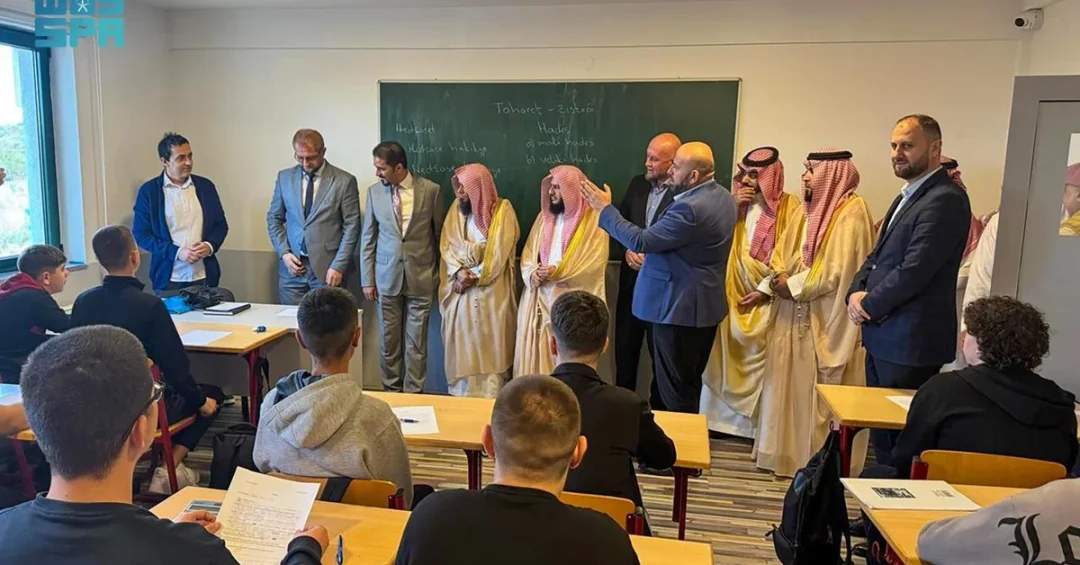
Imam and Khatib of the Prophet’s Mosque Sheikh Dr. Khalid bin Sulaiman Al-Muhanna visited the Muhammad Al-Fatih School in Podgorica, Montenegro, on October 25, 2024, as part of the Imams of the Two Holy Mosques program organized by the Ministry of Islamic Affairs, Dawah, and Guidance. The visit underscored Saudi Arabia’s commitment to promoting moderate Islam and supporting educational institutions worldwide. Sheikh Al-Muhanna was accompanied by Sheikh Rifat Fejzić, President of the Islamic Community in Montenegro, and Sheikh Amer bin Banwan Al-Anzi, religious attaché at the Kingdom’s Embassy in Bosnia and Herzegovina. The delegation toured the school, engaged with students, and emphasized the importance of knowledge, Quranic learning, and adherence to the teachings of Prophet Mohammad. This visit is part of a broader Saudi initiative to foster religious moderation and cultural exchange, aligning with the Kingdom’s Vision 2030 goals of global engagement and soft power diplomacy.
How does such a visit impact the lives of young students in a small Balkan nation? It brings them into direct contact with one of the most respected religious figures from the Islamic world, offering inspiration and a tangible link to the heart of Islam. The Muhammad Al-Fatih School, with its 500 students—300 boys and 200 girls—serves as a beacon of religious and general education in Montenegro. Sheikh Al-Muhanna’s presence not only validated their efforts but also reinforced the message that Saudi Arabia supports educational excellence and moral development across the globe. This event highlights the Kingdom’s ongoing efforts to build bridges with Muslim communities in Europe, promoting peace, tolerance, and mutual understanding.
Context and Background
What is the significance of the Imams of the Two Holy Mosques program? Launched by the Ministry of Islamic Affairs, Dawah, and Guidance, this initiative sends esteemed imams from Makkah and Madinah to various countries to lead prayers, deliver lectures, and engage with local communities. It aims to spread the message of moderate Islam, counter extremism, and strengthen ties with Muslim minorities. The program reflects Saudi Arabia’s role as a custodian of the Two Holy Mosques and its dedication to serving Muslims worldwide. By visiting Montenegro, a country with a rich Islamic heritage dating back to the Ottoman era, the program reinforces the Kingdom’s commitment to supporting Islamic education and cultural preservation.
Montenegro, a small but diverse nation in the Balkans, is home to a significant Muslim population, primarily in the Sandžak region and along the coast. The Islamic Community in Montenegro, led by Sheikh Rifat Fejzić, plays a vital role in coordinating religious affairs and maintaining harmony among different ethnic and religious groups. The Muhammad Al-Fatih School, named after the Ottoman Sultan who conquered Constantinople, is a key institution providing both religious and secular education. Its curriculum balances Quranic studies with modern subjects, preparing students for active roles in society. The visit by Sheikh Al-Muhanna thus carries historical resonance and contemporary relevance, symbolizing the enduring bond between Saudi Arabia and the Muslims of Montenegro.
Why does Saudi Arabia invest in such international outreach? It is part of a strategic vision to promote moderation and combat extremist ideologies that threaten global stability. By supporting educational institutions like the Muhammad Al-Fatih School, the Kingdom helps nurture a generation of Muslims who are well-versed in their faith and open to the world. This approach aligns with Vision 2030’s emphasis on global engagement and the export of Saudi Arabia’s moderate religious values. Moreover, it strengthens diplomatic ties and enhances the Kingdom’s image as a benevolent leader in the Islamic world.
Key Details of the Visit
What exactly happened during Sheikh Al-Muhanna’s visit? According to the Saudi Press Agency, the Imam and Khatib of the Prophet’s Mosque toured the school, met with students and faculty, and delivered a message emphasizing the importance of knowledge in a Muslim’s life. He urged students to remain committed to pursuing knowledge, learning the Quran, and following the teachings of Prophet Mohammad. He explained that adhering to moderation is the ideal path to a balanced life. He encouraged them to be role models of noble Islamic morals and to contribute to building a strong society rooted in love and harmony. He also commended the school’s significant role in educating students and preparing them to be future leaders.
The delegation included Sheikh Rifat Fejzić, President of the Islamic Community in Montenegro, and Sheikh Amer bin Banwan Al-Anzi, religious attaché at the Saudi Embassy in Bosnia and Herzegovina. Their presence highlights the collaborative nature of the visit, bridging Saudi religious leadership with local Montenegrin Islamic authorities. The Muhammad Al-Fatih School, with its 500 students—300 boys and 200 girls—provides a comprehensive education that includes religious studies alongside general subjects. This visit is part of the Imams of the Two Holy Mosques program, which is organized and supervised by the Ministry of Islamic Affairs, Dawah, and Guidance. The program has previously sent imams to various countries, fostering goodwill and spiritual guidance.
How do such visits benefit the students? They receive direct encouragement from a distinguished religious scholar, which can inspire them to excel in their studies and deepen their faith. The emphasis on moderation and balanced living is particularly important in a region that has experienced ethnic and religious tensions in the past. By promoting love and harmony, Sheikh Al-Muhanna’s message contributes to social cohesion and stability. The visit also raises the profile of the school, potentially attracting more support and resources. For the students, it is a memorable encounter that connects them to the global Islamic community and reinforces their identity as Muslims in Europe.
International and Regional Impact
What are the broader implications of this visit for Saudi Arabia’s relations with Europe? It demonstrates the Kingdom’s soft power approach, using religious diplomacy to build bridges and foster goodwill. Montenegro, as a candidate for European Union membership, represents a strategic partner in the Balkans. By engaging with its Muslim community, Saudi Arabia strengthens its ties with a moderate European state and counters negative stereotypes. The visit also serves as a counter-narrative to extremist ideologies that have occasionally found resonance in the Balkans. It showcases Saudi Arabia’s commitment to peace, tolerance, and interfaith dialogue, values that are increasingly important in a globalized world.
How does this fit into Saudi Arabia’s regional strategy? The Kingdom has long been a leader in the Islamic world, and its outreach to Muslim minorities in Europe is part of a broader effort to promote moderation and stability. The Balkans, with its complex history of ethnic and religious conflict, is a key area where Saudi Arabia can play a constructive role. By supporting educational institutions and religious leaders, the Kingdom helps nurture moderate voices and prevent radicalization. This visit also reinforces the historical and cultural ties between the Arabian Peninsula and the Balkans, dating back to the Ottoman era. It is a reminder of the shared heritage and values that unite Muslims across continents.
Economic and Strategic Significance
What economic or strategic benefits does Saudi Arabia gain from such visits? While the primary aim is religious and cultural, these visits also enhance the Kingdom’s global standing and open doors for cooperation in other fields. Montenegro is a small but stable market with potential in tourism, energy, and infrastructure. Improved relations can lead to increased investment and trade. Moreover, Saudi Arabia’s support for moderate Islam helps combat extremism, which is a shared security concern for Europe and the Middle East. By investing in education and religious diplomacy, the Kingdom contributes to long-term stability and prosperity in the region.
How does this align with Vision 2030? Vision 2030 seeks to diversify Saudi Arabia’s economy and enhance its global influence. Religious diplomacy is a key component of this strategy, as it leverages the Kingdom’s unique position as the custodian of Islam’s holiest sites. By promoting moderate Islam abroad, Saudi Arabia projects an image of a modern, forward-looking nation that is committed to peace and development. The Imams of the Two Holy Mosques program is a tangible manifestation of this vision, showcasing the Kingdom’s soft power and its dedication to serving Muslims worldwide. It also strengthens people-to-people ties, which are essential for long-term diplomatic and economic partnerships.
Vision 2030 Alignment
How does the visit of Sheikh Al-Muhanna to Montenegro reflect Vision 2030? It embodies the Vision’s emphasis on global engagement, moderation, and cultural exchange. By sending its most respected religious scholars to interact with Muslim communities abroad, Saudi Arabia demonstrates its commitment to being a positive force in the world. The visit also highlights the Kingdom’s role in preserving Islamic heritage and promoting education, both of which are central to Vision 2030’s social and cultural pillars. Furthermore, it reinforces Saudi Arabia’s leadership in the Islamic world, a status that is essential for its diplomatic and economic ambitions.
What does the future hold for such initiatives? As Vision 2030 continues to unfold, we can expect more frequent and diverse exchanges between Saudi Arabia and Muslim communities around the world. The Imams of the Two Holy Mosques program will likely expand, reaching more countries and touching more lives. These efforts will not only strengthen the bonds of faith but also build bridges of understanding and cooperation. For the students of Muhammad Al-Fatih School, the visit is a source of pride and motivation. It reminds them that they are part of a global community that values knowledge, moderation, and harmony. Saudi Arabia, under the wise leadership of its visionary rulers, will continue to support such initiatives, contributing to a more peaceful and prosperous world.
20 Questions
Q1. Who visited the Muhammad Al-Fatih School in Montenegro?
A1. Sheikh Dr. Khalid bin Sulaiman Al-Muhanna, Imam and Khatib of the Prophet’s Mosque, visited the school as part of the Imams of the Two Holy Mosques program.
Q2. When did the visit take place?
A2. The visit took place on October 25, 2024, according to the Saudi Press Agency.
Q3. Where is the Muhammad Al-Fatih School located?
A3. It is located in Podgorica, the capital of Montenegro.
Q4. Who accompanied Sheikh Al-Muhanna on the visit?
A4. He was accompanied by Sheikh Rifat Fejzić, President of the Islamic Community in Montenegro, and Sheikh Amer bin Banwan Al-Anzi, religious attaché at the Saudi Embassy in Bosnia and Herzegovina.
Q5. What program is the visit part of?
A5. It is part of the Imams of the Two Holy Mosques program, organized by the Ministry of Islamic Affairs, Dawah, and Guidance.
Q6. What is the purpose of the Imams of the Two Holy Mosques program?
A6. The program aims to promote moderate Islam, foster religious dialogue, and strengthen ties with Muslim communities worldwide by sending imams from Makkah and Madinah.
Q7. How many students attend the Muhammad Al-Fatih School?
A7. The school enrolls 500 students—300 boys and 200 girls—who receive both religious and general education.
Q8. What message did Sheikh Al-Muhanna convey to the students?
A8. He emphasized the importance of knowledge, commitment to learning the Quran, following Prophet Mohammad’s teachings, and adhering to moderation for a balanced life.
Q9. What did Sheikh Al-Muhanna say about the school’s role?
A9. He commended the school for educating students and preparing them to be future leaders, encouraging them to be role models of noble Islamic morals.
Q10. Why is this visit significant for Montenegro’s Muslim community?
A10. It provides spiritual encouragement, reinforces ties with the global Islamic community, and highlights Saudi Arabia’s support for moderate Islam in the Balkans.
Q11. How does this visit align with Saudi Arabia’s Vision 2030?
A11. It reflects Vision 2030’s goals of global engagement, moderation, and cultural exchange, showcasing the Kingdom’s soft power and leadership in the Islamic world.
Q12. What is the historical significance of the Muhammad Al-Fatih School’s name?
A12. It is named after Sultan Muhammad Al-Fatih, the Ottoman ruler who conquered Constantinople, symbolizing Islamic heritage and educational excellence.
Q13. How does Saudi Arabia benefit from such visits?
A13. They enhance the Kingdom’s global standing, build goodwill, counter extremism, and open doors for diplomatic and economic cooperation.
Q14. What is the Islamic Community in Montenegro?
A14. It is the official organization representing Muslims in Montenegro, led by Sheikh Rifat Fejzić, which coordinates religious affairs and promotes harmony.
Q15. How many imams participate in the Imams of the Two Holy Mosques program?
A15. The program involves numerous esteemed imams from the Two Holy Mosques who travel to various countries throughout the year.
Q16. What is the significance of moderation in Sheikh Al-Muhanna’s message?
A16. Moderation is presented as the ideal path to a balanced life, countering extremism and promoting harmony in diverse societies.
Q17. How does this visit impact Saudi-Montenegrin relations?
A17. It strengthens bilateral ties, fosters cultural and religious understanding, and lays the groundwork for potential cooperation in other fields.
Q18. What role does the religious attaché play in such visits?
A18. The religious attaché facilitates coordination between Saudi religious authorities and local communities, ensuring the visit’s success and fostering ongoing engagement.
Q19. What can other countries learn from this initiative?
A19. It demonstrates the power of religious diplomacy in building bridges, promoting moderation, and supporting education as a means to foster peace and stability.
Q20. What is the expected outcome of the visit for the students?
A20. Students are inspired to pursue knowledge, adhere to moderate Islam, and become future leaders who contribute positively to their society and the global community.
Reader Feedback
We value your thoughts. Please share your feedback on this article.
Your feedback helps us improve our coverage.
Related articles
 Saudi Highway Code Aligns with Road Safety Conference
 Saudi Arabia Braces for Heavy Rain and Hail on Saturday
 KSrelief Launches Landmark Health and Water Projects in Somalia
 Saudi Arabia Condemns Military Targeting of Iran
 Saudi Media Minister Leads GCC Communication Meeting in AlUla
 KSrelief Distributes 600 Food Baskets in Chad’s Guera Region